
Translated material
Effective policy myth and logos

It is believed that a myth is a certificate of disappeared rituals or ways of thinking. However, the myth itself should not be attributed to the past time. The myth arises, that is, it becomes an actual myth in gray antiquity, but directly before the eyes of the observer. It is the fresh critical mind that notes the inconsistency of certain ideas to the modern level of knowledge and announces the transfer of these ideas from the realm of the real to the field of mythology. At this moment, when the myth is born, we should forget about the reasons and prerequisites that remained in the past, and begin to urgently look for the new factor that turned some segment of reality into a myth.
One of the most promising to study the myths of our time is the myth of the significance of political institutions .The Russian socio-political practice of recent months contributed, in my opinion, the rapid obsolescence of the former ideas about political mechanisms and political instruments that arose at the end of the Middle Ages.
Invisible to the world reform
The meeting of the Liberal Mission Foundation on October 2 was devoted to discussing the issue of why the street protest was not promoting a progressive part of the elites to accept a new agenda, including the requirement of a gradual but real democratization of political life, as well as formulated under the Medvedev Modernization brand and “Software elements” in the Strategy-2020. The political reforms that began in December 2011 were obviously much more radical than the tasks set by Medvedev’s “modernization”. But the meeting participants did not pay attention to this circumstance. Why? Because these reforms were doomed to oblivion. On the one hand, they were, on the other, they were not there. It suddenly turned out that even such significant innovations in the state-legal model, about which no one was dreaming the day before their announcement, did not change anything. The opposite is true:
Powerful political factors were the events of not an institutional, but very individual nature , of which it is extremely difficult to distinguish a formal component.It is enough to recall what difficulties political scientists, publicists and network analysts encountered a year ago, trying to explain how and why the predicted by almost everyone, the transfer of power to Putin suddenly smashed social apathy and eventually led people to the streets. In the same way, then many wanted, and they could not explain the resonance of the Pussy case Riot , unprecedented not only for the Russian Federation, but, perhaps, for the entire post -war history of the country. The decisive factors were not democratic changes in the legislation on elections and election practice, not simplified registration of parties, not the admission of an unsystematic opposition to television, but completely different things: Putin’s tears, Medvedev Twitter, foam on Kurginyan’s lips, the reflective properties of a polished table in a pure residue in a pure lane, a word The "blasphemy", which was just as quickly involved on television, like Sveta from Ivanovo, a flight with the Siberias, the abduction of the defenseless and other similar things. Any of the “Russians” who lived in Soviet times feels that this is precisely what is important, and the laws are secondary , and that one tears of Putin weighs the most official institutions. This is not a metaphor. At the same meeting of the Liberal Mission, Dmitry Oreshkin noted that the Eurasian Union party declared by A. Dugin did not take place, "but it lives and wins - at least in the offices of the so -called" power wing "of the Putin elites." For contrast, I remind you that the parliamentary parties existing in Russia usually reproach in the complete absence of any real political potential. Moreover, this situation, apparently, testifies not so much about the dictatorship of the executive branch as the inability of the legislative power itself in Russia to ensure its independence. The fears have repeatedly expressed that the change of leader in Russia would not lead to anything other than the appearance in the near future of "New Putin" (see e.g. V. Pastukhov. " Heroes in the crowd" ).
Lost recipe
The question is constantly and intrusively raising: we are dealing with the institutional vice of the system itself or with the shortcomings of "service personnel"? Is the recipe bad or not a normal cook? The second option seems to be more convincing at first glance. The situation looks like we simply do not know how to use democratic mechanisms .
However, the relationship between the normal functioning of Western democracy and the “correct” use of its mechanisms is not completely unconditional. Even the official (not to mention unofficial) restriction in the rights of the population does not prevent Western democracies from maintaining their democratic essence. We can recall the ironic attitude of modern Westerners to the main argument of Soviet anti -Americanism "And you are oppressed by blacks," moreover, even the apartheid system does not prevent a different country from being considered free, as the slavery did not interfere with the existence of policy democracy in ancient Greece. It seems that the standards of Western democracy are ensured not by democratic institutions, but to something else. More precisely, democratic institutions themselves became the design of this "something else"! So the funeral ritual serves as a decoration of death, and not a cause.
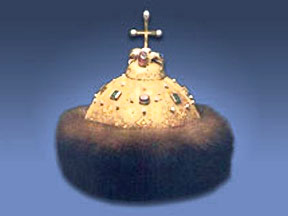 Monomakh cap. Photo: museum.ru
There is no recipe for democracy, there is only a tradition. The initial impulse of this tradition was lost somewhere in the European Middle Ages, and it still exists only due to the mechanisms of socio-cultural diffusion, well known to ethnologists and archaeologists. However, these things, understandable intuitively, for some reason are little interested in political science, which is entirely focused on classical, i.e. Western model. The facts that do not fit into this model have long been mentioned in public discussions, but are not yet reflected even at the level of social thought, which sees in them not the subject of research or a reason for it, but only the opportunity to state the inferiority of the old and alien model. The changed myth needs a new logos. Meanwhile, the crisis of the Westphalian system, the erosion of the principle of state sovereignty, caused by globalization, weakening the role of national identity and citizenship, as well as the creation of totalitarian methods for monitoring the branched system of personal rights and freedoms that followed complete emancipation - all this sharply reduced the significance of representative forms of power.
The principle of delegation by a citizen of his political will no longer works, and the effectiveness of politics does not depend on what is commonly called political institutions .This greatly resembles the situation in the Roman Empire by the end of the II century AD, when the Senate and other legislative assemblies of the policy type still exist, but no longer play any role, and Roman citizenship completely loses its prestige. There are completely different connections, although the state mechanism remains the same. From this point of view, the new Middle Ages, predicted by Berdyaev, are not far off. And the fact that the predictions of Berdyaev and Spengler have been about a hundred years - so, after all, the Sub Specie aeternitatis is not a period. For our era, its 476 year has not yet come. But he can come at any time.