
Translated material
The paradoxes of network revolutions
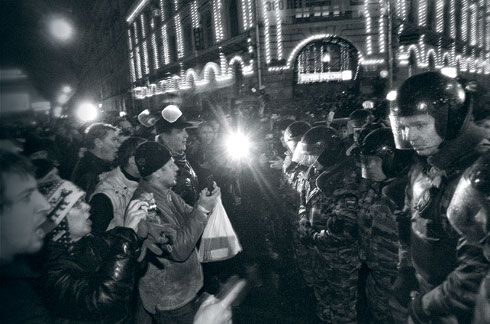 |
| December 5, 2011. Pure ponds |
How Vladimir Putin and the opposition spent free time in 2012
What we must remember about the event, the anniversary of which we celebrate is that it was a complete surprise for everyone.
Actually, all year and went to attempts to comprehend this surprise, to understand what to do with it. Some (you yourself know who) tried to present it as an excess and return the “reality” to the ideas and orders that were before. Like, everything is in place: Putin is popular, followed by oil, the loyalty of intimidated and deduced elites, the fidelity of ferocious security forces. Others, on the contrary, tried to develop the unexpected success of mass protests, make them the main “overturning” factor in the political process, and a ram. Both are not very successful.
"
If Putin fled, dressed in a women's dress, no one would know what to do with it
"
Putin failed to formulate a new presidential, leadership agenda. He snapped, scared, flew with the Siberia, fought for the rating, demonstrated self -confidence, scared again, and demonstrated again. But it did not work very much. The fact is that Putin all year sought to prove that the era did not change, that we remained in the 2000s, but this treasured thought that he suffered was almost interesting to anyone.
Putin, however, succeeded. He managed to localize the protest, limit it
| About how the “year of protest” began, see the material of The New Times “December 2011” |
Reservation of Moscow marches and coordination council. And most importantly: he managed to prevent the rebellion in the elites. But at the same time, of course, he failed to solve the main problem. The rating, barely raising his head after the next television, already next week pecks with his nose. And the vertically-bureaucratic army (intimidated by him) Loyal Putin looks demoralized. And it is clear that the very people who daily compose plans to neutralize the opposition, having arrived home, cover their generals butely than people from the square. They can be understood: the “guarantor of stability” losing support in front of their eyes turns into a source of instability for them more real than young people with posters.
The opposition also failed to develop the successes of last December into a victorious attack. However, talking about the weakness of the opposition is hiding ambiguity. For some, these conversations are an expression of frustration about the failed revolution, for others - a convenient door (as ancient diplomats said), behind which you can hide your unpreparedness to break with the usual menu of Putin's whips and gingerbread. Like, if the opposition were more solid, then - of course, but for now, excuse me, things about the throat, you yourself understand - contracts in Sochi ...
The so -called failure of the opposition is also a direct consequence of the surprise of the events of last December. After all, it turns out that her organizational core, as we see him today, did not prepare a suddenly shot wave, but rather was taken to her crest. This is a paradox of “network revolutions”: social networks sharply reduce the costs of the opposition to mobilize supporters, but as a result it turns out to be a poorly structured, not having a clear program and organizational core at the moment when people have already reached the square.
In general, the lamentations about the weak opposition, although they have some soil, look partly as a man who said: “You have snotty and dirty children, wipe their nose” - and he, woeful at the crumbs, exclaims: “Are these children!” The weakness of the opposition is the weakness of our politics, our political community. And where to come to her strong, if ten years society supplanted a policy from the field of its relevant interest.
Events of a year ago were not a failed Anti -Putin revolution. They were familiar with the change of eras - the end of the non -political era and the beginning of the political. And let’s say honestly, if Mr. Putin fled after the December rallies, changing clothes into a women's dress, no one would know what to do with it. Because freedom, unlike non -freedom, is not a state, but a process. Which, as Mikhail Sergeyevich Gorbachev said, "went."
Photo: Vasily Popov