
Translated material
Middle hobbits, or controlled escapism
Print Vasily Kostyrko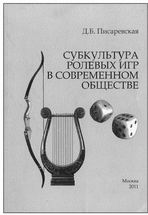
Pisarevskaya D. B. Subculture of role -playing games in modern society. M.: IEA RAS, 2011. 271 p.
In recent years, “Roleviks” - anecdotal people in medieval suits with fake swords, frightening insufficiently informed mushroom pickers in the forests of the Moscow Region and other regions of Russia - are increasingly attracting the attention of professional anthropologists. One of them is Dina Pisarevskaya, who studied the Russian subculture of live action of live action (Rizh) by observation and free expert interviews from 2005 to 2011. In the West and in Russia, Rizhus appeared independently of each other and almost at the same time (late 1980s-early 1990s). In our country, for the most part, they represent theatrical improvisations on the topic of a certain literary work, in the plot of which “masters”, that is, instructors, introduce an element of controlled variability. The player at the same time becomes both the acting person and the viewer of this action: he solves the intellectual tasks that the master sets him, and enjoys getting used to the role and dramatic interaction with other players. In addition to imaginary literary worlds, the role -players restore some historical events, but in this case they adhere to a more rigid scenario. The possibilities of reincarnation offered by field role -playing games are great. Within the framework of the game world, you can temporarily change your age, social status, national, religious, racial and even gender. In the book of Pisarevskaya, you can find a detailed description of the ritual of Rolevik’s venue in a game, which the author wittures the ancient rites of the transition. It is also interesting how the course of the game and experiences of the participants are recorded in the subculture - videos, photos and songs that make up a whole role -playing “folklore”. The author’s observations about the attitude of the role -players to authentic rites and religious ceremonies are very valuable: often participants deliberately distort them so that, for example, a wedding or the adoption of Islam “by the game” does not have consequences in real life. In the early 1990s, newspapers wrote a lot about the detrimental effects, which role-playing games allegedly have on the socialization of youth and its mental health. “Non -hot on their heads” Roleviks were charged even by murders. However, as Pisarevskaya shows, if in those days these accusations had at least some real soil, then in twenty years the situation has fundamentally changed. Firstly, the assortment of imaginary and, accordingly, depicted worlds has expanded. Starting with Tolkien’s books, the role -players switched to Russian fantasy, science fiction, detectives and historical events. Secondly, representatives of the subculture who do not distinguish their gaming roles and real life (on the slalevik slaleng-“marvelous”) have lost their leadership positions. “Masters” began to receive salaries, the subculture overgrown with the auxiliary business, learned to interact with the administration of those rural areas where games are held. And the point here is not just in the legalization and commercialization of the process: the latter, as Pisarevskaya notes, cannot become one hundred percent, because in this case it would completely destroy the playing atmosphere. More important than another. If earlier the bulk of the players were twenty -year -old students, now the average age of the role of Rolevik has increased to 25 years. Successful young specialists are gradually replaced by under -centered youth. In a word, from a closed subculture of Rizh, before our eyes, they turn into a full -fledged social institution of public, which seems to have entered the life of Russian society seriously and for a long time.
The grandiose, probably, the plan "who spoils the Bullets is in the Union of Dissatisfied"