
Translated material
City - a set of events, not buildings and citizens
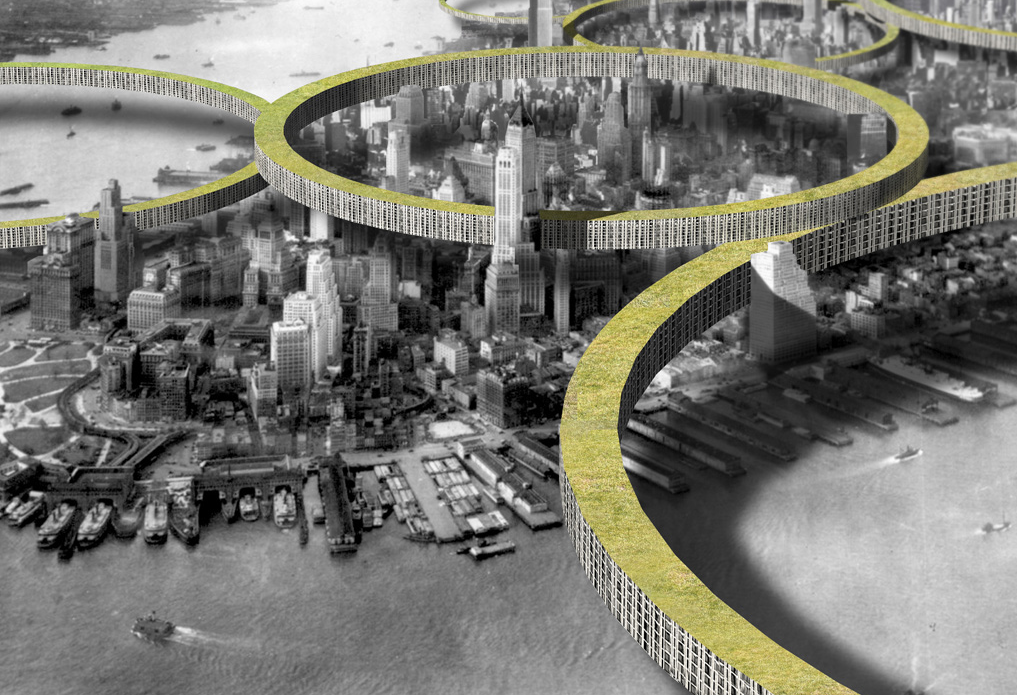
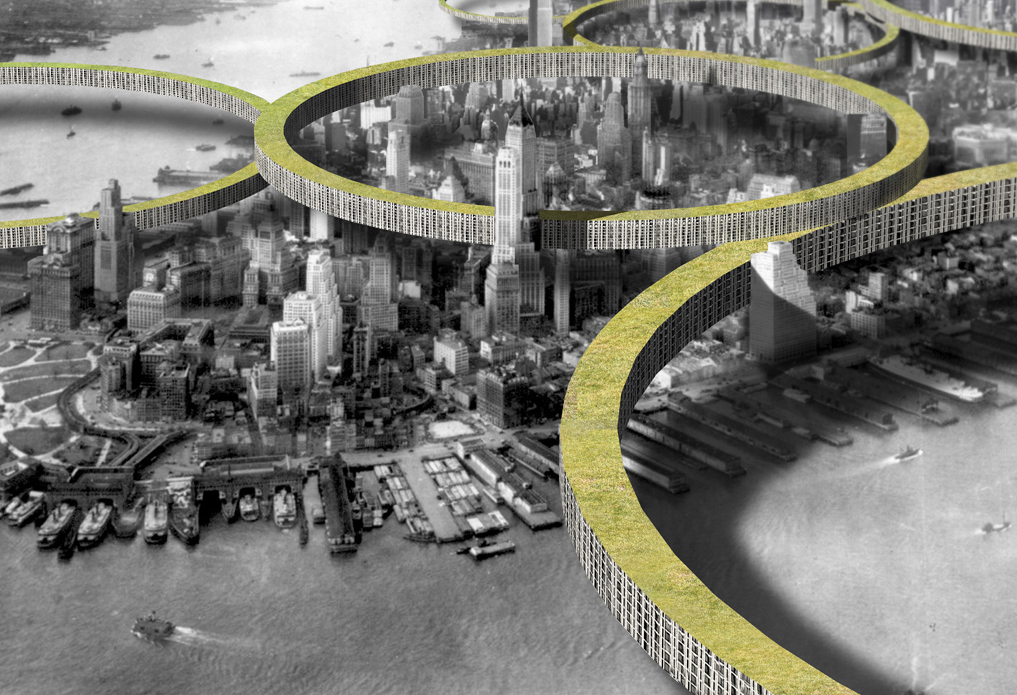 Ring City, Tiago Barros & Filipe Taboada, Photo: Wallpaper.com www.wallpaper.com
Viktor Vakhstein - candidate of sociological sciences, head of the Department of Theoretical Sociology and Epistemology of the RANEPA under the President of the Russian Federation. Here is a summary of his conversation with Boris Dolgin, Dmitry Iskovich and Anatoly Kuzichev, held in the studio of the Science 2.0 program, - the joint project of the Polit.ru and Vesti.fm portal. The audio recording of the program is available here .
Sociologists (in any case, microsociologists) look at the city exactly the same as ordinary people. For sociologists, the city is not a set of buildings, spaces, money that circulate in it, but the actions of people in everyday life. What is called EVERYDAY URBANITY is city everyday life.
There are two types of research. The first is Urban Studies - city research. For example, the study of Paul Lazarsfeld regarding how speed people move around the city. He showed that during the great depression, men went slower than women, because they have more time, they are unemployed. And women do not remain without work even during the period of economic downs.
The second type of research is actually sociology. Sociology, which unexpectedly became interested in the layer of everyday everyday life and began to study how people look at the city. So, Michelle de Certo in his book “The Invention of everyday life” showed what is happening with the cities, on the example of how everyday human practices are changing. For example, he claims that a medieval city is a tactile, bodily, physical city, narrow streets in it, it is not visible, it is filled with smells. Therefore, when a person was walking around the medieval city, he had completely different channels for obtaining information than now. And the modern city is built around the tyranny of the gaze, what de Certo calls "visibility of space."
The modern city is built around the tyranny of the gaze, what de Certo calls "visibility of space."Today, another method of attitude to space is returning, which was rather characteristic of the medieval period than for the period of high urbanism. The fact is that the high urbanism, built around the tyranny of prospects, around the wide, open gaze of the avenues, showed his failure.
The boulevard has become a symbol of freedom after "Occupy Abay", although the boulevard is precisely the part of the French city that appeared not for the convenience of walking, but for the convenience of shooting so that the cores fly well and conveniently. Now in Russia a boulevard is a place to which people go to stocks and make it a new symbol of freedom. In Moscow, boulevards perform a function that in normal cities they perform public spaces.
The French and the British go differently
The study, which is conducted at the Moscow Institute of Social Cultural Programs, is just an analysis of what changes in the city, in terms of new requests of citizens and in terms of new opportunities for their satisfaction.
You can trace how the queries are changing, by the way people go. A wonderful study of British ethnic metodologists about how the British and French go differently at the Gare du Nord station in Paris, at what speed, where they look at this moment.
During our study in the Okhotny Ryad, we analyzed how people enter the premises of the shopping complex. Those who come from the front door (from the side of the Manezhnaya Square) instantly slow down the pace of movement, their pose relaxes (in Moscow we walk very quickly compared to other megacities of the world), the horizon of the look is expanding, they look less under their feet, and the person goes into flange format.
When a person enters the "Okhotny Ryed" from the metro, then he continues to flee for another 20-30 meters. How do reconitions occur, at what point can you read the boundaries of space in the bodily behavior of a person?And when a person enters the "Okhotny Ryed" from the metro, then he continues to flee for another 20-30 meters. How do reconitions occur, at what point can you read the boundaries of space in the bodily behavior of a person?
On the example of the same "Okhotny Row", this is perfectly traced. Formally, it begins 20 meters to the place where it begins real. But a person does not perceive this space as another place, no matter how expensive boutiques it is filled.
The way people read the space bodily, how it affects their behavior, how it changes the pace of their movement is today interested in researchers of the everyday city.
Public spaces of Moscow
In Moscow, an attempt is being made again to make parks public spaces. Everything will change, and this is evident in the example of Gorky Park, Sokolnikov, and so on. For a long time it was the opposite. If you look at how Moscow parks are controlled, it will be found that the main parameter is the number of green spaces, that is, the park director is beneficial for his park to be forest. And in the forest it is very difficult to arrange public events.
There are two alternative hypotheses. One of them is political, it consists in the fact that in Moscow for a long time, public spaces were destroyed by political order. Classic example: why Manezhnaya Square a shopping complex? Not because there was a need for a shopping complex near the walls of the Kremlin, but because there was a need to make huge crowds of people who could become uncontrolled in the center of Moscow.
The second hypothesis is that everyday practices are changing. People begin to work with the city differently, and therefore it is already pointless to look for political will as a hidden source of changes. A classic example - why are benches in Central Park just such a length? It seems that it is convenient to sit on them, it seems that they are very comfortable and intended for the human body. But in fact, the researchers of the Central Park say, they are such that homeless people could not sleep on them. It was an order for a New York municipality - to come up with a bench so that it was convenient to sit on it, but the homeless could not sleep on it.
The behavior of people of the big city
One way or another, Moscow is not the place with which you connect yourself, not part of the identity. And when we begin to ask what Moscow is, people often sound in people's narratives, that this is such a huge city-office. That is, the place of work, the place with which economic interests are associated, but nothing more. About 60% of people do not connect themselves with the city, they do not consider themselves Muscovites, including people who were born here.
Moscow is not the place with which you connect yourself, not part of the identity. And when we begin to ask what Moscow is, people often sound in people's narratives, that this is such a huge city-office. Those who now write Strategy-2035 seriously thought about such a paradox. On the one hand, Moscow is included in the first ten cities in terms of high cost of life. But in terms of life, it is in the last places compared to others.
In our project on social cartography of Moscow, there was an attempt to trace where people who have lived for more than 15 years in Moscow or those who were born here go, what places they advise their visitors to friends. And if they advise friends of the Kremlin, then they themselves go, for example, to the VVC.
Of course, in event, Gorky Park is now running out, it becomes a new place to assemble communities. But a big problem - is there any communities in Moscow? Because, relatively speaking, the assembly places are places in which the city feels like a city in which people feel their belonging to it. If more than 60% of people do not feel their belonging to the city, then, in general, the assembly places are part of the office space.
This is a property of the so -called global cities. The global city is a city in which you do not live. He is never identical to himself, and the people who live in him are actually present in him only physically - they do not belong to the space of their stay. The global city is not a place. And the question is how to make it a place again.
Who wants to live in Moscow?
It turns out in a paradoxically that those who came here less than five years ago want to live in Moscow as in the city. They go to theaters, they walk the streets. The idea that the old Moscow intelligentsia is a keeper of Moscow values is greatly exaggerated.
The main consumers of everything that happens here is visitors. Moreover, the visitors who are up to five years are mass consumption, and after five years, these are people who prefer selective cultural consumption, they have their favorite places. Today, among the requests of citizens, a request for event, for the quality of the environment, and not on the activities of specific cultural institutions, dominates.
Large museums, museums-oligarchs do not lose their attractiveness, especially for those who come to Moscow, and they will always have their own target audience. Although now there is a very noticeable request of old respected museums to change politics, because it is already impossible to simply sell a brand that has formed in Soviet times.
The museum is one of the most paradoxical institutions, it combines two incompatible logic. For example, at the city meeting, the director of museums can seriously discuss two topics in a row. The first is how to deal with the "museum night", when a crowd comes to the people who stomp, bring dirt, and they are not interested in works of art, they came up here simply because the "night of museums" was fed on television ... And then the next point on the agenda: how to make someone at least go to us?
The museum in its functionality combines two mutually exclusive ways of existence. The first of them is an exhibition fair, when it is necessary that people come to the booth and look at the performance, and on the other hand - the Fort Knox, a very important storage function. The museum should be preserved and transferred to the next generation of the values of the previous eras. These are conflicting functions, such an inevitable functional dissonance in the work of the institution and cognitive dissonance in the head of its director.
Culture today is a set of events, not a set of institutions. And this will have to take into account the authors of the new cultural policy of the city. But such a change requires a turn in the brain, which is stronger than the "Faust" Goethe. How to do this is not very clear now.
And this is already changing our research tools, because the city becomes consisting of events, and not of buildings and physical bodies that flanify between them.