
Translated material
Grigory Gritsenko: Growth structure

Grigory Gritsenko 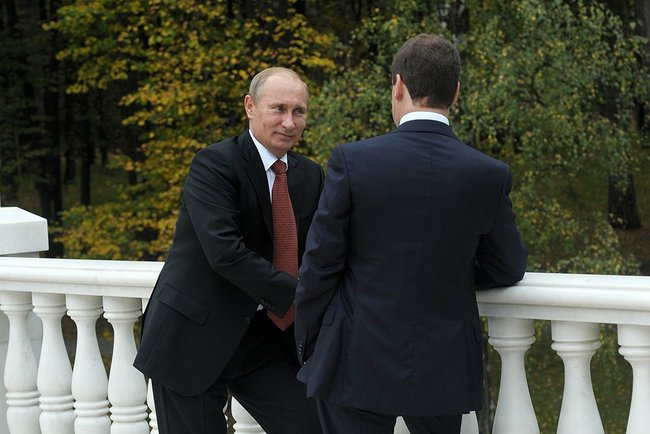 Vladimir Putin and Dmitry Medvedev. Photos of the press service of the President of Russia
 Vladimir Putin and Dmitry Medvedev. Photos of the press service of the President of Russia
The general results of the work of Russian industry in 2012, as expected, do not give grounds for optimism. The total production index has grown by only 2.6%, which is a rather sad sight compared to 2011 (an increase of 4.7%) and, especially, on 2010, when an increase in production was 8%. Growth in service industries, transport and energy turned out to be even less - 1.7% and 1.3%, respectively. Thus, it can be stated that the recovery growth has ended in Russian industry, as well as most of the world industry, now it will fluctuate at the same level, that is, to stagnate. And this stagnation can last many more years, until, finally, the world economy will come out of depression and again begin to grow.
For our industry, world stagnation means that the demand for the main goods of Russian exports will not increase and, quite likely, will sometimes be reduced. Sluggish external demand will force Russian manufacturers either to keep the production of products at the achieved level, or even reduce it. At the same time, unfortunately, they will not be able to reorient from the external market to domestic Russian manufacturers, since the domestic Russian market is much less than the external one - and has already been well mastered by everyone.
However, this sad perspective has an alternative. It is due to the fact that not all branches of Russian industry are in a depressive position. Some of them demonstrate quite decent growth rates and, as a result, will probably be able to stretch the rest along with themselves. But for this, a restructuring of the structure of the Russian economy should occur.
This structure would be easiest to call two -layer. The first layer is export production, and the second is production working on the domestic market. Moreover, these layers are not in contact with each other directly, but through mediation of the world market. We will show the model of this interaction now.
If the demand for Russian goods is increasing in the world market, then prices are rising in demand, and after rising prices, the profitability and release of these goods are increasing. And after the growth of release, export production revenues are increasing: staff wages and corporate profit. One part of the income received is spent on imported goods and services, and the other on the products and services of enterprises of the second layer, which leads to general economic growth. Moreover, the transition of part of the income from exporters to enterprises of the second layer in some cases was forced, since it is impossible to do without services of a number of industries (for example, transport and energy). But other sectors of the second layer are forced to conduct a difficult struggle for exporters' income, and did not always win competition with imported goods and services.
On the contrary, if prices fall in the world market, then this leads to a drop in export volumes, which is immediately broadcast into a reduction in output and income. And the fall in income leads to a reduction in expenses for both imports and goods produced by enterprises of the second layer, after which a general economic decline begins.
True, the second -layer enterprises have a chance to occupy a market niche, which was previously occupied by foreign manufacturers. And if they succeed, then, after the general fall in production, the scale of economic activity increases again, but, of course, not in those volumes as before the crisis.
Such was the model according to which the Russian economy functioned for almost two decades. But now, it seems, this model is beginning to change. The Russian economy has a third layer in the form of branches of foreign companies that launched production on Russian territory. That is, in the Russian industry, we have three groups of manufacturers - exporters, “traditional” manufacturers of goods in the domestic market and “new” manufacturers.
If you look at the production statistics of products over the past year, it is clearly visible that the industries supplies for export are stagnant, but working on the domestic market grow at a very fast pace.
So, oil production increased by only 0.9%, and the production of natural gas (natural and associated) even decreased by 2.7%. Coal production increased by 5%, the production of primary timber and cellulose did not increase at all, the smelting of steel increased by only 3.3%.
These, quite modest indicators, strongly contrast with the indicators of another industry, namely the automotive industry. Over the past year, the release of cars increased by 13%, and it is well clear why. Branches of foreign car concerns grades grades their production in Russia, and after this the production of cars increases. Since the market of vehicles is very capacious, and before the crisis of 2008 it was more satisfied due to imports, the prospects for the transfer of cars of passenger cars are very large. Therefore, this industry will surely preserve high growth rates in 2013 and in subsequent years.
Moreover, the transfer of the production of foreign cars will expand the production and related sectors. Firstly, this is the production of components (to achieve at least 50%localization), and secondly, it is an increase in the release of autobensin and lubricating oils. Moreover, we are already in a shortage of Autobenzin, which in 2013 is planned to be covered by oncoming supplies from Belarus.
However, the list of rapidly growing industries is not limited to only cars. Some "traditional" manufacturers, or sectors of the second layer, also sharply increase the production of products. So, the production of buses rose by 31%, freight wagons - by 13%, and the production of the main building materials, brick and cement by 9.5%.
Of course, it would be very tempting to explain the growth in the release of growth in the automotive industry in these industries. However, now it’s too early to talk about this, since the volumes of the production of cars are not so large as to influence other, not related sectors of the Russian industry with them. Therefore, suppose that growth in industries working on the domestic market is still stimulated by export industries, which, even if they do not increase the production of products in natural terms, but still generate a decent stream of income. And this flow is enough for both local budgets for the purchase of buses for motor transport enterprises and railway operators - for the purchase of new wagons, and to the population - to buy new apartments (the introduction of which, incidentally, exceeded the level of 2011 by 5.3%).
In general, while export brings income sufficient to stimulate domestic production, a heavy decline in Russian industry does not threaten. And if the sectors of the “third” layer will gain power sufficiently to influence all branches of the Russian economy, then stagnation will disappear, despite the world industrial depression.
See also: Grigory Gritsenko Caution growth of Russian industry Grigory Gritsenko Rost or Stagnation Grigory Gritsenko Running in the industrial place Grigory Gritsenko American crisis in the service of the Russian economy