
Translated material
Violence as a policy
About the fact that there is no need to wait for repressions: politically motivated lawless violence, albeit so far with the prefix “micro” is already a given
Time sign - Auto -Zak
The annual report of the Ovdinfo.org site gives a picture of protests - or at least the activities of repressive bodies, that is, the police and the courts, in their suppression - significantly different from generally accepted ideas. It seems that everything is not so scary yet. “From the moment of the beginning of mass political protest on December 4, 2011 to December 31, 2012, the ATS-Info recorded 5169 politically motivated detentions in Moscow and the Near Moscow in the course of 228 events, of which 1312 detentions are in December 2011 and 3857 for 2012,” the report said. Despite the universal feeling that the power of the authorities for street activity is growing every day, in reality for the whole of 2012, only twice as many participants were detained on street actions than in one partial month at the end of 2011, when the authorities, apparently, hoped to “crush” the street protest quickly and decisively (despite the fact that, as it was easy to understand the total number of protests of 2012 years. Significantly more than on December 2011). We simply began to learn more about each case of detentions, more worry more for the detainees in social networks, we see more information about this in our own tapes - and this fact speaks of the “extinction” of protest sentiments no less than the numbers given.
Another thing is more interesting. The report fixes the emergence of new, systematically repeated forms of protest activity that attract police repression. In addition to the usual rallies, pickets and processions, the classification of shares includes “walks” and “occupy”, generating a significant part of political detentions: in total these are 1340 detentions, almost a third. In the course of relatively harmless in appearance (and not even formally prohibited by any legislation), the events actually delay almost no less than at rallies - 22 rallies account for 1978 detentions.
Vintilov analysis
Judging by the chronicle available on the site, a rare even agreed public event was dispensed with without a single detention. Almost all the street activity unpleasant to the authorities is accompanied by the “Windulov” of certain participants: the arrests of activists on the approach, the search for an excuse to detain at least someone or the detentions without a preposition. If we assume that the statistics of the OTD-Info got more or less everything that took place “protest” in Moscow, it turns out that new, non-traditional, creative forms of activity-“walks” and “occupy”-occupy a substantial place in the total volume, more than 15 % of all performances. We add a category that the authors of the report indicated the uncertain word “action” (“mainly theatrical shares, that is, shares that suggest not only and not so much written or oral demonstration of their position, which present their position with the help of a particular action”) - this is another 17 %. Traditional rallies, marches, eco -camps, simple campaigning accounts for only 21 %. The rest is mainly pickets, that is, forced, for lack of the best, forms of activity, theoretically less punished (in fact, there are 729 detentions on 80 pickets, that with a relatively modest number of participants in this type of manifestation, they are even more risky than mass shares). A rather unexpected point for those who like to talk about the inorganization of the protest: 99 out of 228 political performances taken into account, there is no organizer at all - not only an organizing committee or a formal organization, but also a pronounced group of activists with their own face. In the amount of the event without declared organizers and events organized by independent, non-constitutionalized activist groups, they make up 60 % of the total, and “answer” for 40 % of the detentions (it would be interesting to find out-the matter in their relatively more modest number compared to the shares “authorized” by one or another political force, or in some other thing). The data show that the Moscow street protest is indeed mainly a network, horizontal phenomenon, a product of self -organization of ordinary participants.
Those who wish can also study in the report a list of initiators of certain street performances and the corresponding number of detainees, and draw their own conclusions. I only note that during the nine actions of the organizing committee of protest actions, 778 people were detained - which leaves far behind both 8 shares of “Strategy 31”, in the amount of 429 detention and 23 shares of another Russia (193 detention). Of course, we are talking about speeches with fundamentally different numbers of participants. However, the repressive activity of the authorities shows that mainly pre -agreed shares initiated by the organizing committee, many times accused of conformism and agreement, cause the authorities at least no less anxiety and cause no less readiness to use police violence than the immeasurably more rigid performances of radicals.
Outlaw
A list of typical violations during detention and during further proceedings in administrative cases is unlikely to surprise anyone:
- Police officers do not warn those detained as expected, do not submit and do not explain the reasons for the detention;
- Police officers apply, how delicately the authors of the report, “excessive physical force” - photographs and videos on the same site, as well as evidence of eyewitnesses in the report itself, allow you to see that we are talking about beating, intentionally causing pain, humiliating and dangerous for health treatment with detainees who often do not pose any danger to OMON according to their physical data;
- The police burst into a cafe to detain participants in protests (or people similar to them), clearly no longer participating in any active street actions;
- instead of the official detention of a person who captured without explanation, is transported to the police department without any legal grounds with the wording “to write an explanation”, “verification of involvement” in other events, etc.
- delay journalists;
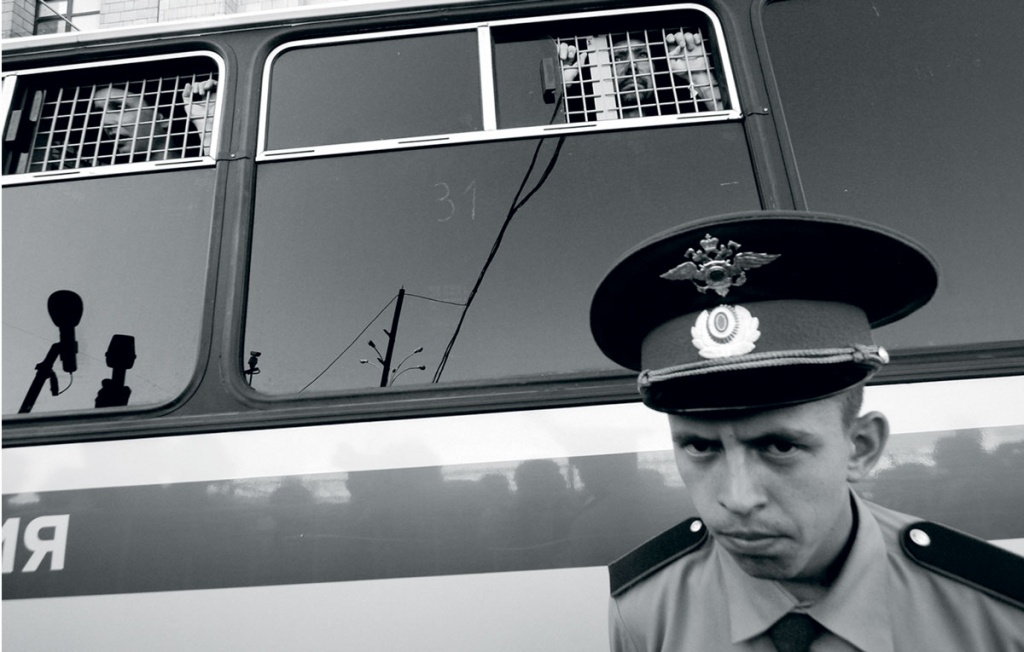
- The detainees are beaten in the autozaks, they are intentionally kept for hours in the cold or in stuffiness, cases of intentional inclusion of heating in the hot time and even exhaust gases in the cabin are noted. At the same time, if the detainee time is regulated by law, then staying in the car is not included in this period; The police use this to intentional suffering for the detainees;
- the terms of the detention of detainees in the police department before the charge under the relevant article of the Code of Administrative Offenses are regularly exceeded; Falsify data from the registration books;
- Protocols are printed “under coping”, they are filled not by the police officers who carried out the detention: most often the police officers, where the detainees were delivered, and not those who detained them, that is, riot police;
- defenders are not allowed to detainees; Those who need help refuse to call an ambulance, ATS officers resist the hospitalization of the victims;
- court hearings on administrative cases continue a few minutes; The testimony of the protection of the protection is ignored, the readings of the police are not investigated and accepted for the truth. The judges even refuse to receive “solid” evidence, such as photographs and videos from the scene of the detention;
- The courts almost always make accusatory decisions, and the appeal in a higher (district) court almost never ends with a revision of the case.
Conclusion
Thus, the word “repression”, albeit with the prefix “micro”, in the description of the practice of “political” detentions here is completely appropriate. We are dealing with arbitrary, politically motivated violence, not related to compliance with the legal procedure and not limited court decision.
Ella Paneye is a sociologist, a leading researcher at the Institute of Law Problems of the European University in St. Petersburg, author of the book “Rules for the game for a Russian entrepreneur: development of market institutions in the context of the inconsistency of legislation” (2008)
Photo: RIA Novosti