
Translated material
Anna Sakoyan: Pirinting Education
Anna Sakoyan  P2PU Logo Source: Facebook.com/p2puniversity
 Site screenshot
 Pirving University. Photo: Facebook.com/p2puniversity
 Бейджики P2PU
 Аня Каменец
 P2PU Logo Source: Facebook.com/p2puniversity
Pirive education
The rapidly spreading model of mass open online courses (MOOK) proceeds from the fact that due to the emergence of new technologies, higher education can be rebuilt in such a way that the educational process as such will become free. Although the status of these projects is still far from stability, resources like Coursera, Udic, Edx and Khan Academy have already gained great popularity among users. However, with all the innovation, all these projects are based on their traditional educational scheme - when there is an educational institution, there is a course authorized by him, which is necessarily conducted by a teacher from this institute, there is a class, tasks, a system of final certification and the ability to certify advanced training. They just try to transfer this model to new rails.
Against this background, a very remarkable phenomenon is a mass online move, which to date has taken shape in the form of the so-called pyric learning (P2P Learning) [1]. Its specificity is that it was born precisely from those opportunities that there were no before. Its foundation is the Internet, technology 2.0, mass digitization of all kinds of materials and a large number of open educational resources (Open Educational Resources, OR).
Prototypes, of course, existed before. The most obvious of them are training groups based on horizontal connections (stages of groups, circles) and a barter exchange of knowledge. But the characteristic feature of this case is that the volume of available materials that can be used for educational purposes has increased many times. Plus, there was much more opportunities to find people with close interests and make contact with them. On the one hand, a wide variety and accessibility of materials is good. On the other hand, it is difficult to use such wealth when, for example, you need to join from scratch to a completely new topic. Navigation is needed here, and preferably competent.
Traditionally, the teacher becomes such a navigator in the new area. The selection of the teacher, in turn, is carried out either according to the institutional principle or on the recommendation. Such guides can be more knowledgeable acquaintances, but if they are not, then the question arises from where to get them. In a “user + Internet” situation, it can be difficult to find a teacher, and it is more difficult to study alone. But if there is a certain point at which people who want to learn something gather, and competent people come there who are ready to share their knowledge on a voluntary basis, then it is much easier to organize the educational process.
Pirining training platforms
Where is demand, there is a proposal. The platforms that make it possible for this kind of interaction began to appear in the line of movement for freedom and openness, about the same row as non -profit organizations and volunteer associations for free culture , open software , access and, finally, data . Here you can immediately note a significant difference from centralized platform providers of the MOOKs. Since many of these providers platforms are created as commercial organizations (Coursera, Udacy), they are in the relationship of competition with each other, and their main task is to come to study with them, and not to competitors.
With peering platforms, the opposite is true. They just exist due to constant exchange of resources, methods and personnel, so almost any large peering project will be provided with one of the nodes in the network of similar partner projects. As an example, take the P2PU platform (PEER 2 PEER University, peering university). At the moment, he is in close partnerships with such projects as Creative Commons (and their openness school ), Open Knowledge Foundation (in particular, with his data school ), Mozilla (and her web-time school [2]), Codecademy , Mit Opencoursewaree , Open Study and many others.
So, P2PU is a site created in 2010 on which any user can create his own course in absolutely any subject and in any language. The site itself is originally English -language, but users (on a voluntary basis, of course) can translate it into native languages, which is gradually happening. There are already versions (at different stages of readiness) in Spanish, in Korean, Chinese, Swedish and Hebrew. For those who do not know how to translate the site technically, there is also a special introductory course . In addition to scattered user courses, the aforementioned schools are also placed there.
The course looks like assignments built in a certain order, how to perform them, and links to external sources that are recommended to be used during execution. A separate page is devoted to each task, and on each page, users can leave comments and communicate with each other. Anyone can also take a course, but there are three gradations of participation that involve a different degree of activity. You can undergo a course without registering, but simply completing the tasks at your discretion (those that allow performing alone, because there are group tasks). You can register on the site and sign up for the "tracking" of the course. This is for those who, in general, are not going to participate actively, but in principle consider this opportunity and, most importantly, does not want the course to accidentally be lost. Finally, you can (also after registration) sign up as a participant. This is a format for those who are going to actively communicate with other participants and share their achievements.
An important feature of any course is that there is no (and is not supposed) as a teacher, nor even an instructor. The course is a variant of the sequence of actions leading to the acquisition of a particular skill. People who considered that they needed this skill, gather for this course and further, using comments and other forms of interaction, are trying to learn. Theoretically, an option is possible in which a group of users decides that the course is ineffective (but people are good), and will continue to jointly look for other opportunities for obtaining the same skill.
The creator of the course can also participate in commenting and other interaction, but this is by no means an obligatory part, and he does not perform any controlling function. The moment is connected with this that a large number of courses begins with the fact that it offers participants to create their own network of interaction. The most popular way is to offer users a training blog (this is a fairly common genre) and share a link in the comments, and then publish reports on the tasks completed on the blog and generally talk about impressions. After that, users can subscribe to their favorite blogs, thus monitor someone else's experience and share their considerations on specific issues. Actually, one of the most important tasks of the pyric course is to give participants more motivation for collaboration.
Domestic initiative
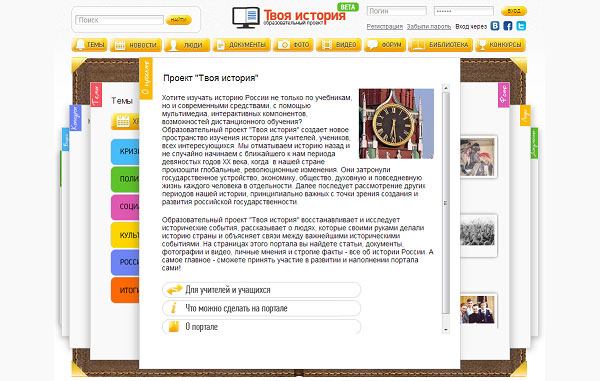
Here you can recall the domestic initiative, in no way related to the P2PU, but, nevertheless, using some similar principles. We are talking about the project "Your History", History4you . It appeared relatively recently, but it is already clear that in a number of signs it is very reminiscent of a peering platform. At the moment, “Your History” offers to study mainly the Russian history of the 1990s: “The uniqueness of the period of the 90s is that this story is alive. A living story is good in that there are eyewitnesses of events and is dangerous in that these eyewitnesses are absolutizing their views on these things ... The portal gives students the opportunity to look at different views of different eyewitnesses and make sure that there are many living things in history, and this is not a linear process, but a large mosaic, ”explained one of the creators of the resource, professor of the Higher School of Economics Department, Andrei Iooffe.
Site screenshotOne of the characteristic peering features of the resource is that it, being centralized on the site, also actively connects social networks to the process. The site itself contains various materials regarding this period, and their number can be replenished by users themselves.
One of the features is that the user can change his role in his profile - “student” or “teacher”. As a student, you can participate in “Lessons” or “Open lessons”; On the rights of the "teacher" you can create your own educational projects.
Denis Terekhov, director of the Social Networks, which developed the portal,believes that this platform must be finalized until more universality, and then it can be used in application to various humanitarian disciplines.
Mechanical MOOK
We have already talked about platforms, which requires serious technical developments and large financial investments. Meanwhile, there is a format that, for all its specifics, is fully consistent with all the signs of MOOK and at the same time does not require practically any financial investments, as well as special technologies. By the signs of MOOK, we mean mass (that is, the absence of a limit for the number of participants), online localization, free for participants and limited time.
As an example of such a MOOK, which, in particular, was the first to realize himself as such, we can cite a joint project P2PU, MIT OCW , Codecademy and Openstudy called “ A Gentle Introduction to Python ”. This project is a regularly repeated eight -eaten introductory course on the Python programming language (the next course, the fourth in a row starts in June). Registration takes place on the MOOK website. During the registration, the participants, first of all, leave their email address, to which after the start of the course the newsletter with tasks will come weekly. As in the case of the courses on the P2PU, there is no instructor for the course - even the newsletter is made by a bot. There are only tasks, auxiliary materials that are given links, and other participants that you can consult or help them. An important component of the course is again, navigation on networks and communities where you can get the address if there are some problems with the completion of tasks. In parallel with this, the project has a blog in which, in particular, all the mailings are published ( here, for example, in January 2013), and they can be read at any time.
All materials of the course are also available regardless of registration. One of the key “textbooks” of this MOOK is the Codecademy platform, or rather, the interactive tasks placed there for the development of Python. These tasks, of course, can be performed by themselves outside of any connection with this course and not even knowing about its existence, since the platform itself is known and popular. There are step -by -step clear tasks that can be performed in the same browser window and instantly get the result.
What, in this case, is the meaning of registration and participation in the newsletter? The fact that registration is a filter for users in terms of training and interests. A registered user automatically gets into the environment of people who also study Python and are also in the initial stages. At the same time, someone, of course, will have a slightly higher level, someone has a little lower. However, everyone will be in an equal position and will be able to ask questions corresponding to the level, to which someone probably has already found answers and is ready to share them.
According to a similar principle, curriculum (in fact also mechanical moloks) are built at the School of Data, which are called “Data Expeditions” ( Data Expeditions ) and can be organized both by the school (the mailing is carried out by the bot) and individual users on the topic of interest.
Specificity P2P education
Of course, such projects are rich material for researchers involved in the theories of educational processes, and for practicing teachers who are interested in new approaches and methods of their application. The area is completely new, so while there are trying to develop research methods and criteria for evaluating the results. One of the recent studies, just on the P2PU material, can be seen here (. PDF ).
The predictable skepticism, as in the case of crowdsourcing projects like Wikipedia, can cause a complete lack of centralization and institutions that could guarantee quality. Another point is that, unlike institutional courses, the piceps and the mechanisms of expert evaluation are not built into the peering courses. That is, in each case, of course, they can be completed, if there is the will of the training group, but in general, all this is based on the personal interest of the participants in somehow moving the process. The main question is how peering models are trying to solve problems for which traditional education has already developed a solution.
Discipline . The task of any training course is to pass it. Traditional education acts here by the method of whip and gingerbread. A whip is a system of control and assessments; Gingerbread is a final certification and the ability to verify, and in the future and monetize their skills. The peering model does not have any one by default. But here she asks the question: is it necessary for everyone to take the course to the end? What if a person is satisfied with the skills received in the middle of the course, and so far he no longer needs? The surveys conducted among the participants in the mechanical MOOK testify to the fact that many users who have come down from a distance to a formal end consider their results quite satisfactory and are able to use them in their interests.
Pirving University. Photo: Facebook.com/p2puniversityManagement of the process . In traditional education, there is a teacher or instructor for this. There is no one in the Pirintovo. Is the group able to organize in such a way as to adversely follow completely faceless instructions? Here, again, the question of the motivation of participants and their ability to interact. As the aforementioned study shows, as a rule, the training team each time breaks up into two parts: active participants who constantly communicate and exchange experiences, and passive participants, who silently observe all this. Among the active are usually those who, in fact, become the process of the process and the link between all other participants in active communication. This is far from necessarily the most informed user, but he initiates the initiator of communication, and others begin to follow his example.
The passive audience is tempted to be considered as free fiber, who only use the fruits of other people's labors, but they themselves do not share anything. However, as the same study shows, in the peering education this silent part is an important potential from which new active participants are formed in the future. In particular, among the silent there are many newcomers who first ended up in a peering environment and feel uncertainly in it - accordingly, they need time to get used to it.
Measurement of progress . The educational process implies that students will gain new knowledge. To evaluate successes, you need some kind of mechanism. In traditional education, this is a kind of expert institution (teacher or commission). In pyrynia education, everything is much less unambiguous. However, there are different measurement methods. Firstly, there are skills, the mastery of which is amenable to automated assessment. Secondly, perhaps a peinal assessment when other participants express their opinion about the results and offer their recommendations. Thirdly, you can try to apply your skills to practical tasks and see what happens. Fourth, finally, you can find an expert. Parting community participants do not exist in vacuum. Usually they have quite public profiles in which their contacts are indicated, as well as regalia, which go far beyond the P2P community. If you find an expert in the appropriate area, you can seek an assessment to him.
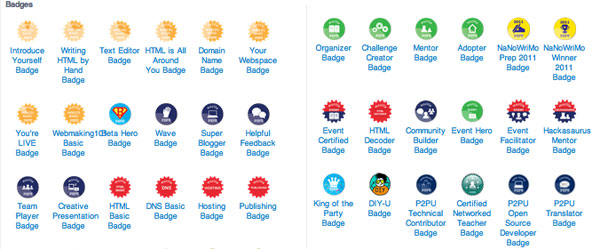
Reputation . In the traditional version, these are diplomas, certificates and degrees. This is all the same in the pyric version. As a kind of surrogate, a badge system appeared and develops. Baiga is, in fact, a symbolic picture that is assigned this or that meaning. The meaning can be any: from “just a good person” to “excellent blogger” or “webmaster”. Badge systems are local, that is, they act only inside any one community (in Codecademy, for example) or more general. Now in this case, Mozilla set the tone, creating the Open Badges system, into which the Baiga of partner projects like P2PU began to integrate. Baige can create anyone (on P2PU, again, a special course ).
To create a badge means to make a picture for him, to determine in which cases it is assigned and what is the assignment procedure. Some can be given simply from sympathy; others - as gratitude for useful recommendations; Still others are automatically assigned according to the results of the passage of a course; четвертые, наконец, присваиваются за проекты, представленные для пирингового оценивания (проекту начислили не менее такого-то числа баллов – его автор получает бейдж).
Бейджики P2PUЕстественно, вне пирингового сообщества такие бейджи роли не играют, но, во-первых, они помогают сориентироваться внутри сообщества, во-вторых, в силу интеграции, существенно выросло сообщество, в котором они имеют значение.
Панкующие
Аня КаменецПо итогам всего этого появилось движение Edupunk, которое формализовала и популяризовала американская писательница Аня Каменец ( Anya Kamenetz ) в виде сайта Edupunks' Guide . Собственно, этот проект – попытка алгоритмизации образовательного процесса на основе существующих в Сети способов получить бесплатное образование. Специфика проекта в том, что его цель – вывести процесс самостоятельного образования к тем же практическим результатам, которое дает традиционное образование, то есть к получению реального сертификата и дальнейшему трудоустройству. И, конечно, в основе этого подхода лежат пиринговые принципы.
Прежде всего, проект по шагам рассматривает этапы выстраивание личного образовательного курса: определение цели; поиск людей, которые могут помочь советами или поделиться навыками; формирование индивидуальной программы, позволяющей овладеть нужными знаниями; расчет сроков обучения; поиск менторов (людей, которые добровольно возьмутся помогать в обучении); создание сети контактов в социальных медиа; и, наконец, получение сертификата в различных институтах. Речь идет, естественно, об американских институтах с их спецификой. В частности, в ряде случаев можно сдать платные экзамены по требуемым дисциплинам, и если их успешно сдать, институт дает сертификат.
Насколько эта система действительно работает, пока судить трудно. Однако поклонников у нее много (на ее основе, в частности, есть курс на P2PU ), и они в той или иной форме применяют разные аспекты этой методики.
Notes
[1] Слово «пиринговый» происходит от английского «peer», что в данном случае обозначает партнеров, или людей, находящихся между собой в равном положении. Выражения «peer to peer», или «peer 2 peer», или «P2P» в применении к сообществам подразумевают, что они устроены по горизонтальному принципу и что блага в этих сообществах распространяются не от центра к периферии, а от одного участника к другому на равных основаниях.
[2] В оригинале мозилловская Школа веб-ремесла называется School of Webcraft. Среди участников этого пирингового проекта нередко встречаются высказывания о том, что первичный импульс вступить в эту школу был вызван созвучием названия School of Webcraft со School of Witchcraft (and Wizardry), Школой чародейства и волшебства, известной также под названием Хогвартс .
Смотрите также: Анна Сакоян МООК: революция в мире образования Современная история станет историей человека Анна Сакоян Новое образование