
Translated material
Cinema from the prosecutor
In the opposition
 Cinema from the prosecutor
July 24, 2013 Alexander Podrabinek
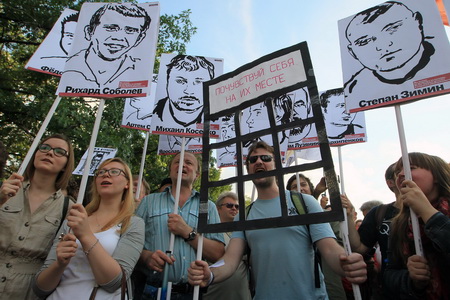
The "Swamp" promises to become the process of the century. Not in the sense of its uniqueness and drama, but in the sense of protractedness and meaninglessness. If the Kremlin law enforcement officers are better formed and thoroughly brought up, they would have made other reasons to accuse the opposition of all mortal sins. But they are what they are, and therefore they accuse twelve people of riots who arranged a face unidentified by the investigation.
At the last court hearing, they surprisingly openly presented the court with two groups of evidence. On the one hand, the fact of the mass riots is confirmed, in their opinion, beaten by police, inverted toilets, spaved asphalt and shouting anti -government slogans. On the other hand, the guilt of the defendants is confirmed by the fact of their detention, the charge and the fact that they are in the courtroom in the position of the defendants. In this logic, one gap remained in this logic - the actual connection between the “unrest” and the defendants - but the accusation does not pay attention to this “trifle”.
In order to cloud the essence, the accusation saturates the case with a mass of non -meaningful details and information. At the last meeting, the prosecutors announced the protocols for the inspection of video evidence - in other words, they read out what the investigator saw in the video. What was not there!
Here, the investigator in tragic colors describes a certain yellow object of a spherical form in the hands of an attacker, who after a moment goes through the air towards the unfortunate policeman. Fortunately, the guardian of order is alive and not even crippled, because a terrible spherical object is most likely just mandarin.
Here the investigator describes the actions of the demonstrators. Since unidentified persons are not established, the investigator sets nicknames for them by the nature of the clothing. You have to call them somehow! It is appropriated by the operational pseudonym "cap", the other - "visor". It looked something like this: the “cap” threw unidentified objects into the police, the “visor” waved at an unidentified policeman by an unknown object of indefinite length.
Lawyer Vadim Kluvgan, in his comments on the announced protocol, sadly joked that soon, probably, the charges would refer to Vaska Kirpich. Why not, in fact?
The accusation, meanwhile, was practicing with terrible force in the description of people and events. State Duma deputy Ilya Ponomarev was not enough just to call a deputy; It was necessary to give him a mysterious and criminal hue. Therefore, in the protocol, he is described as a person "with baldness of the hairline." The investigator called another demonstrator "an unknown person with a flag in his hands." “A face with a flag” is, of course, a bright criminal image worthy of entering the textbooks of Russian forensics and be sung in endless cop novels and TV shows. Yes, and the investigative creativity itself could become a bestseller, if it was more robbery. And then one unlucky policeman demonstrators “failed” to the ground, and the booths of the dry closets were “pushed” towards the canal.
On Tuesday, July 23, the meeting began with the discharge of the judge. His defendant Sergei Krivov, who accused the judge of a systematic violation of Russian legislation and probable interest in the outcome of the case, stated. On the day after day, Judge Nikishin does not give Krivov the opportunity to submit a petition. These petitions are ridiculous to the judge - she probably already knows what the sentence will be, so what are so many words for? But Krivov does not know this, although, perhaps, it is guessed that the fate of the defendants are a foregone conclusion. But he, a strange person, wants everything to be according to the law. He is not a judge Nikishin!
Nikishina discharged herself and rejected, and then decided to watch video signatures. The next half an hour on three monitors in the courtroom hung the same picture-the view to Bolotnaya Square from somewhere is down, probably from the "House on the Embankment". Sometimes this plot was replaced by another picture - a view of the worship of the mountain. Lonely passers -by walked along Bolotnaya, a street noise was heard. Nothing happened. Everyone stupidly looked at this masterpiece of cinema, not understanding what all this would be for. The prosecutors seemed to be confused, and everyone ran up with questions to technical workers demonstrating “proof”. I think they begged for the techies to do something so that at least some movement began on the screens. Starting a mighty look in the mighty screens of the monitors, everyone waited for something to begin.
And it began. It would not be better. It turned out that the prosecution ranked the Live Minaev program for evidence. Soon, Sergey Minaev himself appeared on the screens. Self -domestic, cheeky and rude, he, imposingly swaying in an armchair, tried to look at the same time as an objective “informant” for the audience, a witty commentator and a loyal Putin slant. The latter he best succeeded - either due to an innate tendency, or by official necessity. In the worst traditions of the Soviet television and propaganda, the personnel of the “gloomy and embittered” Bolotnaya Square were interspersed with the views of the “positive and cheerful” Poklonnaya Mountain, where at the same time Putin's lovers gathered for the “folk gathering”. Then the famous galleryist Marat Gelman joined Minaev, who shyly assenting the host and moderately sharing his anger about the demonstrators.
What all this is related to the evidence of the guilt of the defendants is not clear. However, the court presenting such a “evidence” was a very clear illustration of the level of evidence of the prosecution. In essence, the idea of the prosecution is to show the court and the public some terrible personnel and terrible comments, and then indicate the court at the defendants. That's all the evidence. Everyone sees the connection? Not all? Nothing, the main thing is that the judge saw. Or, more precisely, she pretended to see. Because all this actually has nothing to do with the future sentence.
Photo EPA/ITAR-TASS