
Translated material
Grow a monster
Children are beautiful. No one knows what of them will come when they grow. Well, who would have thought, looking at the one -year -old Joseph, Adolf or Mao, having matured, will they become bloody monsters of the 20th century? Is the small Salot Sar (the future Paul sweat), the lip -eyed Saddam Hussein, or without any hint of a beard, a tiny Fidel could frighten adults with their bloody habits? It is hardly. Like all children, they were loved, raised and ... raised.
It is not known whether any of the parents regretted what was done, but very, very many people in many countries cursed the day when these seemingly harmless guys were born. But what happened was accomplished. The further depended on many reasons. Including from how friendly and insight people were who opened the doors to these children in big politics.
I must admit that they did not immediately become complete villains. The little Joseph, protecting his mother, threw a knife into his drunken father. Later, in his youth, he wrote poetry. Adolf in childhood sang in the choir of boys. Then he composed poems and novels, wrote a libretto to Wagner’s opera, painted a lot and quite successfully sold his paintings. Mao in childhood was a diligent Buddhist, and in his youth he adored books and read a lot. Paul sweat in his youth studied the radio electronics in Paris, played the violin. Nothing human was alien to them. Including the slightly crazy emperor of the Central African Empire, Jean-Bedel Bocassa, who, before adding to the eating of opposition and schoolchildren, served in the "fighting France" and in 1944 participated in the landing of the troops of the anti-Hitler coalition in southern Europe.
In short, in life and politics, villains do not immediately manifest. At first these are charming children, then ardent and capable young men, and only then can the features of future dictators can see in them. It would be someone to look at!
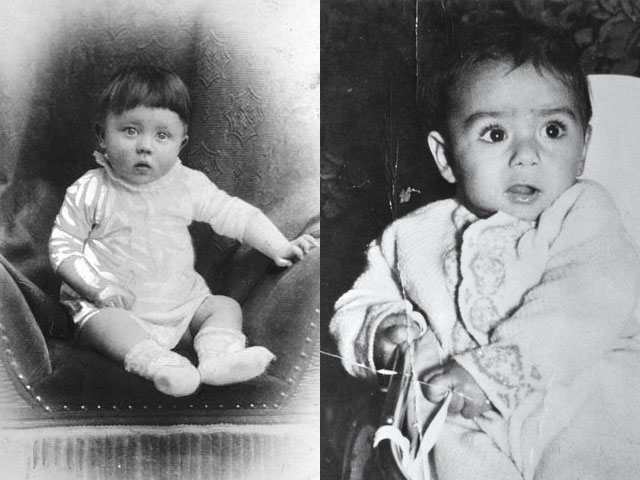
Dictators in childhood. On the left - Adolf Hitler, on the right - Saddam Hussein.
In fact, there are much more potential dictators than those held. In countries with sustainable democratic institutions and an indifferent society, dictators do not withstand political selection and are rejected in the early stages of their career. In countries emotionally and politically unbalanced they can pretend to be lambs for a long time and society discovers their wolf skins when it is too late to drink Borjomi. In such unhappy countries, the anti -dictator filter can perform an opposition if it exists and is quite consistent in upholding democratic values.
However, applicants to dictators, at least at first, most often operate with democratic phraseology. They promise democracy, legality, order and universal happiness. Upon a closer examination, it turns out that the happiness they promised is by no means universal, the order is akin to the cemetery, the legality will not correlate with human rights, but democracy with suspicious flaws and a special taste. The sooner it turns out and becomes well -known, the better.
Lenin and Trotsky promised to distribute the land to the peasants and factories to workers, to end the war and build communism. Hitler fascinated the Germans with promises to get unemployment, build socialism for workers and give the heat to the English-American capitalists. Many other left -wing dictators promised universal happiness.
Some were more pragmatic and more specifically. Fidel Castro promised to replace the relatively soft dictatorship of Fulhensio Batista with democracy. Paul sweat with his red Khmers promised the Cambodian peasants to protect against thief bureaucracy. Francois Duvalier in Haiti and Alexander Lukashenko in Belarus came to power under the slogans of the fight against corruption. Those who forgot that the road to hell was prayed to the hell with good intentions, they made these promises with a bang. An influential political opposition, capable of explaining the essence of what was happening, or was not, or she hoped to use a new situation for her own purposes. Stubborn and ambitious politicians seemed opposition to a suitable ram, which could be removed after the matter was done. In practice, most often it was Taran who removed the non -calculated oppositionists.
In different versions - more or less tough - this was repeated many times, including in the post -Soviet republics. Boris Yeltsin came to power in the wake of democratic changes that society longed for. He was supported by many sometimes naive, sometimes prudent people who enjoyed public trust. Having received power, Yeltsin very quickly turned democratic transformations, and replaced democratically tuned politicians with helpful officials from former party apparatchiks. In Russia, then there was no rather influential opposition that would convince society that it was impossible to build democracy with the hands of the nomenclature communist, who gave the service to the totalitarian regime of the decade of his life. The bulk of Russian citizens preferred to be charmed by the democratic phraseology of yesterday’s secretary of the CPSU Central Committee and not pay attention to such “trifles” as personal and business qualities that allowed him to make such a successful political career in the USSR. The Russian "maybe he will triumph."
Political life in Russia is now experiencing some revival in connection with local and regional elections. This is especially clearly visible in Moscow. No one promises dictatorship and lawlessness. Everyone promises democracy and legality. Even a candidate from the Communists. What can we say about the opposition candidates!
But maybe it is worth considering candidates more carefully? Sergei Mitrokhin from the Democratic Party "Yabloko" claims that in the Moscow camp for immigrants human rights are not violated , because the conditions of detention in them are quite acceptable. Yes, at least at the Metropol Hotel - they have no right to hold them by force without sanction; Moreover, those who have the documents are in perfect order. And does this person promise us to protect democracy?
Alexei Navalny, from an even more democratic party, RPR-Parnas, at meetings with voters , operates with obviously false figures about ethnic crime in Moscow and the pace of emigration of the male population from Tajikistan to Russia. He has the hardest of all candidates to the attitude to migrants in general. He greeted Russian expansion in Georgia. And will he protect human rights and legality?
The opposition of democracy of democracy suggested by the opposition candidates. It seems that democracy is not sovereign, but very peculiar. Of course, both of them are good as a ram against the illegitimate Moscow government, but maybe it's time to look back at the story? Maybe the stock of time and capabilities is not as great as it seems?