
Translated material
More light?

What can interest us in the V Moscow Biennale ? Certainly not what she will be about this time. At the level of festival, which was reached by Moscow artistic life over the past couple of years, the significance of any content proposed by the viewer this time will be reduced to the name of the “next”. At the level of the dynamics of the latest issues, it comes down more or less to satisfy the most diverse interests in turn: it is not so important what candy you will stretch out of the cat-with raspberry, lemon or orange taste. First, they offered to try the post-colonial (Marten, 2009), then the medial (Waibebel, 2011), and then, for the sake of the correct variety,-the curator-“girl” (de Zeger, 2013). Therefore, it is better to talk not about the content, but about administrative and ideological circumstances - in this situation they, and not in any way curatorial stations, are truly diverse.
So, by the way, this year for the first time in its history, Biennale takes place on the site controlled by the city. A couple of years of Kapkovsky activity (despite the news of Kapkov’s departure from the post of head of the Department of Culture of the city of Moscow, his name will continue to exist for a long time, because the structures created by him continue to exist. - Ed .) Led to the total integration of Moscow cultural institutions and initiatives into a universal network of communicating vessels that are actually proposed by citizens: MSO Manezh, Gorky Park with Gorky Park. "Garage", Moscow Museum of Moscow, Pushkinsky - the list can be continued. Everything is covered by an equalizing impulse of neoliberal improvement, aimed at that actually a heterogeneous audience, circulating through all these spaces, recognizes itself in a single image of a “cultural middle class”. Precisely because this system exists exclusively to create a certain class identity, constructing a certain self-awareness of citizens of a large city, it is dominated by the logic of serial production of content, and there are no truly important cultural initiatives and institutions at this level and cannot arise.
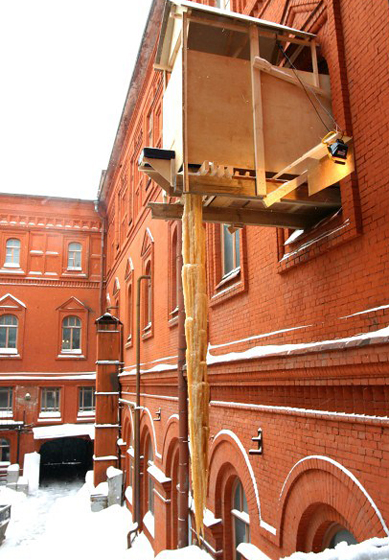 © Moscow Biennale Gelitin, Pipi Bill, 2005
Now, in this integrating and total system of improved city cultural institutions, fixing the representation of the class about itself, but not producing any liberation, which could be expected from living culture, Moscow Biennale also joined. Until now, it has existed in a parallel measurement of federal and private spaces, since the federal body-the Ministry of Culture finances and conducts it still. And the fact that Biennale finally met with the new, “Kapkovskaya” Moscow at the administrative level is the circumstance of not only economic, but also ideological.
The forgotten ambitions of Joseph Bakstein are already nostalgically sound already nostalgic ambitions to get to the pages of The New York Times : after all, the Moscow Biennale did not begin as a festival event for Moscow, but primarily as a “big event for Russia”-this was the name of the symposium, which ten years ago, in 2003, spent two of the founders of Biennale, two years ago, in the Central House of Arts. Victor Misiano and Joseph Bakstein. Even before their gap, when the first was removed from business with the complete silence of the still not trained solidarity of the community (the history of Misiano’s removal from the leadership of Biennale can be read here . - Ed .), The discussion took place in which the curatorial heavyweight took part. Zeeman, Obrist, Chelant, Storr arrived in Moscow, where, in addition to the need, there was obviously the opportunity to organize a certain “big event”. The only question was whether it should be Biennale - a form that was already recognized as crisis, archaic, in need of revision. Indeed, the result of very exciting discussions was the conclusion that if you make a large exhibition, then in a new way, if you fit into the world biennal wave-then in its own way. The normalizing equalizing pathos of the “adequately working system of artistic institutions”, which gradually began to seem a certain end in itself and a sign of true civilization, did not sound at the symposium - everyone wanted to express a new, brewing modernity, but not to come to an imaginary Western norm. It was mainly about how to create something vividly connected with the local context-and most often the example of young Biennale in Istanbul and Kwangju was given as an example.
It is better to talk not about the content, but about administrative and ideological circumstances - in this situation they, and not in any way curatorial stations, are truly diverse.
In a funny way, when it came to negotiations with the ministry, not these two Biennale, but the most conservative Venetian, which at the same time expressed as if more understandable for officials, the idea of international events and the Olympiad type, at the same time, began to lead. When Bakstein-practical began to act without a Misiana Theoretic, the project was very lost in dreaminess, although it seemed to come close to its material implementation, having left the risk of dissolving the uncertainty of open capabilities. The main engine and the main trap of the enterprise was the idea that with the help of Biennale, Russia will find a person who will enter it into the Western capitalist modernity. Then the illusion gained power that the “beneficial” functioning of capitalism in Russia is somehow connected with the mimetic compliance of the cultural canons of globalization, one of which is the infrastructure of contemporary art, and its crown is Biennale.
In fairness, the biennial form was opposed to the “market” “art” that had already existed at that time and was supposed to indicate an alternative to purely gallery art. It was then, in 2005, the Lenin Museum and a brilliant idea arose in the winter in winter-the idea is actually obviously exoting: it is clear that the calculation here was primarily for foreigners. Now no one would have decided to hold the largest exhibition event in the January frost. Then they wanted to make the event unique - albeit in a few tourist veins, but this clarifies how much it was nevertheless focused on Western perception. The organizers joked that this is Cool Biennale - and everyone remembered a giant icicle, tearing on a booth of a wooden toilet attached to the wall of the museum (the work of the Austrian Group "Despitin").
But, despite the rude and export element, the first issue was obviously preserved by the Misiana intellectual impulse: the “manifesto” (whose creators were Misiano), a progressive and in fact a more democratic model of collective curators (in one project was answered together by Hans-Ulrich Obrist, Daniel Birnbaum, Yara Bubnova, Iosifov, Iosifov Bakstein, Nicolas Burrio, Rosa Martinez). The exhibition turned out to be young, lively and exciting: many young artists were involved, a significant number of new works were performed, and the main “market” jugles of our scene of the then scene (Kulik, Mamyshev-Monro, AES+F and Dubossar with Vinogradov), offended by the fact that they were not included in the main project, were displayed separately under the sign of Star Z -reconciled A comic story about how truly conflicting contemporary art shared the stupid and glamorous stars of the local market.
If the first Biennale contrasted itself (although recognizing that it is part of the same system) fair, then the second appeared a grandiose meeting of art and private capital, so bright and obvious that no “art-mosquito” with its petty harmless trade was compared with it.
One of the successes of the first Biennale was that she went into the former Museum of Lenin, which was only handed over to the historical museum and did not manage to redo it to the 1812 museum. Then it became clear that one of the main problems is the site. The rental, which was requested by the then-play, was equivalent to the real Biennale’s small budget in fact, and the statements in Moscow had not yet been rolled, and the fact that the Lenin Museum was empty, became not only a success, but also an ideologically transitional moment. The state was suspicious of modern art, and the city and private entrepreneurs who have not yet discovered the ideas of “effectiveness”, the more they did not understand what a similar enterprise could be useful to them. So it is no coincidence that the desired spatial opportunity arose in the most symbolic place of gaping, formed in the old Soviet museum system.
The second release was in the sense of the ideological significance of the opening spatial capabilities even more indicative. If the first Biennale contrasted itself (although recognizing that it is part of the same system) fair, then the second appeared a grandiose meeting of art and private capital, so bright and obvious that no “art-mosquito” with its petty harmless trade was compared with it. The success of the first issue showed everyone that the biennal form, by definition, meaning a loud event, and tickling substantial inconsistency is a good way to build symbolic capital. The unfinished Tower of the Federation and TsUM readily accepted the Biennale, the Tower Tower even took over the expenses for the development of the exposition, which is usually a very costly budget item. The only problem was that the room was not at all suitable for installation, it was again winter time, and cargo elevators on which the works were raised, broke from frost. The workers dragged the objects in their hands, and this installation was remembered as one of the most difficult. It was against this background that the Biennale's bow and a lot of money occurred. And the most provocative component of this issue was the philosophical conference included in the main program and organized by Bakstein, to which the stars of modern left -wing political thought such as Changal Moff, Giorgio Agamben and Jacques Ransier. Their performances were mockingly not somewhere, but in the maiden of consumption, Tsum, which was considered a manifestation of the commissar’s tactical genius.
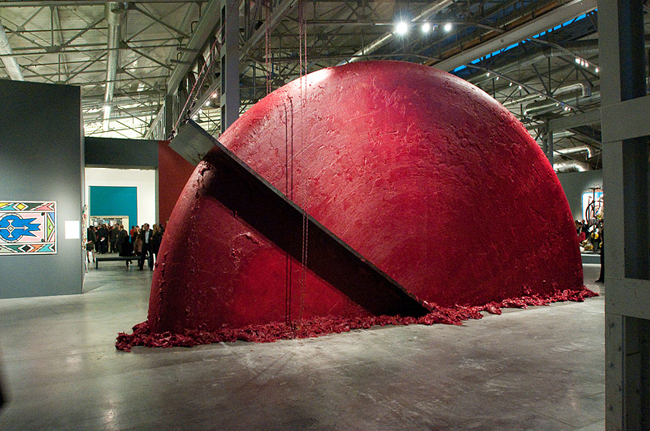 © Evgeny Gurko III-I Moscow Biennale in TsSK Garage, the project “Against exclusion” by Jean-Juber Marten
But still, the Biennale found its final, rigid form of a stably reproducing festival event in which there was no trace from the original intentions, Biennale in 2009. Then the very free idea of collective curators was rejected in favor of one proven figure- Jean-Juber Martin , and most of the budget went to transported by Martin the finished works of famous artists from different parts of the land. The newly “garage” agreed to accept Biennale, with which the Moscow Biennale fund already managed to work on the exhibition of Ilya and Emilia Kabakov “Alternative History of Arts” . The “garage” was still something new for the city, and the form of an empty universal exhibition space with a non-articulated curatorial program, but a well-aware social function of the “modern cultural center with a bookstore and a cafe” was still preparing to become dominant. The choice of a “experienced” curator with a program worked in advance testified that the event is already obviously done not for the world, but only for the city, that is, it is imprisoned not for the production of generally significant knowledge, but exclusively for domestic consumption. And the fact that most of the budget did not go to the production of new works and the support of local artists, but to transport the finished ones, it said that ambition also faded a live connection with the local context. Biennale designed her format, the most important features of which were the regularity of reproduction and maintaining the status on the local stage, and the contents - that is, content - became an additional and secondary issue. However, it was then that this issue began to occupy the public: the choice of the curator began to be discussed as controversial, as well as the internal mechanisms of Biennale. Having established in its completed form, she finally came under suspicion: the community began to interest the method of making decisions - about the curator and how the budget was spent.
A comic story loomed about how truly conflicting contemporary art shared the stupid and glamorous stars of the local market.
The fourth, Vaibeli, the release became perhaps the most failure. He was inferior to Martenovsky in attendance ( 70 thousand visitors against 100), namely mass, was an excuse for the closed and sufficiently authoritarian policy of Bakstein in the leadership of Biennale. The fact that the curator was chosen according to the principle of elementary formal-thematic dialectics-after a colorful needlework postcolonialism, something technician was required-unpleasantly evident. Not only did Webel not be going to peer into the country in which he made Biennale - unlike the thorough Martin, he also did not care about exhibiting too much, he arrived at the installation almost at the last moment and did not particularly do work either. The main expenses of this output were on the development of absolute raw and naked premises of the ARTPLAY cluster, which was neutralized at the former Manometer plant, the development of which Biennale was supposed to contribute - this, of course, was the meaning of mutually beneficial cooperation. It was on this Biennale that the idea of attracting volunteers to the installation of volunteers first received its mass embodiment. Until now, they recall the work of the Clair E Fontaine group with several hundred thousand matches, which 200 replacing volunteers stuck for 10 days so that later they could effectively burn overnight . (However, even this was not done as it should: when the volunteers gathered the work, it turned out that they were somewhat lingered and could not burn it to the exhibition, as they managed to mount other works and the fire would threaten them, so it was decided to burn at the finisage. Thus, the work was shown by the unfinished one. In general, several works on that biennale did not work: especially the video and especially the video and the video and the video and the video and the video and the video and the video and the video and the video and the video and the video and the video Interactive installations, which is quite symbolic, given that Biennale was made by a large fan of modern technology Peter Webel .)
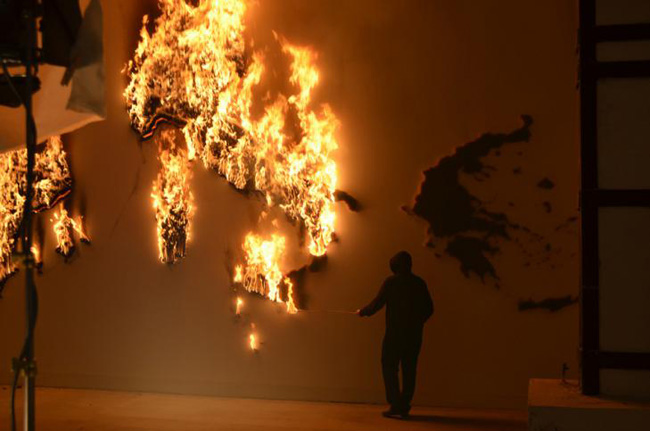 © Cyril Radetka Claire Fontain Claire Fontain - Pigs burning
It was to this issue that the younger part of the community was able to formulate the main issues for the leadership of Biennale: an initiative group was created, which managed to call Bakstein to Dialog . The main claims were an opaque procedure for choosing a curator and opaque spending of funds. A petition project was developed, which did not receive wide support: they objected that nowhere in the world the choice of the curator is determined by the open democratic procedure, and the rhetoric of the “money of taxpayers”, which are spent opaque, can lead to a complete collapse of subsidies for modern art in general. Nevertheless, for the new, fifth, release for the first time on the current biennal site, the Expert Council section appeared. It turned out that the experts who select three candidates from the Long List, and then consider the submitted applications, were almost in full force of the same persons who oversaw the first three Biennals: Bakshtein himself, Ambassador, Bubnova, Marten, Birnbaum. As a result, arguing with the choice has become even more difficult: Bakstein firmly fenced his conservative strategy with a wall of venerable authorities.
The form of an empty universal exhibition space with an unarticated curatorial program, but well -aware of the social function of the “modern cultural center with a bookstore and a cafe” was just preparing to become dominant.
In 2007, when Biennale first tried to get into the arena, he was not yet at the disposal of the Department of Culture of the city of Moscow and asked for rent money that Biennale could not afford. Now, in 2013, the new Kapkovsky arena, which has become part of the cultural screen, which in the peak of political repression would have fired Muscovites from unpleasant reality and would become the mirror in which the class of satisfied citizens identifies himself, is in a desperate search for content-he managed to shelter several pseudo-museums and even dubious Lexus festivals Gibrid Art . So to accept the Biennale was more than the logical outcome of this oncoming movement. Technically, for Biennale, this is a good solution-due to location, as well as in the sense that less funds are spent on development. In addition, de Zeger brings less and spends more on the production of a new one. Claims were taken into account regarding the inattentive attitude of past curators to the local context.
Но что бы там ни было, вопрос, что и как производится, связан прежде всего не с тем, кто стал куратором и как его выбрали, а с типом пространственности «Манежа», в котором биеннале надеется закрепиться на последующие выпуски.
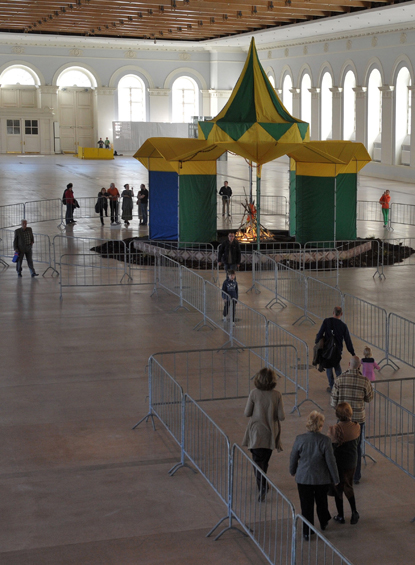 © Дмитрий Лекай / Коммерсантъ Открытие выставки Ирины Кориной «Вооруженные мечтой» ЦВЗ «Манеж»
С проблемой заполнения Манежа столкнулась уже Марина Лошак (до назначения директором ГМИИ им. А.С. Пушкина она возглавляла МВО «Манеж» с 3 июля 2012-го по 1 июля 2013 года, созданное Сергеем Капковым специально для нее. — Ред .). Она первая стала делать там большие инсталляции: это наименее интеллектуально затратная стратегия, которая позволяет создать видимость события, наскоро заполнив огромную пустоту. Единственная проблема тут — трудоемкость и масштаб. И параллельно с Московской биеннале уже какое-то время назад Манеж пришел к идее привлечения волонтеров. Так делалась инсталляция японки Тихару Сиоты с тысячами пересекающих пространство нитей: Манеж разместил объявление для желающих приобщиться к современному искусству. То же самое происходит теперь при подготовке пятой биеннале. На нее приезжает беспрецедентное количество художников — около 50 (двое не хотели приезжать, но куратор их переубедила . — Ред .). Большинство из них монтируют работы сами, и им требуются ассистенты. Чтобы освоить чудовищный объем Манежа, де Зегер естественным образом выбирала крупные, зрелищные и трудоемкие в монтаже инсталляции. Все очарованы Манежем как идеальным местом для крупного зрелища — единственная проблема состоит в том, что, чтобы все это собрать, привлекаются силы, на оплату которых заведомо не предусматриваются ресурсы. Многое держится на энтузиазме: волонтеры сами пишут письма с предложениями о помощи. Их даже слишком много — биеннале отбирает тех, чьи навыки подходят к текущим задачам лучше других. Но даже если бы самовызвавшихся волонтеров не было, думая о том, как осуществить производство, биеннале заранее полагается на возможность привлечь бесплатную рабочую силу — скажем, студентов Британской школы дизайна.
Все очарованы Манежем как идеальным местом для крупного зрелища — единственная проблема состоит в том, что, чтобы все это собрать, привлекаются силы, на оплату которых заведомо не предусматриваются ресурсы.
На первых выпусках идея волонтерства вряд ли вообще могла возникнуть: статус у искусства был не тот, и не было еще необходимости создавать гигантское зрелище-ивент. Теперь же это грозит стать постоянной реальностью биеннале, что диктуется самим типом пространства Манежа. Маленькие работы просто проваливаются в этом объеме, поэтому нанятое де Зегер архитектурное бюро FORM строит сложную, впечатляющую композицию из пятиметровых фальшстен, чтобы произведения не растворились в огромном пространстве. Де Зегер огромное внимание уделяет сценографии экспозиции и тратит на работу с архитекторами существенную часть времени, что и понятно: в Манеже любая неудача с масштабированием сулит провал всего зрелища.
На наиболее сложные инсталляции (например, работу архитектора Александра Бродского, который является самым востребованным в Москве заполнителем пустых пространств художественными зрелищами) требуется до десяти волонтеров, которые работают почти неделю. Пять монтажников и пять волонтеров нужны на инсталляцию китайского художника Сун Дуна, пять волонтеров — на инсталляцию Моны Хатум, десять человек в течение недели должны втыкать 12 500 булавок для работы индийской художницы Ранджани Шеттар и т.д.
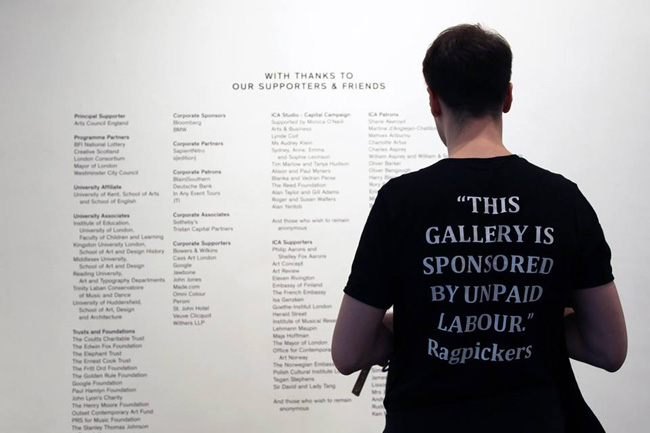 Акция коллектива Ragpickers в лондонском Институте современного искусства против эксплуатации волонтеров и интернов
Интересно, что практика волонтерства распространена и на той же «Документе» с той только разницей, что там оно сулит определенную интеллектуальную выгоду, на последних же двух выпусках Московской биеннале волонтеры привлекаются исключительно для примитивного ручного труда типа втыкания спичек или измельчения фольги (на IV биеннале волонтерам обещали оплату телефонной связи, обеды, приглашения на вернисажи и «веселую атмосферу». — Ред .). И именно сведения о затраченных таким образом усилиях являются затем самыми любопытными для прессы: после биеннале в ARTPLAY «Афиша» опубликовала занимательную инфографику , в которой подсчитывалось количество серпянки и скотча, ушедших на производство выставки.
И действительно, не взятые по отдельности форма и содержание должны нас интересовать. Интересы биеннале наконец-то стопроцентно совпали с интересами культурной администрации города: под эту связку подверстываются необходимое количество стройматериалов, труда, пусть даже бесплатного, масштаб, форма и тема — и в этом главный смысл и содержание грядущей выставки. Большое событие для России окончательно превратилось в большое событие для Москвы — эту новую локальность, завязанную на неолиберальной перестройке городской культуры, и следует критиковать.
Выставка «Больше света» (основной проект V Московской биеннале) пройдет в Манеже с 20 сентября по 20 октября, официальное открытие состоится 19 сентября.