
Translated material
Kirill Svetlyakov: "The theme of the exhibition is a labor that is not quite labor"

On September 23, an exhibition “ Museum of Modern Art: Department of Labor and Employment” was opened in the State Tretyakov Gallery on the Crimean Val . This is one of the largest special projects of the V Moscow Biennale of Contemporary Art, and it is dedicated to conflicting labor relations in which the artists are included. In the walls of the Central House of Artists, the exposition of modern authors was collected, adding archival materials. You stop counting the number of participants after a forty name in the list. The exhibition is large, a lot of labor is spent. And therefore, in addition to the substantial part, it is interesting how a project, whose name quite directly refers to one of the pioneers of institutional criticism , builds its relationship with artists. This was said about this by the head of the latest trends of the Tretyakov Gallery and the curator of the exhibition Kirill Svetlyakov.
- Tell us about the project.
-The exhibition represents the history of labor from the 1960s to the present, speaks of whom the artist feels himself in the labor process.
We started from the Soviet industrial period of the 1960s and 70s, the exposition is opened by archival surveys of the subbotniks of the Tretyakovka employees, who correlate with the performances of seventies who simulated labor relations. Scientists went to the subbotniks, many of them were festively dressed, they did something, dug, all this was documented. And far from always the process was like labor.
This is the topic of the exhibition - work that is not quite a labor that does not have a certain status. In many cases, participants in this exhibition either imitate work, or try to do something with their hands, or include someone to this manual work, or go to the plant and try to reproduce some industrial standards, or play with manual labor on Earth or production. This also includes artists who are trying to build relationships with other areas of activity, partly due to the fact that they often do not feel support within art. They have the feeling that they work on the entertainment industry, which, working with certain institutions of contemporary art, they are hostages of certain forms of art production. From here, perhaps, this desire is either to leave the territory of art, or to attract other areas of activity into it.
The first section of the exhibition is called “Liberation from Labor”, and it is voiced by the Marxist dream, which was partially realized in the USSR: not only the erasing of the boundaries between manual and mental work, but also a rejection of labor as a form of any coercion. Marx began with the refusal of operation, and ended with the rejection of labor relations and the transition to the stage, when labor becomes the basis of self -improvement.
Inside art, they often do not feel support. They have the feeling that they work on the entertainment industry, which, working with certain institutions of contemporary art, they are hostages of certain forms of art production.
The subbotnik was just the first holiday of the contented worthless and free labor of people with higher motivation. Art is largely a form of this erasing borders between labor and not difficulty. Because the artist can do anything. He can work, he can sleep, can get out of bed with the feeling that he had already worked.
In another part of the exhibition, Alexander Melamide retrays artists to plumbers and offers applied educational programs in the museum, which should teach art. But, on the other hand, why did the subjects such as aesthetics, world artistic culture, and the museum cannot be introduced in the technical schools, and the “locksmith business” discipline cannot be introduced? There is a category of people who will perceive it better through the museum. There will be several public classes. It was assumed that they will be visited by students of the Bakstein school (I mean the Institute of Problems of Contemporary Art. - Ed .), He even called me, was interested in that it would be like that. In general, the course of Yuri Albert, probably, will go for it. Students generally go differently to all sorts of classes, often miss, but it is important that these classes will take place. And in the final they will connect the pussy on the third floor. Toilets do not work there, plumbing cannot fix them, and perhaps artists will be repaired. Again, speaking of art, you have to talk about problems.
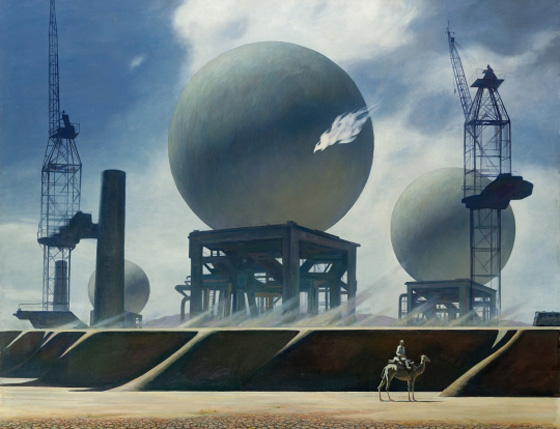 © State Tretyakov Gallery Camille Mullashev. Above the white desert. III part. From the series "Earth and Time. Kazakhstan". 1978
- And how are the artist’s labor relations and institutions drawn up in the Tretyakov Gallery? Do you sign the contract?
-We have an act of acceptance-transfer and an agreement on the transfer of work. The latter implies the existence of a kind of work at the time of signing. But many works are created specifically for the exhibition in the walls of the Tretyakovka. And this is good, because the museum becomes the center of art production, where labor is done only at the exit, it is not yet at the entrance.
There are works that are not material. For example, the “Department of Visual Observation Systems” Max Ilyukhin is a set of cameras that you will not transmit. And the question of what is the subject of the contract for the Tretyakov Gallery is not resolved, because nothing is transmitted. A group of people who mounts cameras for a fee come. All this is the Maxim project, which, of course, appears on the site, but it transfers his idea, this is intangible work. It is not decorated, because formally it was not conveyed. We can put inventory numbers on cameras and protect them, but this is called "permission to vehicle exhibition equipment." Due to the fact that it is not clear what to denote as a work, and complications arise in the conclusion of contracts.
The system of contracts is a system of legal relations, it is the work of the legal department. I think this is still ahead. The legal department is not ready for work with individual agreements, there are only typical ones, which extremely complicates the possibility of working with contemporary art and artists.
It turns out, on the one hand, you are an intellectual elite, and on the other, a mound at a construction site.
There is another feature of cooperation with artists who work with galleries. You agree with the artist, and at the exit is a gallery. I say: “Dear friend, an artist, because you asked money for production, and for some reason we must conclude an agreement with a gallery. This gallery has saved or in this way it wants to implement the project at our expense and still take work? ” However, I know the artists who, after such steps of the galleryists, broke their relations with them. Unfortunately, not all galleries are ready to participate financially in museum projects of their artists. For the most part, artists do everything themselves.
We have not worked out the technology of continuous production of art. The artist is constantly looking for some money, we are looking for too. The artist agrees with someone about the press of materials, he agrees so that someone gives him chairs or something else. It turns out, on the one hand, you are an intellectual elite, and on the other, a mound at a construction site. There are, of course, artists who are included in the industry, but not all of it want, and this is not always useful.
- Among the participants, Nadezhda Tolokonnikova and Ilya Trushevsky are declared among your participants. How does cooperation with those who are in places of imprisonment?
-It was assumed that Tolokonnikova would show the clothes that she sews in the workshop, but with a touch, the connection was somehow interrupted. And the works of Trushevsky arrived. He simply thematizes what he does in places of imprisonment. He works on machines, he has a workshop, he continues to engage in art, but it is derived from the situation in which he ended up. These extreme forms of employment and I wanted to show.
 © State Tretyakov Gallery Group "Nest". Help the country in growing bread. Promotion documentation. 1976
- The description of the project was still mentioned by the artist’s exit to reality as a way to stay in art. What did you mean?
-It seemed to me that the artist who has some other experience is interesting. I mean that sometimes institutions are produced by the so-called contemporary artists who know the conjuncture, they know someone in a party, they know some curators, but they do not have material, especially in cases where this is the first specialty. An interesting artist is, for whom contemporary art is a second specialty, who has something to work with. Otherwise, this is scholasticism, an endless solution to already solved problems.
- And if you return to some regulation of the relations of the institution and artists, what is your position about this? Are you for some minimum set of conditions that would always be prescribed in the contracts and are respected? Do you think this is generally necessary?
- It is necessary, this will bring some clarity to the relationship. But contractual relations are always easier to draw up when the project is individual. For example, a retrospective exhibition or author's individual installation. Then the artist really concludes an agreement on the creation of the exhibition. In the case of group projects, where 30 or 40 artists are immediately involved, ties are included more informal.
It is also important that people who know art are engaged in agreements. Well, imagine: I talked about something with the artist, we discussed the project. And then a call is heard, and they say to him: "Hello, this is an employee of the accounting department (or lawyer)." And there people talk to whom he is nobody, for whom he is a legal entity and nothing more. The specifics begins: “When will you present the lists of work? We need accurate lists with sizes. When do you plan all this? " I'm not sure that artists are ready for this form of relations. There are artists who can clearly answer all questions and agree to do everything according to the regulations, but there are 50%of them. Our legal department is now ready to work with institutions. The mechanisms are already debugged there. Otherwise, everything is solved by personal relationships and agreements.
The legal department is not ready for work with individual agreements, there are only typical ones, which extremely complicates the possibility of working with contemporary art and artists.
- Do your artists participate in the process of installing work?
- Yes, of course, many participate and want to see how the work is mounted.
- Is this a voluntary aspiration or necessity?
- There is a need if the work cannot be assembled without the author, and there is a desire for the artist to see the work before the opening. Because at group exhibitions, the artist especially often has the feeling that he is very impressive.
- Artists are generally very easily injured people.
- Yes, curators too.
- In situations where the artist goes into the category of the installer, can this work be paid?
- It is precisely most often that this work is paid. There are even entire installation brigades that consist exclusively of artists. Although in post -Soviet history you will not look at, he is not the one who it seems. All exist in border or intermediate spheres.
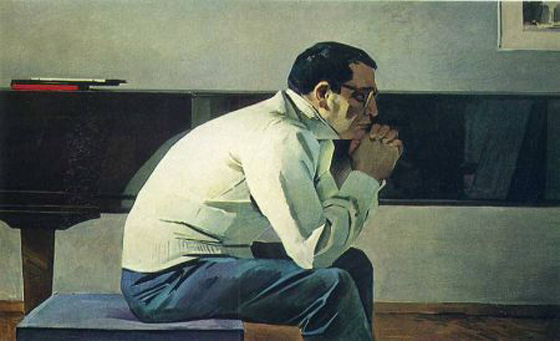 © State Tretyakov Gallery Tair Salakhov. Portrait of composer Karaev. 1960
***
The issue of labor relations between the institution and the author seems to rest on the problem of determining what to consider the artist’s work and the product of this work. At the same time, the artists themselves are no less difficult when trying to find their position as part of the economic aspects of interaction. Eternal conflict "Grandmas vs. Creativity ”each resolves for himself, so the community as a whole is in a limited state. And individual initiatives to establish certain norms and make clarity, attempts to consolidate remain an attractive idea.
As a result, his monetary component falls out of the artist’s work. And the whole process becomes more like the natural exchange of authors' work for their temporary placement in the walls of the institution. This suits everyone exactly to the extent that allows the situation to remain unchanged. Neutrality rests on both sides. But the question is clearly painful, because attempts to raise the topic invariably cause a reaction in the range from slight excitement and discontent to frank aggression. And in this case, the comment of one of the project participants - Maxim Ilyukhin can be indicative. In it, he spoke about the process of work, preparation of the exhibition and quite emotionally described the condition of the artist actively participating in the life of the art community. In addition, Andrei Kuzkin’s answers are no less indicative, who learned about his participation in the exhibition from us. (Comments from artists received before the opening of the exhibition.)
Maxim Ilyukhin
At the exhibition there will be two works that I can call mine. One job is the Office project of the ABC group ( Art Business Consulting ). It consists of two parts. The first part is a series of posters about the everyday life of office employees in the early 2000s. The second part, which turns this work into installation, is a series of “flat employees” , which we added to the posters in the mid-2000s. We had already shown this work in Moscow, Vienna and St. Petersburg. It is connected with the history of the ABC group itself, we all worked in offices in these years. Having received an art education, we found then that in order to earn a living, we inevitably have to go to work in an office, and we decided to do a job about what is the environment in which we are.
For the exhibition, we will reproduce this work again. We print images on a home laser printer, on sheets of A4 format, glue these sheets with each other like a puzzle, and we get monumental images that we laminate with stationery adhesive tape. We do this ourselves, inviting several assistants to whom we pay for their participation. In the weight of the work, I hope that the museum installers will help us.
For expenses related to the production of work, we received money from the curator of the exhibition Kirill Svetlyakov, which, as I know, he received from the sponsor of the exhibition. I gave him a receipt about this.
We have trusting relationships, we know each other and are in one professional community, so we work on such conditions. We did not ask for artists for the artists for participation by the curator, since we believe that the exhibition in the Tretyakov Gallery is symbolically important to us. The exhibition is temporary, if we are talking about the acquisition of work, then we will discuss their cost.
At group exhibitions, the artist especially often has the feeling that he is very infringed.
The second work, the “Department of Visual Observation Systems” , is my personal. This is a network of video cameras that are placed at the exhibition, shoot everything that happens, and this video is broadcast to the audience on the monitor inside the exhibition. I already did this work a few years ago, but then the cameras and the possibilities of broadcasting were different. Installation and cameras are provided by a company that specializes in this. As I understand it, their activities are also paid due to the participation of the sponsor. The financial flows themselves in this work do not directly concern me, but the performance depends on them. In this matter, I was connected with the curator and I assume that he is interested in maximum capacity, but limited by resources. Therefore, we discuss with him opportunities and decide what we can do.
I did not ask for participation for participation for the same reason: the exhibition in the Tretyakov Gallery is important for me regardless of financial rewards, so I myself did not ask for about it.
I must say that over the past years of my practice, I am accustomed to relate to artistic activity as follows: who needs it, he pays for it.
I think that labor relations can be formalized as you like, if it suits the participants. I am inclined to reflection, sometimes it seems to me that some things and relationships could be harmonious, better, more comfortable, more productive. Usually, I consider such thoughts as a manifestation of my own depression, since we already live in the best of the worlds, as Leibniz said.
I am somewhat exaggerating the optimism of my mood and I can explain this only by the fact that you, an unfamiliar person, in addition, a journalist, ask me such personal questions that relate to my existence and, one might say, basic needs related to my survival. I don’t know why you ask me about this and what you plan to do with the material received. That is, I understand that you are writing an article on colta.ru, but the further fate and resonance of what you have written are no longer controlled, or maybe they will affect my life too.
No one helped me become an artist - only, on the contrary, they scared: it will be bad, there will be no money, there is no talent, there are no connections, why do you need it, go learn, go work.
I'm scared. For years I have been engaged in this work, adapted to the environment, got used to it, made my acquaintances. This is an activity for which I abandoned other possible positive scenarios of my life. I went to the office, from where I quit when it was possible to engage in art more, as there was a platform on which you could make an exhibition every month. Я использовал ресурсы своей семьи, своих родителей, чтобы заниматься искусством, не приносящим никакой финансовой прибыли, только эфемерный статус и круг знакомств, который еще нужно постоянно возобновлять и поддерживать; писать что-нибудь увлекательное на Facebook ; ходить каждую неделю на вернисажи, конференции, биеннале; ездить за границу на ярмарки, на которых ничего не покупают; читать рецензии на выставки, которых происходит по несколько штук в день. И все это ни за грош. Все ради статуса — современный художник, человек, который изобразил свое время, герой поколения.
И вот вы меня спрашиваете: а на какие средства вы этим занимаетесь и все ли вас устраивает? Мне перед выставками по ночам снятся кошмары, я не сплю или не могу проснуться. Я бегаю по знакомым в поисках недостающей камеры или видеопроектора. И так уже годы, лучшие годы моей жизни. Middle age. Когда мои одноклассники пьют пинья-коладу или возвращаются домой с работы в новом, современном авто, я таскаю коробки с инсталляциями, которые негде хранить. Когда мои соседи строят беседки для чайных церемоний, я строю сараи, чтобы хранить работы, которые никто не приобретает, а выбросить жалко, так как для очередной выставки, возможно, не будет бюджета на изготовление работы.
Все ли меня устраивает? Certainly. У меня что, есть право влиять своим отношением на то, что происходит? Так и мое отношение меняется. Когда я отдохнул, сделал выставку, получил приглашение участвовать в следующей или просто на время отвлекся от всей этой суеты, мне хорошо, мне прекрасно. А когда опять надо срочно куда-то бежать, что-то доделывать, это ад, которому не надо искать метафор. И это все иногда может быть в течение одного рабочего дня. Никто не помогал мне стать художником — только, наоборот, пугали: будет плохо, денег не будет, таланта нет, связей нет, зачем тебе это нужно, иди учись, иди работай. И вот появилась возможность быть участником выставки в Третьяковской галерее, куда я в детстве с мамой ходил смотреть Васнецова и Репина, «Аленушку у пруда», сказку как она есть. И вот я могу оказаться сам в такой сказке, сам ее сделать.
Вы меня просите рассказать подробнее о трудовых отношениях. Это трудные отношения, сплошной труд. Все, надо ехать отвозить работы в мастерскую.
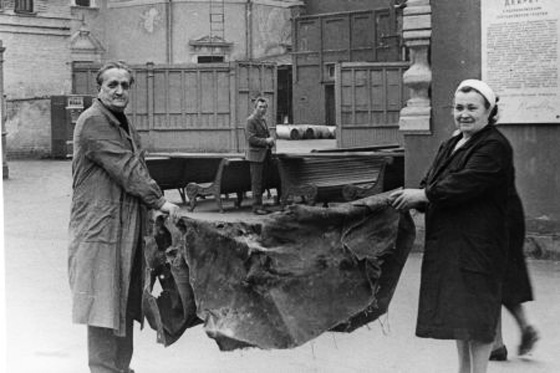 © архив Профкома Государственной Третьяковской галереи Коммунистический субботник в Государственной Третьяковской галерее
Андрей Кузькин
— Какая ваша работа представлена на выставке? Она создавалась специально для выставки или это была готовая работа?
— Без вас я бы и не узнал, что участвую в этой выставке. Организаторы обратились в галерею, галерея дала работу. Я был не в курсе до последнего момента. Работа старая и известная, в свое время прославившая меня, — видеодокументация перформанса «По кругу» (премия «Инновация»-2008).
— Вы сами будете монтировать свою работу?
— Думаю, что нет, это видео на диске, там нечего монтировать. Монитор будет предоставлен галереей.
— Как оформлены ваши трудовые отношения с ГТГ? Вам выплачивают гонорар за участие?
— Договор, видимо, заключен с галереей — о том, что они берут, выставляют и после возвращают произведение. Естественно, никакого гонорара нет. Не могу сказать, что меня устраивает, но я уже к этому привык. То есть я из принципа никогда ничего не прошу, если же сами предлагают, то не отказываюсь. Однако предлагают весьма редко и, как правило, иностранные организации. Покупают работы тоже очень редко. Сейчас я живу на деньги одного мецената, которому просто нравится то, чем я занимаюсь. Если бы этой подпитки не было, то, думаю, мне пришлось бы очень туго...
Поддержите художников хотя бы морально, приходите на выставку .
Выставка «Музей современного искусства: Департамент труда и занятости» будет работать до 30 марта .