
Translated material
Kabakov ship
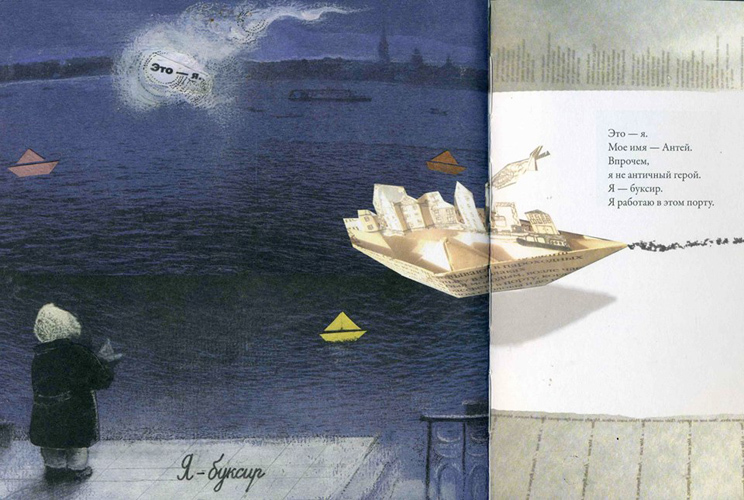
“... floats. Where can we swim? "
A.S. Pushkin
Ilya Kabakov as the son of the Soviet underground and the father of Russian conceptualism does not need a presentation. The further, the less. A rare contemporary artist is represented so abundantly in all institutions, at all events. For a long time emigrating Kabakov for many years did not sound in his homeland, preferring to conquer the world arena. Its business card is a long -classic motive for the Soviet communal apartment for a long time. Everyone remembers wonderful characters (“Pushing Primakov”, etc.) and witty texts. His famous work was the “Red Wagon”, on which, in fact, he entered the world art scene, occupying the entire Russian pavilion of the Venetian Biennale in 1993. In recent years, Kabakov has been paired with his wife Emilia. Together they began to actively occupy all Russian art space. The genre of total installation turned out to be self -reproducing.
The new Kabakov project, presented this year in Moscow, is called the "ship of tolerance." His presentation was accompanied by a loud scandal on the discussion as part of another exhibition-John Baldessari in the Garage, during which one of the quiet classics of Russian unofficial painting Yuri Zlotnikov convicted Kabakov in distorting facts regarding art education, which they received together in the 50s. With tolerance at that discussion , it was not very good . And what about the ship?
Actually, the Kabakov "ship of tolerance" has been swimming around the world for a long time. Its idea is as follows: a living ship is built, and sails are made from children's drawings. Children draw pictures and give adults advice on tolerance. The tips are then collected and transferred to a specially organized fund and politicians. So the authors intend to increase the level of tolerance in the world. At each presentation of the project in each country, we are explained that we have a new word in a synthesis of life with art and that, it turns out, tolerance begins with children. With this thought (supported by appropriate funds and grants), the authors of the project went several years ago to the Berber tribe in the oasis of Siva. The audience of the 52nd Venice Biennale, along with the Ship, was then shown the roller with respected authors, which was a European-posing against the backdrop of Berberian exotic, and also told how Berberian children first learned from artists that their peers in other countries live differently. Then a similar operation was carried out in one of the Venetian schools (the authors easily abandoned the original plan to bring Berber children to Venice, why it would be clear later). Here, in fact, is the whole project.
With all due respect to Ilya Kabakov as an original conceptualist, the originality of his projects, unfortunately, has to be questioned more and more often. In the fall of 2008, Moscow showed the largest retrospective Ilya and Emilia Kabakov. The exposition was demonstrated immediately on three sites: Pushkin’s Pushkin MiMI , the Center for Contemporary Art “Vinzavod” and the Center for Modern Culture “Garage”. “No goal,” Muscovites joked when the Kabakovs put their installation “gate” in the Pushkin Museum. Place the thing in another context - and it will read differently. This reception, in fact, lay down one of the stones in the foundation of all contemporary art as such. But now we are not just about art.
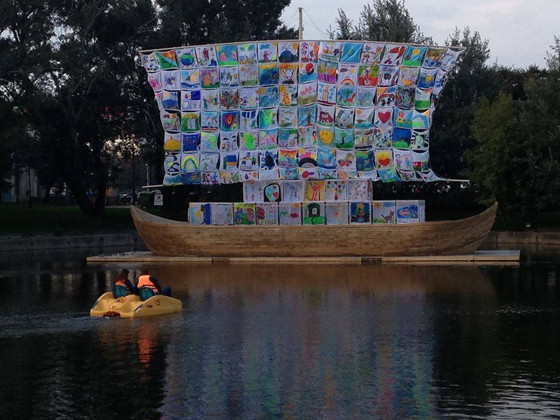 © Anna Shvets "Ship of Tolerance" in Moscow
Do not know that there were dozens of projects like the Kabakovs like the “ship of tolerance” - simply not in contemporary art, but somewhat in another field - it is possible only if it is at all that the human component of such art is not at all interested in. Alas, in modern Russian reality it is customary to call this sphere a squeamish-prostrate euphemism “Social”-social bread, social housing. Human relationships, children, old people remain in the shadow of such a “great art” that is visually only in the sense that it is aimed at creating visibility. After all, the project must be submitted and sold. And the “ship of tolerance” is quite drawn to the UN and UNESCO level. And his budgets are rather big. You can discuss what this work has to do with art, but in any case, less. Dozens of children from different countries served as an excellent and attractive material for creating a work of contemporary art, a “human face” with their own signature. Neither in any booklet, nor on any label or banner in any country, I did not find a list of surnames of children participating-essentially the main authors. I do not think that artists themselves will be able to recall the names or faces of those children who worked on their project. It is unlikely that they even met. I asked this question in 2007 at a press conference of the 52nd Venetian Biennale. The answer was exhaustive. ““ Foneteen ”is engaged in a social aspect,” said Emilia. - And we are artists! ” It seems that the artist’s personal responsibility in the current century is more convenient to forget. For what? There is a "fountain". And it’s easy to please children. Both Venetian and Berber. They probably painted with enthusiasm. In addition, they distributed pots with sprouts and the inscription "seeds of tolerance." The pots probably cost cheaper than two dinnery din on VIP Person, arranged in the Bauer Venice Hotel. For some reason, children-authors were not invited there.
The question is why Russian artists sail to the Berber, and from there it is probably indecent and unreasonable in all the Biennale of the world. But today the ship sailed to Moscow. And here, on their native soil - more precisely, in domestic territorial waters in the culture park - there is an obvious, probably, even for the tavern themselves, the gap between the declaration and reality. If it was a question of helping children, then the authors did not come across, for example, Galego’s book “White on black” or they didn’t know how many abandoned children and dysfunctional families with completely not tolerant, but a very cruel attitude to children are scattered in the open spaces of the post -Soviet space, on which all the taverns grew? As you know, Kabakov did not live in a communal apartment. Nobody requires this from the artist. Another thing is curious: where does this professional pathos come from in ironic Moscow conceptualism?
This was noticed by many. In his blog, the St. Petersburg artist and curator Dmitry Pilikin ironically called Kabakov “Art-Solzhenitsyn” and asked when he would go by train in Russian cities and towns to teach people (“Train train”-what is not a project?).
Moscow conceptualism has grown and blossomed at the manure of Soviet reality (communal apartment, housing and housing cooperative, agitlakat). But this reality has gone. Became a historical fact. Lost relevance. That manure is generally over. (The production of the current is a separate conversation.) And it turned out that art, which abandoned the possibility of direct statement, deprived itself of the prospect of growth. To process manure is by no means the same as with the help of chlorophyll to synthesize living matter from the light. And some conceptual artists, having already discovered this amazing fact in advanced age, begin to preach the most basic (and, of course, banal) human truths with the fervor of neophytes, from which Ironically turned away ironically. This mechanism is understandable: then in their teeth the high words of Soviet demagogy were obsessed in their teeth. But the choice turned out to be short -sighted. The Soviet Union collapsed, the inflation of concepts went the other way, and the conceptualists remained at a dead end: without a language in which one could adequately talk about their own values. “We were Mowgli,” Ilya Kabakov said in that discussion with Baldessari Bald. In science, real cases are described by Mowgli, Romuli and remov. Neurolinguistics and psychology teach us that if the child does not form speech skills until a certain age, then it is impossible to compensate for this.
“Tolerance is such a big word. It is a little foreign and scares a little, but it is very simple. This is when people simply respect that someone else is different, ” emphasizes the director of the multimedia art museum Olga Sviblova, who at the last moment last year de facto refused the“ Give Life ”fund to hold the exhibition of the works of cancer patients; These exhibitions have been held for many years at the largest Moscow venues (Pushkin’s MiMI named after Pushkin, the State Tretyakov Gallery). I just promised, and then stopped picked up. The creativity of seriously ill children did not fall into the list of priorities. Then, thanks to Vasily Tsereteli, the exhibition “Apparently-invisible” took place on time-at the Moscow Museum of Contemporary Art on Gogolevsky Boulevard . That's where I would like to invite the Kabakovovs. They should have been there. Total installation as a fact of life - when every day on the account, when art and life are inextricable, when each line is a feat, when life is happening behind the hospital windows and in the aquariums of boxing. Each time, such an exhibition is a holiday. Children's creativity as miracles, as a path to healing. All apples, all golden balls.
And here are the photos shot on the tasks of Judekka Islands in Venice. This is how the Venetian version of the Kabakovsky “Tolerance ship” a few months after that Biennale of 2007, when the fanfares died down, the fees were paid, the press conferences were completed, and the interviews were born.
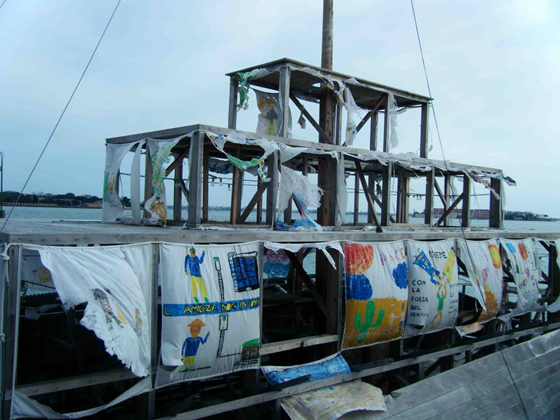 © Ekaterina Margolis "Ship of Tolerance" in Venice
I have not been there for a long time. Probably now he is not at all. No one took care of maintaining children's work, and, alas, this is not surprising. Again, the plots, press conferences, interviews, Gorky Park ... This year, while homophobic laws were adopted in the Duma, and girls and boys were pounding at the Duma, not in schools, but in the center of modern culture “garage” were held “tolerance lessons”. About the creative component of the silence - in the end, Ilya Kabakov is already a middle -aged person, can afford to repeat to infinity.
But it is impossible to be silent about children. So far personally, my tolerance does not extend. It may seem that these are trifles (you think - children's drawings!), But living children and children's drawing cannot be a bargaining trifle at the vanity fair that you can’t even name modern art. “Ship of tolerance” with sails from anonymous children's drawings, firmly moored on one of the Venetian embankments. None of the swimming. Standing on pontoons (or on showers?). Not pure art, but not a social project. With an almost immoral budget. Mounted from a cliche set (“children”, “tolerance”, etc.), with a vague purpose and a slurred concept. It is not clear even who is the subject and who is the object. Who teaches tolerance? Either the children of adult politicians with their drawings - but anyone who was at least a little interested in child psychology or dealt with children, knows very well that tolerance is not an innate childhood property at all. On the contrary, if it is not brought up, children can often be very cruel and intolerant of peers - we recall the “scarecrow” or “lord of flies”. The current government, by the way, actively exploits precisely this child-teenage feature, continuing the historical fascist tradition: all “self-organized” associations of young nationalists, homophobic gangs that lure the victims into apartments and filming video, “spontaneous” attacks on migrants, etc. - All this is most often done by the hands of almost schoolchildren . If, on the contrary, adults decided to teach children tolerance, then in this case it is not clear why to hide behind children's drawings and tips. It is no coincidence that the authors of the project did not manage to answer the question of the role of a child-author in the project, as well as the role of an adult as an interpreter. Tolerance is a horizontal concept. Russian society is historically tolerant, but in a completely different dimension. Russian tolerance is a vertical phenomenon: this is tolerance in relation to power at all levels, in relation to the fact that it creates a stronger and highest hierarchy. Often paradoxical tolerance for the "grandfather", to lawlessness and violence not only from witnesses, but also direct participants and victims of injustice. But it seems that such subtleties of the domestic world order are not very interested in artists.
If we talk about the social aspect, then the authors of the first Berber project intended to put money from advertising to teach Berber children in Europe and America. But even here a lot of questions arise: whether children and entire families will suffer from the Eurocentricity of such a missionary approach in the spirit of past centuries, which a civilized white person can recall only with shame and shudder. Maybe Berber children need a program for supporting a language, a traditional lifestyle or, say, water supply?
At each presentation of the project in each country, we are explained that we have a new word in a synthesis of life with art and that, it turns out, tolerance begins with children.
In the same Kabakovs are right. The ship is really a symbol is much more childish and durable than a car or even a plane. And while in the city of living ships on the water, a stillborn art core of tolerance rotted, parishioners of one of the Venetian churches collected money. What? To buy a cow in one African village (isn't it Berber?), Where the son of parishioners went and told how the children without milk are in poverty. They raised so much money that two cows were able to buy. “And now we will have to collect for a stable,” the rector announced cheerfully on the next Sunday on the sermon. Every year, Belarusian children from one of the villages near Gomel are collected every year-a zone, still known for its sad medical statistics. To pay them the way, insurance, to accept in their families - without pump and noise, without funds and newspapers. Every summer, Belarusian children live in Venetian families, play with peers who do not interfere with the fact that their friends do not speak Italian. Venetian gondoliers ride them for free on gondolas around the city (and the standard fee for half an hour of such a boat walk is 70 euros). And everything is just like that. Stupid! After all, another art project could turn out: “Hondola of hospitality”-and straight on the biennal.
Paper boats also sailed. Children from Venetian schools arranged a fair of assistance to their peers from the cancer departments of the Russian Children's Clinical Hospital - they made crafts from beads of Muranian glass, gave their pocket money. In response, small patients of Moscow clinics began to fold boats of paper on which they wrote their desires (like famous Japanese craftsmen) and wishes to Venetian children, and those, having received messages, release boats on their native channels and, in turn, send photos back to the hospital to Russia. After all, many sick children for months do not leave the sterile chambers, and they want to communicate and travel from this no less. “The boat is floating, floating. The boat is gold. Lucky, lucky. Gifts to us with you ... "
Since then, boats sailed and turned into a book - “Ballad of a small tug” of Joseph Brodsky with drawings of children treated from cancer in RDKB and in other hospitals . At the presentation in the Fountain House (Akhmatova Museum in St. Petersburg), each buyer of the book received an author’s boat, transmitted from one of the patients of the oncologists, which he then launched in his city - in the river, in a stream, in the ocean. And again, he sent a photograph to the author of the boat to the hospital.
Well, to the “ship of tolerance”, I would probably not have to remember the old, if I did not accidentally see the news about the “Ship of Tolerance” in Moscow in my Frend Lent. Kabakov can be treated differently, and you can’t cancel past merits. But there are things that, alas, not to justify. After all, old age is Rome that.
Once, when Emilia was not an artist yet, Ilya Kabakov, like many of his associates on conceptualism, being virtually banned, illustrated children's books (a niche, at that time similar to translated for writers). Not from a good life, but from the Soviet regime. It seems that this is the rare case when she can be almost grateful. Kabakov, like Viktor Pivovarov, “co -founder” of conceptualism, we owe a masterpiece of book illustration. However, leaving the empty post -Soviet artistic space, they went in different ways. Someone remained his adherent in pure form. This is art, made in Russia is still in demand. It is no coincidence that Russia has already represented two Venetian Biennale in a row precisely Moscow conceptualists, moreover (in 2011-monastic and “collective actions”, in 2013-Zakharov). Pivovarov decided to melt his experience in the children's illustrator into something more. “In the modern world, there are at least three independent cultures: tall, mass and children's. We will leave the massive. Children's culture is an boundless universe of books, magazines, films, theatrical performances, countless funny characters, comics, toys, games. This is a universe that many times exceeding a high culture. Тем не менее высокая культура детскую не замечает, не считает ее за культуру», — пишет он в одной из своих книг (Пивоваров В. Влюбленный агент. — М.: НЛО, 2001). Пивоваров смело заходит через дверь внутреннего содержания, как и подобает художнику. Кабаков, увы, пробирается с черного хода, со стороны конъюнктуры. Не потому ли творческая (именно творческая, а не публичная) биография Пивоварова сложилась иначе, чем кабаковская? Что ж до корабля толерантности — жаль, что Кабаков просто не вспомнил одну из прекрасно проиллюстрированных им же детских книжек (Ю. Кушак. Плывет кораблик в гости. — М.: Малыш, 1979).
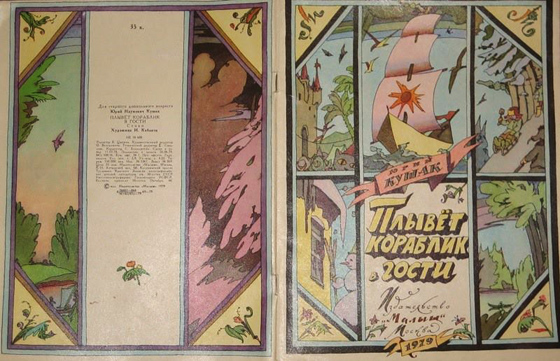 Книга «Плывет кораблик в гости», 1979, с иллюстрациями Ильи Кабакова
Нет смысла пускаться в длинный экскурс о влиянии детского рисунка (и отдельно — эстетики детства, в том числе детской иллюстрации) на искусство XX века и на современное искусство. Детский мир — это та гавань, в которой надеется причалить и корабль Кабаков. Но Кабаковы не заметили другого. Время безликой гигантомании прошло. В сегодняшнем мире у детей есть права, имена и лица. И мне искренне кажется, что маленький кораблик из бумаги, сделанный конкретным ребенком и бережно выпущенный на поверхность венецианского канала или маленькой речушки в российской глубинке, куда красивее и ближе к детскому и просто к человеческому миру, чем недвижимый корабль абстрактной толерантности. Что ж до художественной концепции — думаю, она очевидна.