
Translated material
To do otherwise
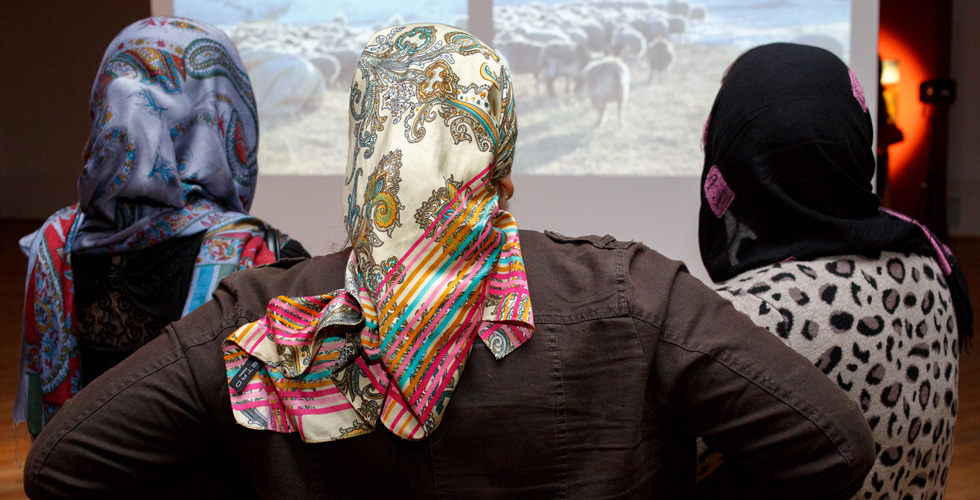
On October 4, in the exhibition hall of the Union of Artists of the Republic of Dagestan, with the financial and organizational support of the Peri charitable foundation, the Taus Makhacheva exhibition “History requires continuation”. The artist, whose fame extends far beyond not only Makhachkala, but also Russia, decided to return home in order not so much to engage in her career as to develop cultural life in Dagestan.
After a trip to Dagestan, friends tell me: "Stop talking about Dagestan." I can understand them, but I understand myself. An excess of impressions, of course, is felt. Actually, this is what was originally embarrassing in the work of Taus Makhacheva - what I wrote about in the texts about her work, about which I polemicized with her and other artists and critics.
Many artists - and not only artists - turn to the fact that they are close and understandable. There is nothing surprising in this, it is rather surprising when you see the opposite - the tortured constructions collected from the fragments of someone else's experience, or even just speculation on common topics, which Yegor Koshelev spoke out not so long ago. But this personal experience, when it is firmly attached to a certain, very specific cultural identity, is fraught with hitting a trap.
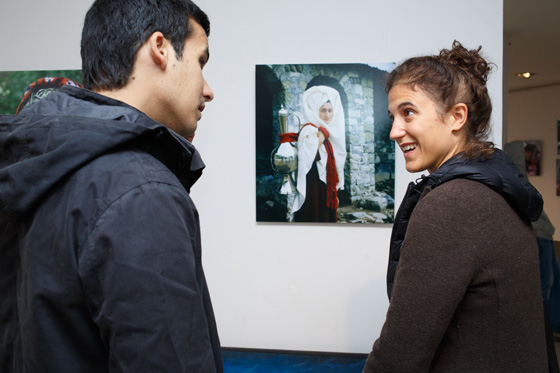 © Nikita Shokhov in the "First Gallery", Caspian. Photo provided by the Foundation "Peri"
As for the artists from those regions that are considered “very specific” up to the stilt of “inexplicability”, it is this view of exotic views from the outside and the accompanying it - on the other hand - the podging of their own unique culture make their works extremely problematic. The texture of extraordinary especially fascinates - and not so much the viewer as the artist, and such an “ethnography” can play a cruel joke with the author. Of all these amazing details and details, it is difficult to get out - with such force they magnetize perception and suspend the minimum effort to comprehend them, and not just capture. One has only to see the ranks of photographs of Dagestan authors in the “First Gallery” in Kaspiysk - with the most beautiful views of the mountains, with a unique architecture of the auls, with penetrated faces - how you feel it. For photographers, probably, there is no too insoluble problem in this, they have other tasks, in any case, if we are talking about documentary series - ethnography is to the place. Therefore, there are no complaints about these photographers. But for contemporary art, this is a clear risk, if not a threat. Actually, from here, for example, conversations about the operation of cultural stereotypes come from. Taus ran into both the texture and with claims close: what to do next?
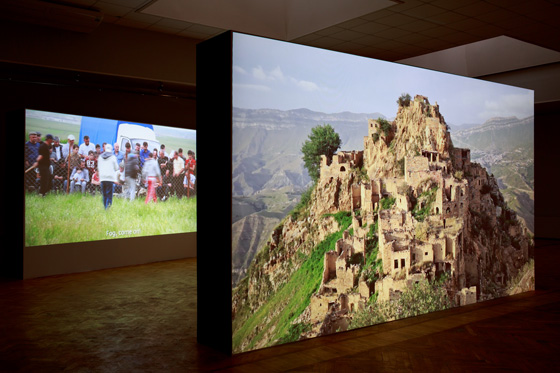 © Nikita Shokhov Type of the Exposure: In the foreground “Gamsutl” (2012), in the background “Let me be part of the narrative” (2012). Photo provided by the Foundation "Peri"
As I already wrote about six months ago in connection with Biennale in Sharje, in which Taus Makhacheva participated with several works, the artist found a way out of the situation, sharply changing both the tonality and the orientation of her works. She either removed or brought to the minimum, almost conditional presence of the figure of cultural uniqueness - in any case, she is not in the “center” of new works; I turned to issues significant and painful not only for Dagestan, but for the rest of the world. Video Gamsutl (2012), where, at first glance, it beats the next “local” plot, has become the turning point behind which a large art story begins, therefore, in Sharje it looked so appropriate and organically in conjunction with the simultaneously documentary and phantasmagoric works of the Lebanese artist Lamia Zhrayizh or the Belgian Belgian Francis. Alusa, in which all local, private stories gain global or even universal significance. “Gamsutl” is not just a story that captures the echoes, alas, of the numerous Caucasian wars of the XIX, XX and XXI centuries, not just an analytical portrait to the limit of ritualized places of militaristic visuality. The empty fortress-Aul, reproducing the gestures of the soldier from the paintings by Franz Rubo and the actor interacting with the ruins, the quiet, unhurried flow of the film break our usual perception of the very Caucasus, about which we have something to say in advance, although we do not know anything about him.
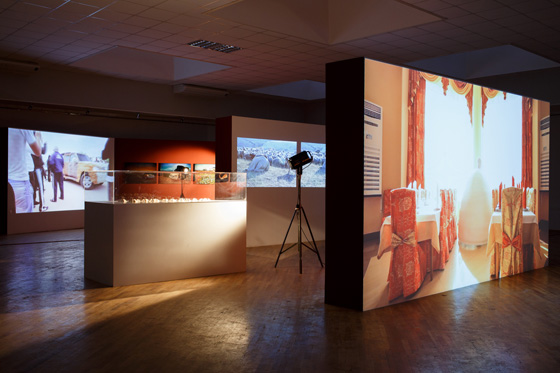 © Nikita Shokhov Type of the Exposure, in the foreground “The space of the celebration” (2013). Photo provided by the Foundation "Peri"
The work of the TAUS, the video “The space of the celebration”, continues this line. Here we see the interiors of banquet halls where traditional Dagestan weddings are held, but there are no all those rites and costumes, the groom/groom/groom/guests that I had to see in photo projects about marriage in other cultures, such as Fahriyi Mammadova in the Azerbaijani pavilion in the current Venice Biennale. Empty halls, frozen in anticipation of celebrations, in Makhacheva’s video are visited only by coconut figures, apparently born from the image of the bride, but receiving a new sound. These are also images of fertility - which is expected - reminiscent of “round” or neighboring Madonnas from Potosi in Bolivia (for example, such ), images of not touching awkwardness, but constraint and loss in the Masculine, patriarchal society of Dagestan.
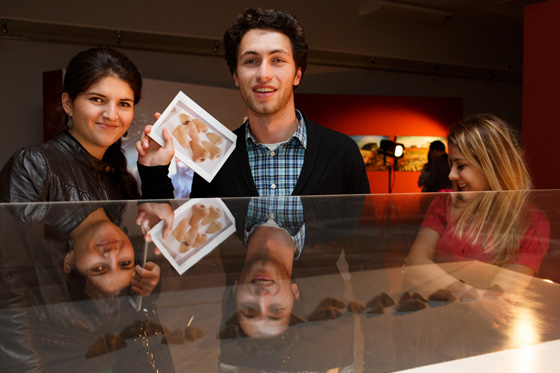 © Nikita Shokhov Photo provided by the Foundation "Peri"
Actually, about this masculinity in the ironic and at the same time referring to the mythological iconography of the key - the project "Landscape". Wooden layouts in the form of “Caucasian” noses, considered a sign of masculinity, lined up like a mountain ridge. It’s funny how the audience reacted to this work - discussed which of the models look like their own noses. In general, the actions of numerous spectators, whom the artist entrusted to the exhibition, hiring the market invocated, screaming “Exhibition, exhibition!”, Are very interesting. Despite the large number of artists in Dagestan, many of whom are engaged in video (for example, Murad Khalilov or Musai Gayvoronsky), video installations are not the most familiar way to demonstrate art for local institutions. Therefore, one of the first reactions is to dance in the rays of the projector, which was done by the children who were on the vernissage. It is characteristic that people associated with art quickly parted in the corners, while the wide audience, unprofessional spectators gathered inside the exposition. And this was the first big victory, the second one was that the Makhachev Taus and the curator of the exhibition Alexei Maslyaev, working with the hall resembling a mini-CDH (it also hold exhibitions like “gold of Russia”) and therefore decided to leave a fairly free space for a thoughtful perception of art. Unfortunately (in Moscow, this is clearly visible), when they give a large room to domestic curators, they try to completely use it, if not to say it, as if they are persistently demanding that they, remember a small room adjacent to the exhibition hall in the GTSIA, which, probably, could never simply close it, it was necessary to do something with it, and often not quite successfully. Makhachev and Maslyaev risked being accused of creating a “semi -empty” exhibition, but it turned out that it worked for them. Somewhat falsehood lined up in a row in the form of a traditional pattern on Dagestan carpets. The work itself was compiled quite tightly in relation to each other, but around - darkened voids, creating not a conflict between the exhibition hall and the works of the TAUS, but a kind of air and spatial tanks that allowed the audience to “breathe” in a dense atmosphere of art.
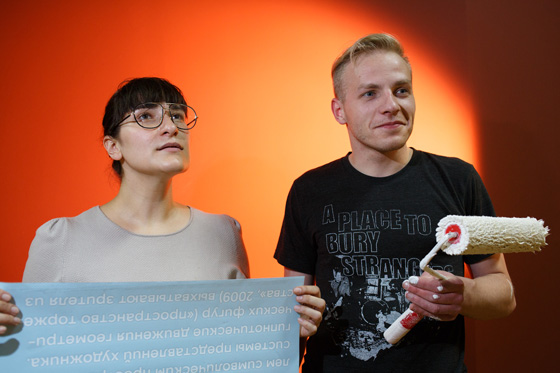 © Nikita Shokhov Taus Makhacheva and Alexey Maslyaev. Photo provided by the Foundation "Peri"
The exposition also includes early work: a project about dog battles (“Let me be part of the narrative, 2012), video about races on a jeep, tuned with furs (“ Fast and Frantic ”, 2011), Photographs of the traditional pattern of henna to the artist’s face (“ Distribution ”, 2011), video about wrapping in Dagestan carpet-kilim ("Carpet", 2006) and others. And although there is no special stop on them, they are necessary to see the work of Taus Makhacheva in development, after all, it is a retrospective, which allows you to fix the gradual change of optics, which I mentioned above.
An important point that was not yet really spoke of the TAUS itself is that in her plans - the creation of a school of contemporary art. So far, still in the process of development, possibly at the level of dreams. I could joke that I am writing about it here so that she would not change his mind, but the Taus clearly does not change his mind. The artist is very serious. Given the number of existing artists and exhibition spaces, as well as how the Makhachkala and Kaspiysk grow quickly - and there is a permanent influx of new residents in the cities of Dagestan - and how much these re -forming communities need to increase and modernize cultural feeding, as the director of the history of the history of Makhachkala Dadaeva, which was directly encountered with this, informed us. With the art-school-one of those bricks that could be needed in the construction of the new cultural environment of Dagestan, the region whose inhabitants so painfully feel their loss from the all-Russian socio-cultural context due to the same conflicts in the North Caucasus and the mass-media hysteria on terrorism and migration (many specially talked about it). In a society that is still largely aimed at veneration of traditions and the past (it is enough to recall the universal reverence for the figure of the poet Rasul Gamzatov, grandfathers Taus Makhacheva), they perfectly understand that update is necessary, that it is necessary to correspond to the present, and not hide from it in their specificity.
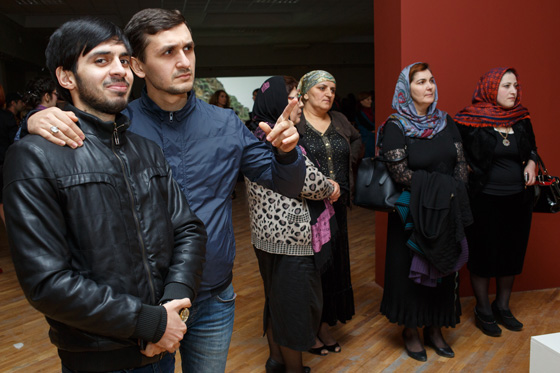 © Nikita Shokhov spectators. Photo provided by the Foundation "Peri"
In one of the recent works of Makhacheva, the “object of the object” is three historically loaded artifact (a solo with horns, a wedding bracelet and a copy of the picture of Vasnetsov “Gamayun, a bird of prophet”) were turned into puppets. Between them, a dialogue occurs - this is a real puppet performance. And although the play is somewhat schematic, the main thing in it is the opportunity to speak from different positions, being dissimilar to each other, to discuss what all concerns us. In Dagestan there are many nationalities, languages and dialects, the same in Russia as a whole. We can restrain each other, for this a lot of mind is not necessary, but we can do otherwise, more reasonable - sorry for the banality. Everything now depends on the personal choice of each person. Taus did it, having moved after studying in London not to “prestigious” Moscow, but to Makhachkala. This is not a return to the origins, but the desire for something new, judging by its activity.
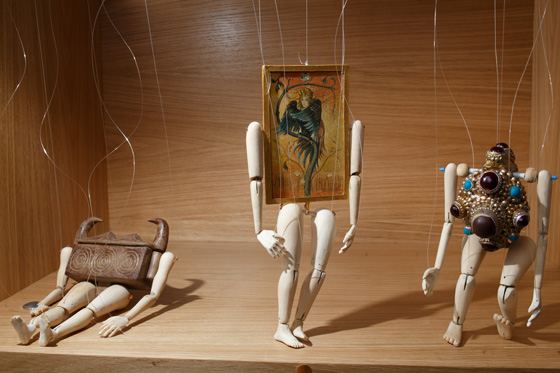 © Nikita Shokhov “The Way of the Object” (2013), fragment. Photo provided by the Foundation "Peri"
All this is especially important in the situation that has prevailed at the moment in Moscow, which has long come off the rest of the country, which is felt not only in Dagestan, but, for example, in the Volga region or in the Urals, not to mention the Far East. Recent events in Biryulev and everything that followed them only confirm this fact. Many in Moscow would like to separate from the rest of the country, apparently not understanding that such a desire is contrary to the material relations in which the capital is included. One cannot but rejoice that the Russian regions, despite numerous difficulties, begin to develop in their own way, to live their own life. This is a complex process, but it, in any case, is more productive than the general vertical centralization. Fortunately, the network structure of exhibition sites or imported projects brought from the capital turned out to be stillborn, and with which pomp was declared, for example, about the same houses of the new culture . It is characteristic that the branches of the GCSI, despite the structure, tied to Moscow, are more likely to move centrifly, begin to slowly but surely work with what they have under subordinate territory, and not with the capital's context far from them. On the ground, various independent initiatives arise or receive a new impulse for development: the Voronezh Center for Contemporary Art is one of these. An example of the “first gallery” in Kaspiysk, which arose in the late 1990s (I must say, with the support of Moscow gallery, for which many thanks to them) shows that the seemingly excessive spaces suddenly form a powerful seething around themselves, the results of which are difficult to predict. In this situation, the idea of Taus Makhacheva is not just consistent with the tendency, but is able to give this movement of strength. Strong and whole - in a political, economic or cultural sense - there can be only the country where the regions are developing freely, otherwise we will observe only an increasingly growing conflict, the first signs of which the inhabitants of Russia feel over the past years. At some point, this conflict can become insoluble and lead to the collapse of the country, but do we want such a scenario?