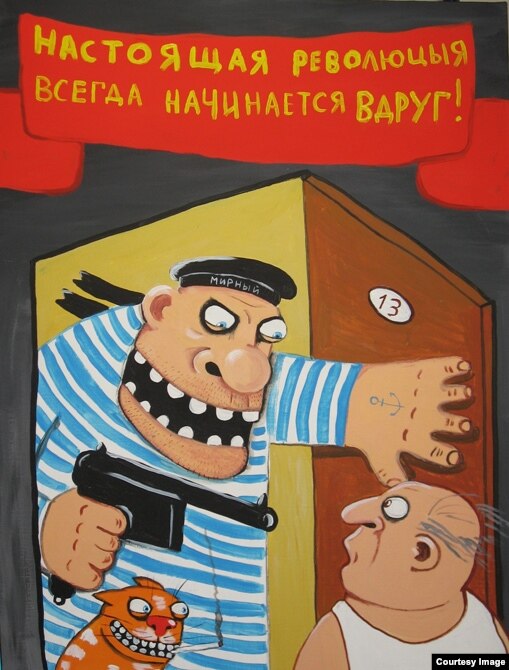
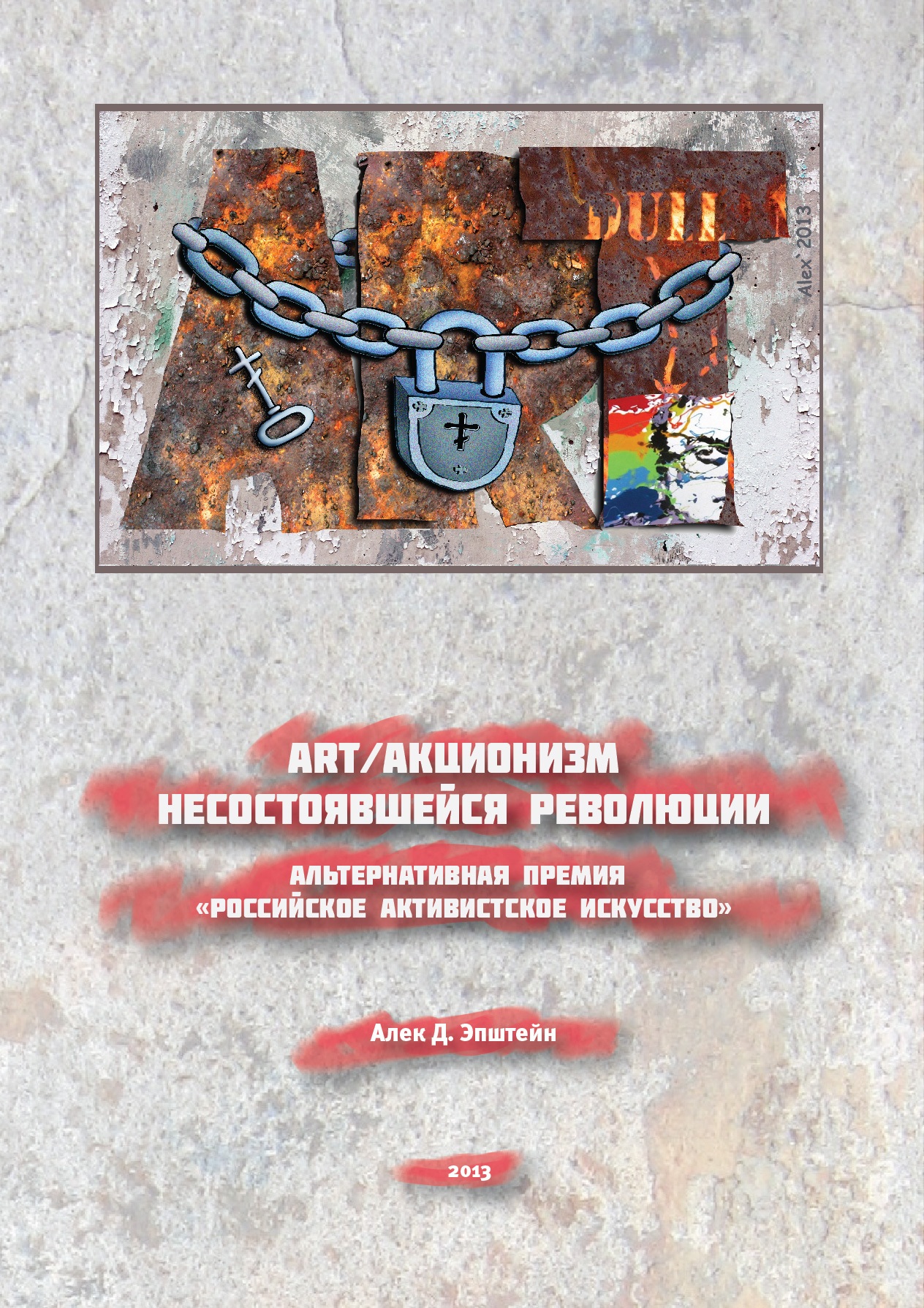
Fragment of Vasya Lozhkin's drawing "Real Revolutiony"
The art of the failed revolution
In Moscow, at the International Festival of Activist Arts , the Media Junior was a presentation of the book "The Art of the failed revolution." Its author, sociologist and historian Alec Epstein answered the questions of the RS.
-Alec, you are the author of books about the art group "War", aboutPussy Riot, about the exhibition "Spiritual Branch", and your new book is also devoted to relevant artists who do not like the Russian authorities. Please tell us about her heroes.
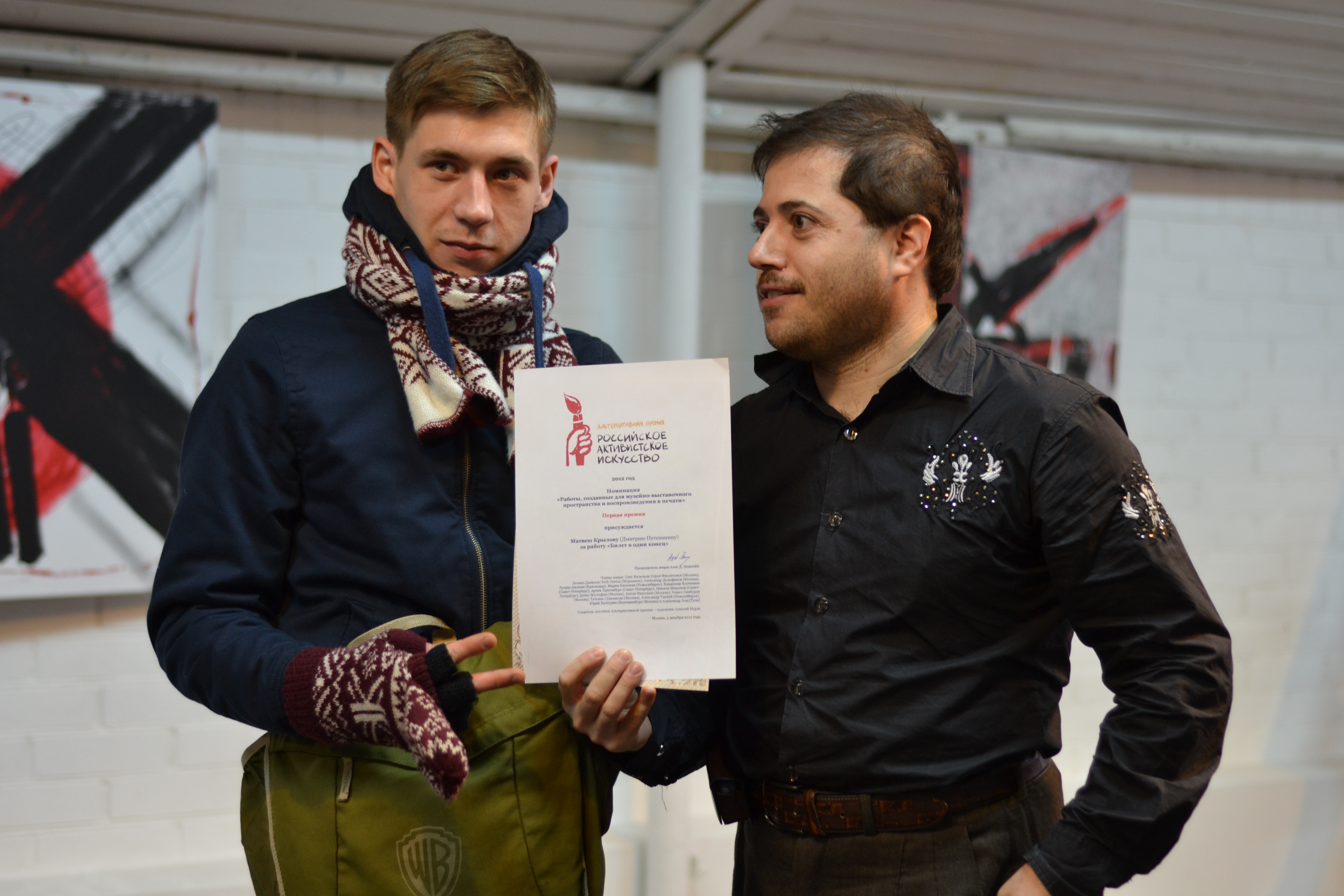
- The further you work, the more you feel like a marginal. In this sense, it seems to me that not so much I or the artists that I write about how much the environment has changed. If a couple of years ago the war group “Innovation” of the State Center for Contemporary Art, the Pussy Riot, could not only receive a prison term, but were also excluded even from among the nominees of the Kandinsky Prize, and nothing but our alternative prize “Russian activist art” was received last year; Both of these awards are awarded by activists, that is, the community of those who themselves work in this field and are in no way connected with state or any Artist Matvey Krylov and Alec Epstein Ocal institutions. It is impossible to arrange any activist civilian exhibition, except, perhaps, the Zverevsky Center for Contemporary Art, for which many thanks to its director Alexei Sosna, who does everything that he does on his own enthusiasm. The uniqueness of the festival "Media -Judicon", within which our evening was held, is this - it is more impossible to spend this kind of evening in Moscow anywhere, in any museum, nor in any gallery. From the exhibition "Spiritual Branch" Evgenia Maltseva and Viktor Bondarenko, about which I made my previous book , it has passed a year, and during this time only one of the works presented on it was included in Marat Helmann in his curatorial project ICONS , which was first torn on a single site in St. Petersburg, then with great difficulty was organized in another, and no longer of the work for the work for any of the works for the work for The year has not been exhibited. The non-conformist art of today's day is squeezed out into the street, as it was in the 1970s. As a result, exhibitions and performances take place where they are least waiting for them: on the streets, at the buildings of the authorities, on bridges, in underground crossings ... We remember the "bus exhibition" in support of Pussy Riot , when the activists took off the bus that made a circle on the garden ring in March last year, because not a single gallery (and, of course, not a single museum) to accept such a museum) The exhibition did not agree ... And Peter Pavlensky, whose performance was held on the asphalt , was the laureate of the first award of this year, at the steps of the Legislative Assembly of St. Petersburg: a completely naked person in barbed wire symbolized the powerlessness of today's citizen in front of the legislative machine, which stamps any legal acts initiated by the authorities, no matter how repressive nature they were.
- Will you try to predict the future of protest art?
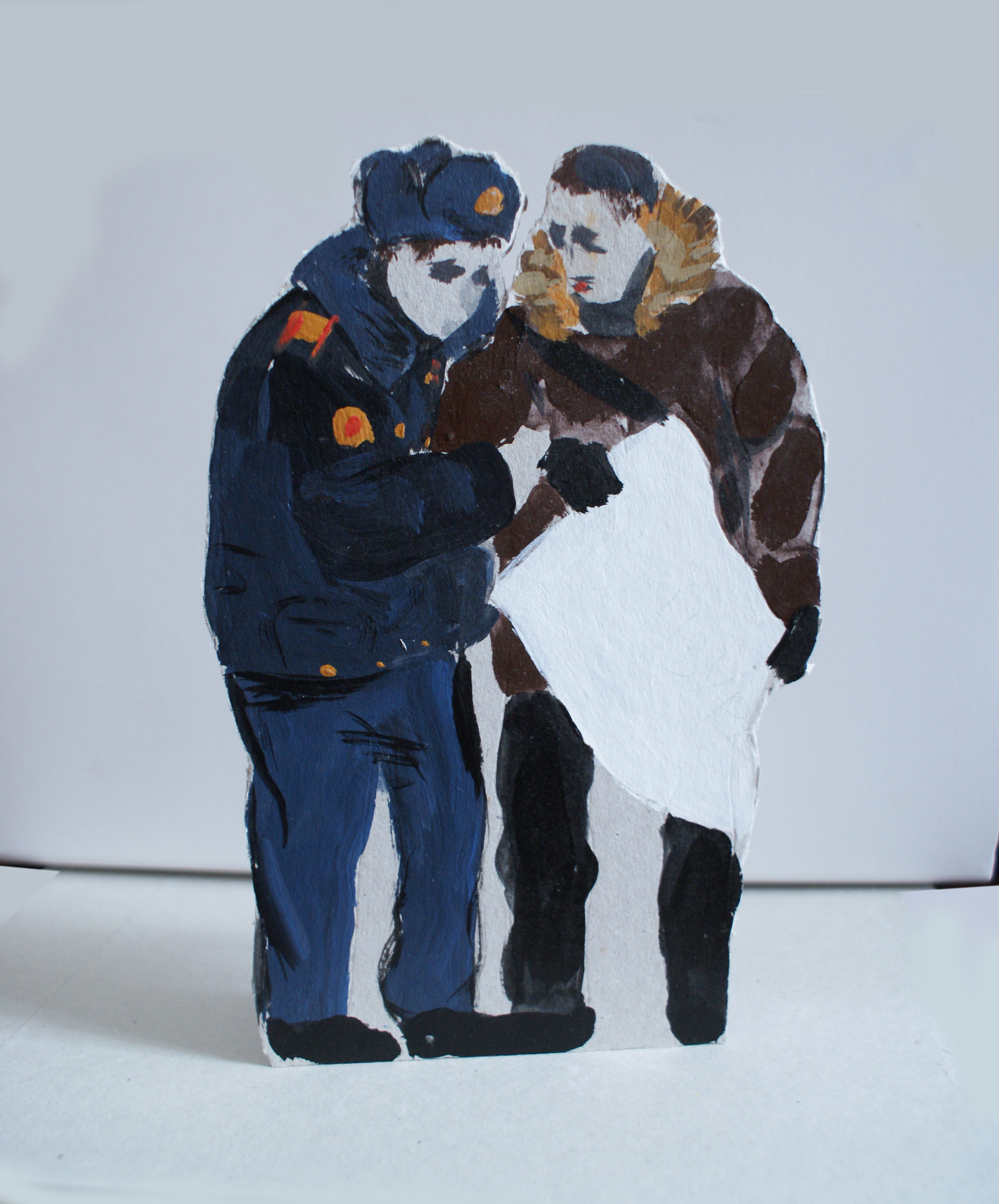
Lusine Dzhanyan, cardboard riot police arrests a cardboard protester, 2012- From my point of view, Russian protest art is currently at a crossroads, and the name of the brochure Dmitry Porchuri - “the art of the failed revolution” - is sensitively conveyed - sensitively conveys this. Since December 2011, when suddenly, after eighteen -year -olds, quite massive rallies on Bolotnaya Square, on Sakharov Avenue, had passed in Moscow, and there were quite a few further on these rallies - on December 5, December 10, on December 24, another in February, but after the rally on May 6, thirty participants of which still languished in prisons or are under trial, the vector has changed a lot. There was another mass rally on June 12, 2012, and in general, everything, further the repressive car clearly began to defeat a civil protest. And we see this both in the adopted legislative acts, and in the folding of protest activities, a very bright, visible symbol of which was the last meeting of the coordination council of the opposition, which did not collect the quorum, which they set to themselves, was not scheduled, and the date of new elections was not scheduled. Some of the activists fled abroad, including two of the quartet of the founders of the War, Oleg Vorotnikov and Natalya Sokol, an ecologist Suren Gazaryan from Krasnodar, anticleric activist Maxim Efimov from Petrozavodsk, LGBT activist Alexei Kiselev, who took an active part in the protest performans Anastasia Rybachenko, who was, which The investigating authorities are sought for active participation in the rally on May 6, and others. And we learn about new and new people who run almost every day; Just the other day, the political asylum in Lithuania was asked by Vsevolod Chernozub, who not so long ago was the co -chair of the Moscow "solidarity". And this situation, it seems to me, began with the arrest of the "War", when Oleg Vorotnikov and Leonid Nikolaev stayed under the arrest for 3.5 months, then with the arrest of Pussy Riot activists. Whatever the scale of protests in the world, whoever acts in defense by Nadia Tolokonnikova and Masha Alekhina, from Angel Merkel to Madonna and Paul McCartney, did not affect the regime.
Whatever we do, we can write books, hold promotions and performances in courts and in other places, the most influential people of modern politics and culture can defend the arrested girls, and this has been going on for a year and a half with a completely zero effect. And the horror is that now we see this with Arctic Sunrise , when 30 people languish behind bars on a completely inappropriate occasion, there are more than a month, until yesterday, they accused of piracy, although even Putin said that they are not pirates, and one of them is the photographer Denis Sinyakov, one of the photos of which from the Pussy Riot promotion in Red Square in January 2012 2012 The year was reproduced in my previous book "Art on Barricades." And again, whoever just got into their defense, and they are sitting in Murmansk in prison, and we are all powerless to help them. When I look at the list of laureates of alternative award Russian Activist Art, then, except for Pussy Riot , we had already settled our laureate Laureate Artem Loskutov from Novosibirsk in prison, our laureate of the first prize of Brother (Matvey Krylov) was in prison, and a number of people from nominees and applicants, participants in this circle are located On the run or in forced emigration. What will now be with Russian activist and state -owned art, from my point of view, is a very, very big question. Firstly, they have nowhere to exhibit them, and I have already said about this, the museum and exhibition space is closed to them. Secondly, the social movement, which, as it seemed in December 2011, is ready to support them, the self-destruction of the Coordinating Council of the opposition, whose elections were furnished as a big breakthrough, was an obvious indicator of this. And when activists are detained, and they find themselves in prisons or in the position of political residents, there is no one to support them - neither in the art community or among civilian activists. And I am afraid that the surge of Russian activist and state-owned art, which began with the “War” shares at the turn of 2007 and 2008, now, almost six years later, we have been completed, we are present almost during the sunset of Russian art activism and art-actionism, which is very, very sorry. This small book, the presentation of which was held today, I tried to pay attention to this problem ...
-The book market remains more or less free, but I know that you had difficulties with the publication of the book: publishers are afraid.
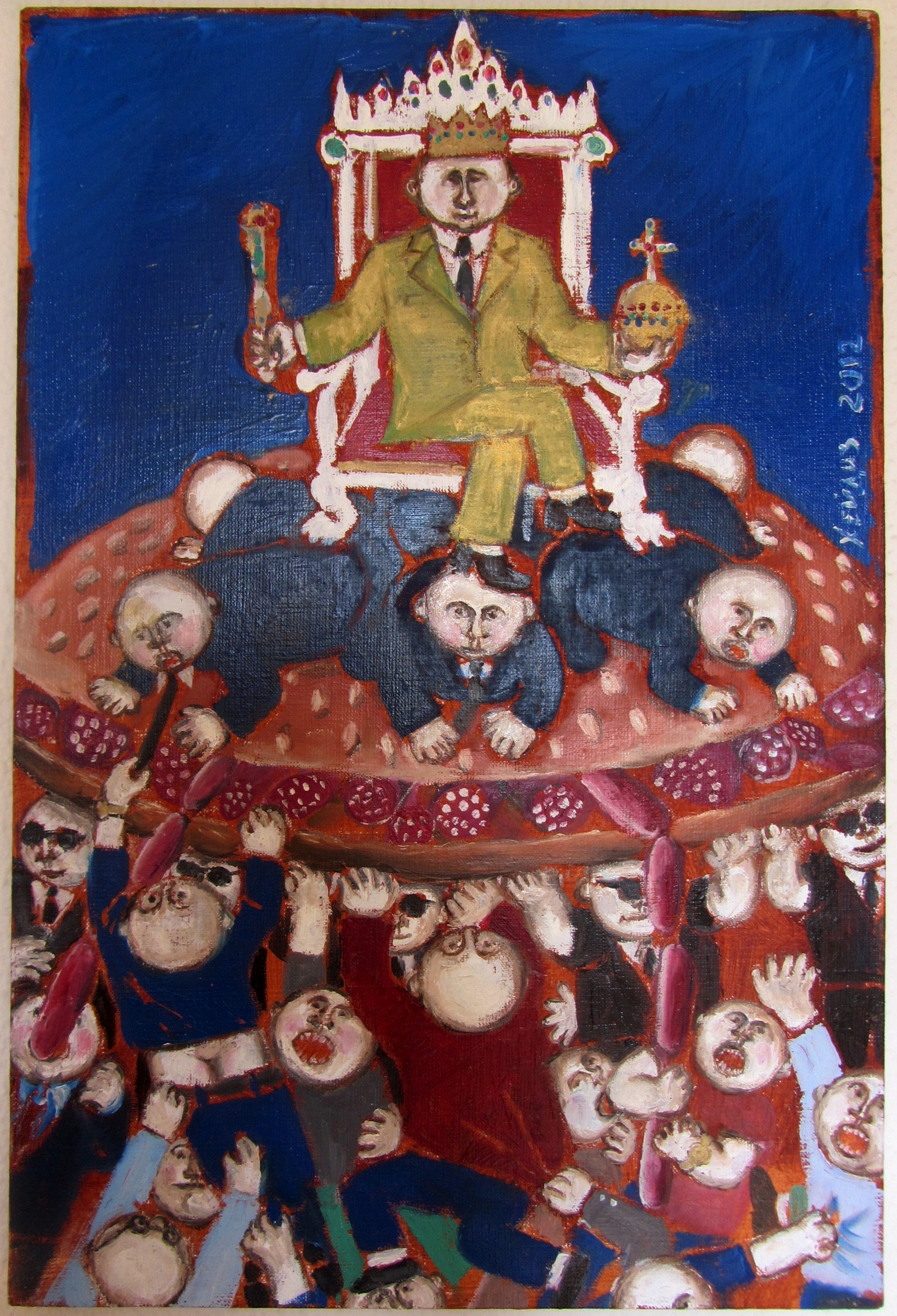
Lena Haydiz - everyone is striving for a throne (2012)- I published this small album completely with my own money. There was no structure that would be ready to speak in support of this project or at least somehow support it. If my book about the “War” group was released in the spring of 2012, even if the new publishing house, in the summer of the same year, managed to publish the album “ Art on the barricades ”, and then “Spiritual Branch”, now there was not a single structure that would be ready to provide any support or simply put its vulture, although the author I am quite famous, and the reproduced works are among the most striking works of modern activist art. It seems to me that this in itself says a lot about it. Today there is no cultural or publishing institution that would be ready to publicly somehow solidarize with civilian activist and state-owned art-they are more likely to run like from fire, and I do not see reasons for optimism here.
New activists appear, say, the same Petya Pavlensky, his performance, which I spoke about, this is his second performance, the first is an artist with a sewn mouth, which was also implemented in St. Petersburg, this was already after the arrest of Pussy Riot activists, this is a new “call”, this is not a man of “war of the war” of 2008. We see the work of people whom we had not seen before, for example, the remarkable installation of Philip of the Food "The Crying Virgin on the bridge", which was implemented by him in February this year on the Crimean bridge, opposite the Cathedral of Christ the Savior. We see the works of artists who are already present in this discourse for a while, sometimes quite a long time, like beautiful graphic artists Alexei Jorsh and Victoria Lomasco or the master of social art Lena Haydiz. At the same time, we see the complete defenselessness of the artists: for example, one of the most striking, in my opinion, artists of the young generation Lusine Dzhanyan recently, a few weeks ago, in the middle of the school year, they fired from work from the institute in Krasnodar, where she taught painting and skill of the costume, and none of us could provide her with any real institution, no other higher educational institution The place of work proposed Lusine Dzhanyan.
And this situation, when we are crushed, like flies, one by one, and we cannot find any place that would be ready to support us, it seems to me that this is very visibly indicated by the difficult situation in which modern Russian activist art is located. Again, let’s recall the famous, which sounded throughout the country of a series of works of the Krasnoyarsk artist Vasily Blondov, who was no longer accused of sacrilege regarding religious symbols, but of blasphemy, perhaps, a new symbol of the civil religion of Putin's Russia - the Olympic Games in Sochi. And for the series of 35 works by Vasily Ilekonov, the then director of the Perm Contemporary Art Center, Marat Gelman, was lost for a series of 35 works, the most famous modern Russian art buler; Once the dismissed governor of the Perm region, he did not turn out to be needed by any other institution, not one offered him a job. This resembles the story of the dismissal of Andrei Erofeev from the Tretyakov Gallery, and from the Sakharov Center Yuri Samodurov for organizing the exhibition "Forbidden Art", but when Yu. V. Samodurov was fired from the Sakharov Center, he was still offered a job at the State Center for Modern Art, even if not the director and not even the head of the department, but at least some workplace. Marat Helman was not offered anything, like Lusine Dzhanyan. И вот ситуация, при которой мы не в силах спасти наших арестованных активистов, при которой мы не в силах помочь нашим вынужденным политэмигрантам, при которой мы не в силах помочь тем, кого увольняют, при которой мы не можем организовать выставку активистского искусства нигде, и если мы хотим что-то делать, нам нужно устраивать перформансы на улицах и площадях или в подземных переходах, или снимать автобус, ситуация, In which we cannot publish the book anywhere, I repeat, I published this book simply with my own money from the first to the last penny - this situation, it seems to me, very clearly indicates that rollback in the field of cultural and public freedoms, which takes place in modern Russia. At the end of 2011, it seemed that the pendulum would “swing to the left” that a civilian public rise began, but today, after almost two years, we see that, swaying to the left, this pendulum was very, very much swayed to the right, and I'm afraid, for a very long time.