
Translated material
Private company SpaceX brought to orbit the first commercial satellite using the Falcon 9 rocket
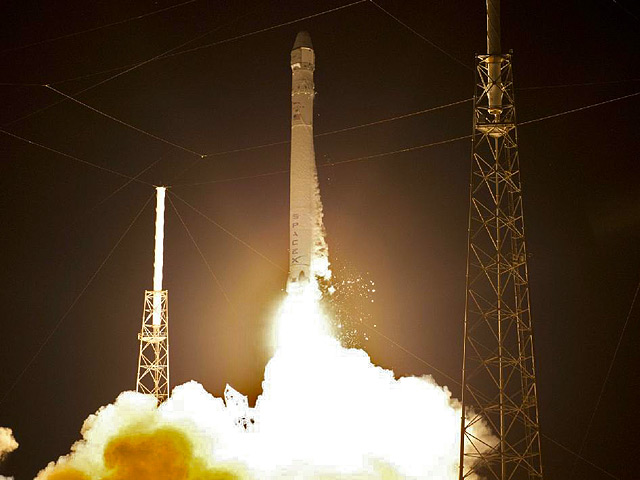
From the cosmodrome at Cape Canveral in Florida, on the third attempt, the Falcon 9 of the private company Spacex has been successfully launched. The SES 8 European satellite is displayed in orbit and has already begun to transmit a signal.
The start was made at 17:41 on the time of the east coast of the United States (02:41 Wednesday, December 4, Moscow time). SpaceX was going to carry out its first launch of a commercial satellite on November 25, but the start was postponed on November 28. Each time, the countdown of time was interrupted due to problems with the engine, and as a result, the experts decided to completely replace one of the nodes of a two-stage missile, the company's press service recalls.
The SES 8 telecommunications satellite of Orbital Sciences weighs 3.2 tons and is made for the SesWorld Skies Dutch communications operator. It costs $ 100 million and must serve users in India and Southeast Asia for 15 years. The satellite reached his orbit 33 minutes after the start of the Falcon 9 rocket. Online broadcast was carried out on Space.com .
According to the Air Force , the ARIANSPACE, which is at the disposal of the ARIANE 5, and the Russian-American company, at the disposal of the ARIANE 5 missiles, are currently competing for the commercial launch of satellites.
California SpaceX can tighten competition due to lower prices. So, the cost of launch SES 8, according to the SpaceFlightnow portal amounted to $ 55 million, while the cost of launching the Proton-M rocket is $ 80-100 million. European missiles are twice as much as Russian.
The current launch was the seventh for Falcon 9. Previously, they flew on low orbits and mainly delivered goods to the ISS by order of NASA. The SES satellite is brought into an elliptical orbit with remoteness from the Earth from 30 to 80 thousand km. The Falcon 9 of the new modification installs new Merlin 1D engines, the capacity of which is 60% higher than that of the first models.
SpaceX representatives assure that the company has already received applications from a number of telecommunication and other companies for new launches, 50 starts are already planned, the cost of which is $ 4 billion.
“We intend to increase production to 18 missiles per year in the next couple of quarters, and from 2015 we will bring this indicator to 24 missiles, carrying out two launches a month,” said SpaceX Director Gwinn Shotvell.
Recall that another successful SpaceX project is Dragon , the only unpileable ship that is currently used that can deliver cargo to the ISS.