
Translated material
Robert Lepage: "The modern theater is wider than our ideas about it"
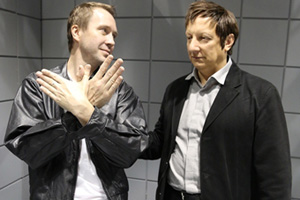
The founder of the company ex Machina Robert Lepage debuted on the Russian stage by the play "Hamlet | Collage ”in the capital's theater of nations. The text of Alexei Bartoshevich about almost the most anticipated premiere of recent years in which the artistic director of the National Theater Evgeny Mironov plays all the heroes of the Shakespearean tragedy alone, read immediately after the January holidays, but for now, CoLTA.RU publishes the conversation between Robert Lepage with Dmitry Renansky - not only and not so much about the new production of the laureate of the “Europe”, theater, theater, theater, theater. How much about his creative method as a whole.
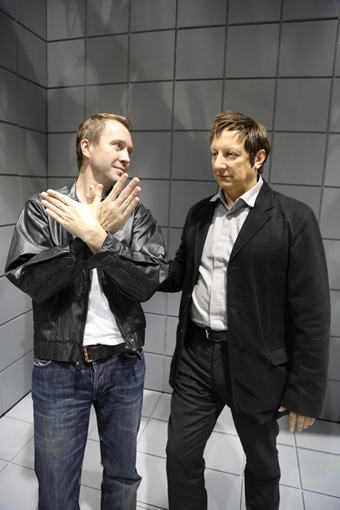 © Roman Dolzhansky Evgeny Mironov and Robert Lepage
- Until recently, it seemed that the modern directing in its evolution has come from the theater of interpretation, which unconditionally lost its positions in the past decades, to the writer theater, the reference examples of which can be called all your key work. In recent years, however, we have been observing the birth of a completely new type of interpretation theater, not at all like the one we have been accustomed to the last century. In it, the director will not only re -intonate one or another classic text: freely varying plots and starting from the motives of the textbook primary source, he creates a fundamentally new artistic reality, which often has a rather indirect connection with the original. A vivid example of such a theater can be called the performance of Kshishtof Varlikovsky “Shakespeare's African tales” -and something tells me that your Moscow performance can also be attributed to this department.
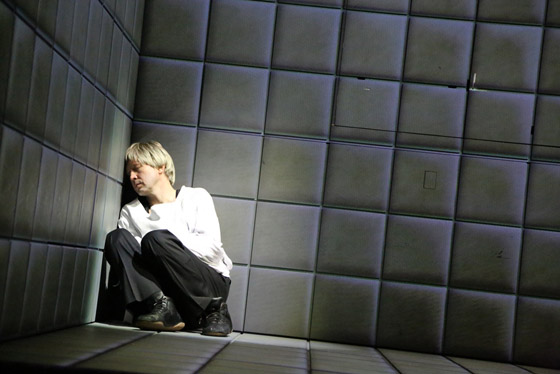
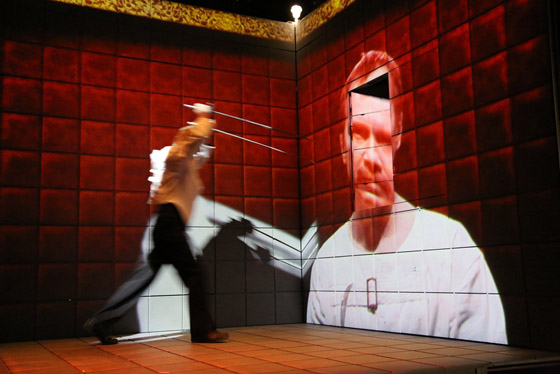
-I would prefer to refrain from generalizations: nevertheless, judging the trends and processes taking place in art, is the matter of critics and theorists of art, but in relation to the play “Hamlet | Collage ”The formula you deduced will be rather true. Evgenia and I (Mironov. - Ed .) We do not re -read, but we rewrite Shakespeare - that is why the word “collage” is present in the name of our work. In fact, during the rehearsals we created a work that is far enough in terms of dramaturgy from the tragedy of the Danish prince. Another thing is that we built this new building, one might say, from the bricks of Shakespeare's material: that Hamlet hid for centuries - say, a hint of the incestiveness of events taking place in Elsinore - we pulled into the light, and what seemed less interesting to us, on the contrary, took into the shadow. "Hamlet | The collage ”is really impossible to classify either the theater of interpretation or the writer theater-the method of creating our performance somewhere at the junction.
 © Roman Dolzhansky
- By the way, about the method. One of the key issues that the audience is asked after your performances is related to the methodology of creating large -scale projects such as a nine -hour “lipsink” or the “map” tetralogy. Dozens of characters, dozens of formed plot-final patterns of polyphonic plot lines-how do you lay out this, so to speak, solitaire?
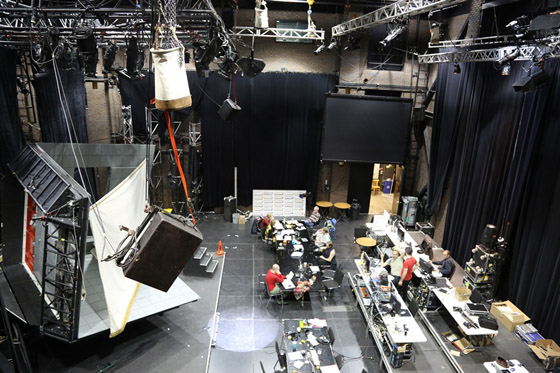
-At the very beginning of work on the future performance, it is important for me to know about him as little as possible, to be a kind of pure sheet-without any in and without a clear point of view, without any special attitude to the project. It is much more important to listen to the members of my team: what do colleagues think about our work, what considerations they have. Say, when we composed the same Lipsink, from the very first day it was clear that we would make a performance about a human voice - and only, nothing more. Gradually, every day we are more clearly imagining the contours of the performance, more better comprehending the future plan: we understand how the plots intersect with each other, we clear the paths that ultimately lead us to the final point of the route. The moment of the first show of the play is very important for the viewer - in EX Machina, a working run for close friends of the theater is usually arranged long before the premiere, after a discussion occurs, we listen to all the wishes and comments, then to return to work, to the editing. We seem to look in the mirror, we know ourselves.
 © Roman Dolzhansky
- How did this process go in the case of a “lipsinka”, how did you build the drama of this colossal canvas?
- The structure is always secondary in relation to the material composed collectively. From the outside it may seem that I am a kind of demiurge, the Cretaceous, creating the worlds, but in fact, believe me, my merit in creating the performance is hardly greater than the contribution of the rest of the EX Machina . Another thing is that it is I who often act as a person who sets a certain reference point in our path-I already seemed to say in some interview that the process of creating a performance for me is akin to the journey of Christopher Columbus to India, which ended, as you know, by the discovery of America. I will explain on the example of Lipsinka: at the first meeting with the team, I, as I remember now, talked about how one day I flew from South America to Montreal. In the neighborhood with me in the business class, there was an opera singer who taught a new party on notes, and on the very last row of economy class in the arms of a poor South American refugee, a baby was desperately cried. The combination of these two such unlike human voices - a sophisticated opera voice and the voice of himself, so to speak, Prostitsky - determined the semantic coordinate of the future performance. Then, of course, we clarified the details, but the direction of movement was set.
- The keyword of the lexicon of your theater is freedom. How do you manage to feel so comfortable on the opera scene, where the director deprives his main tool - work over time?
-Everything is quite simple: when you cross the threshold of the musical theater, the main thing is to realize that you cannot do the same thing in the drama in the opera territory-you have to fit into a rather strict framework. I love to work in tandem with conductors: if you do not forget that your roles are delimited and fixed, then those conflicts that often occur in the music theater can be easily avoided. The opera theater exists at the junction of time and space: the time for you is organized by the composer and conductor, the director’s task is to organize the space in such a way that the music feels comfortable in it. Say, it was precisely such a goal that we pursued when we set the Nibelung Ring in the New York Met : it was necessary to create such a spatial environment that could respond to every nuance of a musical score, each composer gesture.
 © Roman Dolzhansky
- You do not limit yourself to a genre framework - you work not only in drama and opera, but also in the circus, shooting a movie, just released the film "Triptych", which, in fact, is the film render "Lipsinka". Is it possible to talk about the evolution of your directorial handwriting with such proteinity?
-It is quite obvious that I do not have any single proven recipe that I use every time regardless of whether I put the show by order of Cirque du Sogas or release the opera in the Milan La Scala . Therefore, the category of style, aesthetics, or, as you say, handwriting, of course, is leveled. Although, perhaps, I just never had to think about it. I am not at all concerned about self -reproach - on the contrary, I like the anonymity that distinguishes the modern circus: at one time I was terribly delighted that in the same Cirque du Soleil there are no stars - the only star is only a world -famous brand of this company. When I put the performance, I am really preoccupied only with the output to get something homogeneous to create a cosmos. Naturally, on Venus you will behave differently than in uranium: the atmospheres of these two planets vary too much. So in art: in the circus, in the cinema and on stage, I behave differently. When they talk about my theater, each time they strive to use the word “high -tech” - but I, as you know, have released many performances, technically very, very simple. In general, it all depends on the nature of the stories that I want to tell the viewer at one time or another: for some I need to go to a circus tent, for others - to climb the theatrical stage, for the third - to make a movie.
 © Roman Dolzhansky
- Where did Robert Lepage come from, where to look for the origins of your theater?
- In my youth, I was literally obsessed with theatricality in the broadest sense of the word - and found it anywhere, but not in the theater itself: in those days, the dramatic art in Quebke was too bourgeois, if not more. Theatricality was found in rock and roll, in the tradition of performance. I well remember what a strong impression on all of us the visit to Canada Pina Baush. Of course, Ariana Mnushkin with her idea of the theater as a meeting of one team (authors of the performance) with another team (public) affected me: her ideology Théâtre du Soleil had a strong influence on me - we can say that I have been following the covenants of Mnushkina all my life, if you want, my guiding star.
- In recent years, eschatological moods have prevailed among the theater people. Do you share the concern of your colleagues by the global crisis of the theater language, which is talked about today?
- Yeah, even Zhenya (Evgeny Mironov. - Ed. ) At dinner, after one of the rehearsals, he asked a question, the essence of which came down to how, they say, to live on. And what, in fact, happened? The farther, the more I am convinced that the key problem of not only the modern theater, but also art in general is the narrowness of those who are engaged in this very art. Moreover, narrow -mindedness is often aggravated by arrogance - it is monstrously annoying when I hear statements that cinema or television kills the theater: maybe we should look at the tools of other arts in order to enrich our language due to new opportunities? And in general, the culture of the 21st century does not recognize the genre hierarchy, what can we talk about here? I am convinced that the problem lies not in art, but in ourselves: the modern theater is wider than our ideas about it.