
Translated material
The invention of the alarm clock
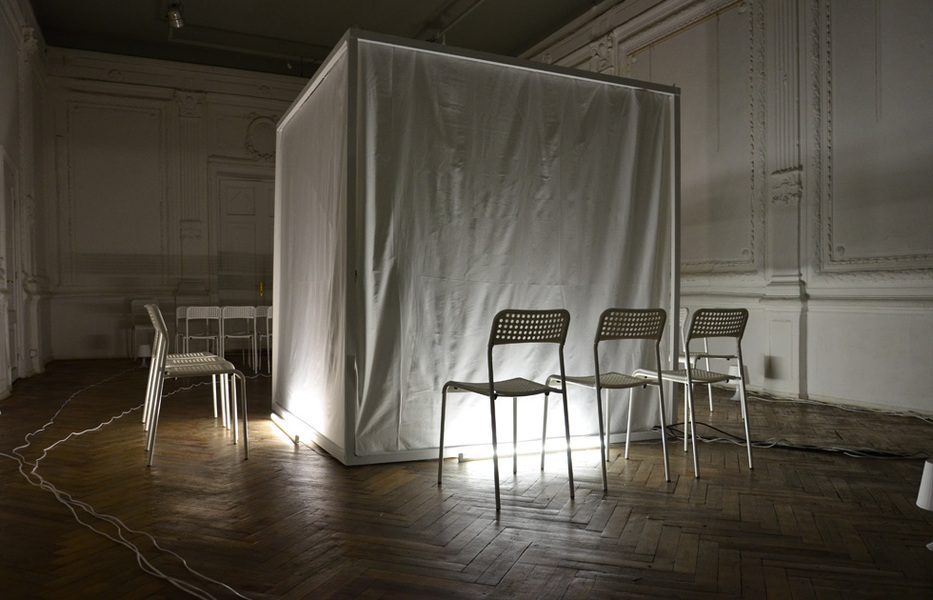
Rumors that the concept of Dmitry Volkostroelov serves the concept of John Cage, have been the key to the performance of John Cage for a long time. However, the director did not hide. At times, even a certain irony was, that Volkostroelov fell out to become a permanent favorite of a bonus called “Breakthrough”: the word that the founders imagined a rush and a jerk, in the presence of a laureate, returned the former, now forgotten semantic overtones - a gap and a cliff; Unpleasant gaping in the middle of an even landscape. The somewhat simple -minded ambitious of the task is to transfer the principles of the sound koans of the American classic into stage language - with each new performance, Volkostroelov manifested itself more and more distinctly, without losing neither sunk nor simple -mindedness, but not growing nuances - rather, on the contrary, the nuances are obstacles, extra noise, Maya’s rustling. In the last days of December, Gestalt was finally closed: in the “taiga” space , the “lectures on nothing” John Cage in the production of Dmitry Volkostroelov were held. Well, in fact, that's all. It was as if Dante considered a walk on hell as a successful motivation in order to elake to Virgil. The conductor became the goal; The key is a leap door leading to the key.
“We feel more and more that we are moving into nothing,” is pronounced in the performance over and over again. Amendment: We, spectators of the performance of the Cage lecture, are moving not into nothing, but to Cage. His surname is at the poster, it is also on the set of cards, playing the role of the program here, and if in the past Volkostrel performances it might seem that the director tries on the role of Cage from the theater (which would mean to supplant the memory of the original in this territory, replacing the “lecture on nothing”: there are still two of them, a lecturer and a supplier, guru, gurus Both the medium and the gap between them became clearly visible just when the director intended to make the method also material. The staging of the Kage lecture for Volkostroelov is the gesture is primarily hierarchical, and two participate in the hierarchy - and different. And the names of the foreign states that flashes in the text of the lecture, and a slightly old-fashioned rhetoric about control and capital, characteristic of the 50th: here and now, in the “taiga” space at the end of 2013, this lecture is not created, but it is reproduced, it is reproduced, it is a canonized text, carefully extracted from the cultural heritage houses.
What is normal for a normal theater, but disastrous for the theater, which took the radical, utopian concepts of Cage for the model. The ideal is the ideal of the uncertainty, proclaimed and admitted by John Cage, when setting a lecture by Cage himself loses his coveted sterility, because in the middle of the insoluble, inconspicuous, deadly, a defined artifact sticks out - in all the horror of his specifics - name: John Cage. As a key, he is only a way, approach, thought and therefore is ethereal; As a material, it testifies to himself and is therefore irreversible. A simple example: applied to the “love story” of Hainer Muller in the previous performance of Volkostroelov, the rehearsal technique of Cage provided a scandalously endless finale, dissolving the tough task of the author’s text; But it, applied to the “lecture on nothing”, gives a failure, and eight times repeated fragment is replaced by silence without any motivation for termination. For according to all the laws of the universe, from the principle of relativity of Galileo to Gedel's theorem, the Cage technique simply cannot dissolve the text of Cage. There is mediation, there is an extraction - that very name, doubled with a pillar sticking out in the middle of the performance, as if in the fourth song of Maltorore; “Cage” is a symbol and emblem of a concept that denies symbols and emblem.
And all because between the lecture and the audience crept a capricious and intransigent mediator - theater. Which indicates a gap between the place and the time of creating the text - both the place and the time of its performance; For whatever do with a lecture in the theater, she will not remain a lecture. Secondary sign system, what is it here. Cage said: “We need a structure to see that we are nowhere”; The structure of the play of Volkostroelov allows us to see that we are in the text of Cage. Which denotes "nowhere", but not it; So an empty set itself is quite an object, although it does not contain objects. The signifier turned into the designated - Lord God, but what else to expect from the theater? .. What is a surprise. Quelle Histoire .
There is no need that theatrical action is reduced to the covered white canvas of Cuba, in which two performers are hidden from the audience (Ivan Nikolaev and Alena Starostin), and that the procedure for action itself violates many familiar theatrical conventions, the basis is irremovable: we have come and sit. The words of the lecture tell about the “thirst for possession”, which is infected with the modern perception of culture - but Dmitry Volkostrelov once took the text of John Cage and made a certain number of decisions on its production, that is, placed in space and time: he invented a white canvas, and two performers and a light score. That is, an interpretation, that is, a completely traditional theatrical interception of power by the director from the author: and what is it, if not a “thirst for possession”? The words of the lecture, further, tell about the “control”, from which the lecturer-composer renounces both as a composer and as a lecturer (“if someone wants to sleep, let him sleep”), but is it not funny, at least a little, that they invite a Volkostroilov spectators to the performance, seeing a certain place in the darkness and sitting on a whore so that they sat further for the hour? Compared to this degree of control, without which the theater (unlike music) is not able to do, gracious permission to sleep, right, is a little.
That is precisely the main problem of the theater Dmitry Volkostroelov (it will have to be mentioned here only in passing, it is good as a topic for a separate conversation, objective and lengthy). Stubbornly, from the performance to the performance, transposing the cage for the stage, the young director is sometimes amazingly useful routes - however, it seems to not notice that some of them have long been outlet, and all the others are only useful, passing discoveries, they themselves are barren and dead end. Attempts in the early 2010s to create performances in the aesthetics of the 1950s (and on the world scale of the work of Volkostroelov-the year 1958-1959, no later) in the country where the theater still exists according to the rules of the 1900s, undoubtedly, rightly called attempts by heroic; But heroism is in an aesthetic field virtue, no matter how offensive, deeply secondary. In an effort to deal with long -working theatrical techniques and methods, wolf -wolf stakes attacks them from the non -submarine sphere - and sometimes overlooks the specifics of the theater as such, regardless of the era and existing principles. Which inevitably leads to errors and miscalculations already inside the framework set by him himself; Normal revenge of art for neglecting the basics of its grammar.
So, Cage in the “Lecture on Nothing” has long talks about his dislike for the Terts - the performers, between which the text is distributed as a sin, it is this fragment that is pronounced with an interval in the third. And not because it is so conceived, it was simply ignored; And to conduct a dialogue with the interval in the TERPOSE MOST natural and organic, it will turn out if there is no additional directorial instructions and if you are not naturally endowed with the KAIIZHEVIC CONSUMENT by the ideal hearing with dislike for the thirds. Or another example: if Alena Starostina pronounces her text clearly and legibly, then the articulation of Ivan Nikolaev for the most part leaves much to be desired. Of course, we are not in the Maly Theater and not in Comé Die-Fran çaise , and there seems to be no reason to introduce classic speech canons. But the author of the text that turns out - as a sound assault - as a result of Ivan Nikolaev’s pronunciation, he would not have become famous - even among the profans - the work “4:33”. It would be called “4 minutes” or “5 minutes” - or, most likely, “4-5 minutes”. And this is not a nit -pick, not a metaphor - this is a systemic mistake of the Volkostrelovsky transposition of the Kage method. The renunciation of the conceptualist Cage from “control” does not prevent the artist Cage from maintaining fidelity to accuracy. Uncertainty as a method does not mean the uncertainty of the result; The subtlety of the face in this seems to be the guarantee of true, serious complexity of any avant -garde art.
All these mistakes, perhaps, would have caused much more sympathy if Volkrostrovs had mastered the genuine Terra Incognita . But during the time of Cage, the theater was not more conservative than music, and Cage’s discoveries are easy to find parallels in the then stage art. The only difference is that the theater of the 50s followed the logic of its own development and therefore made its discoveries and “breakthroughs”, based on internal rules and patterns. Simply put, there were no language losses, now and then Volkostroelov with his intricate trajectory of the Theater from the spirit of music. All the details and language elements, about which Volkostroles now and then forgets, are exactly those that in fact these two arts differ. There is no dispute, the ambitiousness of the “Magus” makes Dmitry Volkostroelov the honor: to come up with a whole theater again, whether a joke. It is only a shame that this theater invented by him now was read undisputed and almost classic in Paris, Berlin, and in New York. In one story, Taffy, going out to breakfast, began to reason: it would be good, they say, to come up with a machine that you tell in the evening when you wake you up, and in the morning she wakes you up ... And then his daughter was cut off: “Dad, this is an alarm!”.