
Translated material
One and a half man
The performance of Vasily Senin "Five evenings" - about proud loneliness
The performance of Vasily Senin "Five evenings" - about proud loneliness
The most famous phrase of Alexander Volodin’s play “Five Evenings”: “Oh, if only there was no war! ..” On the evening of March 1, 2014 from the stage of the Pskov Academic Drama Theater named after A. S. Pushkin, she sounded especially sharply.
In “Five Evenings”, the protagonist Ilyin (Arthur Vakha) pronounces the Yesenin words: “My life, or you dreamed of me!” And he begins to talk about youth, which "promises and deceives." Sergei Yesenin has the next two lines, which did not enter the play of Volodin, sound like this:
Like I am a spring with a ease of wound
Ride in a pink horse.
| | | --- | | 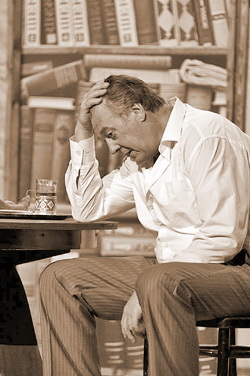
In the performance of the director Vasily Senin, this very frenzy is fully present - especially when the rumble of Leningrad trams is spreading around the hall (and, thanks to video executions, it often spreads). From pre -war times, when trams also walked through the streets in Pskov, there was no such tram hum.
Black and white trams are replaced in the play of romantic pink horses. They rush somewhere with a noise. Maybe they rush back, in 1959, when the play “Five Evenings” was written by Volodin.
Senin escaped some special modernization, which surprised some spectators. The action of the play and performance takes place at the turn of the fifties and sixties. Otherwise, the connection that connected the heroes with the Great Patriotic War, which separated Ilyin and Tamaru (Oksana Bazilevich), would be interrupted.
An invisible war is an evil rock. And everything else in the play and in the performance, one way or another, is associated with good rock, with happiness. Elusive, but still happiness.
When the big and restless Ilyin complains about the deception of youth, he hears in response from the middle -aged Tamara, who was never married: “But she did not deceive me at all. I always knew that I would be happy. And now - happy! "
This is a very difficult matter - to show happiness on the stage and not slide into pathos, not to become a rider on a pink horse, a rider or a rider with “pink snot”.
In this performance - an amazing thing - everything is in order with happiness. And this applies not only to Tamara - at the moment when Ilyin finds it after a long separation.
The eternal trouble of the Pskov Drama Theater of recent years and even decades is the absence of an ensemble on the stage. Not musical, but acting. There are successful roles, but some distortions constantly arise inside the performance. Someone plays well, and someone, serving the number, replaces the decoration.
There is an ensemble in the project “Five evenings” by Vasily Senin, who appeared in St. Petersburg at a time when he had not yet headed the Pskov Drama Theater. Therefore, there are also characters of all heroes without exception, prescribed more than half a century ago by Alexander Volodin.
It turns out that it is not necessary to stand on the head, it is not necessary to climb out of the skin to surprise the audience. And this sensation arises not only due to the effect of recognizing the usual play. You applaud that you did not spend two and a half hours wasted, and the words written in the last century in another state still hurt you.
Vasily Senin emphasized in an interview that there was no parallels between his play “Reserve” and “Five evenings”. But it was difficult to get rid of the thought that there is still parallels. And not only because the same couple on the stage is Arthur Vakha and Oksana Bazilevich - plus Evgeny Filatov, who played Major Belyaev in the “Reserve”, and Timofeev in “five evenings”.
This is not only the case.
| | | --- | | 
The cold, slightly detached Leningrad humor is important here. Dovlatov has it. But Volodin also cannot be taken away. It is felt from the first lines of the play when Zoya (Margarita Bychkova) says: “I just ask, don’t interpret my behavior as a matter of easy accessibility to me”, and Ilyin, counting the newspaper, answers phlegmatically: “Okay”. - "What - okay?" - "I will not interpret."
There is another parallel that allows us to draw some conclusions about the views of Vasily Senin. He, among other things, just likes retro.
The play “Five Evenings” may have appeared not only because the play is good, but also because it was possible to organically enter the documentary frames of black and white noisy and somewhere all the time of the rushing Leningrad and dilute, no, to saturate the action with ancient songs-from the Utesian tango “The Secret” to the words of Anatoly d'actil to the hymn of the Soviet Union.
True, the anthem turned out somehow strange. Words sound in the play, but from 1955 to 1977 in the USSR this anthem was performed without words.
The songs are generally permeated by Five evenings. Five evenings - five songs. Tamara sings under the guitar the "Ballad of a nail" composed by the novel Matveeva in 1964. Ilyin hoarsely sings the “cereal” of Yuza Aleshkovsky, composed in 1965. The desperate girl Katya (Anna Arefieva) stubbornly votes: “And I like him, like it, like it, like ...” ... ”...
Nevertheless, the through melody of the performance is the pavement tango “Secret”, it is “Song of an unknown beloved”.
I have a heart
And the heart has a song
And the song has a secret
If you want, guess.
| | | --- | | 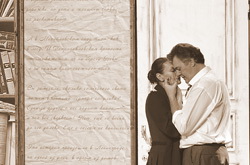
Heroes are only doing what they guess. A good song should always have a secret.
It would seem that the play "Five evenings" about loneliness. Everything is lonely in it. But it is more correct to say: the performance of proud loneliness.
Proud loneliness does not at all look like ordinary loneliness. This is something opposite.
When the 19-year-old Katya says: “You have to be proud,” Ilyin immediately says to the toast: “For pride”.
It is ironic, but to the top of this pride is crowded. This is almost pride, sin. He deceives with shame. And shame returns his love.
About Katya, or rather, Anna Arefieva, in general, I must say separately. Her role in this acting ensemble is very great. Her young telephone operator Katya connects the era: the beginning of the forties, the end of the fifties and the present time. Such, probably, was Tamara in his youth. But such a girl now, in the 21st century, looks modern. She glows from the inside. The duet of Katya and Glory (Mikhail Casapov) generally determine in many ways in this performance. They represent the future in which you want to live.
How old is Katye today? Seventy four? It was not for nothing that Volodin began the play from the remark: "This story began long before these five evenings and will end soon."
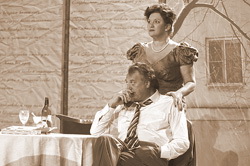
As stated in the play, two women account for one and a half men. So on Zoya with Tamara there is Ilyin, he is one and a half man. One man heads a garage in the Far North, and another half of the man, part -time, is arranged by the “chief engineer” at the largest chemical plant - especially for the consolation of her beloved woman. Nevertheless, the failed chemist Ilyin activates the chemical reaction of love in the brain with the participation of dopamine, phenyleneine, serotonin and norepinephrine. [ 1 ] He is a large chemical plant for himself. It is no coincidence that Ilyin teaches fame: "Chemistry, my brother, you are my most abstract, most logical and at the same time the most practical of the sciences."
In the end, Ilyin rolls a monologue about freedom: “A person must always remain himself. The most profitable position ... Remember: I am a free, cheerful and happy person. And I will also be happy and for various reasons. What I wish you ... "
A variety of happiness is also a consequence of loneliness.
Ilyin stopped pretending and felt free. For which I received a tragicomic exclamation from Tamara in the back: “I respect you!”, And not the obvious: “I love you,” because everything is clear with love, she is. From the lips of Tamara, at the leisure of the reading letters of Karl Marx, it was supposed to sound: "I respect."
Alexander Volodin, as far as one can judge from his plays, poems and memories, was a man who loved and respected his heroes, and therefore the audience. And in order to put his play, you need to sit on the same tram, do not confuse anything, read the text, catch the sound, look at inconspicuous trifles, just like in the "Ballad of a nail":
It was enough for me that from the nail
There was a small mark.
| | | --- | | 
It happens that in an inconspicuous trace of a nail there is more sense than in whole volumes.
Volodin generally has a very good remark (“Katya and Glory returned to their room, sat down side by side on the sofa - quiet, concentrated”).
If you are able to play quiet concentration, smoothly turning into unobtrusive cheerfulness, then you will succeed in the play “Five evenings”.
The heroes of "five evenings" survived both the war and the world. And they remained cheerful people.
* * *
Wars are usually untied by the unfortunate non -free lonely people who know for sure that they are forever out of love.
Alexey Semenov
- Anthropologists from the University of New Jersey (USA) conducted a scan of the brain to find out which areas are responsible for a sense of love and established that supposedly dopamine gives a feeling of well-being, phenylethylamine increases the level of excitement, serotonin creates a sense of emotional stability, and norepinephrine-the impression that you can achieve any goal.