
Translated material
Not only found
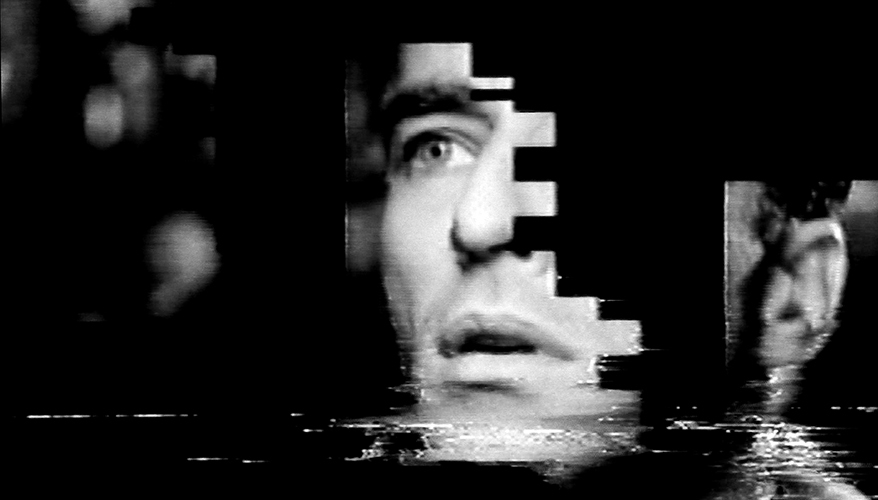
From May 16 to June 30, the third time in Moscow will be held annual to the Rossdisciplinary Media ART festival " Videofocus " , organized by the State Center for Contemporary Art. It is dedicated to the flow of visual arts, which are in the areas of art practices related to video art, cinema and digital art. The festival will consist of several programs, including the Found Footage exhibition / Found film ”, a retrospective of the films of Derek Jarmen, the premiere of the film by Philip Grandlery “ White Epilepsy ” in Russia , as well as an extensive educational program. About the most interesting events of the upcoming festival - in the COLTA guide . Ru .
This year, the Videocus festival is dedicated to Found Footage , “Found Images” or “Found Materials”. This concept of curators Karina Karaeva and Dasha Biryukova interpret quite widely, implying a visual structure by it, which is characterized by a rejection of visual perfectionism. Most often we are talking about the study and processing of a borrowed or impaired image, as the curators explain. But if the exhibition “Found Film” will present the works of such artists as Masha, Abigail Child, Peter Cherkasskoy, Christoph Girard and Matthias Müller, corresponding to the term Found Footage in a strict sense in the international artistic slang, then Derek Derek Derek in the retrospective program and the retrospective program and “White Epilepsy” by Philip Grandrhee only to some extent imitate this aesthetics, much more serious into the study of the poetic capabilities of the movie language and working with various video techniques. The shame of the definition of the Found Footage , on the one hand, is due to the poverty of the Russian video art segment in this area (in the abundant production of such art in the West), on the other hand, to show the organizers to show as many different experimental methods of working with the video at the festival.
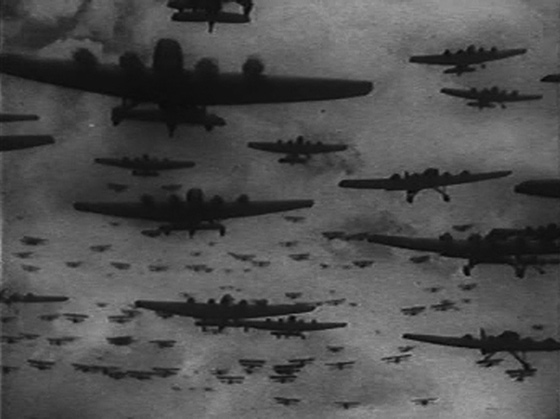 Masha is one -year -old. Return me a propeller. 2009. 20 ', color and h/b, minidv, sound, Russia
Found Footage / Found film
The exhibition hall of the GTSIS
At l. Zoological, 13, p. 2
May 16 - June 15
Masha is one -year -old
The work of the St. Petersburg video artist “Return me propeller” consists of comparing the repeated alarming frames of aircraft and paratroopers from the film by Alexander Dovzhenko “Aerograd” (1935) with documentary episodes of the private life of a modern married couple. The author’s ironic look emphasizes her initial feminist position and pushes into thoughts about the masculine myth translated through cinema.
Albert Alcoz
Video of the Spanish artist and theorist of experimental cinema Albert Alcose called " NIF FIN " It can be called a traditional example of visual research in the Found Footage genre. In his work, he offers the audience an alternative interpretation of the film “Learn a shameless” (1970) Agustin Navarro. The artist uses the final frames of the film, greatly blurring the focus in them and slowed down-so that “natural” causal relationships are distorted. As a result, Happy End is not so obvious.
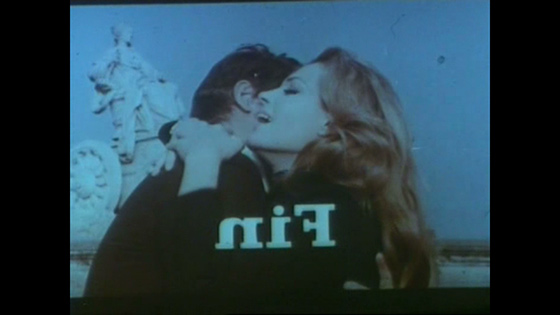 Albert Alcoz. NIF FIN. 2007. 3 Min, Super 8, Color, Sound
Christoph Girarde and Matthias Müller
The editing film “ Cut ” by Christophe Girarde and Matthias Müller asks a serious question about the nature of the movie from the point of view of the opposition of integrity/fragmentation, the need for division to achieve unity. Famous video artists from Germany compare the physical "body" of the film, film, during the installation with wounds and seams on the human body. From the frames of the cut, chilled, bleeding and bandages of human bodies, they collect a new, “innumerable” body of the film. “The seam closes the wound, but at the same time emphasizes the injury. Thus, the stitches retain the wound, while the incision generates the sequence, ”writes Binotto, the film critic of Johannes Binotto, writes about this work in his essay: Operations on the body of the film.
Abigail Child
The theme of memory and lost image, often arising from the use of Found Footage , is closed in the work of the American artist Abigail Child “ Pie and Steak” with an author’s “Education of a girl” in the post -war American suburb. Abigail Child took her own family video archives, preserved on the bright film Kodachrome , but contrasted them with a processed digital sound of modern radio transmission. “Pie and Steak” was conceived as part of the project “suburban trilogy” - “digital novel in several chapters”, dedicated to the reconstruction of the past family in its connection with the topics of citizenship, immigration, gender identity.
Peter Cherkasy
Doctor of Philosophy, Expert of Structural Cinema and Found Footage Master of the Austrian Peter Cherkassku gathered his work “approaching attractions” From samples for commercials that were not planned to be preserved. The name itself immediately refers to the experiments of Sergei Eisenstein, the “installation of attractions” - the search for means of maximum impact on the viewer with the help of bewitching images. Folded by graceful allusions on the history of painting, music and cinema, pieces of lost advertising sample are formed in a playful visual poem: this is “a kind of view of the history of the movie in the rearview mirror”, as the film critic Christic critic comments Kristof Hubert.
Philip Grandrhey. "White Epilepsy"
Cinema "Torch"
Sh. Enthusiasts, d. 15/16
June 11
Philip Grandrhey makes a movie on the verge of Yavi and Dreams. “White Epilepsy” is a fifth work in his filmography (“New Life”, “Lake”, “ Masao Adachi ”,“ gloomy ”) and the long -awaited premiere for the Sinefils. The director himself admits that his film "Water is woven from emotional stress and anxiety that make up the essence of the story." Indeed, the cinema of Philip Grandrian is narrative exactly to the extent that the tactile potential in the frame space allows. Its territory in the cinema is a specific sensuality of the image, which he easily achieves, shooting not even on film or digital analogues, but on a video camera. As the curator of the Karina Karaev festival noted, the Grandrhee films are “a variation of a modern video in which the painful state of the frame causes a feeling of random shooting”: the image appears in his frame as a kind of “primary”, and perhaps just in this his films come closer to the aesthetics of Found Footage , remaining in the area of exclusively staged cinema.
Philip Grandrhey. "White Epilepsy." 2012
Derek Jarmen. Retrospective
Cinema "Pioneer"
Kutuzovsky Vrib., 21
On the 20th anniversary of the death of an outstanding British director, a full retrospective of Derek Jarmen will be shown in the framework of the Video Focus festival. The intellectual and rebel, he quickly received the glory of the heir to the great Italian director Pierre Paolo Pazolini. Like him, Jarmen was a radical in art, politics and public life, fought with censorship, with the Tatcher government, with the church. His protest was deprived of all decorativeness and therefore poetic. “The director is manifesting his otherness, clothing it into mythopoietic images,” writes Dasha Biryukov’s curator about the fidelity of Jarmen Quir-culture. Other sources of his inspiration were an interest in the occultism and teachings of mystics, an unstable punk culture and baroque theatricality. Jarmen rejected narrative structures in favor of free work with the image, sound and memory. He created and left his personal cinema, which cannot be confused with any other.
The retrospective of Derek Jarmen is transferred to the fall.
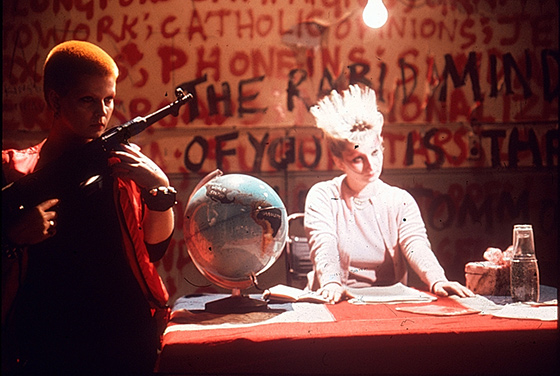 Derek Jarmen. Jubilee (Jubilee). 1977. 35 mm, Color, 104 min
Educational program of the Festival "Videofocus"
A significant addition to the exhibition program and the shows cycle will be a series of lectures and discussions about the Found genre Footage , the features of the cinema of Derek Derek Jarmen and the aesthetics of films by Philip Grandrin, who will also come to Moscow and on June 10 will take part in a creative meeting on the theme of “immanent sensuality”. Another creative meeting is scheduled for June 6: it will be possible to talk with the video artist Albert Alcoz on how to “rewrite cinema”. A lecture on the features of the analysis of cinema Derek Derek Jarmen will read Kinoved, Doctor of Arts Lyudmila Klyuyeva. The artist Vladimir Arkhipov will talk about the things found during the lecture "Home -made Russia". The curator Olga Shishko will give a lecture on the film "Installation of attractions" by Alexei Isaev. Sergei Shutov will talk about the “Techno-Mushroom remixes of remake”, and Andrei Smirnov will tell about the history of sound art and the practice of using “found sounds”.