
Translated material
"And they play badly"
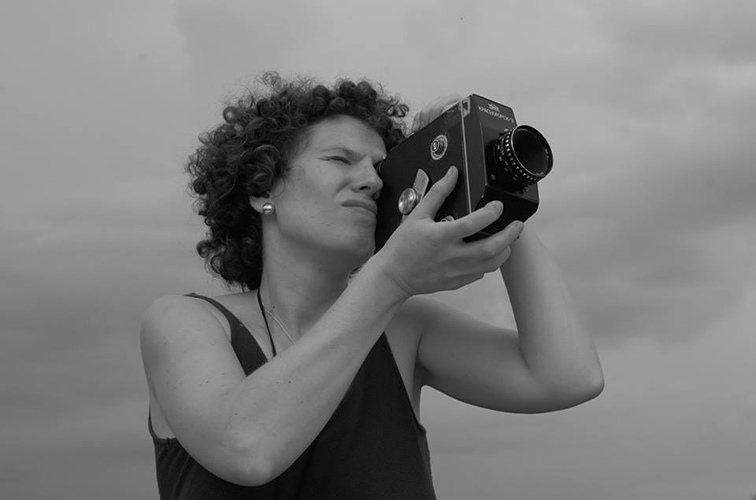
Lisa Babenko, a Ukrainian critic and curator, talked with the Russian artist Masha the one -year -old, a member of the Festival " Videofocus " .
Lisa Babenko: Masha, it’s symbolic that, talking to you now, I am in the Crimea, near the Kerch Isthmus, and you are in Russia, in St. Petersburg ...
Masha is one -year -old: yes, symbolic ...
Babenko: Although in fact, I must immediately correct myself - we are both in Russia. In New Old Russia, with annexed territories and the colonial past. Your recently made video, which I would like to talk about in view of our geographical circumstances, is a “feast during the plague”, you called it, referring to either the Pushkin’s tragedy, or John Wilson ’s original original “ City of The Plague " . Putin is clearly Valsingam, presiding at a feast during a whispering plague. Pressing metaphorically, does today's Russian government continue to produce imperial “plague” for you?
Masha is one -year -old, "Feast during the plague", 2014
One -year -old: it seems to me that this is not entirely connected with the empire. He (Putin. - L.B. ) is really the chairman in the plague situation. But, in my opinion, there is no imperial context in Pushkin’s tragedy itself. Don't know. The reference is most likely to the Stalinist congresses, whose participants clapped for half an hour, for 45 minutes and could not stop, because they were afraid of repression, were afraid to stop and show their disloyalty. And if you look at this speech, you see these allusions: people who are sitting there and “carefully”, on the verge of boredom, listen, take a close -up. It turns out such a played performance.
Babenko: Yes, I watched this, Putin’s speech before you before the Federal Assembly in the Kremlin Palace on the day of the legal annexation of Crimea. Lightning bouncing of parliamentarians to the beat of Putin’s speech, collective ecstasy. I do not want to aesthetize violence, but subjectively I experienced this broadcast with a feeling that I would call the "negative elevated." It is amazing how this spectacle echoes the fact that Laku-labart and Nansi described in their work “Nazi myth” dedicated to the aesthetic sources of fascism.
One -year -old: yes ...
Babenko: It didn’t seem to you that you can really feel something like that here? And the cameras, slowly fixing the faces, issue it.
One -year -old: well, with regard to the speech, its original documentation, if we consider this speech in terms of its construction, it seems to me that the operators themselves do not quite give themselves a report what they are doing. That is, they follow the traditions [shooting] of the performance, but at the same time they do not notice any moments. For example, these views are intensified as soon as you slow down the material. It seems to me that in the material itself there are hidden opportunities that remained incomprehensible to people generating it. Due to the fact that these views are slow, they become obvious. And if they do not slow them down - well, plus I still made a couple of manipulations - they will slip away. Therefore, only close attention, for example, to the subject of the elevated, which you said about, reveals here some internal inconsistencies, some kind of banality, and anything. This is a fairly simple cinematic tactic, when you either slow down or lose the material back, preventing it from developing in time and space.
Babenko: Yes, the same technique of obvious slowdown I saw in your video “Blessing” with Zhirinovsky.
Masha is one -year -old, "Blessing", 2014
One -year -old: there are also special slowdown, a game of views. When I need to fix some fragment, I resort to tactics creating a situation of “stuttering” in which a person cannot deploy a phrase or something else.
Babenko: The goal of the operators was really as at Stalin's meetings: to create a collective representation of the surname, where not a single person can express disagreement or disinterest.
One -year -old: In fact, this is such a blockbuster. If we consider this record from the point of view of cinema, then the principle of eight is very common there, when you build connections between the speaker and the listener and through it identify yourself as a spectator. The only difference is that there are these ultra -circular plans and much attention is paid to people's reactions. For example, as you said, their servility. Most likely, this record was mounted very quickly, and the eyes of the camera slip away from us, but this is precisely what came out when slowing down. People sitting in the hall constantly monitor the cameras looking at them, so you can see how they play sedimentary, attention, etc. I did not include all the material, but there were funny fragments, when a sizoing gaze could not be kept anymore and people developed some practices of struggle against boredom. Medvedev, for example, looked at the ceiling. The main thing is not to fall asleep and “hold” this look.
Babenko: When analyzing the installation and plans, of course, all this can be seen. But the general impression was this: was this constructed imperial blockbuster, demonstrating Soviet continuity, real?
The one-year-old: yes, and since I still found some part of the Soviet Union, I can see that all these events are clearly designed, and it is precisely at the expense of their actors. If you turn off the sound of the filmed meetings of the Stalinist time, you will see this game, this performance. Not only an ideological machine, although it is, but also its actors. And they play poorly.
Babenko: I would like to talk about this. For me, modern Russian-Ukrainian relations are to some extent connected with the colonial history of Ukraine. I would even talk about the Russian Empire now, when the tsarist colonialism of Russia in relation to Ukraine, then Little Russia, was obvious and understandable, but about the Soviet Union, in which there were already other forms of colonialism. Is such an analysis optics in general?
The people sitting in the hall constantly monitor the cameras looking at them, so it is clear how they play sedimentary and attention.
One -year -old: it's hard for me to talk about it. But this is an interesting moment. How much can the Soviet Union be considered as a center and colony? How much can these post -colonial theories be applied to the USSR? Maybe this is a question of the center and periphery with a parallel history? In the case of the center and periphery, power relations are built in a completely different way. That is, post -colonial optics is interesting, but I do not know how shifting it to the history of the Soviet republics, between which equality was supposed. Still, in the case of England and India, this equality was not expected from the very beginning.
Babenko: Yes, but I had in mind the borrowing of a discursive apparatus or the productions of problems that we can find in the post -colonial theory, but, of course, not the context itself. Even in the post -war period, a language policy was pursued, infringing on the development of national culture in the west of the country, because it was considered bourgeois.
One -year -old: do you mean the development of language, preservation of cultural heritage?
Babenko: Yes, and not only. This colonial interpretation of Western Ukraine should be understood solely in order not to provoke Western Ukrainian radicals by Russian populism and the prospect of the split of the country and not to bring these nationalists further than their usual territory. We are not capable of more, as you see. The aggressive behavior of the “Right Sector”, as well as their later participation in separatist provocations in the Donetsk region, are to some extent their answer to the foreign policy aggression of Russia, which began with the dispersal of the Maidan. It is she who reminds the nationalists of the historical aggression of the Russian Empire, as well as the late Soviet power, which fought with the Ukrainianization of the Western regions. In turn, in the east of Ukraine, in Donetsk or Kharkov, Ukrainization and the development of the national idea were never desirable, and this must be taken into account. The current government of Yatsenyuk also mistakenly refused to put up with bilingualism of Ukraine, causing the activation of separatists in the east of the country and a further civil war. We need other discursive forms, post -colonial or left, to convey this experience of the split of Ukraine within the framework of one state territory and one nation. In this regard, maybe you have your own idea of how the visual language of the representation of events should be, relatively speaking, “after the Maidan”?
The future that I assumed for these works is to show my friends and say how all this got to me.
One -year -old: yes, but as for the latter, I, in principle, try to avoid such great generalizations with the language. If you ask if I thought about it consciously, then no, I didn’t think. If you look at my other work, for example, work on motherhood , then they are very different from the mounted Found Footage like "Feast ...". In turn, the work taken on the film will be very different from work about motherhood. And this is not a global issue of language and style, but a matter of specific situations and specific artistic decisions that you make. Relatively speaking, if tomorrow there is a proposal to make a film about the Maidan, I will think about how to do it, what language to speak about it. Everything will depend on my message, on what research question is facing me. He will dictate both methods and language.
Babenko: As for the language, in this sense a recent example of the experimental documentary video that interested me, I saw as part of the past Berlinal. This is the film “On Violence” by the Swede of Herang Hugo Olsson. It problematizes the colonial history of Africa and is entirely built on archival materials, as well as in quotes of the theoretician of postcolonialism Franz Fanon.
One -year -old: You know, I would like to note this feature here. These works ( Found Footage and the like. - L.B. ) do not have ambitions to be shown in galleries or at festivals. They are taken from the Internet and sent to the Internet in a situation of impossibility to be silent. They use completely different resources to achieve an audience than galleries or movies. In addition, the possibilities of Olsson and some Mikhail K., who made the film, moving the material from the Maidan, is not the same. As for these of my works, I did them in a couple of hours. Someone writes their critical statement on Twitter or Facebook , but it’s easier for me to do this using a video. It seems to me that it is important to divide - to whom the work is aimed and for what purpose it is done. I do this as a statement on Twitter . The director who makes the film for Berlinal makes a film for Berlinal. So, he has a budget to go to the archive, copy the material from the films, there is a team, etc. We look at a completely different savings in creating work. Plus, of course, you can not get any dividends except Like on Facebook , while the film shown on Berlinal is automatic inclusion in other festivals and, accordingly, possible distribution. Although, of course, it cannot be ruled out that my status of the artist does my work, maybe a little more valuable. But in general it is just convention. The future that I assumed for these works is to show my friends and say how all this got to me. For example, this applies to an evil video about Zhirinovsky and all this fraternity hosting anti-LGBT-Zakon.
Masha is one -year -old, "Non -traditional", 2013
Babenko: And how do you understand the common phrase of Godra times of his work with the Dziga Vertov group about political films and films made politically? What is a revolutionary cinema made in dialectically for you today? Do we need it?
One -year -old: This is my favorite slogan among the ten commandments of Godard. All my works share it. Yes, this slogan inherits the situationists and those alterations that they were engaged in. I believe that it should be so. Even protest films can be shot absolutely classical, conformist, but for me the form and statement should be united. A radical statement should be made in a radical form, not conformist. Although everything is dual. If your idea requires a conformist form, then it should be like that. But if it requires an experimental, not narrative language, the plagiarism language, what the situationists did ... I think about a radical political form all the time.
Babenko: In the recent film, Olivier Assayas “After May” I came across a curious dialogue actualizing the search for the revolutionary language of the 1960s. This is a classic narrative film about the left activists of May 68 in Paris. Assayas puts the question in the mouth of one of the heroes: should the revolutionary movie not use the revolutionary language? To which the comrades answer him: “The revolutionary language is the language of the petty bourgeoisie. It is important to talk about the struggle, not about styles. Revolutionary workers should create a new cinema language, you need to give them a word. ” That is, in this context we are talking about the whole experiment with the form, about the transfer of the voice in oppressed. But what if you transfer the movie cameras to the same separatists of the Donetsk region? A documentary experiment with the transfer of cameras into the hands of the participants of the shooting by the Russian documentary documentary Kostomarov with Rastorguev in Rostov ...
Documentary cinema and cinema in the classical sense is generally a matter of control and relationship.
The one -year -old: "I love you" ?
Babenko: Yes. What do you think about this?
One -year -old: I think this is a well -conducive film. I know this technique well. I must admit, I watched this film for a long time. He creates the illusion of novelty, but, it seems to me, this is a very well made fake. This is such an attempt - well, as when artists try to draw like children. But artists know how to draw. That is, according to the manner of how people treat cameras, according to how the film is mounted, I see an absolutely thoughtful structure and artistic solution. I can be wrong. We join the same “shuses” of savings, and if you look at how many people worked on the film “I Love You”, this is not Kostomarov and Rastorguev.
Babenko: Do you mean the production commander?
One -year -old: yes. It seems to me to distribute cameras-there is some kind of lack of nothing in this, playing democracy and liberalism: let's send the cameras to the Rostovites, let's say how to use them and what we want from them. Of course, I speak rudely and conditionally, I need to see what the directors themselves say about this. But I do not believe in this game a little, because, of course, people knew that they pronounced dialogs in front of the camera, knew where it was, they understood who required this material . Therefore, the level of ease and honesty (these heroes. - L.B. ) is very, very arguing.
This is the moment of power relations. Why should we distribute cameras to these separatists? It seems to me that the message itself already implies the hierarchy. For example, in the USA there is such a human rights organization of Witness , which really sends cameras to the regions where human rights violations occur, but solely in order to collect documentation, evidence of violations there.
Masha is one -year -old, "hunger" (excerpt), 2011
Babenko: It turns out that the director, in the case of distributing cameras directly to the heroes of the film, acts as if such an employer who is looking for a new cinema language or something else. After filming, accordingly, it is he who assigns and mounts ...
The one -year -old: ... and receives dividends. No, maybe in the case of Kostomarov they paid to everyone who shot . Don't know.
Babenko: On this occasion, I recalled another example of a documentary experiment, also Russian: a battal that has risen around the film "Holocaust is an adhesive for wallpaper?" Mumina Shakirova.
One -year -old: about two girls from the hinterland, who were taken in the end to Auschwitz?
Babenko: Yes. And this is what unites these in my own way of significant documentary experiments with language and material-this is the director’s attitude to his characters, carriers of various political problems of the whole country. It turns out that in the work mentioned here, people withdrawn by directors are objectified: these heroes have no qualitative opportunities to obtain education, they represent the lower cultural layer, etc. The sociologist Bourdieu wrote well about this class difference in obtaining symbolic capital. And certainly this is not a question of the individual shortcomings of some teenager. This is the way about building a hierarchy during video production. Don't you think so?
One -year -old: Well, of course. I was tracking the discussion. Ignorance of such big historical events as the Holocaust ... I saw this passage when the girls were brought to Auschwitz and they burst into tears there when everyone understood. It seems to me that today many Russian documentaries are deprived of this self -reflection, occupying a rather privileged position, which is authoritarian in the context in which they work. Of course, they enjoy it: the material is under control, you can at some point tell the operator that you need to turn on the camera, at some point you can provoke an object to emotions or discussion, ask the desired issue at the right time in the right emotional state, etc. These are all the techniques of documentary cinema. Так что в этом есть момент властных отношений и контроля. Документальное кино и кино в классическом смысле — это вообще вопрос контроля и отношений. В современном искусстве, которое выносится в публичное пространство галерей, по-другому выстраиваются отношения между зрителем и объектом.
Бабенко: Ты хочешь сказать, что в современном искусстве отношения между художником, объектом и зрителем более демократичны?
Годованная: Они другие. Я не могу говорить про демократизм. Я хочу сказать — они радикально другие. Отношения между художником и зрителем переворачиваются: например, художник не может рассчитывать на внимание зрителя. Когда ты заходишь в кинотеатр, тебя закрывают в этом пространстве. В галерее ты сам решаешь, сколько времени будешь смотреть ту или иную работу.
Бабенко: Помню, об этом говорил Харун Фароки, когда был в прошлом году в Москве. Он предпочитает кинозалу пространство музея или галереи, критикуя киномир и телеканалы за коммерциализацию искусства и за подчинение критического потенциала кино законам капитала. На левой критике капитала я бы и хотела подойти к нашему финалу.
Годованная: Да, хорошо (улыбается) .
Бабенко: Знаешь, самая выдающаяся реакция западной элиты на нелегитимный захват Крыма, с которого мы и начали наш разговор, была у французского либерального философа Бернара-Анри Леви. Когда его спросили, почему Украина все время терпит агрессию со стороны России, а Европа при этом осуждает Россию, но ничего не предпринимает, чтобы помочь Украине, он ответил (приведу цитату): «Потому что мы боимся Путина. <…> Это невероятно, это объяснить невозможно, это иррациональная боязнь. <…> Мы боялись Путина в Сирии. Мы боялись Путина в Грузии. И мы боимся Путина тут, в Украине». Когда Леви спросили, готова ли Европа отдать Украину Путину, он произнес уже вовсе сакраментальную фразу: «Европа отдала в Ялте половину себя Сталину. Весь Восточный блок» . Когда Ангела Меркель «сдает» Майдан, потому что покупать газ вдесятеро дороже у соседней Норвегии она не собирается (ее просто сметут с поста канцлера коммуналоплательщики Германии), это также ставит диагноз и Евросоюзу. Что касается Украины, то националистический популизм, на котором основывается идущая гражданская война, стоит на подмене социальных и экономических требований языковым вопросом и вопросом культурной истории. Вместо того чтобы преодолевать кризис безработицы на тех же угольных шахтах Донецка, развивая профсоюзное движение, выплачивая полугодовые долги рабочим и предоставляя молодежи рабочие места, украинские власти занялись языковыми реформами и подлили масла в огонь, способствовали кремлевским планам по аннексии украинских территорий. С точки зрения правых, социальная проблематика коренится не в классовой эксплуатации, а в кажущейся угрозе иноэтнической оккупации (например, бандеровской). Именно в это русло власти выгодно канализировать энергию людей. При этом левой альтернативы на уровне большой политики в Украине нет, и это часть общего диагноза, которая ведет нас к неутешительным президентским выборам в мае.
Годованная: Мне сложно говорить. Я в первую очередь считаю, что Украина — это независимое государство и никакая другая страна не должна и не имеет права вмешиваться в ее политику. Есть границы, есть соглашения, и они должны выполняться. Что касается вот такого поведения европейских стран и Америки как супердержав, то оно рационально просчитывается. Я бы не говорила тут о нерациональном. Будем ли мы поддерживать какие-то абстракции в качестве европейских ценностей или же мы будем заботиться о низких ценах на газ? Причем речь идет о поддержке демократических ценностей не в наших странах. Поэтому понятно, какой выбор должна сделать та или иная страна. Ангела Меркель должна поддерживать свой политический статус и имидж успешного лидера, рационально управляющего своей страной. Поэтому, когда есть вопрос, как обеспечивать своих граждан, конечно же, она пойдет на какие-то соглашения с Путиным. Вообще в идею того, что богатые и успешные Европа или США дойдут до конца в своих внешних декларациях о демократии, странно верить. Как правильно сказал Леви, «сдали Ялту»… Был прецедент. Что касается отвлечения внимания от экономических проблем, то это известная дискурсивная тактика власть имущих, направленная на то, чтобы покрыть все вот этим популизмом и отвлечь от реальных проблем. Об этом писал Фуко, когда он рассматривал в «Истории сексуальности», как властный дискурс подменяет дискурс реальных носителей собой, перерабатывает его и возвращает обратно. Якобы мы говорим о европейских ценностях, а на самом деле никто не будет поддерживать Украину и идти с ней до конца.