
Translated material
Not through the fault of the artist
1.
There are events in which, as in a lens, rays of completely different phenomena and facts gather in a bundle. Such an event was the large retrospective exhibition of Mikhail Roginsky “On the other side of the Red Door” - a parallel project of the architectural Biennale in Venice - solemnly opened on June 6 at the now sad University of Ka Foscari.
The project of the exhibition, which included more than a hundred works of different periods, was prepared for a long time, and, of course, neither the Mikhail Roginsky fund , nor the widow and vice president of the Liana Roginskaya Foundation, nor the architect Evgeny ACS could even think that the Halls of the University of Venice, KA Foscari would become not just an exhibition space, but a battlefield. The university premises for rent for very rather big money then seemed just a successful find, and the fact that the exhibition of the largest Russian non-conformist is under the auspices of the Center for the Study of Russian Art of CSAR (that is, the “king”) seemed quite logical. The oddities began immediately: taking the money, the center began, however, to dictate its conditions, and then, as we were told by the organizers of the exhibition, without putting a cent into the project, put his logo on the exhibition catalog as a coordinator. And yet - then who knew then that it was the director of the center and vice -rector of KA Foscari Professor Sylvia Burini that a few months later will fly secretly to hand the mantle and diploma of the honorary professor Vladimir Medinsky, ignoring the mass protests of his Italian and Russian colleagues . After the scandal with the award of Vladimir Medinsky Burini, she solemnly resigned - but it was nothing more than a spectacular move. The mandate expired, and the rector’s elections were supposed to take place literally after a couple of weeks. In the place of the director of the Center of the Tsar, for the sake of financing which is highly likely and the whole story with Medinsky was started, Burini remained and will remain, perhaps, for life: for no one saw the Charter of the Tsar.
 © Yuri Palmin
The CSAR center is a structure under the roof of the university, however, it is practically not subordinate to it, with its not at all a transparent budget (in Italy, only government agencies are required to publicly report financially), the lion's share of which, according to rumors, is precisely the amendment cash flows from Russia. It would seem, if what Russian money had to go for, then to organize an exhibition of Russian artists. However, the case was accepted even more bizarre turn. In the Roginsky Foundation, until the last, they were sure that they were dealing with landlords. The exhibition was financed entirely by the Roginsky Foundation by itself, but the “king” represents it as its own project.
The case was accepted even more delicate circulation when, after two publications ( 1 and2 ), despite the invitation in his hands and to the personal invitations of the exhibition organizers-the widow of the artist Liana Sheliy-Roginskaya and its main architect Evgeny Assa, the leadership of the “tsar” ordered to cross out of the lists and not to let several hundred people, the author of these lines. The widow of the artist, who turned out to be a hostage to large political and monetary games, almost cried from humiliation: “This is my personal guest. I sent her an invitation and entered the lists. ” - “Not supposed. She is not in the lists. ”
Persona non grata. Well, why are we scandals. Mikhail Roginsky will not be less. Non -conformism is not an empty word, even today and fashionable, but the choice of an artist. Dear for him. Mikhail Roginsky has been not alive for ten years. Times are changing - but human nature is unchanged, and therefore Venice in 2014 suddenly painfully resembles Brezhnevskaya. Former Vice -Rector of the University of KA Foscari and the director of the Tsar, a former student of Yuri Lotman and art critic, an art specialist in non -conformism (what a gloomy paradox), arranged everything as invented: handed it, did, received the promised in return. The calculation is simple. Shame will be forgotten - the center and financing will remain. And who will abandon the exhibition or conference in Venice in the Palazzo of Foscari on a large channel? Fragile artists and scientists. Weak man. Just beckoning. “Well, who knew this when we all started it? - Liana Roginskaya shakes his head woefully. -Each Mishina exhibition for some reason is necessarily accompanied by a scandal ... "
In the Roginsky Foundation, until the last, they were sure that they were dealing with landlords.
The guests, most of which, I'm afraid, have never heard the name of the artist, went through the guard cordons and were lost in a cocktail crowd. After the exhibition, a party with a DJ was planned (the requirement of the leadership of the center as an obligatory component of the vernissage) and a big dinner in Ka Retszoniko. It was not clear to which all this has all this to bottles, regiments, primuses and quiet gray lines on the canvases of Mikhail Roginsky. But this logical gap, it seems, did not bother anyone. Biennale has long been only secular occasions. Money and champagne poured. Water taxis drove up, dresses rustled, VIP swam. It got dark. And we all sat in the yard. Swifts circled over us, it smelled in the summer.
And here I personally would like to express gratitude to the university authorities of Ka Foskari and the director of the Center for the Study of Russian Art “Tsar” - for my audience experience on this side of the Red Door was significantly enriched with the physical impossibility of getting into this space: in a strange way, the non -confusion became an important prologue, as if it set up a faithful note and cleansed the vision of all the extra.
2.
“We have never been as free as during the occupation,” says Roginsky in a video interview. “And just“ I ”are not interested in me.” And really.
The next morning began with the call of Liana, who could not help but restrained the word and, after the celebrations, found time and the strength to spend me throughout the exhibition. Thrusted yesterday's lists with no longer interesting names were lying at the gate. There were almost no visitors at the exhibition. The morning halls have already shaken off the echoes of yesterday's steps and the rustle of dresses, outbreaks of cameras have already evaporated from the walls, and in the paintings there were unnecessary words through which the truth of carrots and bottles, dummies and steam locomotives, Moscow courtyards and corridors appeared.
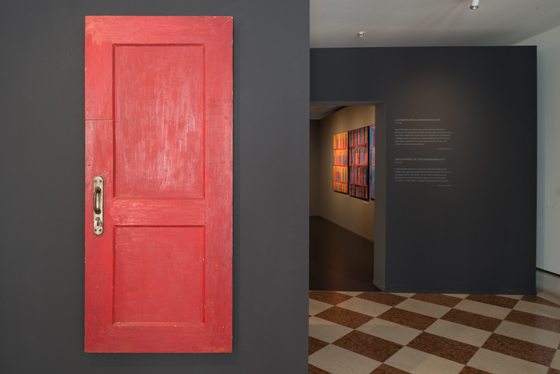
“Nobody needs work. We need a thing, ”says the artist from the screen. An uneven dassignment, thought out to a millimeter, exactly selected half -tones of the color of the walls. The broken space, where the work is almost cramped: to see the work of the late Parisian period, you need at least one and a half to two times more space, but there is nowhere to retreat, the viewer inevitably turns out to be driven into one of the sharp corners (one of the main architectural topics built into the actual more spacious halls of the foskari palazzo, then successfully picked up in the graphic design of the catalog of the catalog of the catalog of the catalog of the catalog of the catalog Designer Irina Tarkhanova) - and in this forces there is an accurate consonance of Roginsky’s work: freedom in the conditions of lack of freedom. Eternal searches and wandering. One of the many cardboard of the Rogin end of the 1980s is a doorway in which the outgoing figure is read-another precise spatial find. Sharp corners are not only a technical solution that allows two work to be near, but not to interfere with each other, the viewer can stand up to see only one, but also one of the main metaphors of this design.
 © Yuri Palmin
“It’s hard to watch Roginsky. Everything should be wrong, ”comments Eugene ACS of his decision of the exposition.
And now, from the hall to the hall, we go through "narrow gates." “I am with them”, “I write what I know” - Roginsky often repeats this in an interview.
Why doesn't Paris write? Paris is a beautiful city, but he does not speak with him. Here he goes on the bus - from the center to the outskirts - and "the bus is gradually blackening." This is interesting, but "I am not with them, not with these people, I do not know them." And I write what I know. With whom are you, masters of culture?
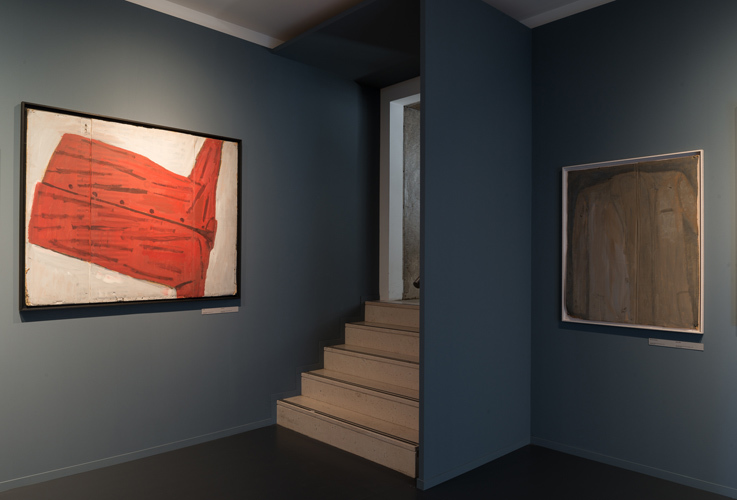
"I'm with them." With teapots, primuses, boxes, with gas stove burners. He knows exactly who to be with them. Moreover, he knows how to be them, how to become paints, to become a kettle written on a piece of corrugated cardboard. To be a blue teapot and red receipt - a double slot in the doorway - and the corresponding weight on the opposite wall, read immediately. A kettle is not an object and not even an interlocutor. The teapot is not him and not even you. The kettle is me. I am a teapot, I am a stove, I am a coat, I am a cloak, I am a shirt, I am a jacket from which a person has just taken out. A separate hall is dedicated to them. Sometimes vertical-flattened along the canvas, sometimes horizontal and therefore almost steaming, which, however, closely within the canvas, they occupy the whole space. One of the visitors aptly called them "Roginsky's shrouds."
What , c entities , and There is Self -portrait .
Step V side from own bodies ,
turned To to you V profile stool ,
view from afar on Life , what flew by .
Here This And Name " Mastery " :
ability Not Fear procedures
Non -existence - how Forms your own
absence , writing off his With nature .
( Joseph Brodsky )
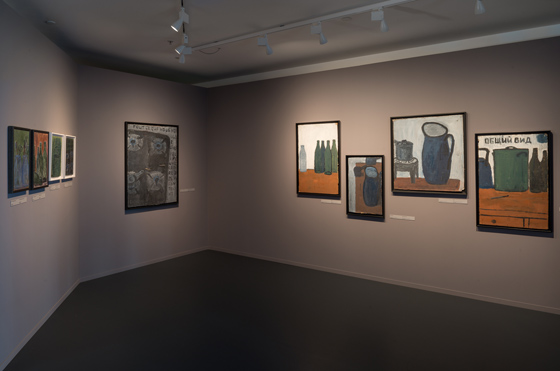
The exposition is opened by the early (immediately after emigration) things of Roginsky: bottles, shelves, for some reason called "alphabet of two-dimensionality". The superficial temptation of comparison with Georgio Morandi quickly disappears by itself. Morandi has the main thing - pauses, space between objects. In Roginsky, each bottle is endowed with their voice of silence. This is not unison or even a choir, but a polyphonic solo of silence. The meager integrity of these works is close to absolute harmony. But you can accept these shelves and bottles for transfers, inventory or alphabet only if you do not hear the picturesque fabric of the whole thing and not see their rhythmic pattern. In the best of the introductory articles to the catalog, Evgeny Barabanov, very convincingly speaks of the theatricality of Roginsky’s things. I would say about their musicality.
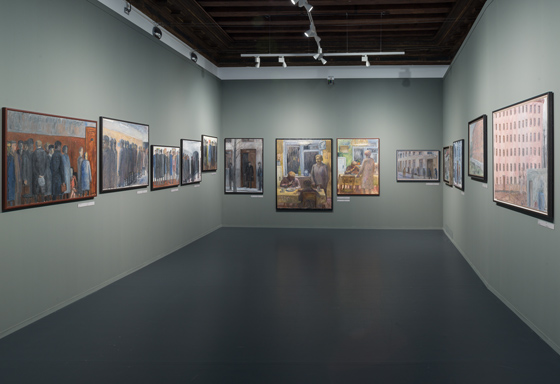
This topic continues in the gray multi-figure works of the 1990-2000s. Roginsky people are “I” in the place of another. “The line for reception”, “bakery”, “at the entrance”. “On the platform” - a series of gray figures, frozen in front of the metro tunnel in existential horror of expectation. And the faceless people on the “Vernissage” is almost a grotesque resembling yesterday's opening of the exhibition at the KOSKARI, and at the same time an almost religious procession (“Dzhottovsky strings”, says Liana).
 © Yuri Palmin
Roginsky writes almost hermetically. The restrained but open palette of Soviet life is replaced by an incorrect, almost deliberately dirty letter. No wonder during this period Roginsky is occupied by the theme of “bad painting”. Decorative color is the main danger that he always fled. Something opposite to the nature of painting. Like a red word in poetry. His Moscow courtyards, rows of impermeable windows, gray houses, melting snow - are primarily domestic landscapes, and if you look for Parisian parallels, do not Pissarro and the brand that he speaks of Paris, but the frozen Parisian streets and deadlines of Vorillo - lines and colors of his inner life come to mind.
And the huge 2.5-meter interior work of 1981 looks quite a revelation. The diptych of the stairs on the bright raspberry wall (“Pink Interior” I and II) rivets to itself and no longer let go. The warehouse of books in the corner of the canvas, pumped smears and free sinks turn painting almost into an abstraction, and yet his letter never interrupts his common blood flow with a deep life of things.
"Obachr" is a new stage and a direct continuation of the shelves of the early period. And the gray-pink “bathroom” (for me is the best work of this period) with its unexpected pearl light for the Roginsky-with all the documentary detail, not so much the approval of the current state of affairs as the promise of another, cud--wing light. The very Pasternakovsky "light of everyday life."
Each Mishin’s exhibition for some reason is necessarily accompanied by a scandal.
Unnoticed, having gone completely unwell paths through the Moscow courtyards and apartments, bathrooms and kitchens inhabited by Soviet pellets, Roginsky comes to such masterpieces of 1981 as “hairdressers”, “showcase”, “buffet” (a picture that was presented by Roginsky at an exhibition of Soviet art in Guggenhaim in New York).
- Hopper? - I ask Liana.
- Yes, partly. But Misha began to write in Khopper, not even seeing Hopper.
But this is only a stage. One of the cycles. As soon as he went out onto the skill plateau, as something again requires care. He cannot be linger. Even the good coziness of the corridors is not for him. And Roginsky makes an enchanting jump into a new expression. Toothpiners. Steam locomotives. In the birthday wife, the work of Nana Brosse Bien's birthday , a open mouth with a toothbrush recall the abysses of a different order. "Saturn, devouring his son" Goya is his direct ancestor.
“I am not an artist. This is my job, this is what I do, but I do not want to be an artist. I could be a priest or a robber of banks ... "
In a half -hour film made by Vadim Zakharov, Roginsky manages to tell a lot. Delicious frivolity and depth of direct speech reveal more and more opportunities for reading his work. The pendulum between “be” and “to have” sways to maximum points. The ability to "be" to the end is a priest. And the desire to have if it is impossible to have a legal thing is the destiny of a robber.
3.
The exhibition is divided into entertained sections, each of which corresponds to its own hall, sometimes two. But if the architectural solution and division of the exhibition space can become a kind of standard of how the language of architecture can speak of great painting, then its structure and the accompanying texts of the curator Elena Rudenko cannot but cause bewilderment.
The artificially fictitious division into the artist invented by the artist is especially contrasting with the minted aphorism of what Roginsky speaks of himself and his painting in three videos presented at the exhibition. Several halls on the walls are given quotes from Roginsky himself, and their intelligible simplicity only enhances the feeling of awkwardness for the art history of curatorial explications: as if the wind mixed up the signs, causing random words that did not clarify anything, but only create another barrier to meeting the viewer and life-life. While the architect deliberately set himself and largely fulfilled the task of the guide to Vergiliev, without imposing himself, the curator seems unconsciously took on the opposite role of Ivan Susanin.
And the statement from her introductory article looks quite strange: “It is best, as you know, those who are engaged in it directly understand the painting, but most artists - Roginsky belonged to them - do not own the skill of spectacular auto -combination.” In the touching confidence that she owns them, Elena Rudenko cheerfully imposes the names of the sections (from the “ABC of two-dimensionality” to the “archeology of the structure”), and comments on them, in which she takes the courage of interpretation, but does not report any facts. (Fortunately, in the catalog, all curatorial entrance texts are removed, only quotes from Roginsky himself were left.)
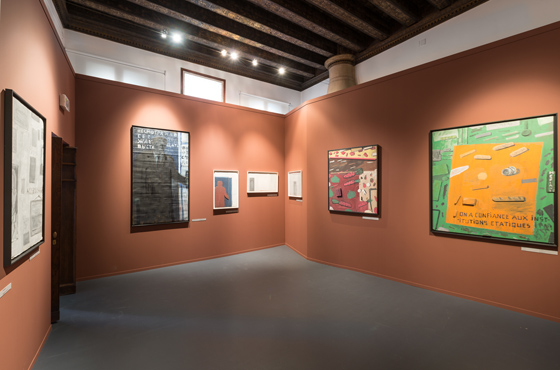 © Yuri Palmin
Other people's words in the case of Roginsky are generally ballast. The role of texts in his painting is akin to the role of radio in the first frames of a film. Set a historical, geographical context, and then shake it like dust from the feet, and go further. In the depths of the canvas. In full color. In the lively, not in art. The inscriptions and texts in Roginsky’s things are primarily the experience of liberation from them. The outlines of letters, typography, the matter of the text itself become part of the picturesque fabric through which everything else is read - what the artist himself denotes a simple formula “drawn life”.
The linguistic component and its relationship with painting tormented many artists. The fact that falls well on the tongue is prevented from expressing something next, blocks his path. The verbal basic, our Judeo -Christian culture opposes painting as such. “Our monotheism was bought by expensive price. In the name of his Jews, they had to refuse to look at nature with their eyes, and not just their souls, ”said Mark Shagal. Maybe that's why - unlike, for example, the Italians - for us, the heirs of this culture, the verbal world seems more effective than, it would seem, more direct visual experience. Painting is easy not to notice, pass by. In paradoxically, this has become even more noticeable today, when the pseudo -storage is replaced by a daily traditional verbal culture. Comics, advertising, computer icons and phones, logos - the entire visual primitive hieroglyphic penetrates consciousness easily and without effort, not falling on any cultural ground, and thereby atrophs the habit of meaningful visual reading of painting in the same way as for the usual reading of literature. According to its destructive consequences, the current visual advertising-screen inflation is not inferior to the verbal inflation of the Soviet era with its ideological posters, slogans, rumors, an unchanged background of the whole life of the then life.
This is my job, this is what I do, but I do not want to be an artist. I could be a priest or a robber of banks.
Roginsky moves with the era, but never goes on her occasion. Так, в работах 1985 года, стоящих и в живописном плане совершенно особняком, текстовой материей становится уже не плакат и не газетная вырезка, а почти комикс. Рогинский открыт всему западному искусству так же, как и российской действительности, его вскормившей. Этот синтез очень ярко виден в работах 1980-х. «Я хотел выйти из русского гетто. Из гетто я вышел, но в Париж так и не попал», — говорит он с мягкой самоиронией, столь несвойственной эмигрантам. И рядом очередная кураторская находка — совершенно по-советски сформулированный заголовок «Борьба с “искусством”». В случае Рогинского звучит и вовсе как двойная ирония.
Когда проходишь по выставке, трудно отделаться от ощущения, что сопроводительные тексты куратора выполняют по сути ту же роль: налепленные слои случайных слов на холстах Рогинского, через них нужно пройти насквозь, чтоб прийти к самому Рогинскому, словно они призваны стать одной из ступеней общей концепции выставки — «Рогинского смотреть должно быть трудно». Глаз действительно не обманешь.
4.
Рогинского хотят присвоить все. Классик нонконформизма, отец «русского поп-арта», «русский Моранди-Хоппер-Бэкон-Уорхол» (вычеркни ненужное). Ему приписывают соц-арт и абстракционизм, чуть ли не подбираясь к концептуализму. Однако Рогинского стоит просто смотреть. Открытыми глазами — как впервые. Он художник без эпитета.
Нонконформизм Рогинского — ни в коем случае не борьба с советской действительностью, как большой художник он вообще шире, чем какая-либо борьба. Его нонконформизм иного качества. Это прежде всего путь и поиск. А поиск правды — будь то поиск недекоративного цвета или формы — не может не привести к конфликту: нонконформизм как антикомфорт, как путь, проделанный впервые, не вопреки, а помимо, без учета разметки. «Не придумывать новое, а сказать тем же языком свое».
В залах Ка' Фоскари нынешняя выставка смотрится уместно именно за счет органичности этого конфликта. И, отступив назад на два шага, даже гламурно-скандальное открытие можно логично вписать в концепцию «неправильной выставки» — когда уста, славящие нынешнюю российскую власть, и руки, доставляющие тайком почетные академические регалии одному из ее самых одиозных представителей и плагиаторов, произносят вступительные речи и пишут слова о нонконформизме и подавлении свобод, совершенно не замечая их горькую иронию. Занятен и текст Бурини к каталогу. В последних его абзацах я не без удивления узнала почти дословные фрагменты ее же собственного текста, написанного к моей выставке семилетней давности «Ежедневные иконы», с теми же цитатами из Лотмана и Топорова. Сближение, конечно, для меня лестное, но едва ли уместное.
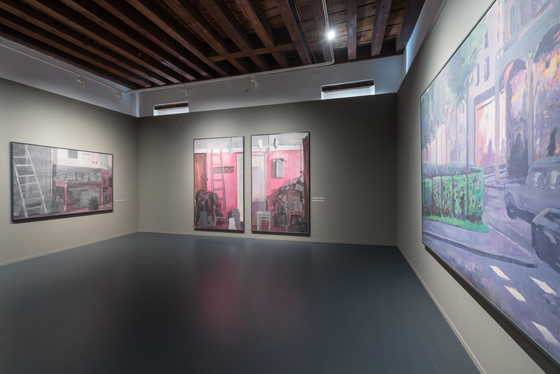 © Юрий Пальмин
Действительно, на выставке такого художника политические скандалы, денежные аферы и просто мелочная месть кажутся уж совсем неуместными и несоразмерными, однако, если додумать до конца, — в этом есть своя логика. Точно так же нагревание и воспламенение — всего лишь второстепенные закономерные эффекты попадания света в фокус линзы, в точку, после которой в точном соответствии с законами физики преломленный пучок света не может не разойтись лучами во все стороны, высветив истинный масштаб большого художника.
Дело идет к полудню. На выставку постепенно начинают собираться посетители. У входа специально обученные девочки — студентки Ка' Фоскари в красных маечках с надписью mediatore culturale лепечут что-то заученное о ready - made и красной двери, символизирующей железный занавес.
Лиана морщится: для нее эта выставка — прежде всего попытка как раз показать всю мощь и наднациональность Рогинского. Открыть его широкой европейской публике. Вывести его из русского гетто. И снова вспоминаются слова Рогинского: «Из гетто я вышел, но в Париж так и не попал». Отнюдь не по вине художника отчасти то же ощущение складывается и с нынешней венецианской выставкой. И все же на этот раз есть надежда, что, несмотря ни на что, перекрыв собой все концепции и амбиции, сработает эффект чисто зрительного накопления и потрясения и Рогинский будет увиден теми, кто еще не разучился смотреть настоящую живопись так, как она этого заслуживает.