
Translated material
Recall Kholin
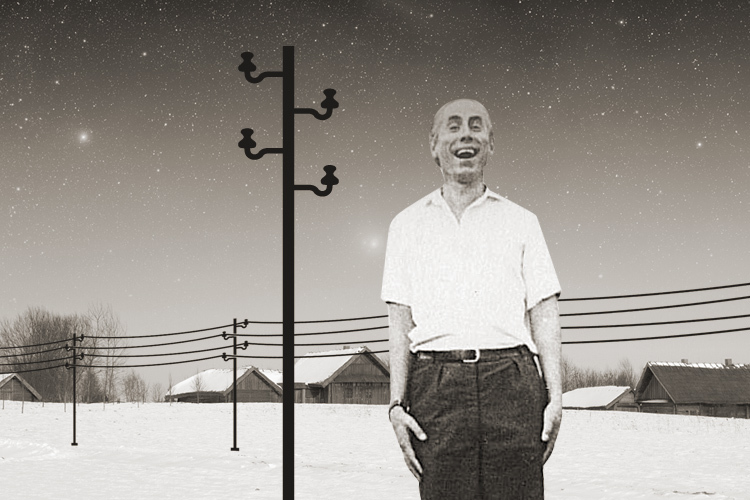
The 15th anniversary of the death of Kholin in the public field was marked by the article by Alexei Konakov.
It seems that the free field of interpretation is almost the main thing that the reader of poetry has. However, such a “free” attempt to read Kholin “politically” forces a dispute. Especially when it comes to a new generation of critics, poets and readers, for many of which the experience of the “Lianozovo group” plays a much less role than for the same generation of Babylon. In recent years, poems of the Armed Forces have been actively compiled and reprinted. Nekrasov, Satunovsky; Close to this group, Eduard Limonov, again began to actively write poetry in which he stubbornly reproduces the poetics of many years ago, where the coupling “Cenitism - eroticism - total irony is an acute -social message” no longer causes any cultural affect. However, it is impossible to say with confidence that for many poets of the younger generation, the reprint of Nekrasov and Satunovsky became a significant reader event. The line “Dragomoshchenko -Schidan -Glazova” and further now turns out to be important now. But the poetic agendas inside one generation vary significantly, and the blacker the air around, the more convulsive, they change faster.
Gennady Aigi writes in Two Posts: "Poverty is seriousness (how serious children are)." Now it seems that the entire acute -social fuse of new poetry, one way or another directed to the left, is just very serious (the exception is, perhaps, some texts of Nikita Sungatov). There is no talk of any relevance of the “ironic” line. What are we poor, anger, exhausted? And if the revolution (it doesn’t matter, imaginary or real) is a matter of children, does this mean that there is no reason for childhood laughter inside it?
Any poetic text can be read politically.
On the day of Igor’s death, not a single drop of rain defiled the earth. The air worn out of the heat broke out the earthen worms and looked at the gathered crowd of people with blue eyes of blurry. Igor’s soul was still ahead of time with the usual medical dexterity was stuffed into a large canvas bag. Without waiting for the removal of the body from the hut, the bag began to bounce and slowly rise. Under the pressure from the inside, the bag broke off with a cool laugh. From the canvas wound, the splendor of gold and silver spilled onto the crowd standing below. And those who gathered in the hut open their mouths to catch on the fly and get enough on a freebie. On the day of Igor’s death, the era ended. The boys and girls brought flowers, made up round dances. And no one knew whether it was necessary to start dancing. The dog of a draw with long ears and lichen on the thin sides approached a huge bunch of shit at an endless fence.
(George Bull, "And when Igor Kholin died")
Considering Kholin “politically”, while paying attention to only the “barracks” line and the slice erotism in its texts would be a mistake. Because there is not only “lyrics without lyrics”, but also:
Human
Sitting behind a prison grate
Lion
Sitting
Behind bars of the cell
Birch is worth it
Behind bars of the fence
Earth
Behind bars of stars
Kholin goes into space with everyone. Kholin is generally cosmic. In Kholin’s verses, the critical position has grown so much with the lyrical subject that the Earth of poetry does not attract him anymore, it can be “as if” to leave. But the “critical” here exactly modifies the “lyrical”, and does not push it out. The subject himself in the poetry of Kholin behaves shocking all the time. It seems that he, at some point, who realized himself in the language and only in him, begins to express himself, slyly naughty, so sometimes his antics literally break out of the pages.
Kholin has a horn
On the lower back
What are you
If you want to make sure of this
Attention
I take off my trousers
Hand
Bitch
It is impossible to build “barracks” cycles of choline only to criticism of “machinery”, “associations of robotic people”, and even more so to prescribe this criticism in the legal department, as Konakov does. Before us is a criticism of the Soviet project and (which is not always) Soviet reality. But can it be argued that this criticism passes along the “conservative” line? The texts of non -certificate authors are convenient, which allow themselves to consider themselves even on the right, even on the left and resist attempts to identify their aesthetic “political” in that unique historical situation when political engagement, an open politicized position was deadly. But does this mean that the “political” disappears from these texts? Does this mean that the generation of the 1990-2000s inheriting non-certificate tradition can be objectively comprehended as an apolitical, and not as a generation that needed a certain time to comprehend actual poetic traditions and a new state of society, which we received at the exit from the “non-certificate literature” and the Soviet Union? This generation, I think, was not “isolationist”, but, as we see today, quite ready to answer the political challenge of time, whether it is the translations of Andrei Saint-Senkov, the songs of the Arkady Kots team or the verses of Stanislav Lviv. Recall that the author of the article “Song of Holin” in a sense inherits the famous position of Kirill Medvedev , however, distorting her challenge to recognition. In this regard, it is appropriate to recall the Almanac “Translit” published in the last issue of Jacques RanSier “Mumb Speech”, at the end of which the author summarizes: “It is useless to contrast the illusion of believers in the absolutivity of literature and the wisdom of the social conditions of its production. Literature - the expression of individual genius and literature - the expression of society represent two versions of the same text, they express the same modus of the perception of works of art of writing ”; And earlier there: “The people are creating a poem. The poem creates a people. "
Any poetic text can be read politically. The position of Kholin himself in relation to the inhabitants of Barack is explained not by the criticism of the gloomy and vague single proletarian body, but by the fact that he just completely identifies himself with this body. Kholin in his elimination of the “author’s self”, which will later appear in a parody-narcissistic game, itself becomes the body of an aborted proletarian, flattened in the middle of the hut, becomes a shit in which it lies. The reverse side of this total irony and cruel objectivism is horror, bitterness in relation to the oppressed people, oppressed as a result of the “great revolution” of the proletariat, bursting through the huts and still existing in his terrible vitality. Already the fact that Kholin’s poetry does not in no way deny poetry as a “weak place”, poetry, which is always on the side of the oppressed, makes it truly political.
It is lying on the asphalt
Cigarette
Box
The sun is in the sky
Smiles
Like living
One drunk
I landed with a head
In the spittail
One important person
He stuck his eye
In the keyhole
Faces of people
Erased
Like heels
I'm funny
I am like everyone else
The desire to unify truths does not allow the right “critical position” to take place. We cannot deny that the “Soviet”, in which the Lianose tradition was born, is a time when direct political non -conformism was, if not impossible, it is extremely dangerous, but the request for non -conformism as a critical and democratic position remained and realized himself mainly through an aesthetic one, which allows us to consider any art of that time politically. It is improper art and poetry that bring to the “Soviet” dialectics, which the culture of the USSR was completely devoid of by the 1950s. As a large dialectical business, the barracks of Igor Kholin can also be considered.
Alexei Konakov easily writes: “In the collective body of the proletarian slums, one could see if you want to see the promise of the universal apocalyptic strike in the spirit of F. Sorel or at least a joyful hope of overcoming death, like Bakhtin’s, but the intention of choline is directed completely differently.” But all the horror is that it was impossible to do this. The Soviet space itself (language, things, events) did not imply any possibility of this. Therefore, the fact that we are now reading Kholin’s poems is a kind of Benjaminovsky miracle. They might not have been. Thinking in such an accusatory way means thinking of a political number of stable practices and formulas transmitted in time and can be actualized and implemented at any time. I am sure that the nature of the political is opposite, extremely performive and at the same time “historical”, i.e. Performatics (including a language performance) is inseparable from the time in which it is done. In other words, Kholin could not want to or not want the Sorevsky strike, he did not even have the possibility of this choice, and this opportunity was controlled by himself, not the subject and not even the Communist Party. It is the worst of all to think of the producing utopian machine of the Discourse of the Soviet-from some point-as the existing in itself, as a self-sufficient one. In this case, the party with all its "bureaucratic totalitarianism" acts only as a shadow appendage of this machine. “In this discourse without a subject, a kind of subtle caricature of a“ process without a subject ”(cf. althusser ), a voice without a name echoes other votes in an unnecessary response invisible to another - an impregnable, but always present” (Patrick Serio, “On the Language of Power: Critical Analysis”). Here, M. Geller will also recall: “The Soviet system is a dictatorship of the language, and in order to fight it, we must first destroy the language of the dictatorship.”
The star of the sky
The sky of the roof
The roof of the pipe
Pipe of smoke
Smoke of a person
For me, Kholin’s poems, which (it happened) I learned much earlier than the verses of Nekrasov, Sapgira, Satunovsky, will always be poems about “man’s smoke”.
Of course, a fatal coincidence is some involvement in Eduard Limonov’s Lianozovites. Especially if we recall that the NBP was established as an “artistic organization”, as a gesture at the intersection of “aesthetization of political” and “aesthetic policy”. However, we will quickly understand that there is no “aesthetic” component here, the aesthetic leaves the NBP literally - along with the physical death of Kurekhin, with the self -removal of Letov. If you try to understand the connection between the poetry of the Lianozovites and the National Bolshevism of the poet Limonov, between the communism and the National Bolshevism of the summer, then through these words Paolo Virno: “European fascism at the turn of the century is a twin brother, that is, the frightening“ double ”, the most radical manifestations of freedom and community that arise in a situation of crisis based work of society. This is an ominous caricature that men and women could do in an era of universal communication, when knowledge and thought skillfully impersonate the common good. This is the transformation into a nightmare of what Marx called a dream of an object. <...> In short, the new fascism appears to be a civil war inside the executive work space, struck by technological storm and post -phraseed ethics. It very closely affects mass intellectuality, autonomist and anti -state impulses, any “ordinary singularity” and citizens who have fierce the Society of Spectacles ”(“ theses of new European fascism ”). The right becomes a double of the left, its reflection in a crooked mirror. Political engagement for young generations becomes like wandering in a dark forest, in a night fog: “To see the twin brother in the face means placing his own practice in a state of emergency, when the most favorable course of events is always fraught with catastrophe” (ibid.).
Publishing the people, labor and lyrical subject in the rays of unbridled monotonous eroticism, injuries and bowel movements, choline, by and large, inherits the European literary tradition - from Boccaccio to Baudelaire. And poetic scatology in conjunction with the theme of the people, characteristic of the European parody almost from the moment of its occurrence, is generally a separate topic for in -depth research. Holin's bowel movements are not only part of the Soviet reality, but also part of European culture, part of the letter and nature of the poetic:
When you will
Turn me away
From the house
To nail it
To the telegraph pillar
Please
Do not forget to take it
Night pot
He
As always
Under the bed
In the legs.
So George the point in prose to death Kholin describes the monument to him as an unfinished monument from a heap of shit: "And when Igor Kholin died, we all continued to stand in this long hut, with this long fence, with this bunch of a shit of an unfinished monument." So we stand.