
Translated material
Collective actions
Crowning the first season of Andrei Mighty as the head of the Bolshoi Drama Theater, the play “ Remote Petersburg” already looked in absentia with a kind of declaration of the intentions of the new artistic director of the BDT. Invitation to cooperation of the legendary German theater group Rimini Protokoll and, as a result, the creation of the Russian version of the whole Europe and continuing the victorious procession throughout Asia and the east of the Remote X project, which is called, kills several hares at once: to set the pro -European (not too much, however, knitting with frankly wild repertoire plans for the next season) Vector of the artistic policy of the renewing BDT , making St. Petersburg one of the units of the woven Rimini Protokoll world theater network, and to identify other strategic guidelines important for the host of the Bolshoi Dramatic - the perception of the theater as a tool of communications and as a social institution, a well -covered city and peace. Together with Andrei Mighty “ Remote Petersburg” released in February, the program therapeutic diptych forms, the first part of which looked like a psychoanalytic session For the troupe of a large dramatic, and the second looks like a session of vision correction for the public of the Tovstonogovsky Theater, looking for a new fate and preparing to open the doors of the restored historical building a few months later - exactly after the completion of the Remote Petersburg premiere shows.
Following Bangalor and Beijing in St. Petersburg, Rimini Protokoll was not met as carriers of the actual theater code, but as guardians of European sociocultural values.
Time played up the BDT, surrounding the appearance of Rimini Protokoll on the domestic stage with a gloomy public context of recent months, the acoustics of which forced Remote X to resonate with especially expressive political overtones. The differences between “ Remote Petersburg” and perhaps the most successful of the recent versions of the performance shown last summer in Avignon are visible to the naked look: there Rimini Protokoll made “Remote” as a serious existential experience, here the metaphysical was forced to give way to the project - although the authors of the project, reasonly, did not have anything in sight. Having preserved the features of the structure, which was well familiar from the past European localizations of the project, in Russia the favorite brainchild of Stefan Kagi and his comrades sounded completely different - as the creators of the performance themselves say, with “Remote X” happened more than once: after Bangalor and Beijing in St. Petersburg, Rimini Protokoll was not met as carriers of the actual theater code, but as Guardians of Western cultural values. The art action unfolding in the public space, “collective actions” exploding the monotonous life of city streets is exactly what Petersburg lacked in the summer of 2014.
 © "Russia Today"
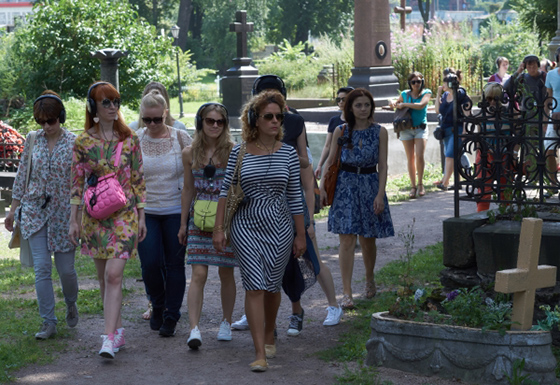
The scenario of the Russian incarnation of the project, we repeat, resembles all other versions of “Remote X” : the general fee is in the cemetery, not so much by viewers as the actual creators of the performance commands the computer voice that is heard at the start of the headphones, the “ Remote Petersburg” is held along the key city arteries. The plot was not undergoing significant changes: Rimini Protokoll suggest seeing the city as a scene, and the surrounding life is like a complex large -scale production, while giving it to co -authors the opportunity to be behind the scenes of the everyday life theater.
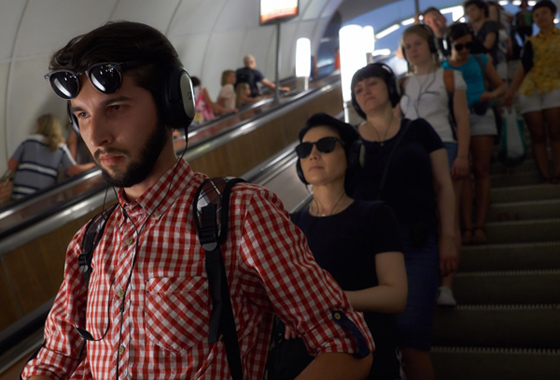
At some point, you catch yourself thinking that “ Remote Petersburg” is actually a very St. Petersburg project in the letter and spirit, which is very organically feeling in the city of formalists and the Pond-all the more having the founder of the “formal theater” in the godmother's godparents. “ Remote Petersburg” is an artistic text, exactly according to Shklovsky “artificially” created so that perception on it is delayed and reaches its high strength and duration ”, consistently focused on the removal of the perception of the text of the city-but along with it and the text of our lives. In one of the key scenes “ Remote Petersburg”, the participants descended in the subway, out of habit, rely on the railing of the escalator - but the voice sounding in the headphones convinces them that they are standing at the ballet machine, offering to make a class. For a moment - and fifty people under the amazed glances of others are inclined in Exrasus.
 © "Russia Today"
Meeting the participants of “ Remote Petersburg” at the very beginning of the route, in the Alexander Nevsky Lavra, the virtual guide sounding in the headphones reminds that we “grew up in an artificial environment, but over time we will become part of nature,” and suggests the question of which of the tombstones that are found on the path we would choose for ourselves. Read the name of the person lying under this grave plate, the voice says: you are more now than him when he died - or less? A computer guide asking the question "What will remain from you after death?" And promising that he will never forget us, sounds the voice of the Chekhov general world soul. Promising that after a meeting with him, the participants of Remote Petersburg will never be the same, the virtual Virgil, in essence, is not lying. Balancing on the verge of an in-depth-being and durable gaming, “ Remote Petersburg” broadcasts the humanism completely unusual for the domestic realities of friendliness-not forcing to frown and does not cause a desire to hide in the cocoon of postmodern irony.
“ Remote Petersburg” is not a theatrical tour of the northern capital and not an entertaining study of urban mythology. This project least wants to solve local history, so to speak, problems: “Remote X” , in essence, is not about the distinctive features of certain cities, but about the unified reality of the existence in them - Rimini Protokoll change the optics of the life of life as such. At “ Remote Petersburg” you understand that it is this property that combines into aesthetic community the most important phenomena of the world theater of the early 21st century - bringing closer to such unlike universes Alvis Hermanis, Robert Lepage, Katie Mitchell and Rimini Protokoll . Their main performances - even “Platons”, even “Lipsink”, even “Christina” or “Remote X” - are united by the desire to see ordinary reality at an unexpected angle that turns the usual vision of the world 180 degrees. And also - emphasized attention to the human person, the desire to give everyone a point of support in the rapidly losing equilibrium of the world.