
Translated material
Jonathan Mills: "All Russian is my beloved"
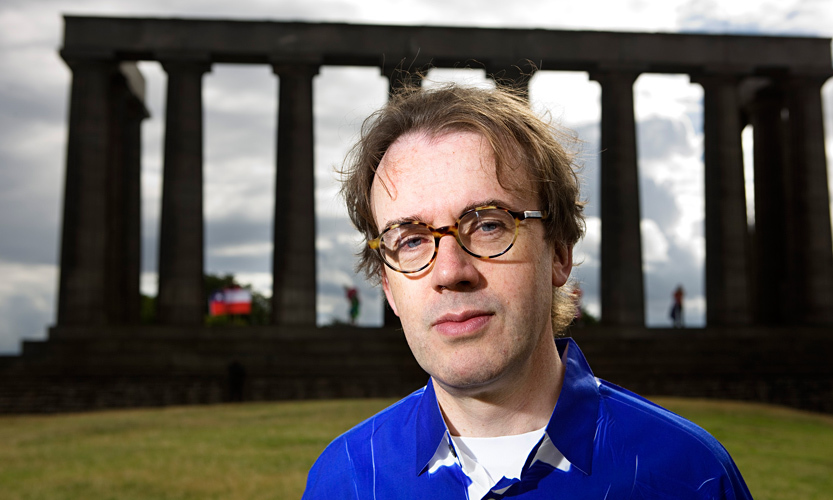
In the capital of Scotland, one of the largest theatrical forums of the world was opened - the Edinburgh International Festival , which is held this year with a strong Russian accent: the headliner of the musical program - the Mariinsky Theater and Valery Gergiev, one of the key events of the theater block - the premiere of the play of Vladimir Pankov “War”. COLTA . RU publishes the decoding of Public Talk Director of the festival Jonathan Mills with the art director of the Meyerhold Center Elena Kovalskaya, last month ago in the capital's educational center Garage.
- The last time we saw each other exactly two years ago on the Strelka: I interviewed you to the premiere of Dmitry Krymov’s play “Summer Night”, which was then preparing to show at the Edinburgh Festival. What brought you to Moscow this summer?
- I will not be cunning: the last few years have been difficult for the relations of the governments of Western Europe and your country. Therefore, it seems to me to be especially important to show solidarity with your leading artists and to note the work of Russian directors - especially before the premiere of the play “War”, which will be held in Edinburgh in August. The world is not only politics, finances and statistics, not only the space of naked facts, measurements and numbers. This is a more complex and subtle reality - I hope that in our conversation we will highlight its poetic side. I am here in order to pay tribute to the poetry that we can perceive together, the poetry of Russia, which we respect and which has always served us as a source of new knowledge. Your literature, your ballet, your art enriched our life. You represent a point of view that is different from ours, and we must pay tribute to it.
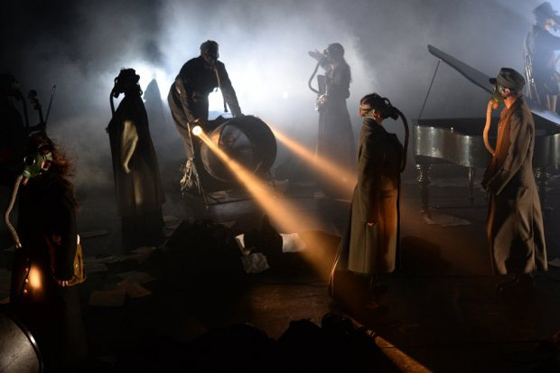 © vladimir vyatkin / edinburgh International Festival Scene from the play "War"
- We turn to the formal occasion of your arrival. I work in the Meyerhold center and, sitting in the office, I constantly hear the GOGOT, music and the clatter of the KIRZA boots - this is Vladimir PANKOV rehearses the play “War” dedicated to the events of the First World War. In August, he will be represented in Edinburgh - whose idea it was? Your or the Confederation of theater unions of the Chekhov festival, in the collaboration with which the Edinburgh festival acts?
- “War” is the result of the dialogue that I led with Vladimir Pankov for many months. I well remember how several years ago we said that the time of the premiere of the performance-August 2014-will carry many meanings. On June 28 - on the very day when the Herzduke Franz Ferdinand was killed 100 years ago - I was in Sarajevo at the very intersection where everything happened, and became a witness to the attempt to heal the wounds inflicted by the events of centuries -old prescription, and at the same time attempts to recall what was blinded by all of humanity. This year in Edinburgh, we strive to pay tribute to the memory of the tragedy that occurred 100 years ago: after all, our festival is a direct result of the events of the Second World War. The Edinburgh festival owes their lives to people who looked back at their past, scratched the back of his head and said: “The First World War was to become a war that would lead to the end of all wars. But as a result, new ones erupted - including the terrible and devastating second world. When will it end? Is there any way to do without killing each other? How to do it? We cannot return only to politics, we cannot do with statistics - we must do culture. ” Here, probably, we can recall that at the very first festival - by the way, he was quite provocative for those times - the first orchestra who performed in Edinburgh was the Viennese Philharmonic. Today it does not seem particularly strange, but if you think about 1947, then remember that two years before that the musicians of this orchestra would be in a British prison as citizens of a hostile country - although they were just musicians, carriers of European culture.
So, I talked with Vladimir Pankov about how I would like to use the capabilities of the Edinburgh festival in order not only to study the facts and circumstances of the First World War, but to look at the wide panorama of history, at what is associated with the relations of cultures and their conflicts - thousands of years ago, hundreds of years ago and today. I was very surprised and struck that, despite the scale of the festival and how much music was played in different years, the seventh, Leningradskaya, the symphony of Dmitry Shostakovich would be played this year in Edinburgh for the first time. It will be performed by the ensemble of musicians from Georgia, Azerbaijan, Moldova, Poland, Belarus, Latvia, Estonia, Lithuania, gathered by the Polish Ministry of Culture and the Institute of Adam Mitskevich, the conductor will be Ukrainian - think about the symbolism of this gesture! The work of your great compatriot will be interpreted by people who lived along the controversial border. This is exactly what the culture can do: to reach those areas to which politics cannot reach. Culture can construct meanings at the time of the dispute, when logical arguments cease to act. Culture can create space and open opportunities - and we must use it.
In how the artist works, in principle, there is something subversive.
The program of the current festival is arranged in such a way that wherever we look, it always has a dimension associated with the relationship of culture and conflict. When the war begins, we lose control of our fate. The play "War" tells the story of a group of young people who are found in Paris in December, on the eve of the Christmas of 1913. They imagine how they will live in the future. We know how mistaken they are in their forecasts. Their lives will probably be full of events, only this will be by no means the events that they dreamed about. This is what the art achieves - to tell us about our fragility, about the need for humility, about the need to overestimate our actions, about the need to maintain human dignity even when it becomes infinitely complex.
- You are conceived by a festival, which will also discuss the problem of the conflict and which brings together people who would find themselves on different sides of the barricades in ordinary life. And next to the international composition of the orchestra, playing under the control of the Ukrainian conductor, we see the name of Valery Gergiev, subjected to ostracism in many countries and at many festivals for supporting the policy of Vladimir Putin in Ukraine and Crimea. How do you think the audience of the Edinburgh festival will react to this neighborhood? Are you afraid of a boycott?
- I want to believe that this will not happen. I hope and I think that it will be met at our festival: Gergiev is a great creator. Of course, his figure was the reason for the controversy in the UK because of the position on the Crimea-but this story has two faces. Now I will not discuss here who is right and who is to blame: not one of the problems we encounter today will be resolved that we will let the artist share his work with the public. We need to observe some distance, some removal between the space of politics and the space of art. It is interesting that Gergiev comes to Edinburgh with the “Trojans” of Hector Berlioz, an amazing production of Yannis Kokkoos, transferred to the Mariinsky Theater from the Parisian opera. “Trojans” can become a good metaphor for a large number of controversial moments in the history of mankind: opera Berlioz proves to us that there is nothing new under the sun. Now look: along with Shostakovich under the control of the Ukrainian conductor, we have the program of Berlioza under the control of Gergiev - and at the same time, the concert of Jordi Saval, which will conduct the music of North Africa. We are betting on those who are interested in contacting different cultures - this is the essence of the cultural dialogue.
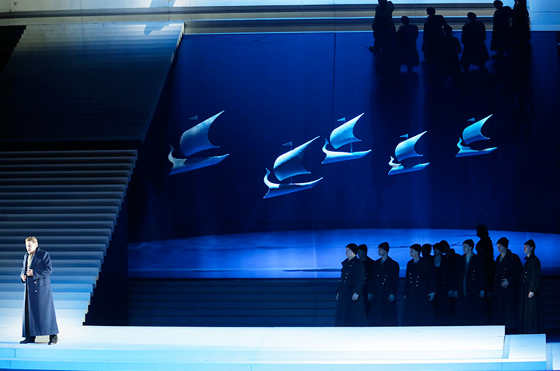 © Mariinsky Theater Scene from the play "Trojans"
Returning to your question: if you really honestly, I don’t know whether there will be boycotts or not, it is difficult to predict whether the world is complicated. But what I am sure of is that Mr. Gergiev will fully support the rest of the festival. We are glad to see him, he is a great friend of Edinburgh. For the past five years, we have repeatedly been in situations that gave rise to disputes and conflicts. Israeli artists became victims of terrible boycotts - but retained dignity, retained their positions at the festival, and Edinburgh's artistic space lived. At the same festival, I remember, we called the theater troupe from Palestine. Everyone protested about the rights of the Palestinians, boycotts of the Israelis, but for some reason they did not pay attention to the fact that we invited the Palestine troupe to Edinburgh. Then I thought: did we leave behind the world in which the protest is important, and not support? Where is the idea not important, but is the noise around it important in the political arena?
- What is most important for you in the program of the Edinburgh festival of this year? What would you advise in the poster to pay special attention? What is the reason for the appearance at the festival of a rather large number of artists from Africa?
- To answer a question about Africa is easier, because it will be difficult for me to name my favorite works in the program. They are all loved: that I do not like, they do not bring to Edinburgh. The African accent is explained quite simply: this year it turns 20 years old in the first free elections in South Africa - 20 years have passed since Nelson Mandela was elected President of South Africa. In addition, South Africa as a member of the British Commonwealth is our important partner. We bring four projects from South Africa, two of which are closely interconnected: all of them, it seems to me, give a concise and laconic idea of what is happening on the South African cultural scene. Answering your dishonest question about my favorite works, I can only say one thing: everything is Russian - my beloved.
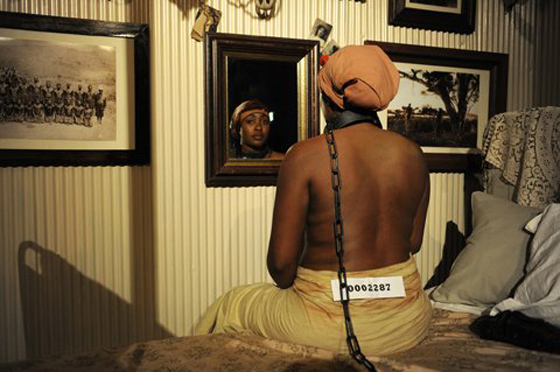 © Sofie Knijff \ Edinburgh International Festival Installation "Exhibit B"
- A paradoxical situation: a festival that defends the independence of art from politics nevertheless shows performances with a distinct political sound. Simultaneously with the Edinburgh International Festival in Edinburgh, many independent festivals are held, which are, as it were, under the head of the main one. How many of them will be this year?
- To be precise, eight festivals are simultaneously taking place in Edinburgh in Edinburgh: a total audience of about a million people, 25-30 thousand artists, about five thousand productions, 350 theaters and sites, participants and spectators from about 85 countries - a cultural context, you must agree, quite wide. Of course, I must notice that I am fighting for the festival spaces to be separated from professional policy. Notice, I'm not talking about the fact that artists must distance themselves from being politically engaged-the artists do what they consider necessary and build their artistic and social strategies differently. Politicians enjoy power as a weapon, and artists are trying to change our perception, our way of thought. This is another power, the power of belief, poetry. The language of poetry is extremely complicated, tenacious, suggestive. Even in countries where censorship appears, artists find a way to express themselves. In how the artist works, in principle, there is something subversive. He must clearly, but at the same time subtly and not too directly express his thoughts. Of course, there are forms of art that are in no way connected with the grammar of everyday language. Music is a language in itself, there are no moods or past tense in it. The dance is also, it hints on a lot, but you, as a viewer, get the right to interpret certain images.
In Edinburgh, we traditionally show very complex, controversial, entering each other in the clinch of work. We protect the breadth of the spectrum of voices sounding at the festival. It seems to me that Edinburgh is so successful precisely because there is no one vote that would explain that it is the festival who wants to tell one or another of his program. There is no unidirectional movement: Edinburgh is a multifaceted organism, and this is his secret.
- How do you formulate the core of your program with such a variety of festivals? When you talked about countries where the artist is forced to express himself in censorship, did you mean Russia? You found Moscow at the time of the emergence of a new cultural policy: we, for a long time forgot what it was, again begin to feel that censorship appeared. We do not want to return to her, but there are people who say that censorship is useful to the artist, because he has boundaries that he can overcome. What do you even think about censorship in art and culture?
“I will answer your first question first.” How to introduce logic and structure to a large festival organism? Each of the forums has its own view of their own device. My festival is supervised and modified - I am its artistic director. I set the tone, set the direction, set the framework for him. I do not invite the participants simply because I like them, it would be absurd egoism. Each time, when laying a festival program, I have to answer many questions. The festival is an experience expanded in time, and each time I have to answer the question: why are we taking this trip? After all, we live in a world where, in addition to artistic, there are many other problems: financial, climatic, political - and so on.
We need to observe some distance, some removal between the space of politics and the space of art.
For those eight years that I have been working in Edinburgh, the routes of our travels have changed a bit. The way I always tried to make the festival, I tried to be on the same wave with modernity, with its constantly changing circumstances. These circumstances took us away from Europe - because the world has changed: the center of the planet is shifting towards Asia. Therefore, this year, our journey, it seems to me, will allow you to study various aspects of the relationship and conflicts of cultures, look at them with eyes, ears and all other senses of artists who have created for many thousands of years. This is a very valuable experience. The festival will be devoted not only to the First World War, the program will be much more comprehensive and, perhaps, more terrible for our viewers - but also deeper. So, one of the oldest texts we turn to will be “Mahabharata”: however, we will show the not famous performance by Peter Bruka-many could see him, but a much more concise version of one of the most important choreographers of Britain, the Khan , where only two performers participate-he himself and the Taiwanese dancer of the Asian musical musical ensemble. This grandiose work describes the creation of the Hindu world, its occurrence from the struggle.
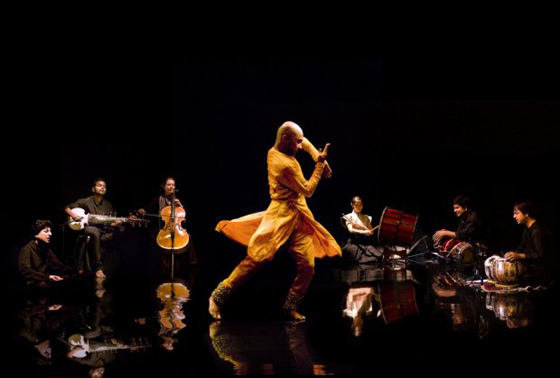 © Richard Haughton \ Edinburgh International Festival Scene from the play "Gnosis"
Your second question was about censorship. Inside the art community, there will always be disputes about whether it is viable, is it meaningful, good or bad-and people will defend their ideas with passion: all this is necessary for art because we do not work with confidence, we deal with thin questions, half-tones. It is necessary to find a thin line between disrespect and dispute, dialogue. Absolutely, even before all censorship, there was a dispute between conservatives and radicals, avant -garde and traditionalists. There will always be beautiful artists and beautiful radical artists, and it will always be difficult to completely agree to the artistic community, to believe in something unconditional. I cannot give a comment or assessment of your position, the situation in today's Russia, but I can offer the following. Your artists can always get an absolute card blanche at my festival: everything in our power is to try to make our life and our art as open as possible. I believe that in a world where the Internet plays such an important role that defines our way of thoughts and, in fact, the existence of our memory, the establishment of censorship will be a much more complex enterprise for any government. I do not want to say that there will be no censorship or that it will cease to be a problem, but, I think, the context in which ideas arise in our world is fundamentally different from what existed even 20 years ago. And this, I think, is very good. The price of freedom is eternal vigilance, so: we must be vigilant. And I wish you success in maintaining the space of the experiment, in maintaining the openness of its borders - whether it is political problems or the practice of art itself.
- Finally, I would like to talk about cultural policy. We would not have such a voltage now in connection with censorship arising if Russian culture had different sources of financing. 99 percent of culture in the country is supported by the state - this has always been and will remain for a long time. How is this arranged in Britain? It is believed that the strategy of an “elongated arm” as a model of cultural policy today is most effective. That is, there is Art between the state and artists council , куда входят в том числе и деятели искусства, — он перераспределяет государственные деньги, а художники участвуют в решении политических вопросов, в том числе в отношении своих коллег. Нам из России сегодня эта модель кажется наиболее демократичной и совершенной. Как вы оцениваете ее изнутри?
— Я попробую ответить кратко, в то же время достаточно подробно раскрыв предложенную вами тему. На самом деле люди, спонсирующие систему, — это сами художники. Я хочу сказать, что, мне кажется, истоки независимости лежат в самих артистах. Мы можем посвятить много времени тому, чтобы говорить о деньгах, можем потратить всю свою жизнь на обсуждение политических рычагов, привязанных к этим деньгам, — более или менее жесткие в разных странах, они есть всегда. Вы говорили о стратегии «вытянутой руки» — там тоже существуют связи с политикой: некоторые решения, принятые Советом по искусству Великобритании в последнее время, были очень политизированными. Ни у одной страны нет иммунитета от принятия политических решений в культурной сфере. Будь моя воля, я бы остановился на модели смешанной экономики, когда культура является плодом сотрудничества между волей художника, волей аудитории, волей государственных органов и волей частных меценатов — главное, чтобы все это являлось выражением стремления общества осмыслять себя. Я не могу ответить на заданный вами вопрос применительно к России, поскольку не живу здесь. Но я не стал бы поверхностно говорить о том, что мы на Западе уже все решили и вы должны только у нас учиться, — это было бы упрощение, и вполне возможно, что показавшиеся успешными на Западе методы не сработают в России. Вы сами должны задаться главными вопросами о природе общества, а уже потом задумываться о контексте, в котором существует искусство. Возглавляя Эдинбургский фестиваль, я наблюдал за деятельностью культурных институций разных стран и должен сказать, что очень редко бывает так, что главная проблема заключена в деньгах, в финансировании. Проблемы — в ценностях и в отношениях между людьми.
Мне кажется, причина, по которой этот вопрос так провокационен, состоит в том, что на него можно ответить только тогда, когда каждый из вас глубже изучит собственную мотивацию, собственную вовлеченность в жизнь вашего общества. Речь идет о гражданской позиции. Наиболее позитивный пример, который я могу привести, — это опыт Индонезии. Четверть века назад Индонезия была несвободным и не слишком процветающим обществом: это было странное место, и было непонятно, сможет ли оно преодолеть все свои проблемы. Выборы, прошедшие там недавно, — честные, прозрачные выборы в самой большой исламской демократии мира — стали хорошим примером того, как можно обрести свой путь, проанализировав свои проблемы. Возможно, здесь попахивает фатализмом. Президент там хороший человек, и это имеет значение, но важен не только президент: он, в конце концов, был совершенно неизвестен в политике двадцать лет назад и даже пять лет назад. Это был просто очень деятельный мэр города Соло, который изменил его жизнь к лучшему. А затем он преобразил один из самых коррумпированных и преступных городов мира — Джакарту. Таким образом он дал людям аппетит. Я думаю, что ответ на ваш вопрос есть в первом предложении «Анны Карениной» Толстого. И вы все его, конечно, знаете.