
Translated material
Riding the boundaries
The capital of Finland is in relatively walking distance for Russians. There are a lot of tourists from Russia, as, indeed, from other countries. And the city government of Helsinki faces the same tasks as the leadership of other large cities: attracting tourists, developing remote areas, regulation of cultural life. One of the ways to solve these issues was the Helsinki festival held from the late 1960s. The festival is largely focused on the statement submitted to the facade of the Kiasma Helsinki Museum: “Culture = Capital”.
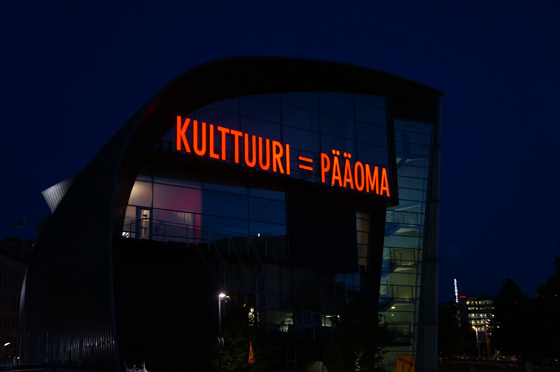 © colta.ru inscription at the Kiasma Museum "Culture = Capital"
The organizers of the festival, first of all, its director Eric Suderblum, and his customers from the city government are largely oriented towards pan -European experience. The festival format is of interest to them, that is, the program of events combines a variety of cultures - from music, modern and academic, to theater and contemporary art. There is also no special internal gradation included in the festival: an experimental art project is adjacent to a serious museum retrospective and popular exhibitions using fashionable network services and phenomena, and a small rock festival in the tent is with the performance of a little-known opera of Shostakovich in an ultra-modern concert hall ; At the same time, the organizers are fully aware of the heterogeneity of such a program. The question of festival here is impossible to raise in the way in which this was done in a recent interview with Viktor Misiano , because, fortunately, no one is trying to issue a festival for something else that happens, for example, in the case of Moscow Biennale of Young Art . The city authorities, like the residents of the city, have an initially request for the festival, by definition of regular and for a wide audience. Around the Helsinki festival there are still a number of mini-festivals, which either include in its program, like the night of art , or are carried out in parallel.
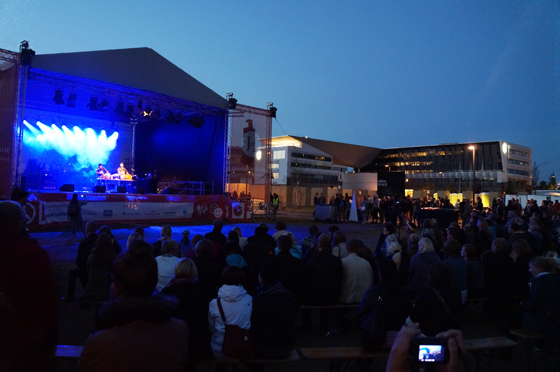 © colta.ru One of Koehehelsinki projects
The logic of the Helsinki festival can be shown on the example of the Koehehelsinki project, which is located in the territory where the railway tracks once passed, storage facilities stood (already in the form of ruins they can be seen now). This is a large platform, dashingly surrounded by wooden cabins - they indicate a border within which those who wish can organize and hold their event (though, as in everything here, you need to submit an application in advance). The name of this space translates as “test Helsinki” or “experiment with Helsinki”. As the author of this seemingly simple solution-the architect Leonard Ma, in the era of Internet worlds as Facebook , Instagram and Twitter , had somewhat forgotten that the first social network was the city, which was originally a platform separated from the surrounding space with a conditional line. It is clear that just as in the case of social networks, city projects like Koehelsinki have certain restrictions - whether it is a limited territory or some rules - but this frame, in addition to restrictions, provides some opportunities. His colleague and co-author of the Koehehelsinki project from NOW Tuomas Toyovonen says that this territory, on which tents, stands and scenes arise and disappears, reminds people that, in general, all architecture is temporary, no matter what materials are used in it.
As for art, several art projects are included in the festival program. The Finnish artist Tommy Tiya, who simultaneously hosts an exhibition in a small museum, built a huge seven -ton sculpture of a “pissing boy” in the city port, against which passers -by are happy to take pictures with pleasure. In general, Helsinki is filled with a public art, however, specifically, this statue will spin this place only until the end of the festival.
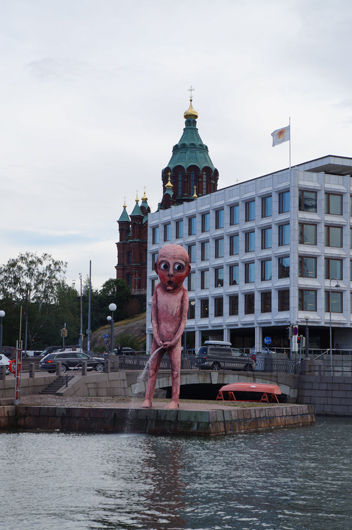 © colta.ru Pissing boy Tommy Toyn
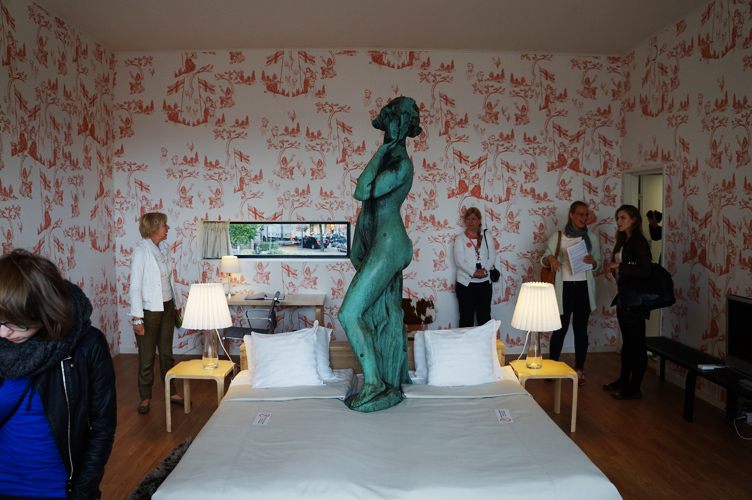
The Japanese artist, a participant in the St. Petersburg "Manifesto" Tatsu Nisha built a hotel room on the fountain, located right there, near the sculpture of Tommy Tyiya. The fountain crings the sculpture of the naked Virgin, which symbolizes Finland. She is called Havis Amanda or Mant. In the Manta Hotel you can rent a room, but only for one night, during the day it is open to visitors. Moreover, this is inexpensive by local standards. The statue literally sticks out of the center of the double bed. The walls are decorated with prints based on the drawings of the Tatsu Nish, and they are also devoted to the stories and images of Finland. In addition, in this issue there is a picture provided by the Helsinki Art Museum, which, in fact, is the initiator of the project.
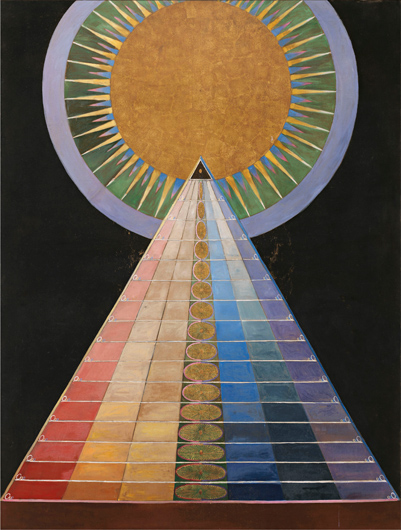 © Media.taidehalli.fi Hilma Af Clint. "Altarbild"
Probably the most important project in terms of the festival dedicated to art is the exhibition of the Swedish artist Hilma Aflint (1862-1944) . The same exhibition was shown a year ago in Moderna Museet in Stockholm with the only difference that the local TaideHalli exhibition hall is not so much space, so it was necessary to reduce the number of work-this difficult selection was carried out by the curator Hannah Mamia-Walter. The works of Afa Clint are shown quite rarely and not all at once, they belong to the fund of its name and are in Stockholm. Therefore, an inconsistent opportunity to see them is really worth using. The artist began with ordinary landscapes, then at the beginning of the twentieth century, along with four more artists, she organized a group DA Fem , which means "five". It is a pity that in the Russian translation “Fem” is not heard, because in many ways it was a protopeministic project, whose participants began to experiment with alternative ways of cognition, clearly anticipating criticism of masculine log centrism. Further after the collapse of the Aflint Clint group, she continued the selected path, while the rest of the DA participants FEM returned to the painting traditional for that time. The organizers of the exhibition represent the Swedish artist as a “pioneer of abstraction”, since the works that are shown here are made earlier than the first recognized abstract works, but Afa Clint painted the paintings under the influence of theosophy and other fashionable esoteric teachings of that time, and therefore it is quite difficult to name with abstraction, as can be called abstraction of various kinds treatises. But the artist, discovered only 20 years after death due to the conditions of her will, is not at all this-she is one of those interesting artists who are little known primarily because they are women, although they were not inferior to many of the major male artists of their time.
The festival creates its own frame. Far from each other, events are placed in one place inside the common boundaries. The randomness and diverse are laid down in the idea of the festival - events, as the townspeople dissimilar to each other, find themselves in the same social network, if we consider it, following Leonard Ma, the city.