
Translated material
Archive and tractor

In the case of a “bulldozer exhibition”, the path from the fact to the myth is extended along and across: the equipment for decorative purposes was drunk in Belyaevo 10 and 20 years ago. By the forces of journalists and participants in the exhibition, she instantly overgrown with semi-heroic-submarine folklore. The art history textbooks resulted in the knocked out teeth of foreign correspondents, who hung Oscar Rabin on the bucket of the bulldozer, dropped along with a picture from some iron pipe Nadezhda Elskaya and retold as a collector Alexander Glezer in a police station, worthy of the best examples of the corrugation series (a kind of lieutenant allegedly told the artists: he said: "You need to shoot only!
And then, and now the “bulldozer exhibition” is perceived as a milestone event, cutting the history of unofficial art on before and after. However, there is an opinion that it was still a roughly worked out social criticism, a war-crying warmer that first went to the street, which was not very interesting to the street, was not very interesting in isolation from the political context.
The painting pulled out onto the Belyaevsky wasteland was believed to be so -so - artisanal art, fed in the Lianoza barracks Oscar Rabin to sell underground collectors and foreign diplomats. An alternative to the eye to the eye of socialist realism, causing curiosity only due to the embarrassed idea of confrontation with the authorities, individualism and rebellion against canons, norms and rules. At least no one managed to see her, at least then-the exhibition is the present, originally made in order to be demolished, lasted no more than a couple of minutes.
Of all its participants, perhaps only Vitaliy Komar and Alexander Melamid eventually came out to the winners who made themselves. The rest pretty soon from the news radars disappeared, giving way to Eric Bulatov and Ilya Kabakov.
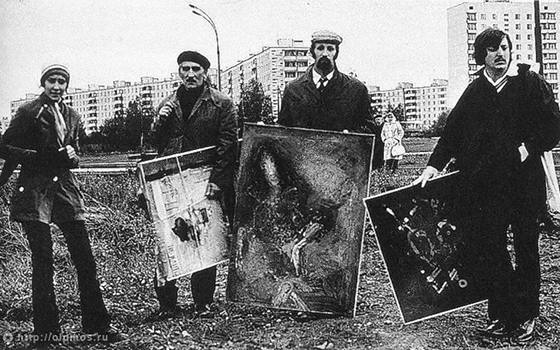
Nevertheless, on September 15, 1974, Non-Konformers, led by Oscar Rabin (among them were Lidia Masterkova, Evgeny Rukhin, Yuri Zharki-only about 15 participants) went to the Belyaevsky wasteland, carrying their paintings in their hands. Two weeks earlier, officials from the Moscow City Council mumbled, they say, we do not allow the exhibition, but we do not forbid it - so, "we do not recommend holding it." Such stars as Ilya Kabakov, however, managed to fall off with slurred - the exhibition was without it.
The outskirts at the intersection of Profsoyuznaya and Ostrovityanov streets were chosen so as not to interfere with “transportation” (always suddenly running), nor the “passage of citizens”. However, in the early morning, police with seedlings with seedlings were imported under the wasteland for local inhabitants - an unscheduled subbotnik began on Sunday.
He was followed by a massacre in the genre of Cyberpanus: the bulldozers and irrigation cars roared, the “landscapers” broke the paintings about the knee and rushed to the non -hollowed artists and specially invited for such a show of foreign journalists. Some were arrested, some spoiled work, health and film. Art then lost the technique, and technology (along with the authorities) - media.
The next day, foreign journalists convened one of the organizers of the exhibition Alexander Glezer to the apartment of one of the organizers of the exhibition. The answer of the Brezhnev punitive cultural policy was an international scandal.
However, the division into winners and losers in this black and white composition significantly slip.
Yes, having seriously stuck, the authorities gave the go -ahead to a new exhibition in Izmailovsky Park two weeks later, and the first secretary of the Cheremushkinsky district committee was sent to the “exile” - the ambassador to Vietnam. On September 29, in the air, he was in the air, settling in the heads of 20 thousand fans of unofficial art, a sweet foreboding of changes, free will. The Union of Artists (and the state as a whole) ceased to be a monopolist in the supply of art to the people.
 © Gallery Belyaevo
However, the USSR has not collapsed and stood in the same incomplete 20 years. In 1975, Gleser, along with a small part of his collection of non-conformists (80 paintings out of almost 500), nevertheless forced him to go abroad. In 1978, Rabin emigrated to France-Russian citizenship was returned to him only in 2007.
In 1974, the format was overcome, “the wall of silence erected in front of non-conformists”, about which the same Glezer wrote in “art near the bulldozer”, was destroyed. Belyaevsky wasteland was declared Senate Square from the world of art. The avant -garde, although through the tooth rattle, is still recognized and admitted to the exhibitions (it is customary to remember the queue in the "Beekeeping" pavilion with trembling in the voice). But for unofficial artists, some of which were finally accepted into SCA, their Termidor, confused, controlled and difficult to prediciate.
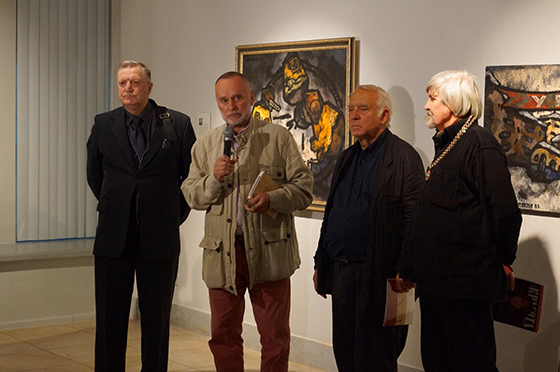
The current exhibition “Freedom is freedom ...” takes place in the State Exhibition Hall and works for demifologization - a return to the fact, the document and work that could not be considered 40 years ago. It again operates as a performance, but this time involving the mutual passivity of the parties and preferably sacred thrill.
Museumification This art did not pass yesterday. Therefore, now there is a loosening of symbols: the Belyaevsky wasteland from the ashes turns into a legalized "place of power", a monument to its former greatness. The played anti -utopia is retrained into the utopia acting: Power - Hurray! - We will never crush our paintings with bulldozers!
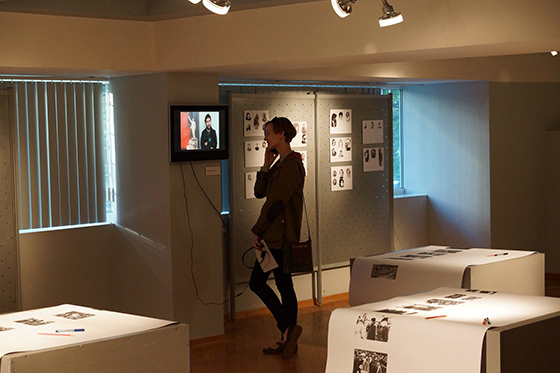
The straightforwardness with which the place is working here with metaphysics inspires a sense of awkwardness. The exhibition is organized on the principle of the local history museum, which structured its slippers. Here are shown a few photographs taken on September 15, 1974, a meager documentation resembling a school wall newspaper, paintings by some participants in the action (a sketch of the monument to the “bulldozer exhibition” of Komar and Melamid, Baraki Rabin, the abstraction of Masterkova) and the Belarus tractor, obviously replacing the missing bulldozer. By the way, the participants of the art group U/N and the students of the institute base licked him from the case to the tires-as an experience of sensory interaction with the signs of time, as they say. But a different metaphor begs - the artist’s relationship with the state and his instrument.
 © Gallery Belyaevo
As a multimedia component, there is a video interview with young artists who reason, whether it is necessary to remember in vain events like a “bulldozer exhibition”. Alexander Salenkov broadcasts about overcoming the status of a marginal and centralized cultural management. Andrei Kuzkin speaks of the optionality of such knowledge for the contemporary artist. And a lively illustration of his statement-Nikita Spiridonov, announcing that in 1974 several artists, heating his hands on the anti-Soviet, made a brilliant international career.
On the one hand, “Freedom is freedom ...” today supports the trend set by the two-part “reconstruction” -the retrospective of the gallerine exhibitions of the 1990s in the Catherine Culture Fund, which received the Innovation-2013 Award. On the other hand, it satisfies the demand for already worked out forms of protest in art.
The journalism of the exhibition works for additional sacralization (so they took out the photos from the KGB archives) and the smoothing of sharp corners (and lick the tractor in the state exhibition hall).
But the problem here, however, is different: in the Belyaevo gallery they cause the spirit of the mid-1970s, not asking the question of how to perceive alternative art today. Especially in a situation where any alternative is either sterilized in advance and placed in the safe space of the museum (as the street art presented at the Artmen Street Festival with the support of the Moscow Department of Culture), or declared an administrative (or even criminal) offense-as shares, for example, Peter Pavlensky. Indeed, with art as with light drugs, it is easier to legalize than to track underground traffic.