
Translated material
Incomplete victory
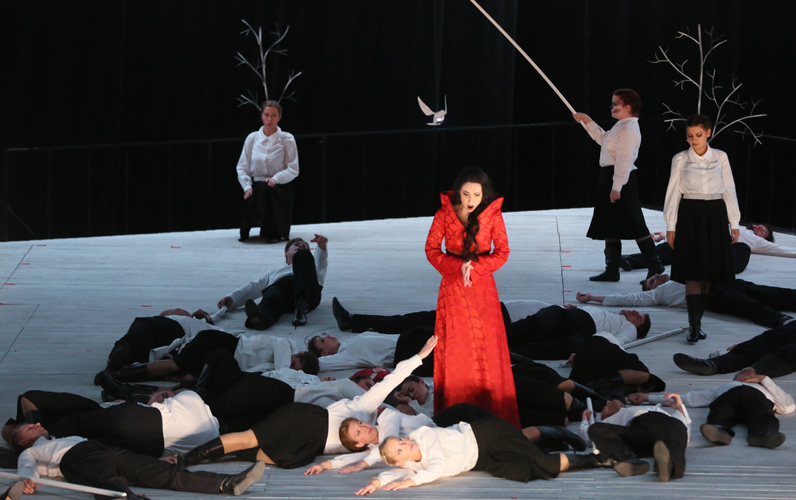
The “New Opera” won another unexpected musical victory, taking up the Mozart repertoire, which all the main Moscow theaters had been caught on recently. Over the past year, Don Juan appeared in Stasika, “All Women do” in Bolshoi, “Figaro’s Wedding” is soon expected there, and earlier for several months it was also released by the “New Opera”. However, one does not have to compete with Moscow, but, of course, with Perm and Custezis, who with his perfectionism, ambitions and European awards as a belibo in the eye. Therefore, when in the pre -premiere “new -rope” debates many times emphasized the doubtfulness of the authentic sectarianism and determination to do with their own vocal forces, without the involvement of Western specialists, even without naming the names, it was clear with whom everyone was arguing.
As it turns out, the grounds for pride in the “new opera” are available. The musical result is impressive. The orchestra under the control of Yana Latam-Kenig, although without any residential strings, plays stylishly and easily, completely not linked in the apparent Mozart simplicity. The harpsichord in recitatives (Tatyana Sotnikova) allows himself to be cute to show off. As if from some treasured chests, a whole scattering of excellent young voices appears, primarily female. Suzanne (Irina Kostina) - just a sip of fresh air. Countess (Elizabeth Soin) - rather a sip of red wine. Their most delicate duet during the joint writing of a fake letter to the count is a charming musical example of insidiousness, which is capable of a beautiful half of humanity. Karubino (Anna Sinitsyna) is a boy's charm and a flat matte female voice. Of the men is most confident in, albeit without a highlight, Count Almaviv (Alexei Bogdanchikov) sounds. His servant of Figaro (Dmitry Orlov) is still in a slightly more complex relationship with Mozart Phoers. But be that as it may, the naturalness with which the new generation of singers plunges into this repertoire cannot but rejoice. And this is only one composition, for the premiere performances the second is ready, and then, apparently, there will be replenishment.
At the same time, the performance is positioned as an international product-not so much because of the British registration of the chief conductor of the theater, but because of the team of directors. Moscow director Alexei Weiro, a student of Anatoly Vasiliev, did his first big opera work with German colleagues (scenographer Ulrika Yokhum, costume designer Jan Mayer, light artists Hannes Zesemann and Hans Frundt), with whom fate had brought him out, as strange as it) in Vladivostok, where on the basis of the Far Eastern Academy Arts they conducted student trainings on Mozart's material.
 © RIA "News"
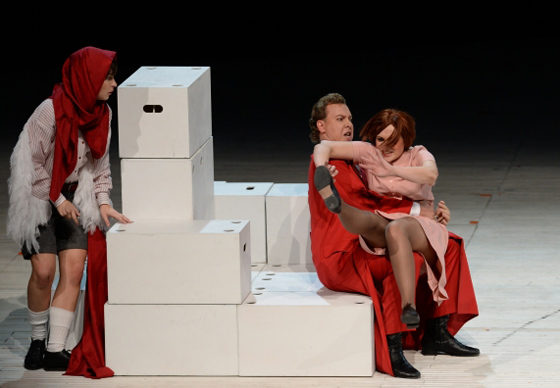
The resulting performance looks borderline: whimsical light, laconic-uniform costumes of soloists, the white top is a black bottom at the extras, instead of the usual decorations-an empty inclined space, which is difficult to move, but which promises a lot. Indeed, a lot of things happen - including the unforeseen. But this, alas, does not develop in a coherent theatrical statement.
The entire first compartment smells of fresh dough, which is a month right on the stage, apparently, then a wedding loaf for Figaro and Suzanne is baked. Every now and then the faces painted with skulls flash, but the death of Bartolo, who is falling on the last tacts of the final fun ensemble (he was killed by the director solely because Mozart did not write to him in this party ensemble), is still a complete surprise. Somewhere outside the window there is a French or some other revolution, the flags of different countries flutter, shooting begins unexpectedly, unexpectedly, everyone falls, and the countess, in her aria, asking for a windy husband to return to her, suddenly faces a fallen fighter who has to be pulled out of the paws of death. Barbarina’s baby grieves about the loss of pins with a coat-craft in her hands-so it turns out that she grieves like a lost girl’s honor.
Much more is happening in the play, but the most mysterious for me, perhaps, is the appearance at the beginning of the second action above the scene of some kind of Suprematist chariots, which, having hung a little already and have not come anywhere, simply quietly disappear under the grates. Fitting through the characters is becoming more and more tedious. Meanwhile, the Mozart plot, which itself is quite spinning, gets confused completely.