
Translated material
"The system will retreat to an independent doctor"
Writer and Cardiologist Maxim Osipov - on healthcare reform in Moscow and doctors' protests
"Most doctors consider the Minister of Health to be their boss and are quite ready to repeat this vulgarity" who pays, he orders music. "And now, when they are reduced, they go to scream," let us go back to the USSR, "says the writer , cardiologist Maxim Osipov , the founder of the charity society of the Tarusian Hospital, the candidate of medical books, the author and editor of many medical books, commenting on the current Moscow Protests against the reform of the capital's health care.
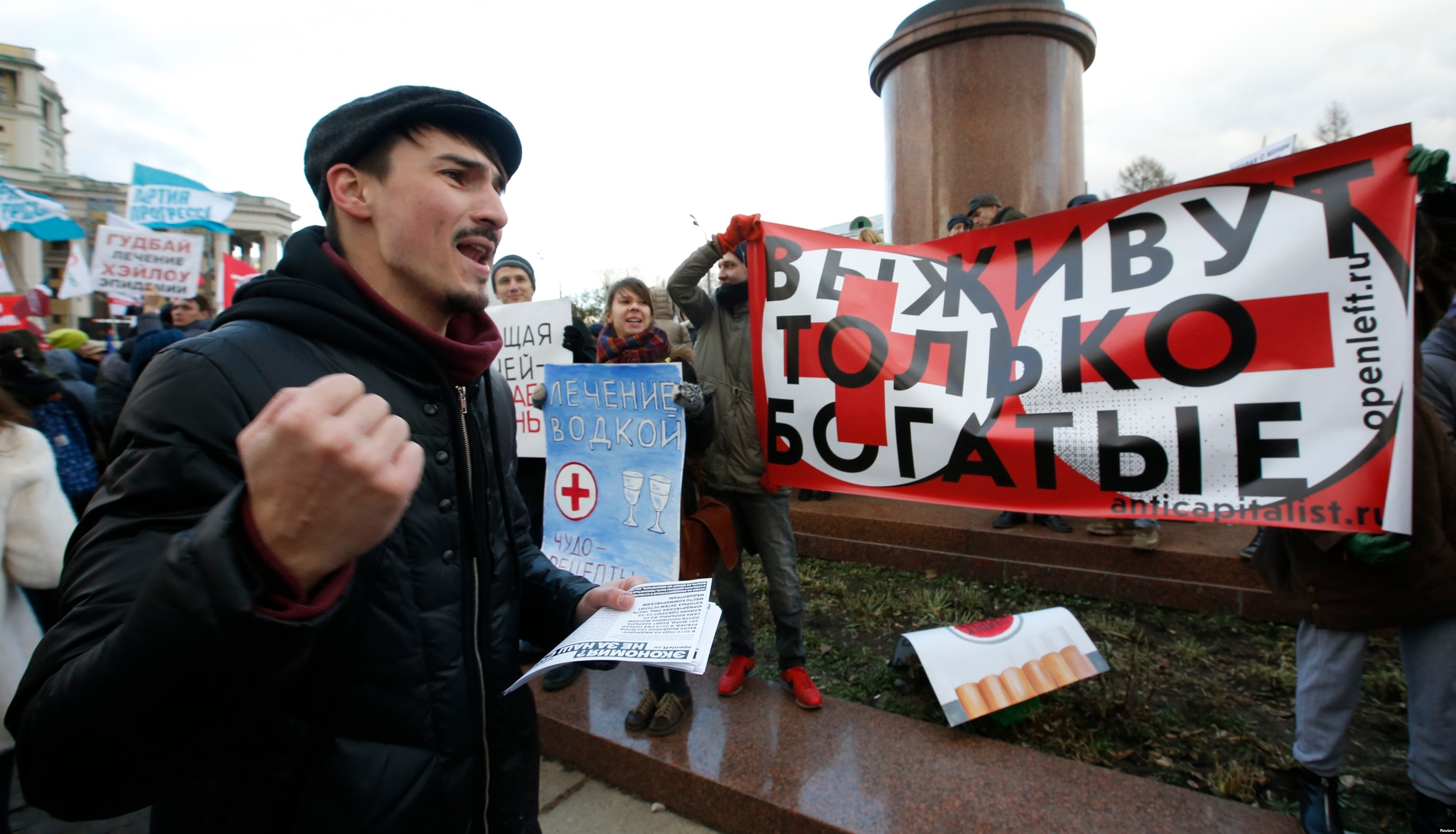
The reform of the Moscow healthcare provides for the dismissal of a significant part of the doctors and medical staff, as well as the closure of 28 medical institutions, including 18 hospitals. Officials call the reform "optimization" , offer doctors to retrain and talk about many jobs in the clinics of the city. Doctors organized a protest on Suvorovskaya Square under the slogan “Stop the collapse of medicine in Moscow!” Last Sunday.
On the same Sunday, Osipov published on Facebook the post “Laughter and Sin” : “In one of the Moscow hospitals, the doctors gathered for a rally, then changed their minds:“ What if the authorities find out? ”“ For this, they go to rallies so that the authorities find out, no? ” - Maxim Aleksandrovich, it’s easy for you to tell you.
It seems to have changed their minds.
Suddenly-hearing: everyone will be fired, on Friday, the 31st. It turns out you have to go. But no, the authorities transferred the meeting to Monday (or, I don’t know, to Wednesday) - this time was not fired. - Maybe they will not be fired at all - why then this rally? They changed their minds again, they won’t go.
(Do you want to be treated with such? Record in the registry. Police, passport. Not for me to teach you.). "
Answering the question of Radio Liberty, whose logic is true - protesting doctors or "optimizing" officials, Osipov notes:
- I have not been working in the municipal Moscow health care for many years, I have been working in Tarusa in Tarusa for half -time. My gaze from here. But in Moscow I live half the time, so I see and know something there. The chess players have such a maxim - in a bad position, all the moves are bad. Those, in fact, are a bad position that there is no good course in it. Nevertheless, you need to walk, something needs to be done. As often happens with our transformations ... Well, not with everyone, there are clearly malicious things, we do not talk about them. I do not think that this reform, which is taken by Mizulin, spring and others. This is an attempt to somehow improve the matter. She has some reasonable grounds. Another thing is how all this is realized. I know that those departments are closed, those hospitals where all sorts of expensive devices have just been supplied - CT, EMT, opened angiography. Now it is closing. In some hospitals, 20 percent of employees are dismissed and immediately hire back to work, because there is no one to work, just following the orders of the authorities. In some places it is said-it is necessary to dismiss one doctor from the department. They dismiss a person who will soon retire, but who is a very good doctor at the same time.
From my point of view, the problem is that medicine has become a service sector
As often happens, all this is realized in such a form that, perhaps, it would not be worth it to start. On the other hand, opponents of all these reforms cause me even less sympathy. Because this pathos is back to the USSR: "We want, as it was in the USSR, there was a wonderful healthcare system in the USSR." This is a myth. I lived in the USSR. There was no good healthcare system. This is an absolute nonsense. From my point of view, the problem is that medicine has become a service sector. Here we have production, but here is the service sector, medical care, pedagogical service. Nobody has yet called the priests spiritual service, but also ... The theater artists complained to me that they relate to the entertainment sphere, and so on. Not everyone puts up with such a position. The doctors, unfortunately, reconciled to their best, accepted it and are quite ready - you want, we will treat the standards. As you say, it will be. Most doctors consider the Minister of Health as their boss and are quite ready to repeat this vulgarity, "who pays, he orders music." But there are areas where the one who understands in music, and not the one who pays for it, should be ordered. Say in music. There is a Russian national orchestra. There is a conductor Pletnev. He in no way considers the Minister of Culture of Medinsky, I think, his boss. In any case, he will not allow him to dispose of what to fulfill and what to fulfill to him. And the doctors agreed, accepted this. And now, when they are reduced, they went to scream: "Let us back in the USSR." This is how I see this picture. The medical community in this situation seems to me that it behaves far from the best way.
The illusions of security will become smaller. Good or bad - not for me to judge
- What is the interested Moscow patient? Need to reform Moscow healthcare? Or is it better to hold on to what is?
- What will be the patient from these reforms. The fact is that health care has a double role-firstly, to treat and prevent diseases, and secondly, to create the illusion of security. For example, if there is a fire, there is always the opportunity to call 01, call the fire department. If you were attacked, you can call 02 - call the police. With medicine too. Medical assistance is extremely accessible in so many types - you can call an ambulance, you can go to the clinic, you can go to the hospital yourself and so on. I think that the illusions of security will become less. As for the real volume of what will be done, I do not think that it will change a lot. I think that those few good doctors who work a lot and actively work in one form or another to work with patients and bring exactly the same amount of benefit as they were brought before. And the illusions will become smaller. It’s good or bad - it is not for me to judge.
The most important thing is a doctor
- You say that they reduce people, hospitals, where the equipment has recently been delivered. What is more important - people or equipment, set up a system where doctors are not so important, or should you focus on good doctors?
- Of course, medicine begins with a doctor. The most important thing is a doctor. Not a manager, not in itself good equipment and so on, but an important doctor. Secondly, the equipment may be good, it may not be very good, but the difference between a 4-sear-free tomograph and a 128-sear is not as great as it seems. It is important that this tomograph work 7 days a week 24 hours a day. If the supertomograph works from 9 to 3 with a lunch break, this is much worse. Equipment is an important thing. But this problem can be solved very quickly-using money to buy something. It is difficult to grow a good doctor. The most important thing is a medical education, this is an understanding of the whole society, that this will not just take years, but decades, in order to somewhat catch up or approach the European level of medicine, but at the same time, reform and something must be done now. Reforms aimed at a medical education and increasing the knowledge of real, and not at these fictitious once every five years of continuing education, and so on, is not yet visible at all. Therefore, I look quite skeptical at things.
Society was not interested in this
And there is an important problem. Medicine is not included in the circle of interests of an intelligent person. We do not have good medical journalism. If you open the New York Times, then on the first page there is some short note that is written in good English from a medical point of view, but understandable the layman. We do not have such journalism. When the journalists ask me to tell me what the problem is, I say: "Please read the declaration of the independence of Russian doctors , which we wrote with Dr. Okhotin two and a half years ago." "Could you briefly state it in your own words?" I say: "She seems to be not long. She is only a few pages and was written quite in our words." "No, no, it is necessary faster. It is necessary faster, it is necessary now." As a result, we get what we get. Society was not interested in this.
You can work and benefit
- I recall my classmate, who in Soviet times went to the doctors and was going, like the hero of Bulgakov, to go to the village to treat the sick by distribution. What to do now a good doctor who acutely perceives his mission? Trying to participate in the reform or locally build some normal system around you, just as you opened a new cardiological department in a hospital in Tarus ?
“I think that a good doctor knows what to do, and not for me to give him advice.” And if we talk about what I would advise a young man who is now coming to medicine, who is full of some good impulses: to read in English special medical literature as much as possible, not to leave some unusual issues for himself. All now on the Internet can be found. And do not consider the medical authorities to be their superiors. Of course, it is administrative authorities, but from a medical point of view you are responsible for the patient, you yourself must decide what to do with it. Believe me that a system that faces this kind of independent, calm and independent position retreats. She does not put a person in impossible situations. You can work and bring some benefit.