
Translated material
"I refuse to show the obvious"
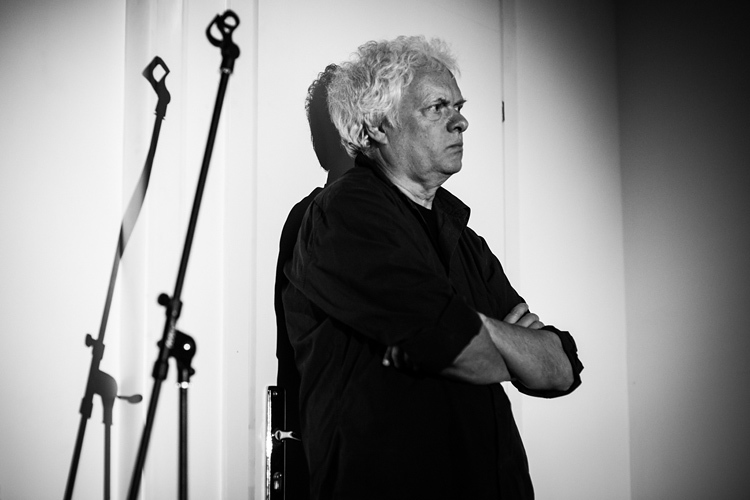
One of the dizzying promises of the Stanislavsky Electric Theater (in the recent past, this is the Moscow Drama Theater named after K.S. Stanislavsky) - which will be staged by the performance by Hayner Göbbels. He is from composers, now rather a director and one of the most important characters of modern art, in which it is better not to make genre distinctions. The first Russian work - “Max Black, or 62 ways to support your head” - is planned for October next year. Rehearsals will begin in the summer. Ekaterina Biryukova talked with Heiner Göbbels when he arrived in Moscow for the first meeting with the troupe. The interview is complemented by a couple of video clips from this meeting.
- I recently came across your interview about Louis Andrissen’s opera “Matter”, shown on Rurtrians at the end of the summer. One thought is emphasized there, I would like you to develop it. You want your performance to cause empathy, but it is very important that the audience does not identify with what is happening. That is, you need to sympathize, but some parallel to the world-did I understand correctly?
- This is right. I do not want the viewer to identify himself with what he sees, I do not want him to seek his reflection in some kind of excellent actor, singer or dancer participating in the play. I would like to create a space in which he will encounter himself. And also-with something that he knows nothing about. I'm not trying to show anything on the stage, I want something to emerge, I want to call something to life. My theater is not a representation, I do not show some real world. I want to create a different reality in this space with the viewer.
The “matter”, which I put for Rurtristennal, is an opera about the unforeseen of matter, that it is impossible to control the world, to manage it. I wanted not to tell a story, but to create a certain experience. In the fourth act of the opera, I brought 100 sheep on stage, over which one airship hung, as if directing them. And within half an hour, the audience could look at the sheep to slow music and inhale their smell. This theater did not try to explain something. The audience went out and asked, for example: "How did you manage the sheep?" I wanted this question to arise with the audience. And I was not going to give them an answer.
This is just an example of how I refuse to show the obvious. On the contrary, it is necessary to create a space for your own discoveries and for imagination.
- You have just finished heading Rurtristennale, where artistic leaders should change every three years. How else is this festival different from the rest?
-Firstly, by the fact that it should occur in former industrial spaces. Only there. There are no standard scenes, black boxes. The task is to give a new life to the former factory premises that remained abandoned and which restored with all respect.
Second. We have a fairly large budget for the production. So that we not only invite existing products, but also released them ourselves.
Third. Here is the rule that I myself formulated for those three years that led the festival. I told myself that I do not want to show any repertoire things, I do not want to show people what they already know. I believe that at least once a year they can satisfy their curiosity and see something that they have never seen. Many, including politicians, said that this would have a bad effect on the sale of tickets. But the exact opposite happened! We earned more than any previous festival. 92 percent of tickets were sold out.
I believe that institutional theaters have such a tendency - to underestimate the audience. The viewer is much more smart and curious than we sometimes think about him. Therefore, I invited the artists that I admire. I could let them create something that they could not create anywhere else. For example, I suggested Romeo Castelcucci to do every year according to the performance. He released this year the version of the Spring Spring without dancers ...
- ... but with bone flour. The echo of these products has reached us, which is now promised at the Diaghilev festival near Kurentzis in Perm ...
- This is just an example of what all the performances of the festival sought: to expand our idea of the theater, to ignore the disciplinary differences between visual arts, theater, dance, music. And all this is combined with a reduction in the verbal text. We had very few text - that is, the theater based on the text. We should not exclude spectators who speak another language or who do not have enough education. Who do not read books, for example. We want to show the openness of the experience.
Every year we invited 100 children from 12 to 14 years old - this is our official festival jury. They arrived by bus, walked along the red carpet, sat in the front row, and the audience applauded them. They watched every performance and invented nominations. And at the end they declared winners in these nominations. We did not invite them so that they liked our ideas. We wanted to see and understand what a reaction could be to them. The awards, by the way, were not always good. For example, Bob Wilson was given a reward for the slowest performance. I was handed a reward for the most indecent costumes. There was, for example, a prize to a director whom they would like to shoot.
 © Olympia Orlova
- So you prefer to work with not the most traditional theater public?
- No. I work with any audience. I do not choose it somehow on purpose. There were traditional spectators who approached after the performance and said that I destroyed their love for the theater.
- You prefer to ignore the differences between different types of art. Does the new Gesamtkunstwerk come ?
- I don't really like this term. Because he is too connected with Wagner, with his idea of the merger of all arts into one inseparable whole. Brecht also very clearly explained that this mixing leaves no place for the viewer who could also connect to this. So I would avoid this word. I am more interested in a combination of separate independent elements. But I believe that initially the separation of genres is just a direct consequence of the separation of institutions, this is not an artistic desire. For example, artists such as Romeo Castelcucci, or Robert Wilson, or Teresa de Cersmaker, or Boris Sharmz, or I - we simply ignore these boundaries, these divisions. We are not interested in the formed expectations of the audience. For example, this morning I worked with the word. But I also like to work with sound, with movement, with images. And I am not interested in asking a question to what kind of art this applies. Rather, on the contrary. The real artistic experience, which we can experience as spectators, we receive at the moment when we do not have enough words to describe what we see. At the moment when the known terms become not enough, we are most involved in what is happening. Of course, we want to understand the world. But art is not about understanding. Art is about feeling what the openness of the world can be.
- You are going to make your first performance in Russia? Tell us what it will be.
-I was invited by Boris Yukhananov to release something for this theater. I was shocked by his idea to name this theater "Electrotheater". I don’t know how it will be here, but in Germany it would look like a big provocation.
- Why?
- Because the theater is words, actors, long stories, and this is in no way connected with electricity. At least - this is what they expect from the theater. But for me, the opposite is true. I work a lot with equipment. And I saw here a chance to breathe a new life into a play called Max Black, a thing that I have already done once, where the idea of what the theater could be expanded. For example, a scientific laboratory. I connect the texts of the field of Valerie, Ludwig Wittgenstein, George Lichtenberg, as well as the philosopher and the scientist, who is called Max Black. He was born to Baku, moved to the USA and became a famous professor there. This performance is about finding accuracy.
For example, Paul Valerie writes: "I hate blur." He wants to understand the world in clear terms. Naturally, the world is much more complicated. But on the other hand, both he and other authors give us a unique opportunity to think about our lives, about our individuality, about our self -understanding, about success, about failure. All these writers, philosophers and scientists have never stopped thinking. I have the same with the theater. We begin to think about words, and then about chemistry, and then we come to the world of the theory of logic. In this production you will see one actor in your laboratory. You will see a chain reaction. Maybe this is a way to make thoughts visible. Thought, the phrase turns into sound, into experiments with fire. You inhale the smell. A huge image appears. It flows into another thought, into another experiment. All elements of the theater participate in this chain reaction. And the starting point is notebooks of famous people.
- How do you see the future of the theater?
- I am not a prophet. I think prophets are very dangerous people, they can destroy the world. I prefer to react to what the artists do. For me, the new life of the theater would be his return to the context of visual arts. I can't say anything about the Russian theater. But in Germany, the theater is largely reduced to making a statement about reality. Language itself is not a form of art. As a result, the theater viewer thinks that his task is to understand everything. And this is a completely non -artistic task. Castelpelli once said that this is a fake question, Fake. The theater does not need to be understood. Gertrude Stein in the 30s of the last century said that everything that is not a story could be a play. The task of the theater should not be reduced to the story of stories. The theater is much more.
- It seems to you, the traditional form of the existence of the opera, a symphonic concert with a whole set of rituals, with all these rules, when you can clap, when it is impossible - how long does it last?
- For the old repertoire, this is normal. I am not at all against the museum of orchestral or opera music. But these institutions are not able to experiment with new forms. In order to create another art, other structures are needed.
- That is, for example, the Bolshoi Theater should not be scolded for not inviting Romeo Castelpelchi?
- No, no. It is very difficult to create something new in such a building. None of my works could have arisen there. Of course, I can show what is already there. They showed one of my performances ( “ Black on White ” , 2004, the new scene of the Bolshoi Theater. - Ed. ). But it was the work that we and I and I and Modern nevertheless created in the building of the destroyed factory.