
Translated material
Dada and surrealism in Hermitage
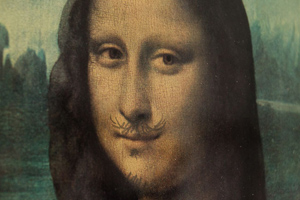
In the main headquarters of the Hermitage, the exhibition “Dada and Surrealism” was opened, representing the collection of the Israeli Museum, which has been formed over the past 50 years, mainly from gifts of friends of the institution. This is not the first joint project of Israel and the Hermitage: last summer, the main headquarters showed an exhibition about Bauhaus architecture in Tel Aviv “White City”. Both expositions demonstrate a legacy, which at different times exported to Israel, beyond the limits of Europe covered by the war. “Dada and Surrealism” is a nomadic exhibition, she came from Budapest to Petersburg.
The exposition is opened by the “hits” of Marseille Dyushan: “Fresh Widow”, “Bicycle Wheel”, “Fountain”, “In favor of a broken arm”, “Drying for bottles”, “Three standard stops” - all remarks of 1964. Surrounded by these subjects, it is as if in the first chapter of the art history textbook. You can’t even refuse to have a aura created, however, not by the material, texture and not touching the author, but by some information field, these very textbooks, words of art historians, teachers and their own timid institutions. Other things of the same artist look more intimate-for example, the assembly “Preliminary sketches and tools for stereoscopic fireplaces”, which consists, among other things, of a pair of 3D-egs with red-blue plastic glasses. Exactly such are needed to watch the show Kraftwerk or "Goodbye, speech" Godard.
The exhibition occupies five halls, the narrative is built chronologically. It all starts with the cubistle canvas “Ball in Zurich” by Marcel Yanko, the three -dimensional collage “Indian trepanation” Christian Shada (it would resemble the material selection of Tatlin, if not for the wildly bright colors) and the “measured ribbons” of Francis Picabia, a plane collage, which, with the help of segments of a measuring instrument, as if striving to go beyond the limits of two -dimensionality. The experiments of the early surrealists with techniques continue the story: Protographer Victor Browner, where the artist uses natural dyes based on coffee and walnut, and covers the resulting pattern with wax. Sheets with experiments in an automatic letter of Andre Mason and players in the “exquisite corpse”. Work in decalcomia - the technique of dry press, invented by Oscar Dominges. Several things of Max Ernst in the technique of grating invented by him, combining painting and graphics and referring to expressionism.
The mutual exchange of ideas, obsessions and phobias between Dada and Surrealism occurs in the very last hall, where photos and photo collages Duchan, Man Ray, Brassai, Hannah Hyuh, Max Ernst were located. In the very corner, there is a one -legged hinge doll of Hans Bellmer, over which Mana Ray’s “Uncreted Virgin” was located in a special box, also a doll, but small, like mannequins in Ikea, stifled with chains, a gloomy, bizarre roll call.
About why watch the exhibition, Colta.ru asked the guests who came to the opening.
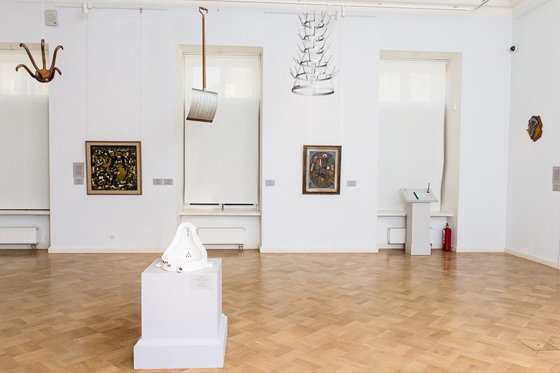 © Mikhail Grigoryev / Fotokollektiv Marcel Duchan. “Hanger”, “In favor of a broken arm”, “dryer for bottles”, “fountain”. Repetition of 1964. In the background - the work of Marseille Yanko and Christian Shad
Elena Shur
Executive Director of the Agency for the Development of International Cultural Relations "Petersburg Salon"
The Hermitage has been establishing communication with Israel for many years. This exhibition is not the first step (and I hope that not the last) and very interesting, because the Israeli attitude to modern art to the world is completely incomprehensible. Unique collections were taken to Israel there, which no one saw, because they usually took them out, saving from something. In addition to the meeting of the Israeli Museum, private collections are presented here, which are now trying to revive, and their owners do not quite understand what they will do with them. The collector acts as a keeper, receives large financial loads, worries that the meeting will disappear - and still continues it, and when it also shows it publicly, this gesture cannot be underestimated. I traveled little, so Mana Ray, for example, saw only on the Internet, and I generally see many other authors presented here for the first time.
Irina Karasik
art critic, curator, leading researcher at the department of the latest trends of the Russian Museum
This is probably not the best world collection-all the main things are in other places-but, in my opinion, it is remarkably done, gives an interesting picture of the development of these two related and different directions in art-Dada and surrealism. In Russia, this is especially important, because we did not have a powerful similar movement, although the harbinger of surrealism, and the interest in it in the 1930s were at least among the students of Malevich. They all knew all this very well, followed the magazines. Modern scientists find a lot of forewords in our art, not to mention the fact that the Russians participated in the formation of the movement: one of the first evenings in Kabar Voltaire was Russian. The exhibition is very interesting, timely, it needs to be watched carefully, since there are a lot of things that require reading, concentration, some of their own mental operations. It is still difficult for me to say it, I will undoubtedly come here again, and now I have caught a common canvas, which is very well built here-in the sense of annotations, and all the material, and some details about individual works. Very interesting collages of Hyuh, Max Ernst. In Russia, there was no such exhibition in Russia: something was with Salvador Dali, but basically these are prints, there were exhibitions of the early things of the world, which also concerned surrealism, the work of early surrealists appeared at some prefabricated exhibitions, for example, in 1989 there was an exhibition of the “Age of Discoveries”. But in focus these phenomena were not shown.
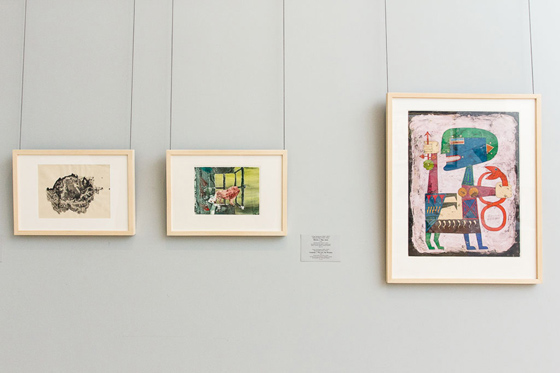 © Mikhail Grigoryev / Fotokollektiv two work on the left - in the technique of decalcomia, on the right - the work of Victor Browner
Alexander Borovsky
art critic, head of the department of the latest movements of the Russian Museum
I did not like the exhibition, so I will not upset the Hermitage ones.
Olesya Turkina
art critic, curator, teacher of the Faculty of Free Arts and Sciences of St. Petersburg State University, leading researcher at the department of the latest movements of the Russian Museum
Marseille Dyushan said that art has his age, and took the work of art for about 80 years. That is, according to Dyushan, these works should have already died, but they survived their time. When I look at the works of Max Ernst or Mana Ray, I think that Dada and Surrealism were associated with what is now called social protest, expressed in artistic form. It was a protest against the banality and norms that the state and the bourgeois society tried to introduce. This radicality just prolongs his life, despite Duchan's statement. Looking at Bellmer, you recall all these monstrous laws related to censorship, and you understand how art is capable of turning and beating them, how much it is stronger. Malevich said that art is much more important than economics and politics, and this is true. It would seem that we have works from textbooks on the history of art, and how people are carefully examined and photographed against the background of work. Probably not so much to show your portrait on the background of Duchan, but because they are still surprised by the paradox of the art metaphors of Dad and surrealism.
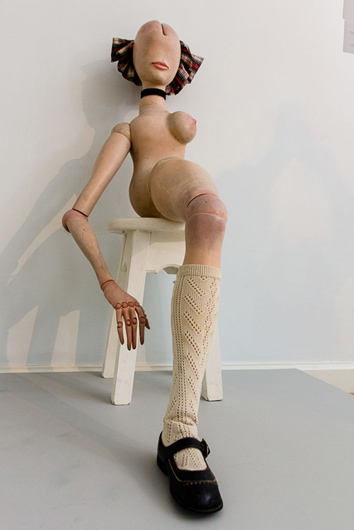 © Mikhail Grigoryev / Fotokollektiv Hans Bellmer. Half a baccup. 1972 (according to the original 1939–45)
Dmitry Novik
Journalist, art critic of the magazine "City 812", magazine "Art", newspapers "St. Petersburg Vedomosti"
The art of the beginning of the twentieth century in the minds of the Western public has long become history and covered with a noticeable layer of dust. The Israeli Museum is part of the Western museum system, so the exhibition is strict and academic. For students of advanced universities such as the Faculty of Free Arts and Sciences of St. Petersburg State University, a visit is mandatory. It is another matter that in Russia Dyushan with comrades has not yet been read, not counted, not understood. And, I'm afraid it will remain so for a long time. But we will not rush with the accusations. When around a continuous dad with elements of a hard Sur, it is unfair to demand a different reaction from our public.
Oleg Maslov
artist
I saw many of the works presented here only in books, but something-and in reality: there is a repetition of Marseille Dyushan in different museums of France. At this exhibition, both originals and repetitions are shown. What is hanging in the first hall - “dryer for bottles”, a shovel - “in favor of a broken arm” and a pussy - Duchan, of course, was not difficult to repeat. It was worth it to delve into flea markets. In the 1960s, he endowed many museums with his own remarks. I do not think that the works of Duchan lost their aura, being repeated: they were still honestly lost and also honestly found for that first exhibition of Dadaism.