
Translated material
"We are people of wrong gestures"
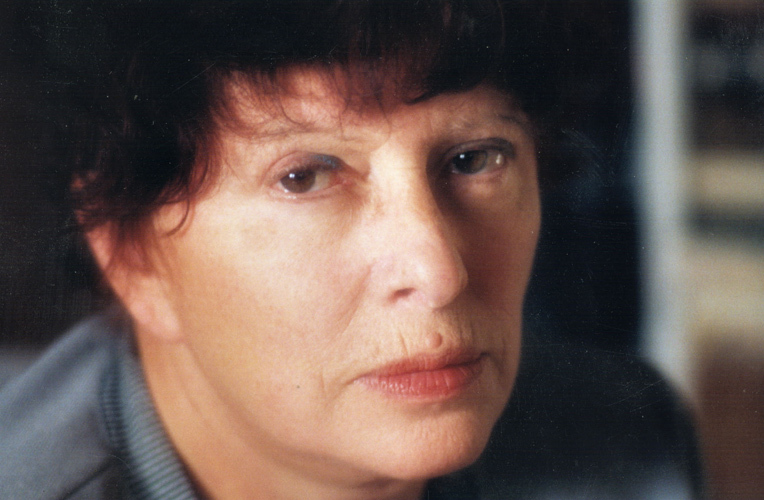
Gleb Morev: Ira, the book of your interview was published in the UFO, which for many years were published in the Mirror Tel Aviv magazine, which was published by you and Mikhail Grobman , and there were, let's say, they are available (the magazine has a network version ), but few are known to anyone. With the release of the book in Russia, the audience has expanded, Moscow intelligent editors shocked by your conversation with Nikolai Ivanovich Khardzhiev reprinted its widely known text on the Afisha website, which, in turn, caused a violent reaction in social networks.
And according to the reaction to this interview, it became clear that people do not understand the context of Khardzhiev’s statements at all, do not understand either his cultural status and genesis, or the angle with which he evaluates the artistic process. Khardzhiev is not one of the Soviet literary critics and researchers of the Silver Age, as it seems to today's reader, but formally, and by self-awareness that has been affirmed over the years,-a younger contemporary, friend and comrade-in-arms of Malevich, Mandelstam and Harms, in a sense, the last Russian futurist, a person who was an author of not only scientific publications, but also post-futs literary texts (under the pseudonym Feofan Buka ). He thought of himself the heir to the twisted, Khlebnikov and, undoubtedly, belonged to the texts that he studied, without any academic impartiality. His self -awareness was the self -awareness of the last representative of Russian futurism.
Irina Vrubel-Golubkina: And the Guardian.
Morev: And the Guardian, yes, but not a passive keeper, but, so to speak, a fighter for the rights of people whose status in culture seemed unfair to him. Therefore, the idea of revising the canon, which shocking today's readers, permeates. At the same time, the context of the publication of the interview is no less important. Namely, the fact that it appeared in the magazine “Mirror”, a magazine, hard - even, I would say, aggressively - standing on a certain aesthetic platform, for which Khardzhiev, of course, is not just an interesting memoirist, but an ally and a like -minded person. This also needs to be understood.
Tell me about how you and Groman recognized Khardzhiev how your relationship took shape, where they started. And how did your meeting take place in many years in January 1991, when did you interview?
Vrubel-Golubkin: The book talks about the environment, this conversation begins with Khardzhiev, goes into the circle of the second Russian avant-garde and reaches today.
We met Nikolai Ivanovich when Nikolai Ivanovich made exhibitions at the Mayakovsky Museum. That is, he made the first exhibitions that incredibly influenced the artistic situation in Moscow. There were exhibitions of Larionov, Tatlin, Filonov, Malevich, that is, completely unthinkable in the situation of that time. And we helped Nikolai Ivanovich hang [work on] these exhibitions.
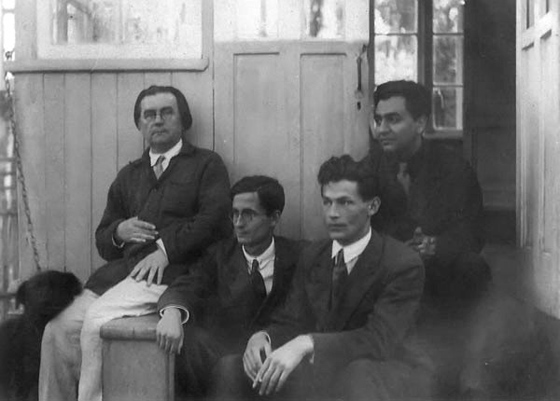 K. Malevich, V. Train, T. Grits, N. Khardzhiev. Nemchinovka, 1933
MOREV: That is, he announced for the first time unknown works of many great vanguard artists?
Vrubel-Golubkina: Things saw things! Things are real. And the exhibition is still a special event. In the Mayakovsky Museum, it was Mayakovsky, they hung fantastic genuine things, obtained incomprehensible by Nikolai Ivanovich, and a circle of people who knew exactly that they were brothers and blood sisters ...
MOREV: They became a point of attraction, collecting people who have previously existed in Moscow?
Vrubel-Golubkin: No, there are no scattered circles at all. If we are talking about New York, for example, a huge New York, what does the circle of artists mean? It can be 200 people. In every place - circles, they are very small. Yesenin wrote to Mariengof from New York that in New York, as in Moscow, we need no one except a few Jewish girls. Nikolai Ivanovich felt not like the guardian and heir, he felt one of. And, in fact, he was not going to let anyone into this territory - that's all. Once I was with Nikolai Ivanovich. The [largest researcher of the architecture of the Russian avant-garde Selim] Han Han-Magomedov called and said that he wrote a book and wants to convey to him. Nikolai Ivanovich said: "Put this book in the mailbox." He says: "She will not fit." And I was a witness to how Khan-Magomedov came, called, Nikolai Ivanovich opened the door, held out his hand, squeamishly took the book and immediately slammed the door. He believed that all these people are profanators.
The life of Nikolai Ivanovich and Lidia Vasilievna literally hung in the balance. This is a miracle that they survived. The criminals simply did not have time to get to them.
MOREV: But you did not quarrel with him before your departure to Israel in 1971?
Vrubel-Golubkina: No, of course. We have never quarreled with Nikolai Ivanovich.
MOREV: It seems to me that your ex -emigration saved your relationship.
Vrubel-Golubkin: No, in any case. Just in any case. No salvation, nothing could be such that could violate our relationship.
Because there was a general understanding, a general attitude to art. And no self -interest, no personal interest, no functioning.
MOREV: You corresponded with him, somehow maintained a connection from Israel?
Vrubel-Golubkina: Very little. We did not trust Soviet mail. Perlustration repulsed all hunting for correspondence.
MOREV: And how did you find it in Moscow in 1991?
Vrubel-Golubkina: I arrived in Moscow, called Nikolai Ivanovich. Well, they and Lidia Vasilyevna [Chaga] were terribly happy! I came to this apartment, filled with incredible treasures, with incredible wretched life! It was an ordinary two -room Soviet apartment on 4 Dovator Street, near the Sportivnaya metro.
The whole house was filled with incredible books. Misha once gave him a unique needlework catalog of the exhibition “Five-Five to Twenty-Five” ...
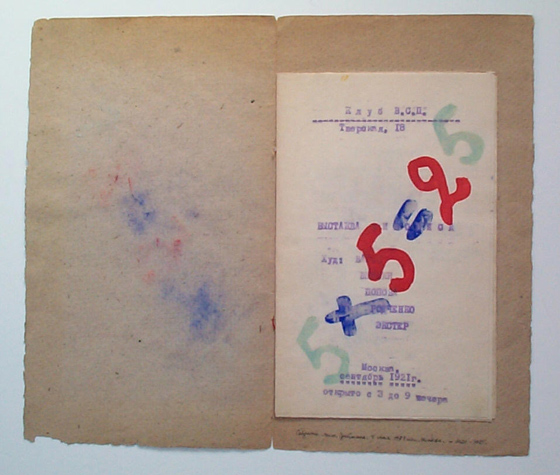 © Meeting M. Grobman Catalog of the exhibition "Five -Five - Twenty -Five"
MOREV: Returning by the time of your acquaintance - you mounted the 1966 exhibition at the Mayakovsky Museum ...
Mikhail Grobman: And that evening, Nikolai Ivanovich went to our house. Well, somehow in me he saw a man of his plan, his understanding, his reactions. Which was very interesting, this has never happened before. Well, he had several of those who remained from the old times of his acquaintances, and this was enough for him, he suited him quite, and he did not need some additional friends.
MOREV: But he eventually quarreled with everyone.
Gromman: We had no way to quarrel with him, since our relationship was very specific. Khardzhiev was sitting with [Yuri] milk at one of the exhibitions, and we go there, hang paintings, take off, and Khardzhiev says milk: “Look ...” And then I was dressed like this: Kirsz boots and a short fur coat. And Khardzhiev, looking at me, says: “Here I look, and it reminds me of those times ... Misha looks like ...” I don’t remember now whom he called specifically. It seems Burliuka. This can be perceived as some random words, but the words were not accidental. People wanted some benefits from him, because he was a keeper of great knowledge, or wanted some paintings, or something else, because he was the owner of such large treasures. We were connected only by the fact that we can say that we absolutely and selflessly loved the material with which we worked. His favorite artists are Malevich, Larionov, Tatlin. There was approximately such a set. Of course, he was much more strictly treated, clear, because he nevertheless shared, who is stronger, who is more significant, so to speak.
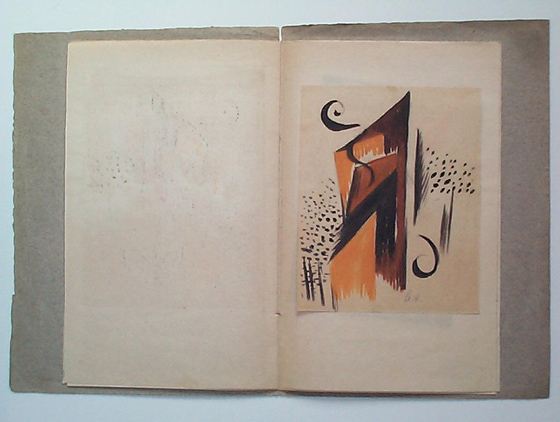 © Meeting M. Grobman Catalog of the exhibition "Five -Five - Twenty -Five"
Vrubel-Golubkina: Why did you give him “five to five to twenty-five”?
Gromman: Well, Khardzhiev had everything, literally everything. When we talked once, I told him about “five to five to twenty-five”, I had three pieces. And it turned out unexpectedly that he did not have, that it was generally surprising. In short, I gave him. I had no commercial relations with him. And he was happy and in the end also gave me something, I don’t remember now what. But he was, of course, happy with this fact of being. However, then Khardzhiev said that this copy I donated to him stolen <...>.
MOREV: But from Israel you no longer communicated with him. And when Ira called him in 1991, for him it was an unexpected bell.
Vrubel-Golubkina: Absolutely not! He called his man. Why not expect?
In 1991, when I arrived, I called, and, of course, he was very happy. And, of course, he immediately called me to him. I arrived, there was an insanely warm meeting. Lidia Vasilievna, Nikolai Ivanovich. He told me about everything that happened. I arrived for a short time in Moscow for the first time [after 1971], but the situation was absolutely amazing, the proximity is amazing! I have been with them almost every day and decided to talk to him. That is, I didn’t even decide to talk to him, we always said, but I decided to write it down. What he said was completely unique. Loneliness was unthinkable. And he felt that all the enemies are all around ... That is, the collection is unprotected, two old men ...
 Nikolai Khardzhiev, 1950s.
MOREV: In 1991, he was 88 years old. How much was the senile phobia, how much reality?
Vrubel-Golubkin: It was not a phobia. The life of Nikolai Ivanovich and Lidia Vasilievna literally hung in the balance. This is a miracle that they survived. The criminals simply did not have time to get to them. We did not think that bandits of a different type would plunder these treasures. There was nothing senile in him! Nikolai Ivanovich was an eternally young man. Maybe this united them with Misha that passions were boiling, passions existed. And he lived with it!
MOREV: Malevich hung on the walls?
Vrubel-Golubkina: No. In general, nothing almost hung on the walls. It seems to me that Larionov’s work, several graphic works, and, of course, there were an endless number of books, all kinds of futuristic and other publications. Nothing hung, everything was hidden. There was fear. The fear that will come, rob, take, destroy.
Gromman: They lived insanely wretched. Some were minimal pensions, but Nikolai Ivanovich did not sell anything.
Morev: Nikolai Ivanovich had already had a sad experience with the West in the sense of joint projects - the story with Bengt Youngfeldt, who had already robbed him by that time.
Gromman: Then, in 1991, he still did not know that Yangfeldt robbed him. That is, Nikolai Ivanovich, like the entire Soviet people, had the feeling that the West would save. He did not know then for sure. He suspected, he said, but specifically this was not. He believed that the West would understand what he does, the West would appreciate. There was such a feeling.
MOREV: In an interview, this is not, but maybe you talked with him about the plans for the export of the collection to the West and the arrangement there?
Vrubel-Golubkina: Nikolai Ivanovich wanted to move to us to Jerusalem and connect his collection with Mishina. That was his plan. And we, as it were, agreed on this. We talked here [in Israel] with some directors of museums, all that ... But gradually it became clear that all this had to be taken out in an unofficial way. Neither the director of museums, nor art historians - all these people, like us, could do this. But the plan was like that, and we even have letters from Nikolai Ivanovich, where he writes, directly or indirectly, that he wants to come.
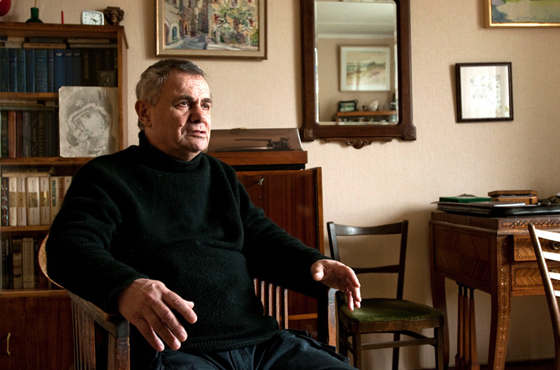 © Evgeny Gurko Mikhail Grobman
Grobman: In the middle there was a point somewhere, the unofficial removal of the collection. And we could not get around this point ... It was not even a matter of us, and the director of museums could not do it. These were not those people who would agree to secretly transport something.
MOREV: Nikolai Ivanovich understood that this feature - illegal export - puts his own security and collection security?
Vrubel-Golubkin: there was no conversation about any illegal exit. Nikolai Ivanovich did not understand all this system, and we, too, did not understand all this system of moving, leaving ... There was a conversation about leaving, he wanted him to be given an apartment in Jerusalem and that he would connect [his collection with the Comban collection] ...
Gromman: He was ready to give his entire collection so that she was in the same hands, albeit not in the state, but, let's say, in the official ones. And for this so that he receives an apartment in which he could live calmly.
Vrubel-Golubkina: Our relationship was absolutely related. For a long time we sent him food, all sorts of dry broths, that's all. Nikolai Ivanovich loved soap very much, for example, and I all the time sent him a good soap (laughs) .
MOREV: How did you learn about his departure to Holland?
Gromman: At some stage, he called us or we called him, and he said such a phrase: “That's it, we are not doing this anymore.” That is, he realized that this is a move to Israel - unrealistic. And then this whole story spun. We no longer discussed this. We no longer participated in this.
Vrubel-Golubkina: And then, in fact, my interview with Emma Gershtein is dedicated to Nikolai Ivanovich, it is about Nikolai Ivanovich, and the fact that Emma is talking about Nadezhda Yakovlevna [Mandelstam] is the same that Nikolai Ivanovich said.
Gromman: It was like one family, where everyone was internally connected ...
MOREV: It is clear that Emma Grigoryevna corrects some assessments of Nikolai Ivanovich, explains them to domestic circumstances, but this is a slightly different status of the statement. Gershtein is just the same literary critic who, unlike Khardzhiev, had no complaints to be the successor of the case of those with whom he had the happiness of being familiar. Gershtein did not consider himself a man of futurism, nor a man of acmeism, but was simply a scientist and a friend of great poets ...
Vrubel-Golubkina: Yes, a close friend, and Nikolai Ivanovich loved her very much, but treated her rather condescendingly.
But what Emma said about the editors of poems, about understanding of poems is what Nikolai Ivanovich said. This is not Emma. These retelling - Nikolai Ivanovich told me the same when I interviewed. He talked with me very, very much about his relationship with Nadezhda Yakovlevna ...
MOREV: It was a traumatic story.
Vrubel-Golubkina: It was an incredibly traumatic story! Moreover, he loved and respected Akhmatov very much. And he did not want to touch anyone in this story in any way. And with all the fact that Nadezhda Yakovlevna really betrayed him, struck a terrible blow, they were still close people. And this is a man of the circle and the man of Mandelstam ... And then, at that stage, he did not want at least one word about it to be written down [on film]. It was so traumatic for him. A blow from the inside!
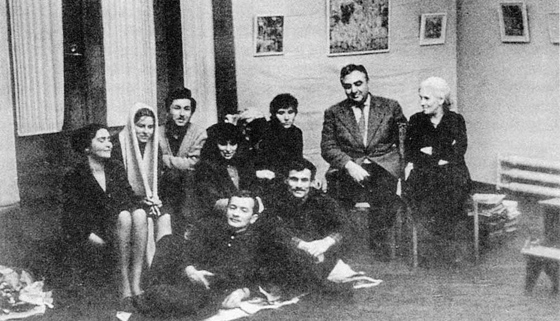 Work on the exhibition of P. Filonov and M. Matyushin in the Mayakovsky Museum, 1965 the second on the right - N.I. Khardzhiev, the third-M. Grobman, sixth-I. Vrubel-Golubkin
MOREV: The central place of interview with Khardzhiev seems to be where he forms his polemic canon. In painting - Tatlin, Malevich and Larionov, in literature - Khlebnikov and Mayakovsky. To the detriment of the rest, first of all, the "great four."
Vrubel-Golubkina: His statements, in fact, are wonderful! The fact that there are great poets are geniuses. This is very interesting. In general, reactions to this publication are absolutely enthusiastic! But this discussion is insanely curious to me, because it determines the state of society. That is what is happening now? With complete tolerance, with the complete absence of a direct statement, direct understanding, direct criteria, this is no longer a situation of literary discussion, passions, creating ... This is a party of party. All this discussion is a conversation from a party. According to the rules of the party, Nikolai Ivanovich is a criminal. Nikolai Ivanovich builds a hierarchy. And the most interesting thing is that this is not a hierarchy of only Nikolai Ivanovich, this is a hierarchy of that time. He, as one of the people of that time, as if convey it to us ... Now it is absolutely unacceptable. Now everyone is good, everyone is pleasant in every way. But there are people who make the wrong gestures, and some of them are us. You see, there is still a situation of “mirrors” with our wrong gestures, our non -playing in a common peaceful and beautiful life.
MOREV: Do you consider it justified to continue the historical rebound between futurism and acmeism, to find out, relatively speaking, who is the first poet - Mayakovsky or Mandelstam? When Khardzhiev says, this is one thing, and when this statement of Khardzhiev turns out to be an instrument in today's aesthetic situation, this is completely different. In the "mirror" of Khardzhiev’s interview, it was presented precisely as an actual statement.
Gromman: But this is not just some kind of demarcation: these poets-yes, such poets-no. This is a very accurate definition: Khlebnikov - yes, Tsvetaeva - no. Akhmatova, for all his proximity to Nikolai Ivanovich, - and at the same time not. I even once on the basis of the fact that I did not value and did not appreciate Tsvetaeva, quarreled with David Yakovlevich Gift. When he heard what I was talking about Tsvetaeva, he was terribly indignant. Just like today, let's say, when it comes to literature, Brodsky is a number one figure, and for us it is, in general, far from one figure.
Morev: This topic - Brodsky’s rejection - continues, by the way, in an interview with Stanislav Krasovitsky ...
Vrubel-Golubkina: Which, it seems to me, along with an interview with Khardzhiev is one of the most important in the book. And all that Stas says is, in general, the continuation of Khardzhiev’s ideas. There is still such an interesting story. В интервью Николая Ивановича одно из самых важных высказываний — когда я у него спрашиваю, что значит «возвращение Серебряного века» и все такое, и он говорит о том, что новое поколение должно бороться, должно отрицать и создавать новое. Сейчас есть ситуация всеобщего плюрализма, всеобщей безоценочности. Это противоположно, конечно, ситуации футуризма. И, мне кажется, отсутствие этого напряжения в обществе, не в обществе вообще, а на поэтической сцене, — это одна из печальных особенностей дня сегодняшнего…
В словах Харджиева люди увидели пафос другого рода, оценочный. Они вдруг увидели настоящую литературную ситуацию. Вот очень интересно, как Миша встречался с Ахматовой. Сколько тебе было лет?
Гробман: Мне было… мне кажется, в 1958 году это было.
Морев: 19 лет. In Moscow?
Гробман: Нет, в Ленинграде. Я позвонил ей, и она меня приняла.
Морев: На улице Красной Конницы?
Гробман: Красной Конницы, да. Я пришел к ней, но я не хочу описывать конкретно, интерьер и все прочее, важнее гораздо другое. Мы стали беседовать, я ей что-то рассказывал, она мне что-то стала рассказывать, показала мне книжку на чешском языке — ее книжка, которая только что вышла, толстый томик такой. Чувствовалось, что для нее это важно. Для меня же она была… Я, конечно, с большим уважением относился к ней, но она была каким-то осколком прошлого, которого уже, собственно говоря, нету. Такое ощущение было, что это все уже прожито. И как-то эта встреча с ней, хотя она была симпатичная, интересная, не оставила желания потом с ней опять встречаться. Через год этим занялись Найман, Бродский и так далее.
Морев: Ты почувствовал интерес ее к молодежи, не связанный с ней самой? Ей было интересно, что пишет молодежь?
Гробман: Я думаю, что не очень. Я тоже не искал ее оценки. Может быть, если бы я ее разговорил, она бы что-то сказала. Для нас же Ахматова…
Морев: «Для нас» — для кого? От чьего имени ты говоришь?
Гробман: Ну, вся наша компания. Вот мы говорили тут об обэриутах, и еще до того, как обэриуты прочно вошли в сознание многих людей, Саша Васильев был большим первооткрывателем, в частности, рассказывал всем, читал обэриутов всем, кто не знал еще о них.
Если бы от Пастернака остались только эти стихи «Доктора Живаго», его бы не было просто.
Врубель-Голубкина: Сын одного из [режиссеров] «братьев Васильевых».
Гробман: Да, это сын «братьев Васильевых». Он был постфутуристической холерой, распространителем. То, что он читал людям, то, что он давал, абсолютно было никому не известно.
Морев: Когда ты был у Ахматовой, вы с ней не говорили про обэриутов?
Гробман: Не говорили на эту тему. И мне трудно сейчас назвать кого-то конкретного. Конкретно говорили об Ахматовой. Она сказала мне: «Я вообще никого не принимаю, но вы сказали, что вы из Москвы, и я подумала, что, может быть, вы специально из-за меня приехали…» Я так про себя улыбнулся: из-за тебя я бы не приехал… Наглый был молодой человек! Это для меня было отжившее как бы уже.
Морев: А Пастернак так же воспринимался?
Гробман: Нет. Пастернак тогда жив еще был, и несмотря на то, что он уже писал эти свои стихи, из романа и так далее, он все-таки иначе воспринимался.
Морев: То есть вы любили его футуристическую поэтику, прощали ему «Доктора Живаго» (смеется) .
Гробман: Совершенно было ясно, что Заболоцкий — грандиозный поэт, его поздние вещи прекрасны, но они все-таки не то, что ранние… Если бы остались только они, то Заболоцкого бы не было. Если бы от Пастернака остались только эти стихи «Доктора Живаго», его бы не было просто.
Врубель-Голубкина: В интервью с [Валентином] Хромовым есть фантастическая история. Они в 1960-м пришли к Асееву, и на Асеева это произвело немыслимое впечатление. Кто там был?
Гробман: Хромов, [Леонид] Чертков, [Андрей] Сергеев… Асеев увидел в них возвращение себя начального. И написал стихотворение о них.
Талантливые, добрые ребята
пришли ко мне по дружеским делам;
три — не родных, но задушевных брата,
деливших хлеб и радость пополам.
Обручены единою судьбою,
они считали общим свой успех,
но каждый быть хотел самим собою,
чтоб заслужить признание для всех!
Они расселись в креслах, словно дети,
игравшие во взрослую игру;
им было самым важным — стать на свете
собратьями великих по перу.
Дыханье, дух, душа — одно ли это?
И что же их роднит в конце концов?
Передо мной сидели три поэта,
желающих продолжить путь отцов.
Вот — Грибоедов, Тютчев, вот — Державин.
And me? Нельзя ли Баратынским стать?..
Был этот час торжественен и славен,
оправленный в достоинство и стать…
И я, традиций убежденный неслух,
поверил, что от этих — будет толк.
Три ангела в моих сидели креслах,
оставивши в прихожей крыльев шелк.
И вторая история — с Заболоцким. У Веры Инбер есть воспоминания. Она пишет, что в литературных кругах ходило смешное стихотворение: «А где ты был?» — «У Маньки спал». — «А что жене своей сказал?» — «Сказал, чтоб не было скандала, сказал — начальство задержало». Значит, ходило это стихотворение. И Заболоцкий услышал это стихотворение и после этого написал свое: «День и ночь стирает прачка…» Но ни Заболоцкий, ни Инбер не знали, что это [Игорь] Холин. То есть Заболоцкий был чувствительным к новому. Он почувствовал, что пахнет порохом.
Врубель-Голубкина: Заболоцкий почувствовал новую энергию. Вот эти соединения — они безумно интересны. На самом деле Второй русский авангард не был продолжением футуризма, это было уже западное влияние, то есть влияние мирового искусства, достижений мирового искусства и в поэзии, и в литературе. И вот в этих интервью ты видишь новые очаги напряжения, новые среды. И это очень важно читать вместе. Сейчас, конечно, эта группа — уже прошлое… На самом деле безвременье — оно всегда очень хорошо. Чем хуже, тем лучше. Энергия рождается не в благополучии, не в понимании, в счастье, а в ситуации безвременья. Но вот эти все интервью дают новую энергию.
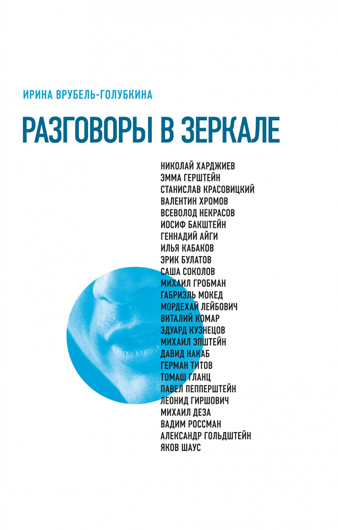 © НЛО
© НЛОМорев: Компонуя книгу, собирая из массы опубликованных в «Зеркале» бесед единое целое, из чего ты исходила? Была ли у тебя сверхзадача? Или это просто сборник?
Врубель-Голубкина: Своя задача есть у «Зеркала», и эти интервью — часть программы «Зеркала». Но для нас очень важная вещь — это формирование литературной культурной среды. Это было у Харджиева и вокруг, было в 60-х годах в Москве, когда люди находили друг друга. Учти, вообще 80 процентов людей, которые составляли наш круг, не были москвичами. [Илья] Кабаков приехал из Днепропетровска, Эдик Лимонов явился из Харькова, кто-то был из Сибири… То есть среда была таким полем притяжения. И такое же притяжение было в Израиле. Мы, в общем, были создателями этой среды. «Знак времени», может быть, был здесь первой газетой, которая заговорила на другом языке. Если говорить о Саше Гольдштейне, конечно, он и без нас бы состоялся, но он был один из людей этой среды. О Втором русском авангарде он знал от нас. Многие годы у нас прошли в бесконечных разговорах, бесконечной общей работе. И часть наших разговоров о литературе, об обществе стала, мне кажется, гармоничной частью этой книги. Эта книга не пишется о прошлом, это не воспоминания. Эта книга, эти интервью — о будущем, которое, как сказал Николай Иванович, уже наступило.