
Translated material
Music for the third ear
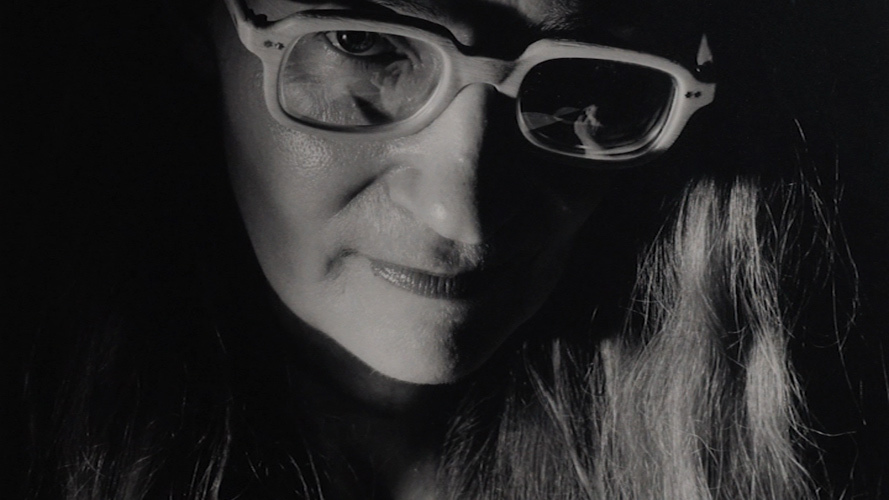
On February 20, the gallery of floating sound working in the media center of the New Scene of the Alexandrinsky Theater will show a film made at the Austrian Institute of Media Aarcheology , the director of the Elizabeth Schiman Institute in co -authorship with a well -known monumental excursion into the history of Soviet electronics "Electro Moscow" Lena Tikhonova in 2012 was shot "Video Porter No. 6: Maryan Amashe." Unlike the previous five, this portrait is posthumous. In addition, the authors take up the extremely non -trivial task - to show a composer whose work in principle cannot be heard in the cinema: Maryan Amasha was engaged in spatial sound and the subtlest faces of psychoacoustics.
She was easy to find out - she dressed very unusually: she constantly wore a red skier costume, often an aviation helmet. Roused, naughty white hair, one dreadlock that she has not cut off since 1962. Bright red lipstick, without which she felt like without clothes.
Maryan Amasha was born in Pennsylvania in 1938. She studied the piano play at the conservatory of Philadelphia, but did not become a pianist - once during the game she beat so much on the keys that the little finger broke. She continued her studies as a composer, first - at the University of Pennsylvania, then in Salzburg and Dartington. For a while, she took classes from Shtokhausen.
Delusion No. 1 - very quiet / very loud music
Some described her music as very loud, so scary for their ears. Others are how barely audible. In reality, Amashe’s work is an ideal example to demonstrate that the volume is a relative and very subjective concept.
In the 1970s, in the Center for Promising Research of the Visual at the Massachusetts Technological Institute (Mit's Center for Advanced Visual Studies), she began to develop music based on Ear Tones -the sounds generated by human ears. The reason was the Triadex Muse - a synthesizer created by Marvin Minsky . Thus, music is what arises in the “third ear” - the so -called effect of otoacoustic emissions, while sounding noise published by the performer is just an intermediary.
Maryan Amasha: “Acoustics call it the modulation of patterns, as well as audible brain pulsations ... When I was just starting to work with this, I had no idea, as it is called, I came up with my names for these strange effects. Then I found the appropriate literature and realized that this area was well studied, it was not just that I trampled on sounds. People hear spirals, hear crooked, various sound forms ... "
Synchronism
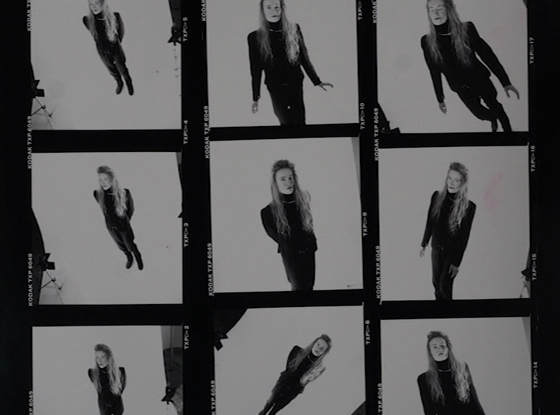
At the beginning of the 20th century, K.G. Jung develops the concept of synchronism. Jung considered synchronism (as opposed to simple synchronism) a principle that complements causality. Unreasonable, synchronously occurring events were perceived by him as having a deep connection, although inexplicable from the point of view of causality. Having received for such fabrications the accusations of charlatanism from the teacher Sigmund Freud, Jung, fearing more large -scale ostracism on the part of the “new Inquisition” of the scientific establishment, practiced synchronism in private, postponing its publication until 1951: “Having written this work, I, if possible, fulfilled a promise about which for many years was afraid recall". In artistic circles, the concept leaked largely due to the friendship of the scientist with Zen-Master Suzuki, whose lectures attended, in particular, Cage.
In the 60s, synchronism becomes the conceptual platform of Maryan Amasha. In 1967, she launched her long-term City Links series, where the sound from remote places was broadcast in real time. In the same year, she performed a 28-hour concert on the radio, mixing sounds from eight different places in Buffalo. Using “original” sounds, as if these were parts of a giant synthesizer, it created its electro -acoustic compositions. This allowed her, focusing on such parameters as the depth of space and the localization of sound, to differentiate sound flows and events.
People hear spirals, hear crooked, various sound forms.
In the work of Intelligent Life (1979), the jazz musician George Lewis , while in the New York port, played a microphone on a thrombone. The sound of his game, as well as the sound of the pier in the distance, were broadcast into Amasha studio, where John Cage read the text. All this was broadcast and mixed live on the concert that took place at The Kitchen club in New York. The performers were three musicians and three places.
Synchronism is a method that gives wide opportunities outside rationality for understanding the world - by pure chance. At first, Amasha interpreted synchronism as the simultaneous listening of spaces remote from each other. In the multimedia series of the 1980s Music for Sound-Joined Rooms, it goes further and combines objects located in close proximity, with remote objects located at an incomprehensible distance.
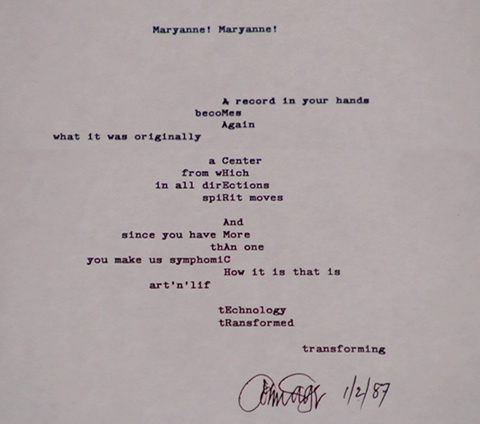
"Master of all arts" John Cage, impressed by these works, in 1987 dedicated her an acrosti:
“Maryan! Maryan! The recording in your hands again becomes what it is originally - a center from which the spirit moves in all directions. ”
Misperity No. 2 - Installation Artist
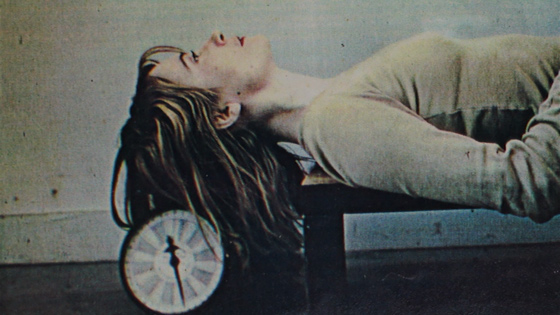
The work of Maryan Amasha is sometimes mistakenly taken as installations. In his book “American music in the twentieth century” ( “ American Music in The TwentietH Century " , 1995) Kyle Gann ( Kyle Gann ) calls it "one of the best artists in the installation genre." I must say, without deeply in the essence of her music, to come to such apparent conclusions to come no wonder - in the traditional sense she did not write in the traditional sense: she was low -sympathetic as the process of “reinstalling and modifying famous musical figures, followed by putting on their own framework”.
Her colleague and assistant Bill Dits recalls her Dietz ) : “Her work is not a sound (as many were mistakenly believed, thinking that she writes“ new ”sounds for every new job), her work is not a technical set (although she cared about this extremely), her work is not ideas to which she appealed (scientific discoveries, etc.); her work is a non -existent place ( The non -PLACE ) , located simultaneously here and where it manifested itself - in us or between us, in our sensory, programmed culture, in the world ... "
Amasha was convinced that human perception was evolving, he constantly needs new codes. Therefore, she herself defined her genre as "Creating scripts for activating consciousness, body and space."
Sound characters
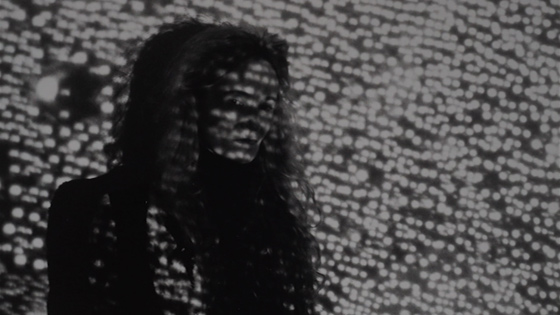
Perhaps the so -called sound characters are the only conceptual heritage of Amasha - they very quickly healed their lives outside her own creativity. Now known as the founder of the “solo” New York Gallery of the spatial sound “Range” , and in the 80s-the young composer Michael Schumacher , trying to structure the generative audio arrays in the premature era, found the concept of “sound characters”: “The concept of the“ sound character ”was taken for the starting point. Sound character-they can be any process or a separate sound: something that functions independently. He can interact with other similar characters - I call it modules. And so they coexist, set the context for each other. But at the same time - they “do not listen” to each other, this was my idea. That is, you seem to open the windows and see that some activity is happening. Imagine that someone is sitting and rehearsing on the violin-two hours in a row. He plays gamma, plays, sometimes repeats something ... This, for example, is a sound character, to whom access opens up to some extent from time to time. ”
John Cage: “Maryan! Maryan! The recording in your hands again becomes what it is originally - a center from which the spirit moves in all directions. ”
She knew her own “sound characters”, according to her colleagues, perfectly. And also gave them the names - “horror”, “burning gold”, “a big nose of God”. Mixing, filtering and modifying them in a certain way, relying on the specifics of space and her hearing, she created more and more works from them.
Selected “Sound characters” from the Music for Sound-Joined Rooms series, where the theme of acoustic spaces and sound structures overlapping each other is developed, were published on CDs on John Zorn Tzadik Records label .
Misconception No. 3 - Lack of recognition
The film regrets that the work of Maryan Amasha never enjoyed the support of institutions. But since the film is not rubber, it does not explain that this is a typical “auto-referent” statement, I had a chance to attend the master classes of the complaining composer: 2/3 of the time, it takes the transfer of the received grants and orders. In this sense - yes, Maryan Amashe was definitely not a “grant”, as Diamanda Galas described them: “They have no original ideas, while they get a lot of money for going to the right dinners.”
Among the festivals and art centers, Amasha had a dignous D ificult for restless perfectionism and the desire to exhibit work in precisely the conditions that they demanded. It has never been convenient for either the old (musical) or the new (sound art) of the bureaucracy. Nevertheless, there were: frequent proposals of joint projects from Cage, a series of music work by order of the dance company of Merce Canningham from 1974 to 1980, festivals in the USA and Europe, the scholarship of Guggenheim. From the 2000th and the next nine years before the end of her life, she taught at Bard College .
In 2005, at the sunset of her days, the still prestigious, but already starting immersion in the abysses of the bureaucratization, the ARS competition Ele C Tronica (Austria) finally awarded her his main prize- Golden Ni C A (by the way, in the same year, the prize was awarded John Oswald OSWALD ) , the theorist and practitioner of Planurfoniki, is late for only 20 years).
The projection of the method
Several years ago, we discussed another attempt to recreate the famous “Good Symphony” Arseniy Avraamov with a media artist, researcher Andrei Smirnov . “Good Symphony” (1922) is an ambitious work that requires an entire city for its performance, therefore, in the course of discussing the inevitable utopicity of the idea, we came to the term “variation on the topic of reconstruction”.
And what else remains? Unlike his teachers, Shtokhausen and Cage, Amasha was not interested in theorizing or creating a system for her work. EAR Tones are not amenable to sound recording, and the sounds that it used to stimulate are too high for the format of the film and, moreover, have always been determined directly by Amasha as applied to the room. In the same way, deprived of the author’s performance in the reverb church halls, its materials for spatial work themselves sound like simple many hours of drones. “They go further than the so-called Site-Specific , which, if there are proper documentation, can be reproduced. Amasha created specific spatial situations, to gain the completeness of which the public performance was required, ”says Helga de la Motte-Haber, researcher of her work Helga de la Motte-Haber) . Most of her last videos begins and ends with her request not to shoot while she speaks (performs, rehearses), materials of the works are an occasion for many years of work of players of the game of beads. Her old “Victorian-Edward” house is in disrepair, her archive at the time of filming of the film was forced to urgently look for another room-at the insistence of Elizabeth Shimans, when the filming group with its employees pack the giant archive, the film was not included.
“We would like to find a way to store her work in an accessible format for people. The difficulty is that each new layer of her work, each group of work has its own specific problems of interpretation, ”says the director of the archive and student of the composer Mikeh Silver . -There is nothing to be done, its absence must be accepted and move on, not thinking about the authentic performance of the works ... Perhaps in the future someone will study her work, someone will find a connection with her. Probably such a person has not yet been born. ”