
Translated material
Imra's creation
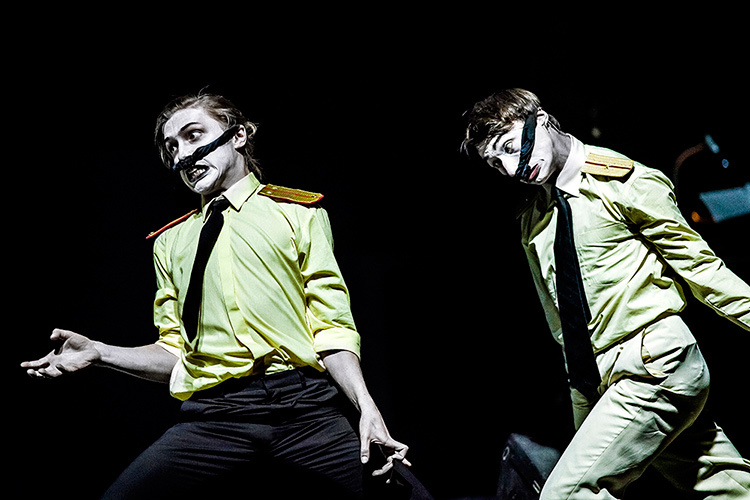
“It was a dashing 20th, we had fun as we could”: a slightly paraphrased Internet meme could become an epigraph to several performances of Maxim Didenko. In a pair with Nikolai Dreden "Lenka Panteleev. Musical ”, fantasies from the life of the legendary Petrograd bandit from the time of the NEP based on the Trekgroshova Opera, two traditions of the left theater - Brecht and the Soviet avant -garde were faced. The recent “Konarmia” according to the stories of Babel turned out to be a musical and plastic composition on the topic of the Civil War. Together with the scenaographer Pavel Semchenko and composer Ivan Kushnir Didenko, he invented a new youth theater for many - with catchy visual decisions, with zongs who do not interfere with becoming hits, and with artists who are quite capable of making stars. The supernature of this theater, which is moving from the performance to the performance, is currently relevant: Didenko, Semchenko and Kushnir have been exploring the theme of the revolution for several years - both political and aesthetic.
It is clear why this trio liked Kirill Serebrennikov so much: the productions imprisoned under the youth audience dreamed of him even in those days when the Gogol Center existed only in the plans. It was the young audience of Serebrennikov that was calculated by the musical “Awakening of Spring” about puberty love and other age -related troubles: the staging lasted a short time, but the repertoire gap poured quite quickly - “Harms. Myroy ”, a new musical performance of Didenko and the company.
 © Ira Polar / Gogol Center
The director, as it is easy to guess by name, devotes his next work to the same culture of the Soviet avant -garde as a whole and the work of Daniil Harms in particular. Light mobile pavilions of Pavel Semchenko-elementary light gray structures equipped with red Swedish walls-resemble the constructivist decorations of Meyerhold. The visual decision of the performance again appeals to the early Soviet “proletarian” theater - based, in turn, on the tradition of folk, field art.
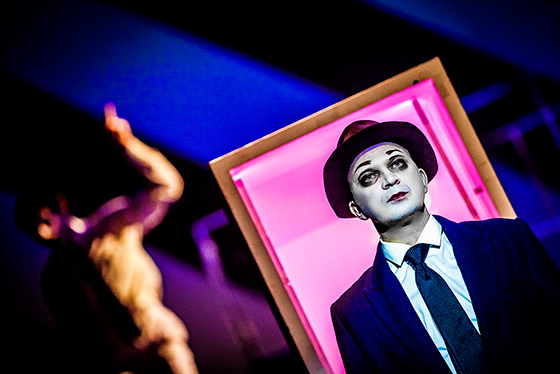
The heroes of Myra wear bright clothes and a clown white make -up, grimace, fight, cut off each other's fake limbs, ride a ball and fly on cables. The style chosen by directing requires a lot from an artist who needs not only to master the Buffonada technique and have good vocal data (and songs for Harms texts in the performance are no less than dramatic scenes), but also skillfully juggle and be able to masterly climb up and updates by decorations. However, Serebrennikov in his “Seventh Studio” brought up just comprehensively developed actors - so that his former students to meet Didenko were prepared in full.
The playwright of the play is well tailored: since Harms throughout his creative life returned to the same heroes and images, according to his works, one can trace the biography of the famous professor Trubochkin, restore the history of the quarrel of two friends or collects together the uniforms of Pushkin. The comic pair of span friends is responsible for the clowning of Clound, for some reason he’s telling about Pushkin-however, in the appearance of the oriental theme in “Myra”, one can see the murderously accurate logic: oriental aesthetics, as you know, was introduced into the XX century Theater almost simultaneously with a platform culture.
 © Ira Polar / Gogol Center
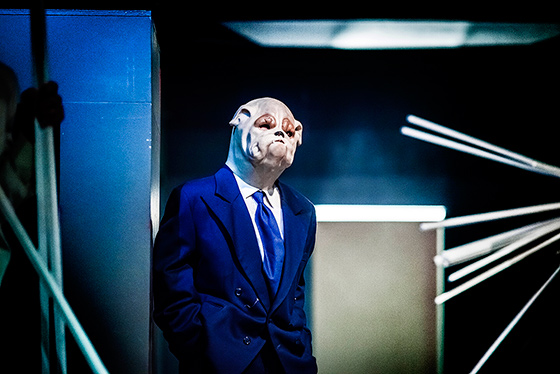
Just as Harms divides the tongue, separates the word from its usual context (“I began to watch the professor too and sees that it is no longer thick, but a barn”), the artist Semchenko and director Didenko change and crushing the human bodies. Pyotr Pavlovich Pakin takes his hand to Andrei Semenovich Rakukin. The professor puts a ball on his head. The professor’s mask leaves the hands of his assistant and begins to live his own life. A large red spot on a black suit makes the silhouette of the one who put this costume on an almost indistinguishable. The actor, exhibited in the “frame” cut in the decoration, as if losing his legs, head or torso.
At some point, you understand that all these unthinkable anthrash are not at all accidental, just as it is not by chance that the director of Harms is the director of the omniscient professor, the travesty version of Dr. Faust, who is attributed to the writer's observations about the nature of the Universe. In the end, the mysterious morpheme “Myr” in the name of the performance is consonant not only with neologisms from the “abstruse” poem of the twisted “holes of Bul Shchel”, but also with a much more familiar word: Sidenko, by his own recognition, staged a performance about the knowledge of the world-which is disassembled in the “Gogol Center”, and then they are collected before the eyes of the amazed ones spectators.