
Translated material
"Mantra of love and tenderness"
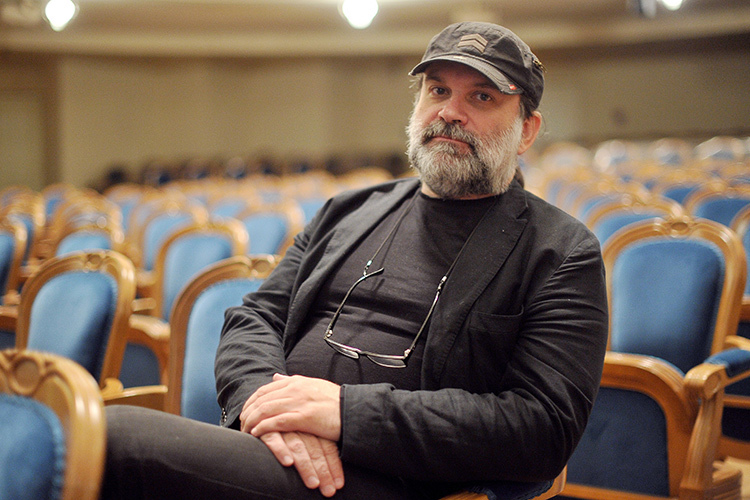
The Big Drama Theater is preparing to complete the season with a triple gulp prime minister: Khudruk Andrey Mogeliy releases the “drunk” Ivan Zarypaev, Andriy Zholdak puts “Harlequin - servant of two gentlemen” by Carlo Goldoni, and the Slovenian director Tomi Yanezhich is preparing for the debut in Russia. Alla Shenderova talked about today's agenda of the BDT with Andrei Mighty.
- I was now sitting in the hall at the rehearsals of the “drunk” and thought about how much the BDT scene and the scene of Alexandrinka were very different, where you worked for many years. How do you build relations with this space, with the city, with the viewer?
- Having for the first time on the stage of Alexandrin, I, despite the entire scale, felt a certain chamber - in the BDT there is no such feeling. Alexandrinka is more compact: Karl Ivanovich Rossi created ideal proportions between the stage and the hall. Here the feeling is that the hall is larger. But it is no more - it is longer, it is more difficult to take. The scene always drags the artist for himself - no matter what school he belonged to. Valery Mikhailovich Ivchenko told me that the existence on the big stage requires a special pathos. The word "pathos" in our time sounds strange and old -fashioned, but in fact something sacred, existing deep in the acting subconscious. In the BDT, the actor has no chance to master the hall without having a point of his own pain inside. This, of course, applies to external technology - a special way of the actor’s existence on the big stage. But every time it requests its actor, its own way of existence. BDT at one time was absolutely adequate to the request of society. And now the request has changed. The city, society, time, the tier Italian theater - all this is interconnected, but how, under all these conditions, finding the authenticity point today? In what language should the theater speak with today's viewer? We had such a documentary project “My BDT” - in it Kalyagin, Dodin, Tabakov, Smelyansky and others talk about what BDT was for them. And then Mikhail Piotrovsky honestly admitted that for him the theater is not an art. Of course, he does not say that, but to the question "Did the BDT change anything in your life?" He answers: "No, the theater can not change anything - the book can, painting can, but the theater and cinema - no." For him, the theater is a social event, an episode. And such an episode could be a powerful episode of Tovstonogov. Tovstonogov left - all, there is no this episode. And he said one more thing: the Tovstonogovsky BDT is the legendary we are talking about - this is the belonging of Soviet Leningrad.
- The Soviet Leningrad was also different. There were, as Akhmatova said, vegetarian times, but there was an era of Romanov when many fled to Moscow.
- You are right. Both Tovstonogov was not easy, and the “Roman comedy” (the play based on the play by Leonid Zorin, staged by Tovstonogov in 1965, never went to the audience.- Ed. ) He was forbidden. And Romanov was a tough relationship. When I started going to the BDT in the late 70s, I also found the "philistines", "holster", "Hanuma". But the "idiot" with Smoktunovsky did not see. By the way, it’s strange: Smoktunovsky worked here for three years here (1957-1960. - Ed. ), And by and large, this is an artist of the BDT. He was discovered by Tovstonogov - further you can argue who unwound him: a rose of an orphan or Dina Schwartz, but this is already a matter of researchers. There are phantoms: Khlestakov Erast Garin or Mikhail Chekhov, and the same dense phantom - Myshkin Smoktunovsky. Although it is better not to watch in the record. Because the theater is like a mandala: it is created and quickly destroyed, but something changes from it. Where, in which information field-I don’t know, but something remains! So Smoktunovsky, of course, is connected with the BDT. There are a lot of legends in the BDT. When I came here, the great Nina Olkhina, Lyudmila Makarova (the same Hanuma) were still alive - both she and Efim Kopeles worked in the theater even before Tovstonogov. And Maria Konstantinovna Adashevskaya played the first role in the BDT back in King Lyra Kozintsev in the 41st year. And this season, together with our interns, she played in the pre -premiere show of the play by Polina Nevedomsky “Neurosis of Love”. And the incredible Georgy Antonovich Shtil is a second -plan artist, a brilliant “master of episode”! I’m not talking about Alice Brunovna Freindlich and Oleg Valerianovich Basilashvili, who in essence “pulling” the theater on their shoulders. Their activity is a property of genetically strong people: there was such a powerful energy here, this was happening behind the scenes ... As Andrei Urgant said, BDT is Olympus, and it is better not to get here with ordinary mortals. Because the gods are allowed; This is compensated by the fact that they are really gods on the stage. Georgy Alexandrovich, however, selected and pushed artists - not so much characters as personalities that very strong personalities gathered here. At some point, they simply could not get along with each other. Smoktunovsky was the first to leave. But this did not really affect the theater: the bench was crowded. And this frantic energy of love, friendship, hatred - it is still felt here. And the cabinet of Tovstonogov is still alive-the efforts of Irina Shimbarevich. True, for some reason the cabinet was made a new one-they searched for three years, found, and in the end they put a new one.
- For what?
- God knows him. Probably to look better. The theater is always a game, myth, partly true, partly composed. But now is such a period when it is necessary to understand as soon as possible what the future has the future. And therefore, my main art project now is not to make a specific performance, but to restart the theater itself.
Theater is like a mandala: it is created and quickly destroyed.
- And you, sorry, have a contract for how many years?
- For three years, and two have already passed. Therefore, we are in a hurry - we must try to quickly restart the car! Few people are aware of this context, but outside this context it is impossible to understand any of my steps.
- Who is your viewer now, have he changed a lot?
- The question is not easy. We largely retained the previous repertoire, because we cannot but play performances - we must fulfill the plan of the ministry, based on which money is given to us. Having jumped up in April 2013 on this train, I already began to rehearse Alice in September-I would have started earlier, but all summer it took a showdown that had nothing to do with the artistic activity of the theater. In early August, the plan of Alice arose. On August 15, I went to Alice Brunovna Freindlich with a proposal. She said: "Yes, interesting." On September 2, we have already rehearsed. It was, of course, a very courageous step on her part, I think that he was dictated by a desire to help the “young” artistic director, for which I was immensely grateful to her. Even if in the process of rehearsals there was a temptation to take her word back, she, as a decent person (and Alisa Brunovna - a man of incredible decency) went to the end, despite all the difficulties and crises. In general, I started with the wheels. And so - without a script, without a scenography, without distribution - we did Alice, and in December we released in the Kamennostrovsky Theater. Well, then - one by one. The “History of the Soldier” by Stravinsky, “Endir” according to Marquez, “From the life of the puppets” by Bergman, “Tomilo” of Boyd, “when I become a little” Korchak, “what to do” in Chernyshevsky ... well, much more. A set of an internser group, directorial and dramatic laboratories. There was no such speed with me or in the BDT, as I understand it, for a long time. This is me to the fact that our viewer is mixed now: both the same, and new.
- Today, before the rehearsal, you said that so far you do not know how the St. Petersburg viewer will perceive the "drunk."
- When I studied at the institute, we were shown an old Soviet film about conformism (“I and others”, 1971 - ed. ), Which was prohibited at one time. Six children are taken there, they give them white and black pyramids, and then five are persuaded to say that both are white. And they all babble: “Both geling, both geling ...” - and the sixth, of course, repeats after everyone. Then the same thing is done with adults: pointing to a portrait of a young girl, nine people say that this is a made up old man. And the tenth agrees. That is, in 1971, a brilliant film was made in the USSR about manipulating mass consciousness! So, we are now so cleverly manipulated that it is difficult to understand where the truth is, where is a lie. In this chaos, it is very easy to get scores, replacing real problems with fictitious; Just choose, for whom - and put it. Why am I saying this? To the fact that the play by Vyrypaev calls to talk about how you feel. It generally seems to me that the time has come for direct statements. Although part of the society is not yet ready for this. Here, let's say, criticism was not ready for the simple message of the play “What to do”: my happiness depends on the happiness of another, I have to make the neighbor well - and then it will be good for me. I recently looked at YouTube to meet his Holiness of the Dalai Lama XIV with American scientists. He came to them and said: "We have a lot of experience in compassion and love - remove the religious component and use this experience." After that, scientists examined for several years how Buddhist monks meditate. It turned out, for example, that different parts of the brain are responsible for compassion for their relatives and for compassion for the enemy. In the process of research, this happened: scientists put the electrodes on the head of one of the monks, then pushed the screens to demonstrate their work to other monks - and there was a laugh: all the gathered monks began to laugh. They laughed because the electrodes were attached only to the head, but not to the heart. There is, it turns out, some wandering nerve that connects part of our brain to the heart-and now it is responsible for compassion. The more a person meditates compassion, the stronger and more elastic this nerve. The Americans opened a whole educational program associated with teaching children compassion. And right: what else to teach children now, besides this?! After all, this is impossible: people today broadcast hatred into the world, hiding behind considerations of a religious sense!
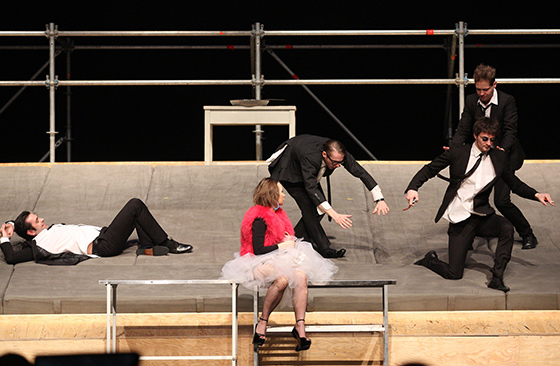 © BDT named after G.A. Tovstonogov scene from the play "Drunk"
-May I ask directly: there are some ways to bring the artists to the sense of artists, if there is no dalai lame nearby?
- Only work! Rehearsal is our religion. Of course, you have to engage in domestic and foreign policy, and at the same time they cut money, make it dependent on which author you will put. You know, I already have calls: do you like the play of such and such a comrade? ..
- And if there is no play of this “comrade” - there will be no money?
- Apparently, yes. We were in a difficult context. But I do not want to blame anyone. Because with all this I enjoy work here! If honest work is going on, the actors, like a sleeping beauty, suddenly begin to wake up, open - and experience happiness from this. The theater has a strong young and middle generation, wonderful "old people". I say: Georgy Alexandrovich collected a great collection. At the rehearsals of the Vyrypaev play, an acting team arose, knowing what he wants to tell the viewer. And so I change - and not only me. You saw the scenery for the "drunk" - no one will believe that this is Shishkin. We always had tricks, costumes, videos, the artist was almost equal to the whole surrounding attraction, and now Shishkin says: let's make a tilt ring - and the artist is on it. And all. For me, this abolition of decorativeness is very important - it leads me to the artist, to its content. To a clear statement that is not closed by any filters.
- What kind of Buddhist music is in the play?
- This is a “mantra of love and tenderness”, I listen to her for the night. I have never worked so directly and artlessly: if love, then a mantra, if a characteristic of a social layer, then Frank Sinatra or Amy Winehaus. That is, everything is straightforward and naive. Now I will quote you to Vyrypaeva again. When he was with us, he told one brilliant story: he sometimes goes to the Sandunov baths. And a few years ago he overheard the conversation of two dudes there. One says: “Listen, I watched the film“ Avatar ”yesterday - Krutan’s thing! After all, I did not even think that nature and we are one whole. ” And so, says Vanya, Cameron explained to millions of people that we - philosophers and postmodernists - are trying to tell our complex language. I will add from myself: the sharper the time, the easier the words should be, otherwise - we will lose. At the same time, of course, the text of Vyrypaev is still complex, fragmentation, the degree of direct utterance intentionally decreases with rough vocabulary. This is such a postpostmodernism, striving for the simplicity of utterance. And in general, already reaching the ultimate clarity. Although I am sure: those who want to be “offended” will always be found.
- Are you talking about those who are “offended” inside the theater or outside?
- I'm talking about everyone. The play "Drunk" is our propaganda of patience and compassion. By the way, what will do with us Tomi Yanezhich based on the book of the Austrian psychotherapist, a prisoner of the concentration camp of Viktor Franc from “say yes!” On the same topic. "Man" - this production will be called. Yanezhich takes an open platform into the hall, the artists speak from themselves. Another job - " Zholdak Dreams : The abductors of the feelings ”based on the“ servants of the two gentlemen ”Goldoni, the Andriy Zholdak releases: many trainees are busy there (we managed to recruit - fifteen people, one better in the summer!) And a young part of the troupe. Plus, the project “New People” of Boris Pavlovich with schoolchildren and another, with autists from the Center “Anton here is nearby”. Plus, we also conceived a cycle of lectures. Yes, I know, there are lectures both in the Gogol Center and in the electric power engine. But in this sense, the Comedy Frances is closer to me: here is the original of the manuscript of Voltaire, there is a chair of Moliere, impressionists in the bar. That is, a story that can be touched. It’s not in vain that you were so surprised by entering Tovstonogov’s office and seeing Clofelin on his table, which he took from pressure.
My main art project is now not to make a specific performance, but to restart the theater itself.
- And, by the way, what are you doing to the anniversary of Tovstonogov?
-Well, firstly, I will try to have time to release the “Roman comedy”-in the context of that long-standing performance and its ban. I want all the old people to work there. Secondly, there will be a Tovstonogovsky evening. Plus publishing and educational activities-Elena Gorfunkel and Irina Shimbarevich will help us here. We will release the brand, a calendar with quotes by George Alexandrovich. The plane will be called Tovstonogov. For many years, Golden Sofit has been presenting the Tovstonogov Award for many years, and we want to make a festival of laureates of different years. Producer Vasily Tovstonogov is now starting to make a film about his grandfather. Well, we want to do the cartoon what I especially like. The question is how much the state and the city will help us with money. And I think we have enough strength.
- An unpleasant question: you will spend a lot of effort on the anniversary, then another six months will pass - and the contract will not extend. Are you ready?
- What is the unpleasant? I'm ready for everything. The cinema will finally take off the long-conceived. I will resume my European contracts. Or simply - everything is an opening, and then I will act. But thinking about it is now unproductive. “Live at full bicycle speed,” as one of my favorite characters of “fools for fools” used to say.
- What should the artist be so that you want to work with him?
- I like the actors: a) with the brain; b) trusting and checking their internal monologue using the distribution of the body in space. Here is Valery Mikhailovich Ivchenko, by the way, I could easily classify my actors. Like the whole team with which we have now released the "drunk". I like plastic, hearing: we speak everything in a bird's language, and it is important that you are heard: how is Sorokin in the novel “Ice” - it is banging, and then it is difficult to explain. Here in Alexandrinka, Sveta Smirnov, who understood me at a glance and as a cat-I could not say anything, but somehow went in the direction in which it was necessary. Well, of course, Nikolai Sergeevich Marton. It was no coincidence that the avant -garde players fell in love: he always wants and knows how to be young. He played a twenty -year -old boy in my gardeners - climbed on the Internet, and even with such excitement! In general, many favorite artists remain in Alexandrinka. In addition to Smirnova and Marton: Semyon Sytnik, Vitaly Kovalenko, Victor Smirnov, Julia Marchenko. And Leah Akhedzhakova, Albert Filozov! It's hard for me to stop. In short: the actor who takes the work of being the author of his character is good.
- Walking around the theater and looking at the photographs, I almost drowned in a picture from Fantasy Pharyvyev: how Yura is looking at - crazy pharyli! What a face of Natalia Tenyakova! And nearby - Zinaida Sharko, Svetlana Kryuchkova, all are absolutely real. The psychological theater that has not been so long ago that sometimes it seems that it has never been. Question: How does the creator of the formal theater come together with psychological?
“You will be surprised, but I have never separated myself from the psychological theater, I still had a cut on this subject with Anton Adasinsky.” Even when Adasinsky went on stage with Dima Tulip, I still understood their relationship, saw the psychology of these people. In the "School for Fools", in the "Hamlet Mashin" we were looking for, first of all, a person. It is clear that there were many tricks, we had fun, but often this happened from fear: to be one on one with a person. Here is my favorite photo - Smoktunovsky and Doronin in the "Idiot".
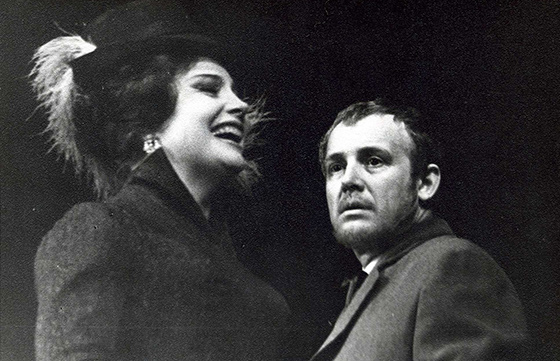 © BDT named after G.A. Tovstonogova Tatyana Doronina and Innocent Smoktunovsky in the play "Idiot"
Мы по ней — по одной фотографии — делали целую режиссерскую лабораторию! То, что сейчас называют психологическим театром, на самом деле не имеет к нему никакого отношения. А настоящий психологический театр мне страшно интересен! Для меня последний психологический, точнее, игровой театр — это Васильев, «Взрослая дочь молодого человека» и «Серсо». Товстоногов практически ушел в мюзиклы, Эфроса я застал уже на излете. Хотя вот вопрос: Лебедев-Холстомер — это психологический театр или нет? Я, если честно, будучи молодым, Лебедева не очень любил. Мне нравились артисты, может быть, менее выразительные, но тонко ведущие свою внутреннюю линию. Но сейчас я смотрю и поражаюсь. Вот если «Дядю Ваню» пересмотреть: Лебедев-Серебряков — это высочайший класс острого и вместе с тем точнейшего психологического существования. А Эраст Гарин — это не психологический театр?! Вообще нет никакого разделения: если у Кастеллуччи актеры существуют неподлинно, меня это тут же начинает раздражать. Что такое система Станиславского? Естественное существование человека в искусственно созданных условиях. Мой любимый артист Николай Мартон может говорить с простертой в зал рукой и пафосно, но при этом абсолютно органичен! Он блестяще владеет формой, но ведь форму — «танцы тела», как это называет Люпа, — не оторвать от внутреннего монолога. Если нет ничего внутри, никакого танца не получится. Так что Пина Бауш, на мой взгляд, — тоже психологический театр. Вернее, все это — тонкая работа с человеческой психикой.
— Вам не жалко расстаться с визуальным театром?
— Я им занимался с 1989 года — надо же как-то меняться. Визуальный театр так или иначе связан с аттракционом. Но количество аттракционов ограниченно. У Дэвида Линча есть киноперформанс «Индустриальная симфония». Он снят в 1990-м, а я посмотрел его лет через десять — было такое чувство, что я все оттуда украл, хотя раньше я его и не видел. Но он уже все сделал до меня! Актер в этом смысле безграничен — он же всегда разный. Человеческая душа, простите за пафос, бездонна, а визуальный образ ограничен. Вот театр АХЕ — Максим Исаев и Павел Семченко на Малой сцене БДТ делают сейчас набор перформансов по «Книге мертвых». Конечно, они невероятно изобретательны, но прежде всего меня интересуют в их спектаклях их персоны. Они, кстати, договорились делать этот перформанс, пока один из них не умрет, — и теперь я не могу думать про этот проект вне этого знания. Вот такие вещи волнуют меня сегодня больше всего. И поскольку я теперь все делаю в лоб, я вам вместо финала просто процитирую статью из газеты, которую выпускают художники-акционисты из группы «Что делать»: «Возможность просто вообразить вопрос “Что делать?” появилась недавно, когда вдруг многим стало ясно, что наступает время серьезных и ответственных высказываний. Любые ироничные, игровые формы репрезентации вдруг стали казаться непристойными. Еще рано говорить о полном преодолении постмодерна, но можно констатировать, что он уже стал невозможен чисто эстетически. Настает время возвращения к принципам».