
Translated material
Cabinet of Dr. Zholdak
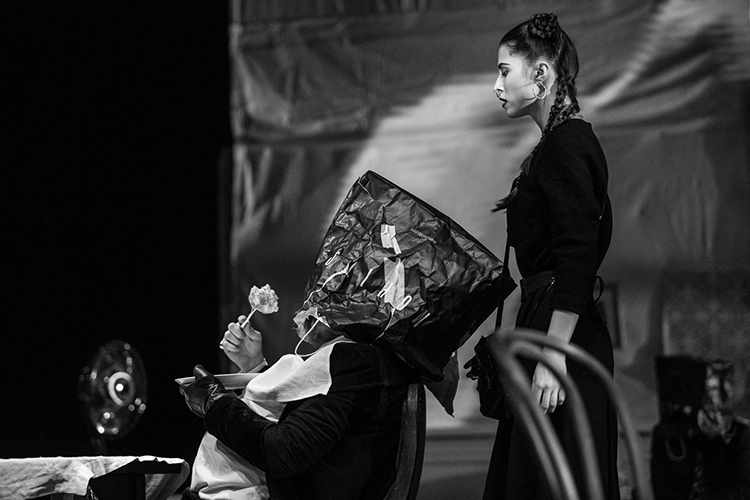
Usually to disassemble the performances of the Zholdak is like cutting water, and everyone who imagines himself Moses inevitably turns out to be a Xerx. They are dense and cloud, but spineless, abundant ideas and style, but scarce with thought and method; Their fury gives out with sprout; They carry out the scenic form, without filling up, and to drive them into slender concepts as stupid as tie a tie on a braid. From the performance, which loudly is called " Zholdak Dreams ” (albeit not according to the author’s will, in girlhood he pretended to be a“ servant of two gentlemen ”, but the artistic council deprived him of shyness and let him in all the gravity), we could expect already perfect Fellines. And when at the beginning of the performance on the back screen, the lunopodic face of the director appears, telling how he “got bored after a week of rehearsals and decided to turn off logic”, the triumph of centrifuga is inevitable: oh, everything, now it will charge the deconstruction, our sins are difficult ... and suddenly everything turns out ... well, not quite so. Not as usual.
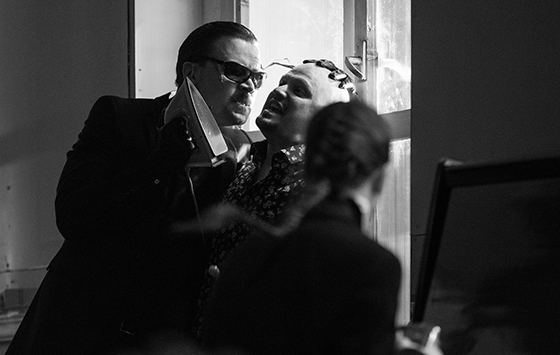
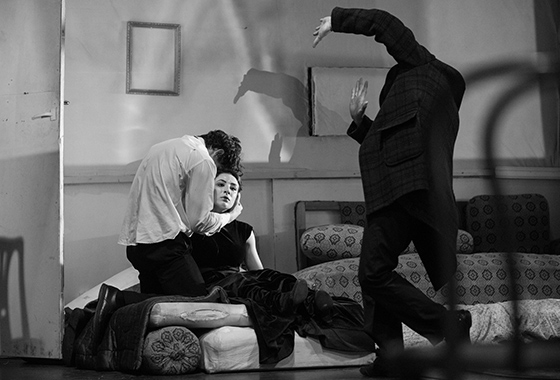
No, neither betrayal, nor crawling here, of course, is not: boredom is overcome, the logic is disconnected. In fact, only the tie was left from the Goldonian original: Federico was killed, so that the lovers of Silvio and Clarice can get married, which their fathers are talking about. Everything else is endless firing, Gagi and Lazzi, coloring and stretching the scene of close happiness, beyond which Carlo Goldoni once followed the full play of tests - and which is now in the Zholdak in a sterile emptiness. And because, besides her, there is almost nothing in the play. And because this scene is not the one that, according to the dramatic numbering, is one or there are four, but the one that is a small BDT and the actors walk on - is literally surrounded by a cosmos. The angels are invaded from it, then what kind of aliens, mysterious music streams from it (the documentary readings of the astronauts who allegedly hear some music when flying over the dark side of the moon are presented from it), there is no division introduced by gravity into the top and bottom (the nominated Truffaldino farts outside the window, as for the illuminator, and I just left the remark “ It pokes it below with a finger somewhere up) ... Sevetta fraught with fate, and it thickens around a cozy capsule room, around the cooing of Silvio and Claric and the ultimate of their parents-now stopping the action, like a stop-cadre, then focusing it, then drooping it with anxious-voluntarily glow behind high windows. In terms of its functions, the Zholdakov space is a cross between the Meterlinkovsky house from “there, inside” (if you do not see it outside, like that of Meterlink, but “out of the outside”) and a mansion from the “fighter angel” of Bunuel, for the threshold of which it was impossible to go out without any rational reasons. However, unlike Bunuel, the Zholdak of his fighter angel shows-there are even several of them. The isolation of the house, however, does not become more rational from this. But it is scary to say, it becomes more cinematic.
 © Press Service of the BDT/ Stas Levshin
Because " Zholdak Dreams ” is built on the cross of two global formal motifs: one - spatial, the other is mask. The mask is understood widely understood, much wider even more than it was understood by its masters of Commedia dell ' arte : Zholdak (perhaps without realizing it) is exactly following the theories of Ivan Gaulle, the Great Lorraine Surrealist, according to which the mask in the theater is a large -plan analogue, the basis and the primary law of the theater, which allows you to work not with reality (“Theater is not the same The reality in which you live, ”conjures the audience of the Zholdak in his prolon), but with“ things behind things ”, with the sphere of super -real, corresponding to children's and archaic consciousness. In Zholdak Dreams ” The mask is also a hypertrophied facial deformation that aliens subject themselves to“ reflectors of people ”, and the decoration itself, as if imposed on a cosmic abyss and those (imaginary) humanized it - and especially the voices transferred from the characters to two actors sitting on the forefront to the hall and the two -way voiced (with amazing, necessary. To notice, with virtuosity and no less charm), almost the whole performance - for almost all heroes.
The Zholdak does not so much put it as the performance stuck, extracting the characters from the thick matter of the stage, as if the rabbi Lyov is a goal from the clay of the walls of the Prague ghetto.
The point is not only that the “superimposed”, as in the cinema, the voice becomes one-due to the unity of the performers and their adoption outside the site-a sound mask of action, which allows (again in strict accordance with the metaphor of Gaulle), as if on a close-up, to discern and disassemble every whisper and sigh; The scene resting on the screen itself turns into a screen for the voicing, flat likeness of deliberately deep reality - not without reason the resulting “phonogram” is so vividly resemble a way to work with sound in some films of Muratova and Sokurov. The fact is that the whole performance, thanks to this technique, turns into a gigantic session of gluttony: so their voice and their will revived the dolls of German film expressionism, and they imprinted the death of their deformed plasticity into the space surrounding them and locks, stopping and splitting the time - and adopting the dubbulas of fate. The Zholdaka here is least appropriate to call the “director” - a person organizing the text and forming a single space of style; It does not so much put it as the performance conjures, extracting characters from the thick matter of the stage, like a rabbi lion - a goal from the clay of the walls of the Prague ghetto.
 © Press Service of the BDT/ Stas Levshin
All this makes the performance of the Zholdak, with all the meditative slipping of stage time and the entire entropy of action under the gaze of the void from the windows, on the marvelous one, but, apparently, for Zholdak-too classic. And therefore in Zholdak Dreams ” introduces another form -forming motive - cyberpunk, which becomes in the second act (more precisely, already in the final of the first) the main one. With all the other motives, it is mounted quite organically: the Meterlylovsk emptiness turns into digital soullessness, puppetness - automatism, a mask - a machine panel; And even the wooden laughter of the Angels X75, as if under a carbon copy, sred to the “Margaritoks” of Hitilova, forms a wonderful duet with metallic intonations of the title “abductors of feelings” X101. Moreover: Cyberpanka is presented by Zholdac so convincingly (with the exception of too intrusive and therefore surface-technical quotes from the “matrix”), which can give other cultural and enthusiasts an excellent reason for revision, say, Kronenberg reflexions (30 years old, however, far) about corrosion of television in the lights Theatrical bodies. And yet - Cyberpank is not so much embeds into the overall drawing of the performance, but gradually subordinates it, without erosion, but decomposing, or even destroying. Entropy and fatum, which in the first act gave rise to tragedy reverb, in the second are increasingly clear, coldly: outside the conflict, without the process of influence - and therefore theatricality in this second act is depleted and emasculated. He is not poorer than the first on brilliant directorial moves, not rude to the drawing, no less accurate - for all extravagance - in the development of roles. He just translates the decay from the level of the plot - to the level of style. Zholdak in his “Reflection of the theater” reaches (quite consistently) to the border of the theater-and makes some half a step around this border. And there - his performance is a witness - a cosmic emptiness.