
Translated material
The court recognized the extremist book of Kvachkov
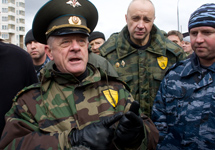
The Lenin Court of Penza recognized the extremist book “Who ruled Russia” by retired Colonel GRU Vladimir Kvachkov. This was reported by RAPSI with reference to his lawyer Oksana Mikhalkin. The book was banned for distribution in Russia.
With a claim for a ban on a book issued by a circulation, two thousand copies, the prosecutor's office turned to the court. The department noted that in the text of this book “There are words, expressions and statements containing negative assessments to the group of persons according to the grounds of belonging to a certain nationality, origin, signs of the motivation to seize the buildings of law enforcement agencies, the media, and communication systems.” These conclusions were confirmed by a psychological-linguistic examination, the prosecutor's office noted.
In February 2013, the judge of the Moscow City Court Pavel Melekhin sentenced Kvachkov to 13 years in a maximum regime on charges of terrorism and the preparation of an armed rebellion. In July of the same year, the Supreme Court excluded the charges of terrorism from the case and reduced Kvachkov with a period of up to eight years .
The court considered proven that activists of the ex-colonel of the People’s Militia named after Minin and Pozharsky planned to seize power in the city of Kovrov, Vladimir Region, and from there to move to Moscow. Kvachkov himself said that he was preparing partisans in case of war with a foreign aggressor. At the same time, in court, he defended the right to an uprising.
In October 2014, as a result of the provocation of prisoners cooperating with the administration, Kvachkov was first placed for 10 days in a schizo, and then sent to a detachment of strict conditions of detention. In mid -November, Kvachkov and all the other 17 prisoners of the SUS detachment turned to human rights organizations in Russia with a letter, which told about the gross violations committed by the FSINITS.
At the end of November 2014, the Prosecutor General demanded to recognize the People’s Militia named after Minin and the Pozharsky terrorist organization and to warm the activities of this structure.
On February 18, the Moscow City Court granted this requirement . Representatives of the FSB and the Ministry of Justice during the trial supported the position of the supervisory authority.
Representatives of the People’s militia, for their part, denied the terrorist nature of the structure. They called its tasks ensuring the safety and territorial integrity of Russia, as well as the education of patriotism. Representatives of the organization emphasized that the army in the years when the Ministry of Defense was headed by Anatoly Serdyukov, could not cope with these tasks.