
Translated material
Poem of ecstasy
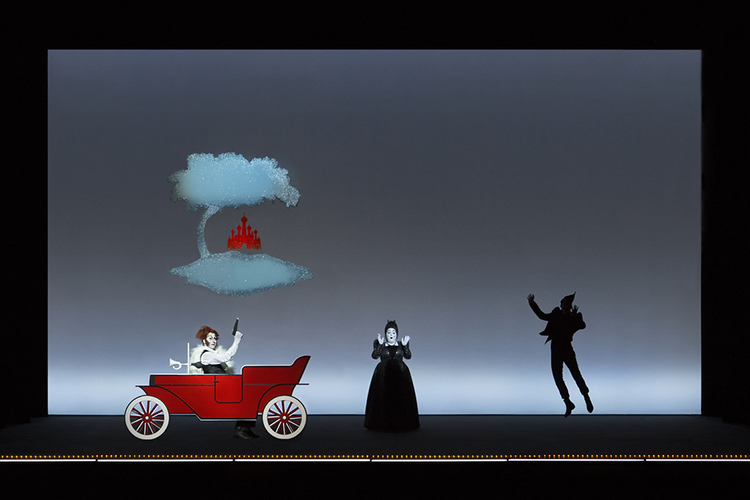
Along the perimeter of the scene of the Theater of Nations, where Robert Wilson put Pushkin's Tales , Variet lights burn. There is an orchestra pit - there the musicians are enthusiastically participating in a synthetic booth, performing Cocorosie music, mixed on a stylistic, polyzhanr eccentrian.
After the long -standing avant -garde masterpieces, Wilson entered a different territory. “Pushkin's Tales” is a paradox performance addressed to a simple-minded public and-to the enlightened. The performance is almost a staging of the method stated in Meyerhold’s software article “Balagan” . The praise of the cabinage, in which Russia does not smell. Is it because in the prologue the actress SESEG Khapsova, the future Shamakhan queen, is instructed to take off the stage and send a famous speech about the Russian spirit and smell to the hall. Pushkin’s fairy tales in Moscow is a universal performance of the “ancient theater”, which is sewn with signs of local or Russian art of the twentieth century, from bilibin to the Suprematists.
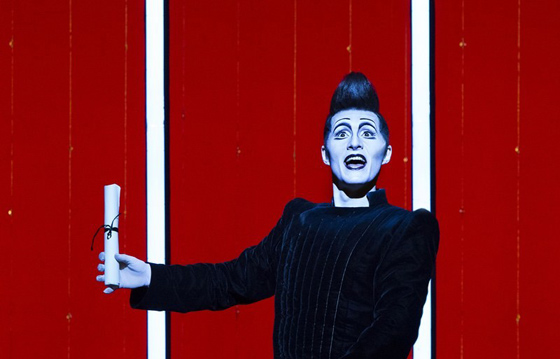
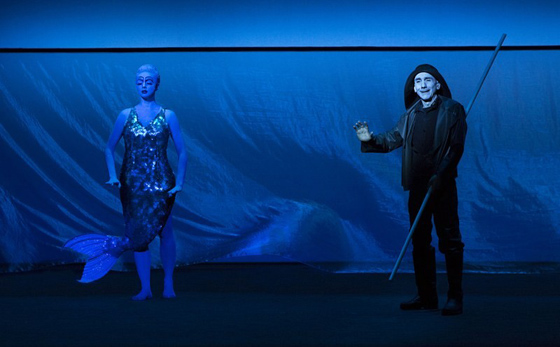
Wilson acts on the stage easily, literally and reverently: a broken trough, the island of Buyan in the image of an elegant toy, tulle more, a Christmas tree made of golden nuts, a tail in a suit of a sparkling ETC fish. And he charges the actors: their costumes and wigs of Iroquois/Pankov (Julia von Leliva), make -up (Manuel Halligan), plastic, voice, intonation - a forgotten lesson taught by the Russian acting school, is contraindicated to the comedian. Or unconsciously turning comedian into the entrapping parody.
 © Lucie Jansch
In essence, these “fairy tales” are an ohmage of theatricality as such, and not at all the “artist theater”. Having survived the era of innovative discoveries in the 70s, Wilson-the classic path of pioneer artists-turned to the power of the primary elements of the theater, having worked with Moscow actors the power of “masks, gesture, movements and intrigues” (Meyerhold). And - Cabotin technique. Miraculous, not decorative. Such a directorial course, at the same time spectacular, all -haired and acute, dissonant, contributed to the grotesque. Wilson developed it multilaterally. I laid out in paints, sounds and miniature details. The fisherman - Alexander Stroyev, having worked out the passage and text, sticks out a blackened tongue; Balda - Alexander Novin - in a suit with posters of constructivists is watching a cliff after a gully and defenseless intermedia of demons; Thirty -three heroes leave the cululis, decreasing in size to the little finger; The tiny boat of the fisherman is suspended on the large screen of the Sea-Neba ETC.
Flapping his faces with masks, Wilson pulled out the ability of middle -aged actors to go out, sing and dance, that is, to bother “under the cover”. And to be ultra -precision. The grotesque, like superiority, became a magic wand of this directing-and the gesture or wand of the conductor determined the “chords” of the legs, arms, spin of performers, exactly like in ballet.
 © Lucie Jansch
Yes, we remember that "the art of grotesque is based on the struggle of content and form." That it is the mask that “helps the viewer to rush towards fiction”; that “the actor’s face is dead, but with the help of his skill, the actor knows how to place it in such an angle and bend his body in such a pose that it, dead, becomes alive” (Meyerhold). However, in the Russian Theater, the original - not formal - stage convention did not reach, as in these "fairy tales", to the poem (acting) ecstasy.
Return the theater to the theater through the booth is the main condition for Wilson's conditional theater, who knows the history of the issue not according to Wikipedia. This is how his “unexpected joint” manifested with our artists and Eisenstein. His own, Wilson, exposure of the reception: switching from one fairy tale to another, from one type of stimuli (public) to another.
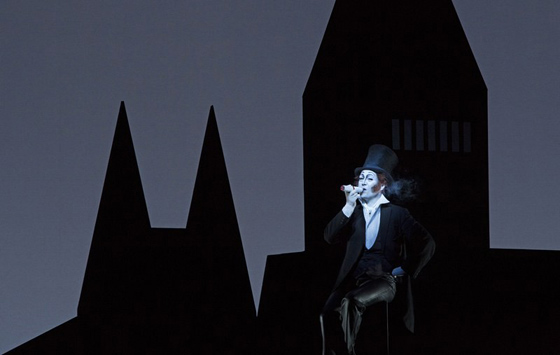
The storyteller - Evgeny Mironov fasten these switching. A poet with the hair of a red clown, a small demon, a purge candy of a cabaret with a dancing gait - but also Burton Hatter. But also the recipient-reader, the keeper of the audio recordings of all the possible manner of Pushkin’s execution, with whom he walks on a remote leash, sits on a tree or rides in a machine like a hero of cartoons.
 © Lucie Jansch
Talking only about the skill of this performance is not entirely fair - there were no stylization of conditional maneuvers here. And to mention the kabuki stood, if you do not forget the mockery of the reviewers of Eisenstein, who called three “common places” who had long scored, in connection with the praise of the Japanese theater: “How musical!”, “What a game with things!”, “What a plastic!”. Moreover, Sergey Mikhailovich continued to ulcerate our Old Testament colleagues, all this is “not so new: Meyerhold has long“ wrapped ”the Japanese!”
Wilson did not disconnect in Pushkin's fairy tales, but gave it. He created for one performance in the Theater of Nations that “monistic ensemble” that delighted Eisenstein in Kabuki - and which he compared with football, a collectivist sport. “A voice, a pot, a mimic movement, the cries of a reader, the emerging decoration seem to be countless beaks, midfielders, goalkeepers, forwards, transferring a dramatic ball and scoring a stunned viewer.”
Who could have imagined this on the metropolitan stage with our players?