
Translated material
Monroe in the museum: two opinions
In Moscow, a very large exhibition of Vladislav Mamyshev-Monro “Archive M” is held . We asked the Gazeta observer to speak . RU Tatyana Sokharev, whom the project seemed to be successful, and the permanent author of Aroundart . RU Anna Bykov, who saw in the Moscow Museum of Contemporary Art on Gogolevsky Boulevard remained unhappy.
Tatyana Sokhava. Archives of mutations
Any attempt to comprehend Mamyshev-Monro once and for all is bought up to the set of approximately the same stamps: the travesty, fed by fantasies about a certain eternal femininity, a journey from the army to a psychiatric hospital, drugs and parties without end and edge. A striking, but thanks to two huge museum corps of retrospect, his world has finally acquired the human size. Monroe ceased to be the sum of intra -bug rumors, scandals and provocations.
The “Archive M” in MMSI, among other things, raises the question of what gives the artist such methods of representation as the Angar museum and the Catalog exhibition. Of course, the museum space, which did not go far from the standard white box, took away from Monroe that element of the thyshop foolishness, which he was expressed. The barbaric, booth spirit of the 1990s and the early 2000s became part of a preserved museum culture. But just such an exhibition is a timely and necessary work aimed at institutionalizing Monroe as a character that can easily get lost in Milovo-Mizuli Russia.
Of course, the exposition organized on the principle of “all Monroe” cannot but be of questions: why to crush unfulfilled projects, is the composition-kaleidoscope so successful? The space of the exhibition can hardly be called animate: a feeling of malice of the day, which accompanied the mutations and transformations of Monroe, is almost completely emasculated from it. At first glance, a textbook approach to the material even looks like an unwillingness to enter it into some problems and discourses.
 © Dmitry Smirnov
For example, a small nook dedicated to “pirate television” looks more like a tribute than a myth: so, just artisanal documentation for the sorties of several artists, the expanding expansion of the media space in order to neighing. Meanwhile, the alternative TV Novikov, the Forester and Mamynev-Monro, which, as expected at the beginning, was supposed to “break through-through the interference-into“ Program A ”led by Artemy [Troitsky],” was essentially the same cultural terrorism as the Video Expemacles of Giya Rigavawa.
Nevertheless, Elena Selina (the second curator engaged in the educational program, acted Antonio Geus) managed not to turn the grandiose volume of the material into a landfill, although the art of Monroe, due to its specifics, is not so easy to catalog. All the finished series are exhibited in one building of the museum, unfinished in another. At the same time, the “Archive M” can hardly be called a whole, built by the narrative. More precisely, the definition of an “exhibition of exhibitions”, organized by layering of islands of Moscow projects, most of which took place in the XL Gallery, and more modestly represented by St. Petersburg.
 © Dmitry Smirnov
Everything begins here with a powerful suitcase, under the eyeballs filled with blonde wigs, feathers, sparkles and other attributes of the Drag, the attributes belonging to Monroe. It ends with a printout of the latest Facebook posts. That is, the viewer goes from concert props, from which Monroe's images grew, directly to the author and his direct statement.
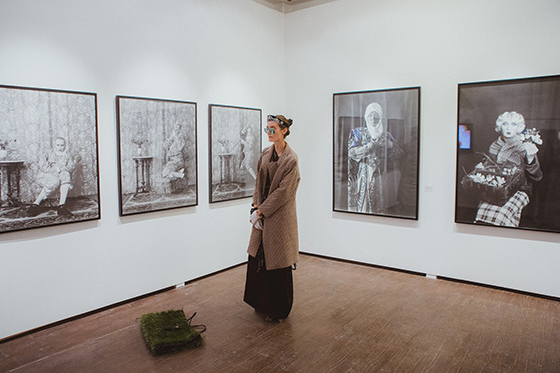
Each hall exists as an independent exhibition project, and peeping behind the process of creating the works that the exhibition exposed, has become one of its main advantages. The series “Politburo” and “Russian questions”, for example, are demonstrated along with endless drafts and refinements of the same images. In the hall dedicated to Lyubov Orlova, there is a draft photo story on behalf of Alexandrov.
In addition, it is the distance that such museum projects ensure that the myth of Monroe's “lightweight” is debunked. His branded sabotage - directed and, including - was not just a wide artistic gesture for the artist, but the finest cultural practice. Working with the wrong side of the gender and sociality, he reborn them from the inside: more archaic layers peered out of each htonic Jeanna Aguzarova in his performance.
 © Dmitry Smirnov
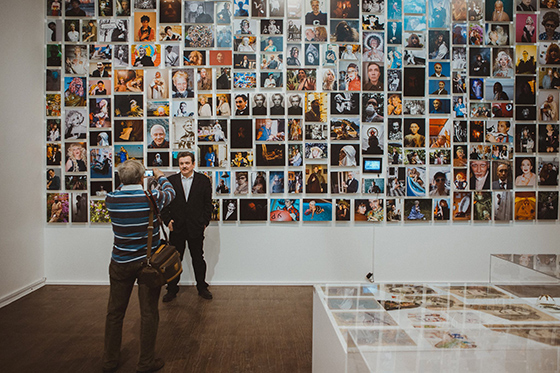
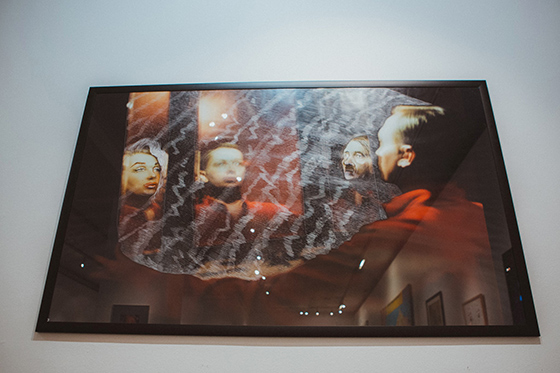
The phenomenon of Monroe rests on constant slipping off, the inequality of what he did. And the curators of the exhibition, functioning on the principle of “characters in search of the author”, caught and reproduced this principle. Especially spectacular in this sense is a hall that resembles an iconostasis that has grown to monstrous sizes, which is hung from the floor to the ceiling with photographs of Monroe in different images. Here he is represented by a mirror man, in whose face the characters were grotesquely reflected in the range from Andy Warhol to Usama Ben Laden.
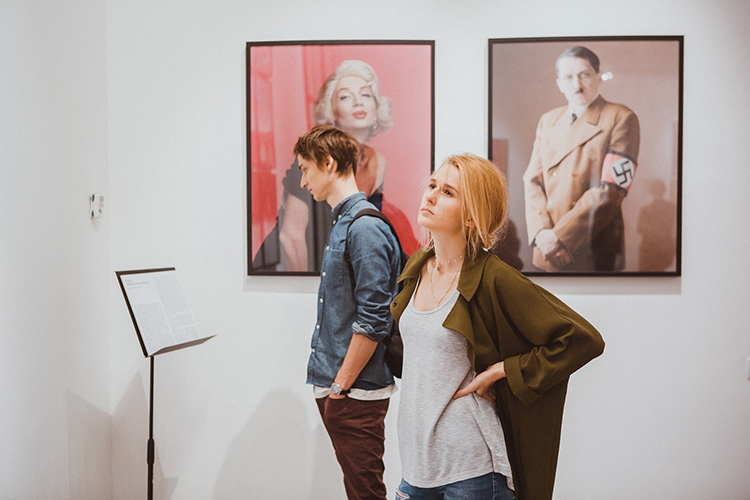
But most importantly, Selina managed to go beyond the black and white perception of the artist, in which they saw either a tricster-beevik, ridicurating the masses of mass-media slag, or a party-player who burned the Berezovsky apartment from the screens of TVs. Here he appears as an author, characterized by phenomenal scrupulousness and intelligibility of the art program, which was hidden under the mask of vulgar monkeying. Dressing in the Shally Pugachev or the phenomenon to open the Moscow -Berlin exhibition in the image of Hitler finally acquired the status of painstaking cultural work, which appears through a rather complex internal structure of the exhibition. Monroe appeared one of the Shakespearean jesters, in whose mouth, as a rule, the main remarks were invested.
 © Dmitry Smirnov
Anna Bykova. Monroe: Kitchen with clouds
In modern domestic museology, the practice of exhibiting art of the late 1980s-early 2000s, especially in its performative publication, was not established. All experiments of recent years have been surprisingly uneven: from masterpieces of imported ( Marina Abramovich in the old Garage) and Estetian-museum ( prigas in the HTG) to theatrical-sovishvoy ( “Performance ...” in the new “garage”) and thrash-experimental ( “90s: Victory and defeat” on passionate boulevard).
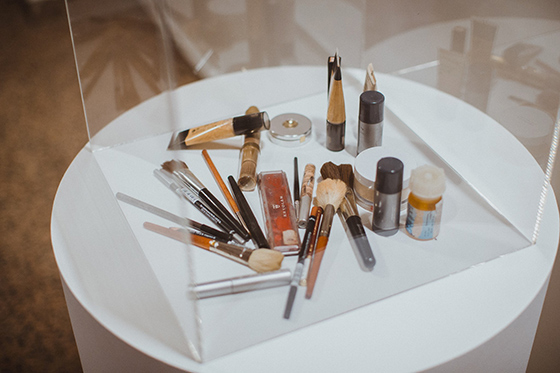
The figure of Vladislav Mamyshev-Monro, as it turned out recently, the museumification is desperately resisting, provoking curatorial archival exploits and exposition misunderstandings. The exhibition-retrospective in two spaces of the Gogolevsky Boulevard and in its court is a certificate of enthusiasm for the “curator group”: the Galerist-artist Elena Selina and the video specialist in the video art of Antonio Dzheus. The curators do not hide their addiction and archival pathos: “The purpose of the exhibition is to structure the preserved material as accurately as possible, show the development of the author in stages, without distorting his initial intentions and not interpreting them in their own way. This is a kind of post-performance- the real existence of the historical character “here and now”, which is represented in numerous photo and video materials, including extremely rare. ” And the viewer, of course, is waiting for biography and stages. But no. The viewer falls on ... photos. A lot of photos. Photos in the frames and without, in gold and black, in good printing of the same format and printed from the Internet, photographs are painted and not, to the grace and after, dangled to the foam card and laid out under the glass. And in all halls, along the whole of this crazy “photo exhibition”, painting is hung and the signs of “the presence of an artist” are placed: wigs, shoes under glass caps, suitcases of accessories, cosmetics and even the last new souvenirs bought monkey on Bali ... somewhere there are gausoleums-gibberries: plywood plywood multileries The zikurates, on which the same photos and the same archival materials are neatly laid out under the sheets of glass or caps. Some halls, according to a clear tradition, were turned into total installations with baths on the walls and kings in the corners.
 © Dmitry Smirnov
The architect of the “Archive M” exposition was Aleksey Podkidyshev, known for exhibitions in the Tretyakov Gallery on the Crimean Val (for example, Retrospective Prigov and “Hypperrealism”), the Manege (“Soviet Neorealism”) and the Pushkin Museum (“Visiting Rodchenko and Stepanova”). With Selina Podkidyshev made a “weightlessness” in the “worker and collective farmer”: the exhibition is very “clean” and transparent, then the material turned out to be an amazingly congenial architect.
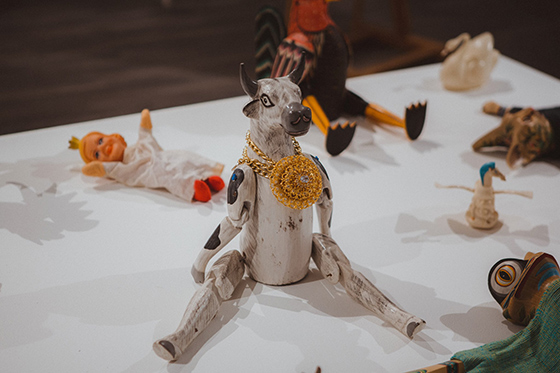
Masyshev had a failure. The neat moves of the architect to lay out the vertical and horizontal rows of photographs from floor to ceiling, plasma arranging, uniform hanging of masl canvas and building thematic rooms-the development of four floors and yard with materials preserved in museums and galleries, as well as on two hard drives of the artist, led to the disaster. The exhibition turned out to be a murder, the sad experience of the exhumation of the corpse of Trickster, the display of scratched animals and dolls, passing things, to the exposition by the artist not authorized. The eternal question about the weak things of the big "masters" is revealed to the offensive clearly: you walk and think - "Why?"
 © Dmitry Smirnov
The horror of the situation is also that the archiving strategy is a commendable in essence in the case of electronic databases, chronologies and catalogs - in the case of museum “restorations”, as it turned out, requires special talents. Seques and realmouses oblige doubly. Therefore, the two-part “reconstruction” of the art of the 1990s of the same Elena Selina in the Ekaterina Foundation, for all its usefulness, did not look convincing as the exhibition did not look at all.
The book still looked convincing at one time, for example, Andrei Kovalev with the anthology of Russian actionism of the 1990s, printed in black according to silver. The original retrospective of Oleg Kulik in the Central House of Artists, also supervised also by Elena Selina and wrapped in black polyethylene by architect Boris Bernasconi. Dmitry Aleksandrovich Prigov looked “to others” in the GTG, depicted by Kirill Svetlyakov and Alexei Podkideshev white and transparent.
Alas, Myshev, alas, did not grow together. There was actually selection of work, the archive turned into a trash, from which you quickly get tired - so the artist “TOP” in his own kitchen in front of the helpless and confused viewer. It seems that the curators were really carried away by the work of mourning: collecting everything and everything around, they lost the main thing - the image of the exhibition itself.
 © Dmitry Smirnov
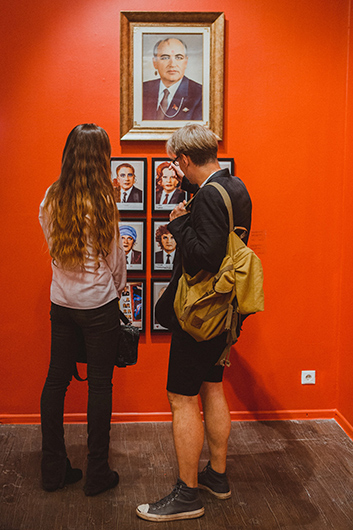
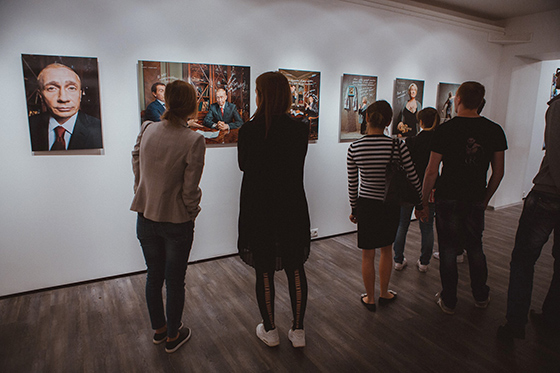
In the case of Mamyshev, there are two more important problems: this is the situationality of his work and his ugliness. It seems that the retrospective of Monroe today demanded from its creators and organizers increased attention to the context, which-somewhere correctly assembled-worked perfectly at the exhibition. In the hall with four author’s repetitions of the same series “Politburo”, two portraits were unexpected in one of the trellis ones, which became the necessary tunnel in time for the author’s “Kitchen”: the degree of their snapness and picture struck. Suddenly it became clear that the Mamysheva move was just the following in an endless series of beautiful decorations: coloring poured by artists and earned portraits of men in the prime.
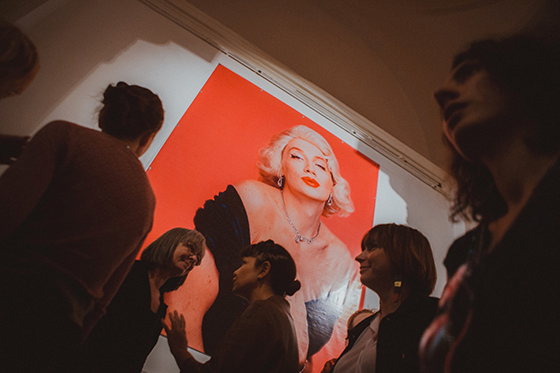
The same kitchen tunnel opened in the hall with Marilyn. Her photographs, magazine clippings with portraits hang a “wall” along with Vladikin experiments of transformations. Here such a “cloud” worked - the recognition effect was revealed and impeccable. Gather the curators to the press of the 1990s and 2000s, making it the background and scene of the artist and artist, perhaps the exposition would have acquired another drama. After all, all of Vladik was surprisingly attached to the situation of the current moment, which, leaving, made him forget a lot. Forget quickly: and now Tymoshenko-Monro seems to be completely overshadowed by its own vital prototype.
The disgrace of the aesthetics of Mamyshev was built on the eternally beloved "the worse, the better." The energy of Trash in his brilliant performance in the opposition to a magazine gloss worked without a happy time when the social and life of the political neighbor and the media in the media. And in the same media “printed” Vladik. It was a typical postmodern strategy of internal undermining. Today, these visual paradigms have dispersed: we still represent Yeltsin with Pugacheva, from there the Stalin-Hitler with Monroe (see also by Sokov), but Putin, in itself, the sex symbol, is completely lonely. And, passing along the walls of the gallery of museum halls and peering into the familiar features of one face after Stalin, Putin, Medvedev, Tymoshenko, you tremble, trying to distinguish and almost distinguishing the following heroes and anti -heroes.
 © Dmitry Smirnov
All Vladik was an artist Media and "Smic", there was the entire cover and the screen - to break. He was, like Gilgamesh, “a seeker of adventure, a brave man, but a tragic figure, a symbol of human vanity and indefatigable thirst for fame, glory and immortality - to such an extent that modern scientists often perceived him with a legendary character”; was like a tricster that “sets the essence of the game process of the situation and life”; As a holy fool - a “reverse prospect”, which puts “an image in place”, “in the place of the external - inner”, “in the place of culture is a cult”, in which “a woman declares herself a man, alive claims that he died. And the one who died is alive. ”
At some point, it seemed at the exhibition that the main move was found, the quintessence of all of Vladik’s life-making was determined. On the dead end wall of the left wing of the “Gogol” estate, Mamyshev depicts a new trinity in the dressing room, placing himself between Monroe and Hitler, beautiful and terrible, scene and tribune, pop art and social arts, to which bloody red paths-festival and nomenclature. But then this topic was dissolved and smeared: Monroe was everywhere further, like Hitler in a wide variety of species and combinations.
The device of the Mamyshev exhibition in today's Moscow was responsible, necessary and politically important, but the result was frankly disappointed: the archival exposition was decided within the framework of reporting and subsidiary cliches, becoming limp ritual commemoration throughout the culture of modernity that goes into the misery. The curator Elena Selina writes that she envies the next curators of Mamyshev-Monro, who will be able to offer their interpretation of the artist’s work on the basis of the archive he collected. We envy the next audience and we.