
Translated material
Cliff in Sos
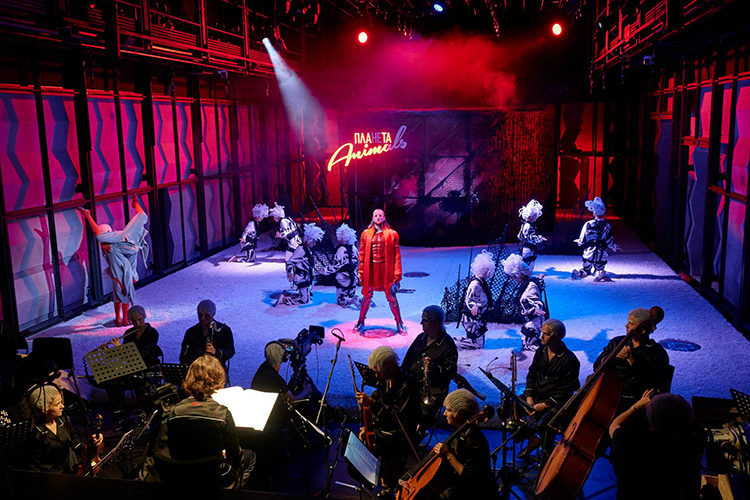
The unprecedented project of Boris Yukhananov ended. Five weeks on Mondays and Tuesdays, the most advanced and monitoring fashion fans of contemporary art went to watch the new series of the Opera series of the Ships Opera series. In the very center of Moscow, on Tverskaya Street, next to nothing suspecting visitors to the cafes and boutiques, there was a hatching of something that there was still no name, and it was not by chance that Hayner Goobbels joyfully dancing a party at the party that had completed the project.
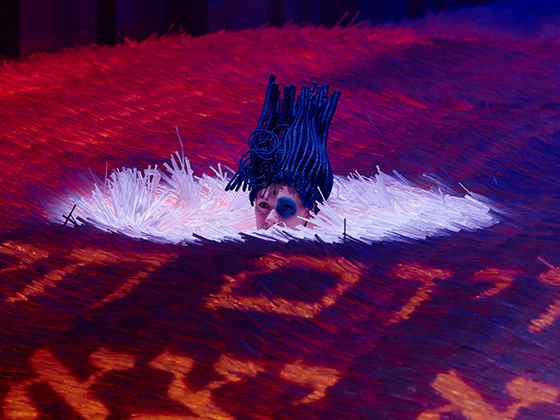
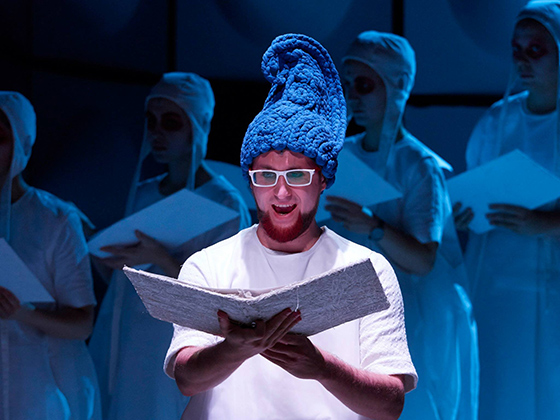
In different series, the hall was drawn to the podium for showing mods, then built up with a more traditional audience amphitheater, or diversified by the minimum movements composed by the director Yukhananov and choreographer Andrei Kuznetsov-Velovlov, then not. Instead of searching for a plot and verbal meaning, it seems to me to give the formulation of the musical leader of the theater Dmitry Kurlandsky , who he invented for this project, is “a manifesto of fundamental infantilism”. Psychedelic baroque of the flowing, luminous, spinning and inflating decorations of Stepan Lukyanov, who became forever recognizable, branded style of the “Ships”, was populated by the impressive costumes of Anastasia Nefedova. The main, absolutely incredible component of the project is several hours of freshly inflated and very uncompromising music, calmly and super -professional Masma musicians, Questa Musica and N ' Caged under the control of Philip Chizhevsky and with the heat of the heat already published on Fancy Music . In five weeks - six operas. A whole factory of new scores, a whole army for all ready -made soldiers of new music.
Each series was written by a new author. All of them: Courland, Boris Filanovsky, Alexei Syumak, Sergey Nevsky, Alexei Sysoev and Vladimir Rannev-not at all alien to readers COLTA.RU, experienced, in demand, very different composers-each in their own way overcame the difficult test of them in their own way-the text of the Roman Saga Yukhananov, settled by mysterious "floods," "Forgives" and "Cliffs in Sosits." If Syumak set himself the task of conveying the text to the listener as intelligibly as possible, then the rest rather, on the contrary, tried to veil it, overcome it in all possible ways, and observing this struggle was almost the main intrigue of what was happening. For my taste, two won - Filanovsky, who wrote a large, honest, beautiful and serious score, who obeyed the annoying dancing of the text with his seriousness. And the author of the hooligan final Vladimir Rannev, who armed musicians with deafening flyboards, with which they smashed the text to smithereens, without sparing, however, the ears of the audience. But the bewilderment about the battles remained, so I decided to ask several authors and listeners of the “Ships” at the end of the series:
- In my opinion, the main content of the “Ships” is an exhausting struggle of music and text. What do you think?
Sergey Nevsky
Composer, author of the 4th series of "Successites"
Any opera consists of many elements. Music, light, movement, scenography, costumes, text form a synthetic structure, the center of gravity of which is continuously changing. When I received the Roman "The Ships", Mitya Courland first suggested that I voice the first action. I refused both because of the volume, so because I do not know how to write operas based on a dialogue. As a result, this fragment was written by Alexei Syumak. The text that I got as a result was almost neutral in comparison with other parts of the opera, it does not contain any philosophical program, is almost not eccentric, almost devoid of bizarre characters like “grandmother's interpretation”, “lip” or “prostitute”, in general, this is an elegic poetic description of the destroyed city, which looks like a parody of a “poem without a hero”. Anna Akhmatova:
The air is clean
But everyone smells the SRA
The ghost of the sparkle
Smell
Station
Where is the soul
Relations of the emergency
And oblique gear thieves
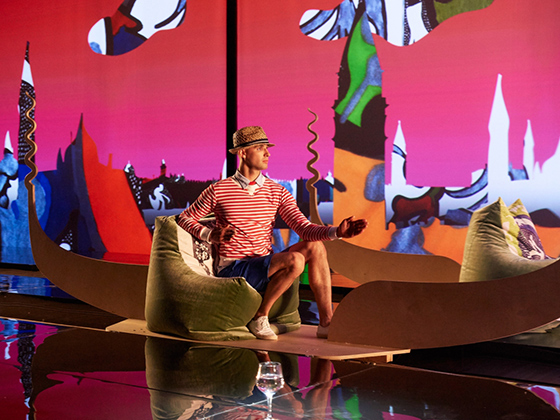
But there is another point that made me be extremely careful with this text - this is a reference to the religious and philosophical content with which I am not familiar enough. I am with a more familiar - in the confessional sense - the content is usually extremely careful (experience shows that the Higher Forces do not always approve when I work with canonical texts), and here I had to deal with theses and characters, which I know too little about. I realized that I risk looking like that hero of the Hasida fairy tale, who brought out many believers of the Jews from the other world with the strength and beauty of his singing, but at the same time he remained in the darkness-firstly, because he was an unbeliever, and secondly, because he was a suicide. In general, it was difficult for me to voice things and meanings that were not available to me, and as a result I gave the whole text that I did not understand, Leshe Sysoev, and he wrote, it seems to me, the beautiful, although rather gloomy and aggressive, music and in a sense saved the situation, because the physical presence and power of his music create a very convincing emphasis in the context of our evening. Well, I completely reconciled with the world of the Shipyards, when musical rehearsals began with Philip Chizhevsky, Masma, Questa Musica and Seryozha Malinin from N'CAGED , and even more so-when I saw the completely incredible scenography of Lukyanov and Nefedova costumes, which referred to the Glam Rock, or to the films of Derek Jarmen. Only the inscription “board - Anima ” (that is, the soul) blinking over the scene through the scene throughout our evening made me be in some inner tension - and now, probably, it forces.
 © Andrey Loor
Boris Filanovsky
Composer, author of the 2nd series of "Ships"
This is not a text at all, but an artificial construct that imitates the mythological case of texts. It is characteristic of the requirement of the bureau in the text not to be changed down to the voicing of remarks, that is, to treat his Roman-Opera as a sacred source.
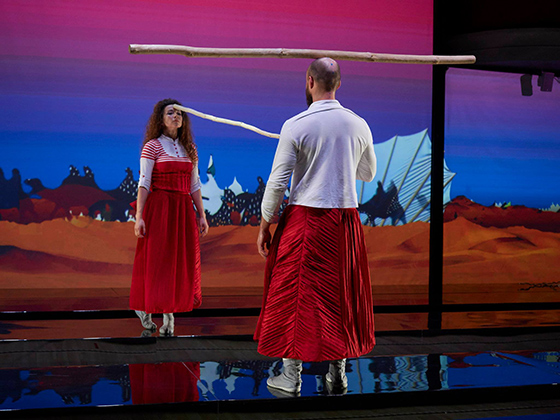
Therefore, all the throwing and the whole struggle, Twimc , were associated with the attitude to the "Sedeems" as a text - that is, to what music can enter into some aesthetic relationship. I think that a bonus suggested another type of relationship: to interpret or comment. That is religious. And when you take this position - that is, you turn a blind eye to the fact that the “drills” are not similar not only to the religious text, but even to the paravention, then everything falls into place. And you can delve into such an interpretation/comment that generally destroy, contradict, do not take into account these letters and words. It doesn't matter. It is important that you do not enter with these letters and words into aesthetic relationship.
 © Andrey Loor
Vladimir Rannev
Composer, author of the 5th series of "Successites"
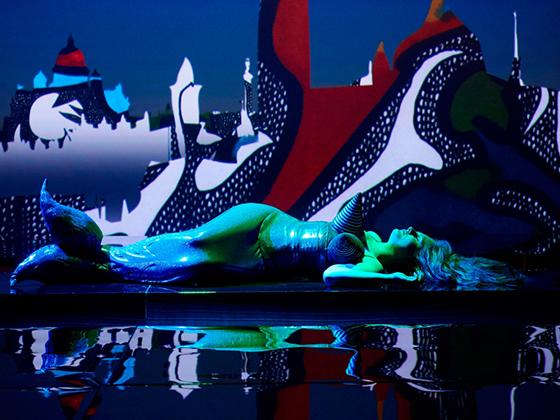
The Italian composer Vincenzo Galileo called for "not to be carried away by music, which does not allow to hear the words <...> and spoils the verse, then stretching, then reducing syllables to adapt to a counterpoint that breaks the poetry." It is he who is so disapproving about the Renaissance vocal polyphony, for example, about the music of Paclesrina. Did Paletrina fight the text? It doesn't look like. He simply did not believe that “music is nothing more than a word, then a rhythm and, finally, a sound, but not vice versa” (again from Galileo). Therefore, with the text of the masters of the Renaissance polyphony, it was not a struggle, but complex, but interesting relations. Like me with the text of the "Ships".
 © Andrey Loor
Olga Fedyanina
Theater
I think here's what: I have a problem with this formulation than I read it more attentively. The struggle of music and text - what, in fact, text? The text of the novel "Ships", taken as a synopsis, as a plot? Or a text taken as literary matter? The struggle of music with the synopsis, it seems to me, is poorly proved, because each composer dealt with a very small fragment of the text. Whether they are familiar with the whole text, I don’t know, but I assume that rather not. As for the fight against literary matter, then I am completely lost. That is, I must assume that the composers are Nevsky, Sysoev, Filanovsky, Courland, Syumak and Rannev with Yukhananov’s texts are exhaustively fighting, and with the text “ L ' amour EST un Oiseau Rebelle / Que Nul Ne PEUT Apprivoiser , / et C ' est Bien En vain qua ' on L ' Appelle , / S ' il lui Conviment de Refuser ” - would they not fight? Or not so painless? (This, if anyone did not remember, “love, like a bird, wings ...”) is hard to believe. On the contrary, looking at the verbal arsenal of Boris Yukhananov and the musical and organized arsenal of six composers, I find a lot in common in them.
If in general, turn to fashionable military terminology, then the central conflict of the “Ships” in the electric theater, in my opinion, lies in the time the balance of the musical, textual and visual environment is built after time. And balance can appear only where there is a maximum simultaneous and opposite mutual pressure of all forces - this is how the form appears, including the artistic one. And personally, the farther to me, the more interesting it is to observe this process, with each next composer and each next series the voltage grows. If it were possible, I would love to watch a new series of the opera series every week-as actually this format would be supposed to be.
 © Andrey Loor
Ilya Kukharenko
Musical critic
The very formulation of this question seems to me a great victory of the chief ideologist and creator of the project Boris Yukhananov. Its provocation has a very wide “radius of defeat”, primarily because this opera series lasts five evenings and in each the tremendous costs of all participants in the process are visible (I mean not only composers who wrote six scores, but also the huge work of the production team and musicians who have mastered the volume of complex musical material). The “Ships” equally provoke and at the same time do not allow themselves to perceive themselves either as a protracted joke, or as a new “Nibelung ring”. And Yukhananov himself sits in the middle of the hall and winks with one eye to those who chuckle, and to the other to those who meditating.
The main novelty of this project and the reason for our analytical torment is how it is produced. Indeed, in the person of Boris Yukhananov, several figures merged together at once, which in a traditional opera process, as a rule, are sometimes separated not only by thousands of kilometers, but also by hundreds of years. The Khudorok of the Stanislavsky Electro Theater simultaneously acts as the author of the literary source, and as a customer of scores, and as a librettist adapting the original for opera needs, and as a director of the first production. Wherever you try to quarrel music and words in this chain, Johanans will still arise in the “third” hypostasis as a peacemaker. The conflict, by the way, is not entirely new, because in the twentieth century, two heroes of Richard Strauss, Kapricchio, argue exactly on this subject, and the Strauss was inspired by the opera Antonio Salieri, which is called "first music, then words."
 © Andrey Loor
Alexander Manotskov
composer, did not participate in the "Sucleys"
In my opinion, the main content of the "Sucleys" is, in fact, music. More precisely - different music of various beautiful composers, united by common space. You can treat Yukhananov’s texts differently, but they have one important property in this situation. They are properly monotonous: in music, for example, the repeatability of the element allows the listener to transfer attention to another level, even forces to move attention. So and here: if you do not try to specifically attach attention to individual seeds, the textual level personally works here as a kind of “Yukhananovsky-Te-O-O-Sweetians”. At the same time, there are pretty moments when suddenly Semema comes in, but they are pretty precisely because they are subordinated to music. Are there a lot in common with Mozart, Verdi and Ligeti? And they, by the way, are written on the same good text. But, accepting the general situation of the funeral mass, we are not obliged to listen to the meaning of each word, listening to music. So and here: there is a certain “Squire myth” (let literary critics discuss literary virtues), the summary of which is placed in one paragraph, and there are musical works. Personally, the text of Yukhananov seems to me perfectly modern ooper. The only thing I do not really like is a certain literature of the project, which manifests itself both in the introduction of the readable text in the music and in the general “media mythology” of the series, and even in the fact that the name of the author’s name is put first on the record. It would be wrong with Pushkin’s text, it is wrong at all - with the text. This is a compositional, mathematical error, the wrong order of subordination of the levels of the world. By the way, the less the opera’s music “hangs” on the text, the better the opera works - and this is also true both with the text of Yukhananov and with the text of Pushkin. There is another important level of content of the “Ships”: this is not a project story, not about different, but directly “vertical” series, that is, the form itself, as it were, says: it is so important. Here you should come right and listen to everything from beginning to end. And I really like that. It really seems to me that the products of the authors of these operas should be met by the same greedy attention of the same number of people as the next season of the popular HBO series.