
Translated material
Colta.ru
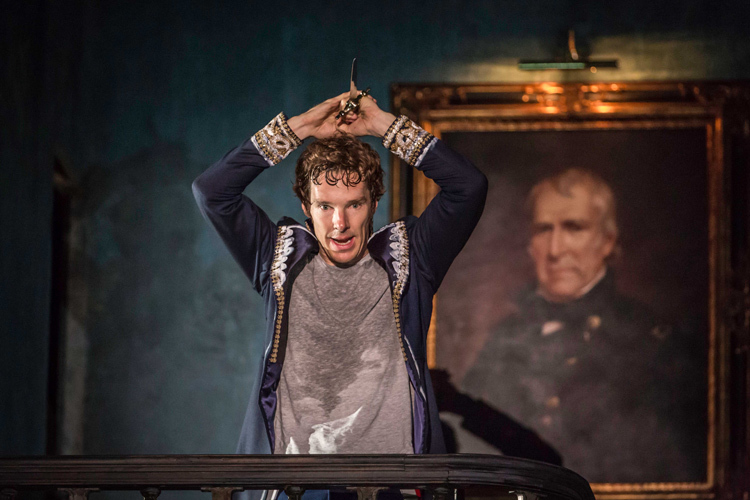
On August 5, the first shows of Hamlet in the production of Lindsay Turner began at the Barbikan London Theater. The premiere of the performance will take place today. In the role of Danish Prince - Benedict Cumberbatch.
Two years for the actor's fans, they were impatient expectation and search for an answer to the question: “So how will he survive?” (after falling from the roof in Sherlock). And two more years - in an attempt to imagine “how he will die” - in the Shakespearean “Hamlet”.
For five years that have passed since the time of Frankenstein, when Benedict Cumberbatch was the last time to go to the theater scene, he managed to do a lot: Sherlock, “End of the Parade” on television, shooting at Spielberg, Hollywood projects, Oscar -winning “12 years of slavery”, “Startrek”, “Playing in imitation”, fans, penguins, pingvins Hobbit, dragon and the crown of current acting quarries - a contract for the personal comic book of the Marvel studio (Dr. Strange). He also made a “seizure of movement” in the “hobbit”. What theater is there? "Hamlet"?
English actors sometimes return to the stage. And those who, after theatrical victories, left the theater to the cinema, and those who, having barely stepped on the stage in his youth and have fallen sensitively, gaining fame, receives a second chance to prove their acting viability to everyone. "London account": the scene decides everything. For Cumberbatch, his “Hamlet” is, of course, not a revenge (the leading English critic Michael Billington, for example, rejected the thoughtful question “whether Cumberbatch could play Hamlet” as a pure nonsense). It must be assumed that for the actor this is primarily the opportunity to "remember everything." Not so much a “authenticity test” as a chance to restore the definition of authenticity. “But in fact, I ...” - as said in old advertising. At first we need to “correctly” - that is, the only possible way for him is to pronounce “to be or not to be ...” and then you can frown menacingly in elegant suites and the power of magical thought to destroy the villains in comics. The “Binding Thread” will be restored.
 © Johan Persson
Cunning schemes, building conspiracy concepts, pretending to be the distance from the roof to the car ... that is, from Wittenberg to Elsinor, only one can say with confidence: which will not be in this “Hamlet”. There will be no Sherlock. Just because he - with his characteristic unceremoniousness - like no one obscures, if it does not absorb, the personality of the actor himself. Although such a Hamlet could come out very curious. Among other things, the tragedy in five acts would go for an hour and a half - due to the speed of pronouncing monologues.
Imagine: Hamlet was torn from experiments in the University of Wittenberg’s laboratory, he experiences the death of his father and the mother’s wedding with the usual selectivity of his famous insensibility - but nothing more. He does not think to dare Claudia (“The nephew - let it, but not dear”) - simply calmly establishes facts, having neither natural need nor the opportunity to play royal and family games. “It does not seem, but there is. I do not want what it seems ”becomes a formula for the search for truth.
Cumberbatch should play so that we, the “dumb viewers of the final”, ultimately asked the Danish prince “stop being dead”.
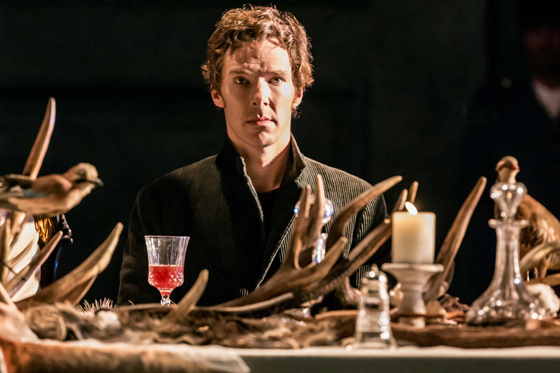
He is deaf to other people's metaphors, and he needs his own practically - as saving funds, the quintessence of meaning. He is not concerned about the power and the Danish throne, however, being a scientist, the prince cannot but be interested in the strange events taking place in Elsinor: his father’s shadow is a privileged client (the sentimental side of the matter flickers, allowing the audience to enjoy their own insight). The “detective” component of the tragedy is insignificant here - it is more important that the researcher is not able to stop: if the game has begun, then it will be completed even at the cost of life - the truth is potentially deadly. The highly functional sociopath has much more similarity with a crazy prince than it seems at first glance - Polonius will be convinced of this (like an object of lightning irritation), and Ophelia (her attempts to keep up with a Hamlet will be especially touching), and Rosencrantz with Hildenster (concomitant losses, no more). The “mousetrap” turns out to be mathematically accurately calculated by a provocation: Claudia will have to be self -disclosory to demand a fire - because the point is to find the king’s guilt before the whole yard. Hamlet in everything was convinced by a characteristic spot on his left wrist. The skull of poor Yorik after the scene with the graves will rest on the fireplace shelf - well, this is already known. The duel with Laert, the result of which is obvious, is the only remaining move after all other options were marked. Actually, farewell to Horazio Benedict Cumberbatch in Sherlock has already played. Twice.
 © Johan Persson
But there would be nothing surprising in the fact that Cambertch in his Hamlet partly rely on the Christopher player, officer and gentleman (“end of the parade”) played by him. The Great Elsinor is bloodless, his time has expired, all hope is on an impeccable prince sent for the sea. This Hamlet is bending under the load of responsibility, the word of the king-father for him is the law: “Nobody disputed the order and eyebrow,” as Lord tennison’s beloved Prince would say (this is his “Words, Words, Words” in the book). Hamlet suffers primarily from the unbearable vulgarity of what happened to Elsinor during his absence, from how everything around was grinded (“How insignificant, flat and stupid it seems to me all the light in his aspirations!”): Not only is the queen like snow, but Polonia was a brilliant first minister, and not a potential rat behind the carpet. The world of the old Danish aristocracy is as a ghost at dawn, and in the marvelous new world of pragmatic small shopkeepers (“From the cold commemoration went to the wedding table”) Hamlet has no place. His nobility, his manners, his speech are perfect anachronism (it is difficult to assume how many variations on this topic could be sorted out by Benedict Cumberbatch in a minute of stage time, discovering hidden comicism at the bottom of despair). In the lively, busy Elsinore, the prince with his high -born melancholy looks ridiculous to abnormality - he is the ghost of the past (a quote from an unrealized Meyerchold plan with the silver armor of Hamlet and the Ghost would be here by the way). And, however, Hamlet is almost impossible to force the action, hesitating is all that he remains: the fall of Elsinor sees him fatally inevitable, the era ended with the death of his father (“Here are two images: here”). Hamlet is too well brought up to show anger, his sadness is infinite, and generosity is suicidal. It consists entirely of exalted ideals. Ophelia, who was waiting for the prince of about twenty years, having received a full of higher sympathy for the advice to go to the monastery, dies as a virgin, going crazy almost with annoyance. The scene with actors turns into a nostalgic game into “good old times” (not without reason, “Murder of a Gonzago” looks more archaic than the main text). The first actor should play John Gilgood. Usually, a puzzling voluntary transmission of the kingdom of Fortinbras is logical here: those who have preserved the greatness of strangers better than their degenerates.
 © Johan Persson
Not the worst option, but he, of course, does not exhaust all the possibilities of actor Benedict Cumberbatch. After all, there is also Frankenstein - the doctor and his monster. “What kind of masterful creature is a man!”: Hamlet may well become a natural philosopher observing metamorphoses of matter, turning the living into the dead, trying to come to life, an alchemical cycle of good and evil, and to record the stages of the physical disintegration of Elsinor and its inhabitants. The Shakespearean text will respond to this especially willingly, and the plastic expressiveness of the actor will complete the rest. From the “dense clot of meat”, which would have to “melt, perish, isolate dew”, and “quintessence of the ashes” - a direct road to “Caesar, who makes his path along the guts of the beggar and the skull of Yorik as the last interlocutor. Death as such, without embellishment, without romanticization, without regrets, without special reason, except for a simple multiplication of deaths, is a worthy dialog partner for the one who became the first actor for several months.
But what if an attempt to create a “genuine” Hamlet for Benedict Cumberbatch is primarily a return home? How many times did London sound “staying here, do not go to Hollywood”? Return to the "normal", relatively non -public existence - is this not a goal that everyone is desirable? After all, if the path of Cumberbatch as a “sweet prince” has just begun, then as a “happy prince” - in the Wilde's sense, he more than took place. And the five -act tragedy of Hamlet, torn by pieces of other people's requirements, misconduct, crimes and desires, can be played for the sake of a cherished replica: “Here you have a flute. Play on it ... ”In the end, Martin Freeman from Richard III arranged a story that he, contrary to general opinion, was able to be terribly-versed (fortunately, he managed to do something else in the play).
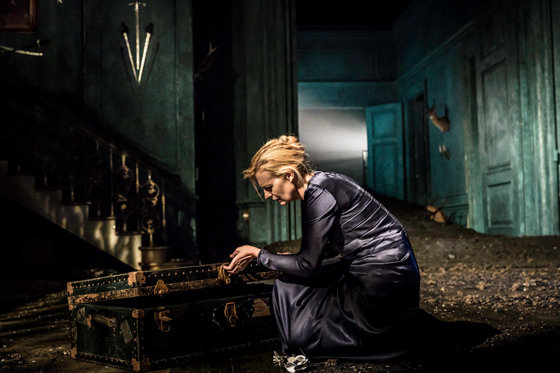 © Johan Persson
There are still many curious options based on the actor's previous works. One trouble-I really do not like any of them. Because I can imagine them. And in the case of Benedict Cumberbatch, his ability to make unpredictable high -quality jumps is just important. Who could imagine Sherlock before Cumberbatch played it? Undoubtedly, this extremely talkative actor will find what to say if he decides to answer the question: "What will be your Hamlet?" But his Hamlet will become what he will become, only when he plays him. Anyway, is it worth playing Hamlet, if you know for sure how to play Hamlet? The way Sherlock fell and how it rose has nothing to compare with how it hung on the edge. No wonder from an unsettled who has not gone to work, but already clearly accumulated experience, the actor includes a Bekket quote, which he repeats in an interview with enviable tenacity, even when he is asked about comics: the famous Fail Again , Fail Better " . On this you can build the tragedy of Hamlet. Undoubtedly, not one of the Shakespearean jokes will disappear in this Hamlet and a couple of unexpected will be added. There is no doubt that Cumberbatch should play so that we, the “dumb viewers of the final”, eventually ask the Danish prince “stop being dead”.