
Translated material
"I am interested in a little person"
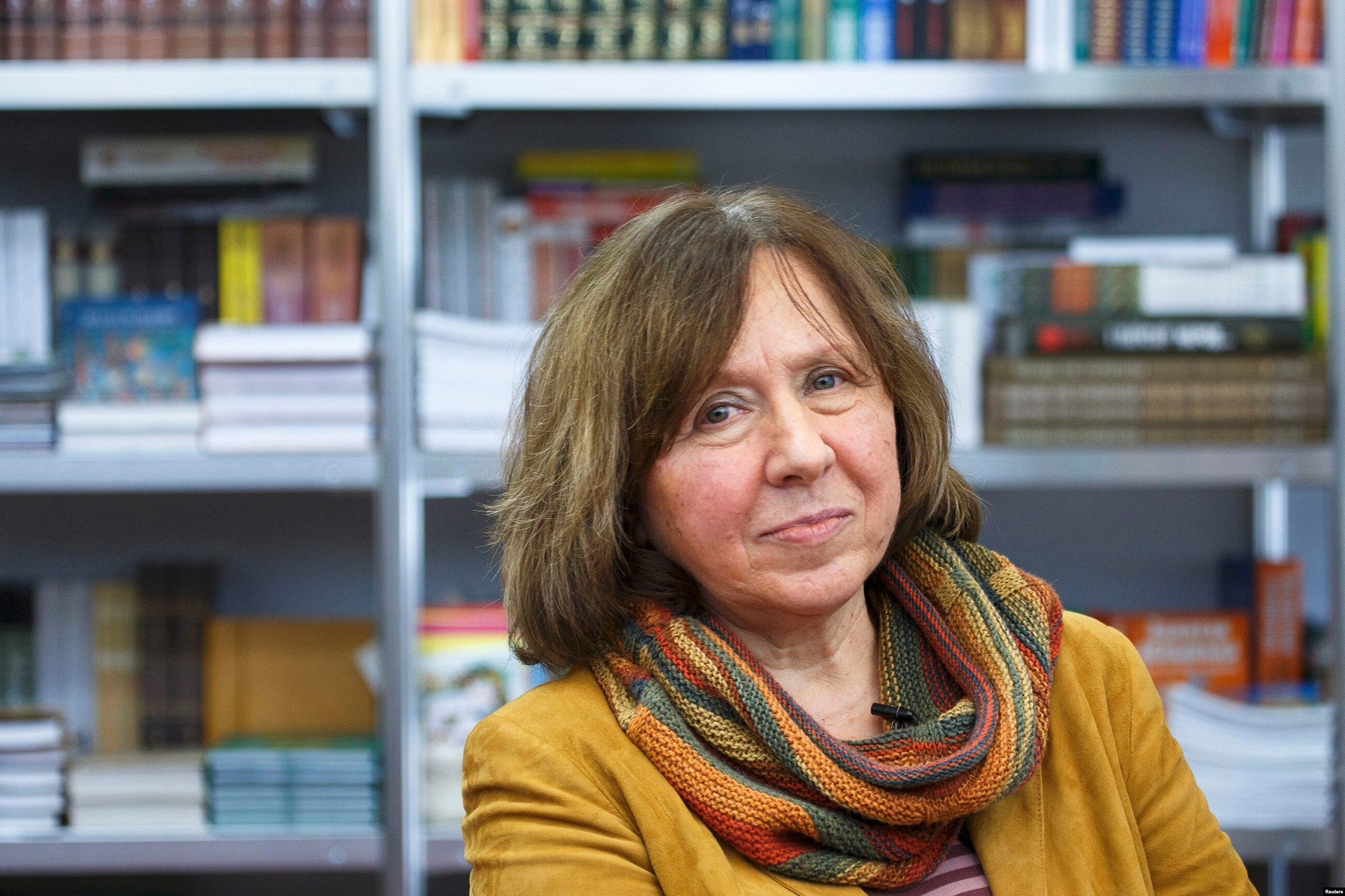
Laureate of the Nobel Prize in Literature Svetlana Aleksievich - about his heroes, Russia, Belarus, old and new people
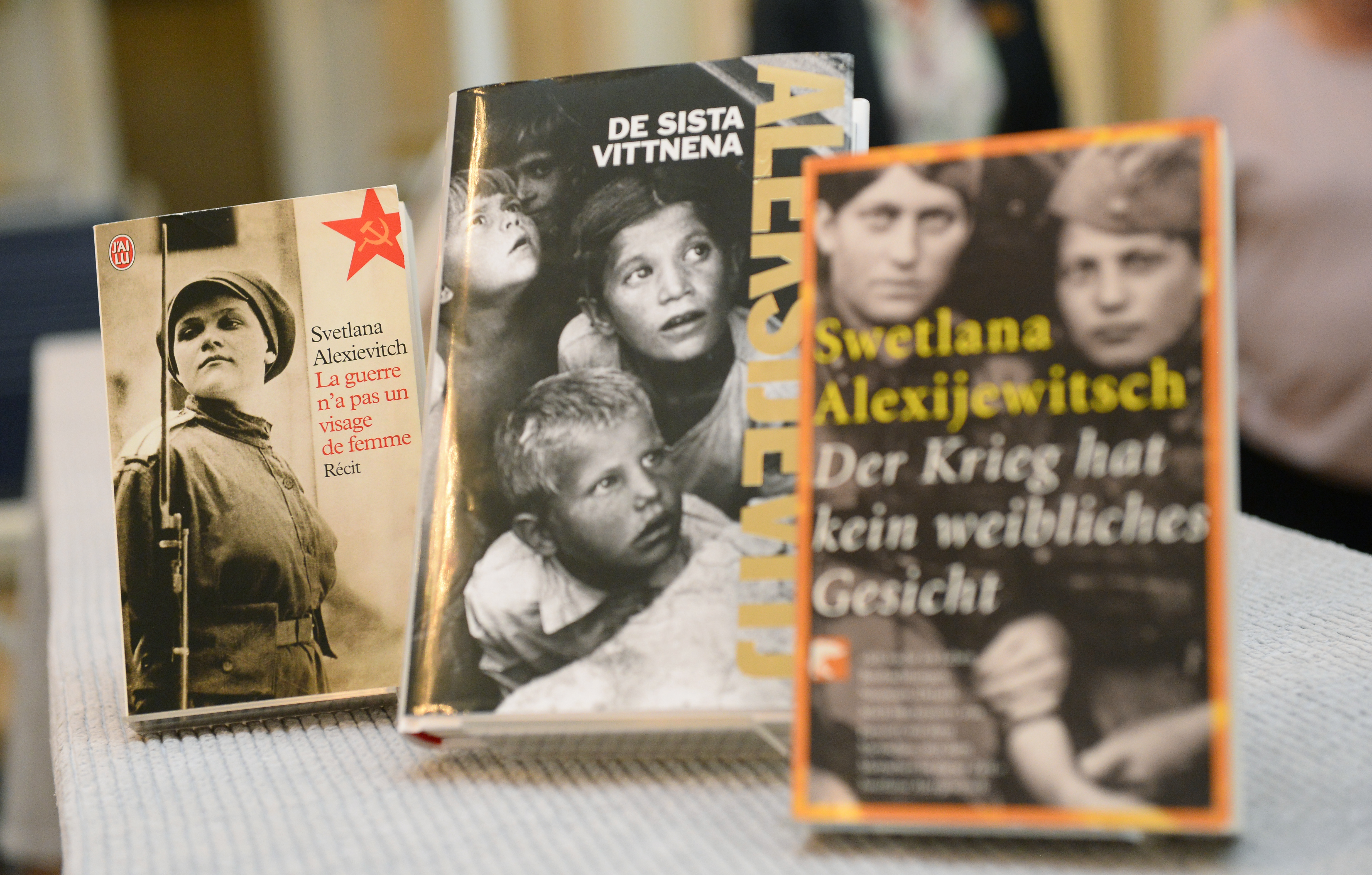
The Laureate of the Nobel Prize in the literature of 2015 was the writer from Belarus Svetlana Aleksievich. The prize is awarded "for its polyphonic work - a monument to suffering and courage in our time." Svetlana Aleksievich was often a guest of Radio Liberty. Here are fragments from the interview that the writer gave our radio station:1998. About the homeland and cosmopolitanism:
By the views I am cosmopolitan, especially after Chernobyl
- I want to live at home, in Belarus. Of course, I could live in many other places, and I have such an opportunity. But what I know and understand is in this piece of land. Not only Belarus, we will call the "post -Soviet space." The only person about whom I guess something or understand something is the person with whom I have grown together, in the culture of which I grew up. This is my occupation. It is this person. When they say to me: "Who are you - Belarusian or Russian?" - I can say what kind of culture I imagine, but in the views I am cosmopolitan, especially after Chernobyl. On this dead land, you are just a person who is trying to find a certain meaning in this life, in everything that is around us.
- Any defeat, if you look at a story, a powerful totalitarian energy idea, is primarily a defeat of men. Something happens to their role and what they did not expect, getting used to the role of the winner, the hunter: he came to the house, threw the skin of a mammoth or a steep salary to a woman and left. I recorded the confession of one man. He is in the recent past the Major, the squadron commander, now he was, as it were, thrown out of the army in 42 years, he, as it were, no one, everything needs to start again, work as a watchman somewhere there for his former subordinate. And this role is not at all on him, his role was under epaulets, almost not to notice how the children grow up, somewhere to sit on duty, the storm to keep far in the sky and come home only as a hero, as a winner. And suddenly it turns out that the family contains a wife for two years, who knows languages, and in general our women keep balance in society today: she brings a salary, she thinks how to feed ... But it turns out, he needs a different courage, not this mammoth hunter, but the courage to go for her son, talk with him, bring him from a kindergarten, and in the end, even if milk soup are milk soup and flush apartment. And he told me: "I can’t live like that, this is not my role, we are not created for this." He is ready to go to Chechnya, for some war, climb onto the roof of the reactor, and he says: "I will probably do the same as my friend." That is, another military man, his friend committed suicide. For me, this is a very figurative picture for today.
1999. About the heroes of today
- The hero who is interesting to me today is not a priest, this is not an intellectual or sixties, this is, oddly enough, this little person who survives, who somehow draws his children from this nightmare, drags bags from China, from Manchuria, Poland and stands in this sun, in the bazaar, the state deceives. It is he, this little man, who accumulates this new experience of life, and he first declares: there is my life, I am responsible for myself, for the first time for myself, for the idea, not to the state, for something. And this is the most interesting hero for me today.
1999. About the time of disaster and people of utopia
The genre in which I work requires that the ear is on the street
-The time we got into was the time of disaster and a disaster-utopia. And we, perhaps, do not even fully understand what time we got and, perhaps, will need a distance, and we will look at all this differently. I wrote and now I am adding the history of the people of utopia, that is, people who will never be again, I would have said so, because now this person is leaving the stage of history. And the point is not in my worldview, but the fact is that this person lived like that, because I just walked with him, for 20 years I went, and turned out to be a man who was at the right time in the right place. I still found the people of the revolution who began all this, the idea was young, strong, attractive. I tracked to the end everything that happened to her, before the collapse and to Chernobyl. And therefore, what we talked about, I honestly fulfilled my writer's duty, exactly as I was brought up by Russian culture and Russian literature. But the fact that in this cycle, I call it the “human man”, I realized that there are not enough two books where there will be a private person: this is a book about love, and the last, seventh book in this cycle is a person in old age, a person alone with this care, disappearance, when he asked: why all this? And this need appeared in me from the sensations of the street, because the genre in which I work requires that the ear is on the street, and the time is present in the rhythm, here in this music. And I can say that the main feeling is in me today, that my internal tool requires some kind of re-equipment and that I somehow want to talk with a person. I want to talk with an individual, hear, hear him.
1999. On the psychology of the victim
Everyone said that someone was to blame, but not he
- I often wonder when I meet with our people who go from the West on trains or in airplanes, and they say: what are the Germans, what are the French, they are so rational, so uninteresting, we kind of smarter and deeper and wider, but such life does not work out. Why it does not work out - it is incomprehensible. Denial reaction. And of course, I think, more deeply - this is our psychology of victim, when suffering is a matter of life, an excuse. This is so deep in us. And the victim, she is in the situation in which today we were, when there were few who won, and many losers, the victim only has two reactions - resentment or aggressiveness. And now I think: in Belarus where I live, this is especially noticeable, since this process is already long, 3-4 years old, it is provoked by the upper power, I think that these development were expected, and even in a sense surprises me why we are surprised at this. When I wrote “zinc boys”, “enchanted by death”, I asked hundreds of people, and no one looked into myself, everyone nodded somewhere upstairs, showed upstairs. That is, a sea of blood behind, a mass grave, but no one said that I was to blame, I shot, I reported. Everyone said that someone was to blame, but not him.
1999. On feminism and male culture
- The male world - they are united around the god of Mars, It can be in different forms, but it is their world, their culture, their traditions. And just walk around museums of the whole world, to see that we are a nation of the era of wars and revolutions. What can a woman offer today, especially in Russia, at these collapse, when everything is in the collapse, and the previous meaning has disappeared, there is no new one? We can only complain. This is also a whole culture of salary, this is female culture today. But we have no ideas, because it is no coincidence that feminism is experiencing a crisis around the world.
2000. On the role of the writer and the new generation
-In our environment and in our generation, we talk a lot about the civil position, about the place of the intellectual today, but all this in some kind of old forms. But when I fall into another generation and speak with people, because the genre that I am engaged in is an art that is lying on the street, the art of votes and votes, when I start listening to the street, I hear a very sharp difference between the older generation and the younger. The younger one does not speak at all about politics. For them, Putin is some kind of mythical figure, but they do not make their life dependent, they are busy with completely different issues, some kind of metaphysical problems, pragmatic survival problems. And I think that a new worldview is developed, a new value orientation. The struggle and confrontation of the mind and darkness, it still happens, but from other positions. A person talks about his dignity, about his own life, that is, you can’t drive this person like this to the barricade, you won’t send it, I hope, in the Barents Sea without insurance, you won’t send it to Chechnya. That is, it is another developing, it goes in another aesthetics, in other forms. And I am afraid that we somehow imagine our role as a shepherd and exaggerate our role. Surely we just need to calmly become intellectual workers and think that it does not depend on us in this life, and if something depends, then it is actually teaching ourselves, and if it is needed, then someone else, one simple thought that no technique, no president will free us from work, think, love, generally look for some meaning of his life.
2000. On the mass consciousness
- Our big trouble is that we still love to deal with ideas that we have in our heads, and not with reality, which overturning our ideas instantly. Here we are dealing with the perfect and reset from the accounts. You just need to understand that we have a very undeveloped mass consciousness. Recently, I was traveling from Sweden with one businessman. A perfectly dressed person says that he has several houses. I ask him: what struck you in Sweden? He says: life. Here I have no washing machine in my house. I say: how do you have no washing machine, but there are several houses? He says: my wife is a washing machine. Here is approximately the level of our mass consciousness, it is enough to leave any club’s political, the party a little further than the garden ring for St. Petersburg or Moscow. It is necessary to work with this people, some step movement should be. We have a very long way ahead.
2001. On the meaning of life and emptiness of survival
In some ways, this idea of socialism coincided with Russian mentality, with this mysterious Russian soul
- L Judy is tired of being humiliated. And spiritual humiliation is, perhaps, even more terrible than material, I would say so. It is quite clear today that the jump did not work out, a jump in freedom or to freedom. It seems to me that it will be necessary for a long time to live in this intermediate time, in such a dark, gloomy, deaf enough, with some glimpses of some hope, with new technologies, but with the darkness of the old. And the answers were much deeper than we thought before. These ideas of sixties, dissident, today they seem to me intellectual traps, this is just a denial. Because, I think, it’s still deeper, despite all the blood. The fact that this whole story is a huge mass grave, anyway, this idea of socialism coincided with Russian mentality, with this mysterious Russian soul. There was some kind of fatal romanticism, a taste of metaphysical secret. The man joined some huge space. And despite all these camps, he always had a chance from the statist to turn not only into camp dust, but into some main character. I think it was an answer about the meaning of life. There is no this answer today, people were left alone with the void, alone with this survival.
2002. On the phenomenon of Lukashenko
The more I drive in Belarus, the more I am convinced that time has stopped
- The rupture between the mass consciousness, the study of which I study, and between the opinion of the political elite. Belarus is a territory, mothballed by virtue of the authoritarianism of the regime, and it is firmly mothballed. And after utopia, as we know, not only bad roads and bad houses remain, but also a corrupted person, a person with instinct and with a sense of victim. I can say that at the beginning, 5-7 years ago, or even 10 years ago, they underestimated such a phenomenon as Lukashenko, who will focus all this and will bring all this to a pure idea. I think that today it would be nice for Russian politicians and our Belarusian opposition to not repeat this assessment, underestimate Lukashenko, underestimate the insidiousness and a rather difficult situation in which he ended up today, and how much he will try to get out of this, and, I think, his potential is still underestimated. This is one of the mistakes that we made, I am afraid, no matter how it will not be repeated now. Because, I will repeat again, the more I drive in Belarus, the more I am convinced that time has stopped. The feeling that we seemed to fall out of time, all the same person, Lukashenko has a very strong foundation.
2010. On the impossibility of revolution
- There will be no revolution in Belarus, we missed the time of the revolution, it could be 15 years ago. No one here dies with hunger. Traffic jams in Minsk, and what good cars! People, in general, began to live well. This is an authoritarian regime, this is one of those varieties of the authoritarian regime that arose in the post -Soviet space. But everyone calls it just dictatorship, and no one thinks, because one authoritarian regime in Russia, and the second with us. And we have it more dangerous. Because Lukashenko chose a social contract with the population. We, opposition, say that we are bad. But we cannot live like in Germany, and, unlike the opposition, people understand this. And human rights, democracy - Chinese is a letter for village men, whom I spoke yesterday. They confuse freedom with opportunities. Sausages in bulk, cheese in bulk, why not freedom?
2013. On the unity of cultures
I liked the first Maidan and the second Maidan, I liked the people who did it
- I am a man of Russian culture. And here is my project, in which I have been engaged in the history of a red man, red civilization for 35 years. She spoke Russian, this utopia. And I wrote in Russian. At the same time, Belarus is my homeland. I think that after the disappearance of the empire, it is very difficult to clean the nations too much. Everything in us is very difficult, very confused. And in Chernobyl, I generally freed myself from such questions. When I wrote a book about Chernobyl, there, in this zone, you feel some kind of mosquito. You are along with a hedgehog, with a hare. You do not feel like a Belarusian there or a Frenchman. You are just a biological species that can disappear. These are all human divisions. It’s like Alexander Men, when they told him: here is a church, there are Catholics, there are Orthodox. He replied: "These partitions do not reach him." Rather, I am a man with world experience. How do our nationalists ask questions: "Why do you have Russian heroes?" Well, this is a serious question, right? I think no, no. The world becomes more and more. Of course, there is a division, but for me personally a person is something in common, one.
- I liked both the first Maidan and the second Maidan, I liked the people who did it. As for the second Maidan, there are problems with the "right sector", with radicals, but I liked the people themselves. But politicians, who later exchanged this Maidan, turned it into something else-this is a completely different side of the matter. And it seems to me that Ukraine is very weak now, and if Europe, America will not help Ukraine economically, politically, then it will be very tragic. This really can become such a Yugoslavia here. After all, the people there live very poorly, and there is bitterness. And the poor person is very easy to make someone. And if they more or less withstand the economic situation, if there is a leader, not as passionate as Tymoshenko, some kind of strong, rational personality, a sober person who will accept the West, with whom Russia will reckon, it seems to me that this time the West is quite close-up, and Russia felt the power of the West, then the Ukrainian state will remain. I know a lot of people in Ukraine, they believe in their future. Probably, we must live there to feel it. As far as I was disappointed in some of my Russian friends, Ukrainian people so delighted me. It seems to me that this country has a future, but now it has a very difficult time. As for Putin, I think that they will still not give him these military campaigns, and I have the feeling that he himself does not want to. But he just took on a certain role, such a mission, and now he is forced to correspond to it. And in fact, it is difficult for a little person to be big all the time, in a certain such a messianic position. It seems to me that he is too mystic. Russia today is not so strong as to challenge the world.

2015. About Nadezhda Savchenko
- I really like this woman! I remember the very first interview of hope, as honestly she spoke about everything that happened to her. This is a man of beliefs, a person with his gaze. This is a military man who did his job - defended his homeland. I believe that the Ukrainian army protects its homeland. Savchenko was stolen fraudulently, brought to Russia, the prosecutor's office has no evidence against her, she has an alibi. When I signed the text of the letter <in defense of Savchenko>, I recalled the famous picture in which Putin is depicted riding a horse - half -naked, the torso is so powerful. And now I think: how does this get along with the fact that a man is fighting with a woman? With such strong, interesting women? When it is already clear that there is very little left for hopes at all. In the worst wars, it is customary to respect the stamina and will of the enemy, even the Germans did this during the Second World War, how many such examples. And for some reason, the Russian government is not capable of this.
2015. About the victory of the new world
No matter how hard the omits and Lukashists try, today's ossification will fly off
- Russia and Belarus, of course, is the old world. There are new cars on the streets, the buildings have a little new architecture, people wear new costumes, but this is the old world, the world of old concepts, and today he went to the last Soviet battle. Not for the highest justice that could be extracted from Soviet experience-there were many Stalinist betrayals, but still in the beginning there were many romantic hopes that suffered a complete catastrophe. Everything ended in blood, as one of my heroes says: "The barrels of meat remained and the sea of blood, so we have the whole story ..."
It will still be a very long struggle, I think it will drag on for several decades. But no matter how the ourselves and the Lukashists try, today's ossification will fly off, because the world is still moving, and we cannot sit on the sidelines, this is unrealistic, if only by virtue of new technologies. На какое-то время можно создать резервацию, ну, может быть, даже на длительное время (в конце концов, есть опыт Северной Кореи), но тем не менее человечество движется в сторону более нормального смысла жизни, когда человеческий дух не унижен, когда человеческие понятия не унижены. Это касается всего прошлого – не только войны, но и ГУЛАГа, который тоже оказался спорным понятием, как выясняется. Например, музей "Пермь-36" – уже не музей жертв ГУЛАГа, а музей работников ГУЛАГа. Будем теперь кланяться палачам, читать, как они мучились, издеваясь над жертвами...
Все очень перемешалось, но я думаю, что старая идея выдыхается. Мир идет в сторону того, чтобы человек остался человеком в том, в божественном смысле слова – об этом писали Александр Мень и Александр Шмеман, – когда действительно речь идет о духе человеческом.
Нобелевская премия по литературе
Test yourself!
Start a quiz