
Translated material
Exquisite corpse
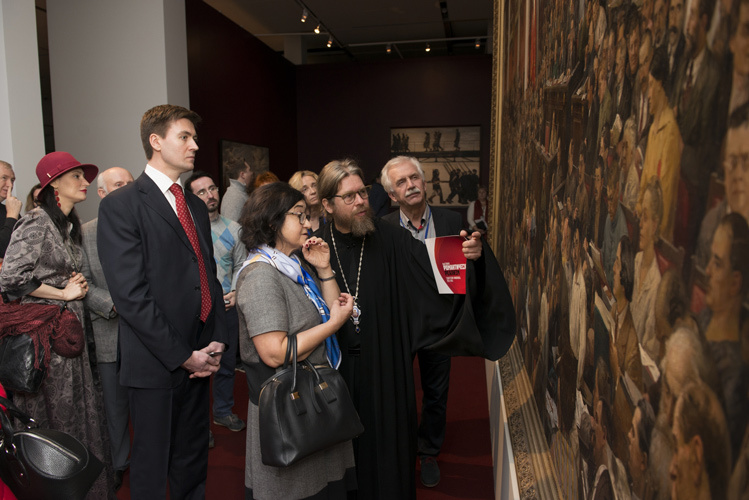
Formally, the exhibition “My story. XX century. From the great shocks of the Great Victory ” , organized by the Patriarchal Council for Culture and the already closed, and the exhibition “ Romantic Realism ” , made by one of the most popular cultural managers of the 2000-2010s, Zelfir Tregulova and Eduard Boyakov , are two different expositions about one era, which (as coincided) opened at the same time, at the same time, at the same time, on the Day of National Unity, at the Day of National Unity, One place is the central arena. But in fact, a resentifying blockbuster based on photographs and quote, in which the church takes revenge for humiliation of the twentieth century and thanks for this strong power in any of its manifestations (upstairs), and an experiment in the field of new myth-making on the material of Soviet painting of the mid-1920s-mid-1940s (below) relate to each other as halves of a sheet in a well-known surrealist game “Exquisite corpse”: the first participant draws part of the picture, bends the sheet and passes it to the second, which, without peeping, continues the drawing. The sheet is unfolded, they look at what happened: if everyone accepts the rules, the result does not disappoint - most often a monster comes out of two different (also in style) halves, which miraculously always suitable for each other, “giving birth to new meanings” (or, as they like to say in the patriarchal council in culture, “clarifying the lost”).
Therefore, when at the opening of Zelfir Tregulov, the curator of the exhibition and the current director of the Tretyakov Gallery, made an individual excursion on the exposition of “romantic realism” for Archimandrite Tikhon (Shevkunova) , who would not be a mistake to be considered an unnamed curator of “my story”, it was clear that although the exhibitions with each other were clearly not consistent with each other, but the curators and the curators, and the curators, and secular and church, there was no reason to be dissatisfied with each other.
But the “documentary” of painting is concluded precisely in its material properties - not in the formalistic sense, but in the fact that it was not born, weightless, from the foam of propaganda, but it was precisely what was produced.
Since the time of the Kapkovsky heyday, the manger as a cultural space has been occupying a double position. He was a guard guarded by the site, which is used for congresses of United Russia and other needs of federal significance. At the same time, he became part of the Manege museum and exhibition association, which played an important role in the integration of the city of exhibition spaces in the seemingly non-uniform, purely consumer circulation of modern culture. The bow of “romantic realism” and “great shocks” for the first time was so clearly shown by the possibility of the symbiosis of these two of these usually diluted in time and space. Organization of city cultural sites with cafes, book and educational programs (it is in this spirit of Tregulov that the Tregulov modernizes the Tretyakov Gallery) and the costly, which requires the media resource, mass propaganda (exhibitions of the Patriarchal Council for Culture, and at the same time “Romantic Realism” are advertised in each metro and central television car, and the entrance to them is free, which provides an unprecedented Attendance) - things that can not only coexist in parallel worlds, as if not noticing each other, but also mutually enriched.
In addition to the infrastructure interaction of the “free” cultural city and church-state propaganda, the similarity of the curatorial techniques of intellectuals from the Patriarchal Council for Culture and such organizers of modern culture as Boyakov and Tregulov is remarkable. In the first and second case, the difference is not deliberately made in working with the material between interpretation and speculation. The fact that is presented as an interpretation, that is, an indication of non -obvious connections, does not become an instrument of release of thought, but should work as a dazzling revelation. Once, the anti-Soviet Tamizdat magazine “Sowing” had a slogan “I didn’t know anything of this”-the exhibition “Great Shocks” also works in this way, and this is the first beat of the impact. “But I want to not know anything further” - so we can say about the exhibition “Romantic Realism”, and this is the second tact.
 © Museum and Exhibition Association "Mange"
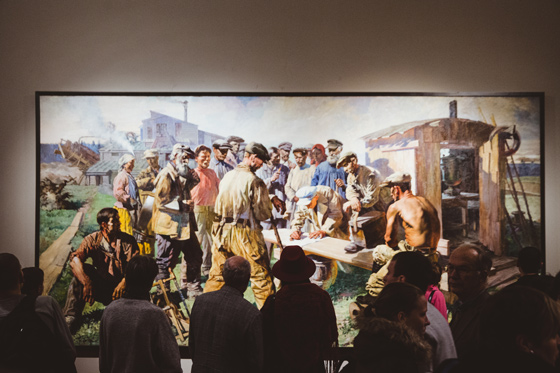
And at the first and second level of the Manege, “Facts” are mounted in a convincing relationship, and the installation breaks are hidden in the enveloping half of the expositions and glued with comments (at the top of the exhibition, priests lead, below, instead of excursions - explaining the texts of Boyakov), and it is not so important that photographs and quotes from the facts act as facts. speeches and memoirs of political and cultural figures, and on secular - thematic easel paintings. Unlike the avant -garde installation, where the meaning appears in spaces between the contexts cut out of the context and not so soldered into the whole with elements, leaving in sight the mechanics of the semantication, here the narrative is drained from the “sources” merges into a magnificent river of historical logic, the revelations of which the organizers undertook to “recreate”. And on no Biennal, the base of the Manege did not see such high -quality falsehood.
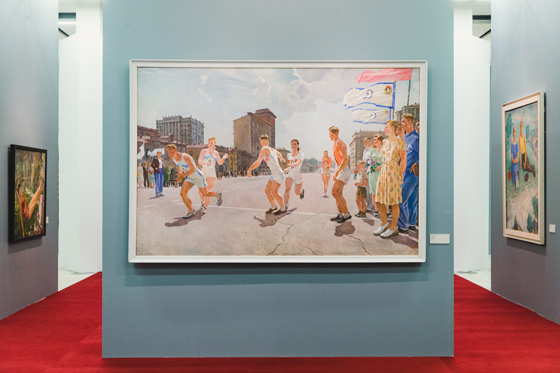
One of the important elements of curatorial practice, which has developed around the Soviet thematic picture, which is at the disposal of the Rosiso funds and other meetings, of which things traditionally borrow (including the Museum of the Armed Forces, the Museum of Modern History of Russia (the former Museum of the Revolution), the Russian Museum), is the attitude to the picturesque easel, which has been produced and existing since then, which has been produced and existing since then Materially and visually, containing a certain truth about oneself precisely at this level. Instead, the picture is treated as a special type of historical source, which, on the one hand, allows us to judge the past as a real former (that is, fantasize about it as the reality we have access), and on the other hand, by its very properties (artistic, and not a documentary object) gives permission to speculation, that is, understood not as a responsible judgment or indication, but as a person. Voluntarist invention, motivating a certain political strategy. But the “documentary” of painting is concluded precisely in its material properties - not in the formalistic sense, but in the fact that it was not born, weightless, from the foam of propaganda, but it was precisely what was produced.
 © Museum and Exhibition Association "Mange"
Here it can be argued that this method of exploiting the thematic picture is laid down in this picture itself, as well as in its fate of an archivated storage unit, and as a result, in the modern curatorial practice that has developed around this thematic picture, which determines the methods of active use of the Rosiso archive in the last decade. This is such a practice that allows you to learn at the disposal of the archive of work thematically, to shuffle as a deck, focusing on their “imaginary” content, which allows you to make up almost the same objects quite diverse statements.
The history of these statements begins with a liberal fantasy interpretation that interprets the socialist project semiotically (“Communism: Dream Factory”, curators Boris Groys, Zelfir Tregulova, Frankfurt, 2003-2004). According to the well -known version of Grois, the “style of Stalinism” becomes an evil dialectical mockery of the intentions of the artists of the avant -garde.
This story continues with a social-democratic interpretation in which the liberation and political dimension ( “The struggle for the banner: Soviet art between Trotsky and Stalin. 1926-1936” , curator Ekaterina Dyzot, New Manege, 2008) is returning to the communist project. Here, artists working with a visual “theme” are considered not as blind tools of propaganda, misleading or two -faced agents of the dominant style, but as independent political actors with their own pluralistic and conscious - strategies and intentions.
 © Museum and Exhibition Association "Manege" Zelfir Tregulov
Almost immediately after the “struggle for the banner”, Zelfir Tregulova oversees the exhibition “Socialisties: Inventory of Archive” on the basis of paintings from Rosiso (MMSI, 2009-2010), which follows a more moderate liberal explanation of these objects as not devoid of historical and artistic interest of propaganda monuments, but between the lines, and between the lines, reducing the issue of authority to the author. state order.
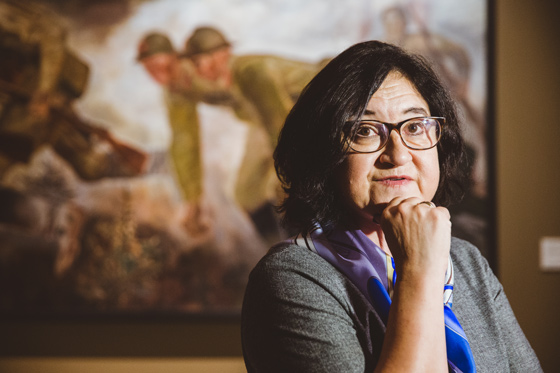
Finally, the “romantic realism” discussed here is the latest re -interpretation of the thematic archive of Rosiso, Boyakov’s frankly conservative project and the same Tregulova, inside of which familiar objects are rewinded as again deprived of the authorship of the uniform discourse, subject to endless re -priority, and here familiar images are represented as magically influenced, but still a good illusion, which is represented, which It is required not to expose, but, on the contrary, restore.
In addition to the listed ideological reinterpretations of the picture from “romantic realism” belonging to the Rosiso archive and some other museum meetings, recently have been found on many less politically articulated exhibitions, which simply ensured the filling of the vast spaces of the MVO “Manege” even during the period when Marina Loshak ruled it. So, on “romantic realism” there are old acquaintances from the exhibitions “workers and collective farmers” (2013, the exhibition hall “Worker and the Collective Farm”) and “Sovetskaya Venus” (2012-2013, ibid.). But at exhibitions of 2012-2013, these paintings were used not as documents, but as variegated passoid contents of the past exothy for entertainment purposes. “The exhibition transfers the image of the ancient goddess of love and beauty in the Soviet era, tracing the evolution of the image of the Soviet beauty” - in the context of “Venus of the Soviet”, the Pimenov girl in a hammock was represented by a commercial pinap, and not an element of an impressive biopolitical project, as on “romantic realism”, where it migrated. The amount read at the level of the content of objects that at the disposal of the system of new sites allowed, thus, to form new and new thematic sublotes and, accordingly, new contents for a variety of cultural consumption.
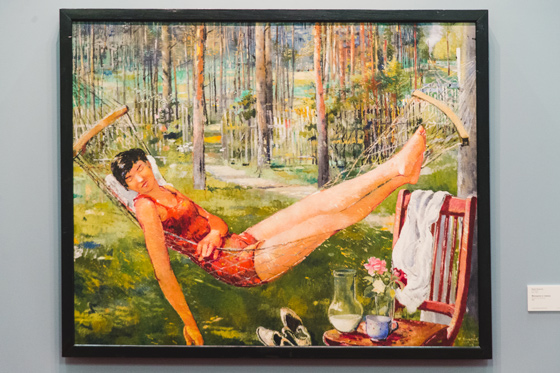 © Museum and Exhibition Association "Manege" Yuri Pimenov. A woman in a hammock. 1934. From the Assembly of the State Russian Museum
The thematic approach was also used for the internal organization of these exhibitions, replacing the dull chronological. Say, the basis of the exhibition of Ekaterina Dygot was a division according to the democratic spaces of communism, also understood as a media (section “Square”, “Gazeta”, “Labor”, “Flight”). At the thematic association (not only picturesque) artifacts of the same period from the collections of various museums, the recent exhibition “Avangard and Aviation” (2014, the Jewish Museum and the Center for Tolerance, the curator of Alexander Selivanov) was built: it is divided into sections “Space”, “Machine”, “Hero”.
But if the target for the table of contents of the exposition was made precisely the spaces of the universal, and in Selivanova-the elements of aviation, understood not just as “one of” the possibilities, but as a sphere fundamental for the futuristic and technical discourse of research and overcoming, then in case of “romantic realism” the thematization of the sections looks like a fantastic assorted, which is formed in lost illusion The greatness that you so want to glue back. And, on the other hand, the sections are represented by Boyakov not as equivalent elements, but as a kind of development with his climax: “creation of a myth”, “image of the leader”, “Red Army”, “Poetization of Labor”, “Come on”, “New Man”, “New Body”, “Holidays, Meetings”, “East”, “Territory of Happiness”, “Architectural Utopia”, “Heroes” and the Great Word - Great - Great - Great - Great - Great - “Great War ”, a point in which a contradictory movement through the halls of history gains its highest final meaning.
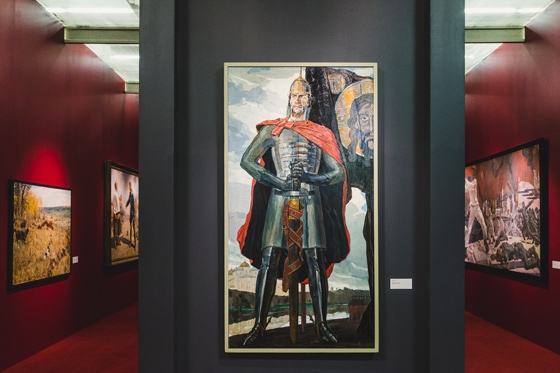 © Museum and Exhibition Association "Mange" section of the exhibition called "The Great War" is opened by Pavel Korin "Alexander Nevsky" (1942, from the collection of the State Tretyakov Gallery)
In explications to the exhibition of Tregulova and Boyakov, the presented material is not designated as socialist realism anywhere - and this is correct, because in the strict sense, if socialist realism as a very specific canon and the type of a picturesque work, there is almost no, not counting several works by Vasily Efanov and Alexander Gerasimov. But in an interview, the curators do not call their material differently as socialist realism. At the same time, the periodization of the paintings-from the mid-1920s to the mid-1940s-covers the time long before the concept of socialist realism was formulated in 1934, and even more so (around 1936) as a result of a guide, mostly apophatic (that is, deflecting and corrective, but not offering their options), the artists were found by the artists The ideal visual equivalent of this concept.
The press, analyzing “romantic realism”, also speaks of “socialist realism”, remaining mostly indifferent to the fact that things connected not by the general history with the beginning and end, as this would like Boyakov, but the general controversy, which did not have the finale, are subjected to this hat. But critics simply continue to enjoy ridicule of the same Isaac Brodsky as an allegedly avid conjunker and “bad art in general” . Meanwhile, Brodsky, together with the rest of AHRR (the association into which he included) in 1936 was defeated by the ideologist of socialist realism Vladimir Kemenov for naturalism in the leading of Pravda. The murderous attack against naturalism followed a week after the editing of formalism, which the post -Soviet art history remembers much better. But to recall the criticism of naturalism would mean abandoning the usual contrast of a valuable avant -garde and a secondary, politically engaged figure, which, in turn, would greatly complicate the possibility of speculation on this score.
Meanwhile, the meetings and rallies of Brodsky are finally re -read not as sluggish academic surveillance of movement, but as an obviously modernist in language modification of an easel picture, naturalistic photorealism - that is, as a certain ratio of thematic painting and new media. Therefore, Brodsky II writes the Congress of the Comintern, Lenin in the Putilov factory and his other paintings-blowings as if standing in the back rows of a crowd with a camera, separated from the far figure of the leader by the head of the heads in caps; This is not at all the theater canon of the Efanovskaya “unforgettable meeting”, a front stage representation, in a ballet breast-expanded chest into the hall.
 © Museum and Exhibition Association "Mange" Eduard Boyakov
But it is precisely the ignoring of the fundamental differences between different objects and what these objects do within themselves that allows Boyakov to stretch his story further than the 1930s, by the 1940s, turning on the “Great War”, which becomes the semantic result of all this mythological mobilization, and the high meaning of the illusions of the sympathetic illusions should reveal here. It has already been written about the gospel pseudoic fantasies in explications composed by Boyakov: this is a parody of the post -Soviet art history, which, however, with its optionality and a craving for sacralization of iconological analysis, itself prepared the ground for such bullying, when the Holy Spirit begins to pulse almost in the peaches of Saryan, traditional mourning palm trees from The column hall establishes continuity with the paintings of Rousseau, and the border between lies and art criticism is non -controversial.
According to the exposition, which Eduard Boyakov was responsible for, it is clear that there is no difference between Hyperrealism of Brodsky and AHRR, structural and spatial innovations in the easel picture, which were occupied by members of the remains and inventions (Deineka, Zernov, Pimenov, merchants and others), whose paintings prevail in the first halls of Laktionov, for which he constantly, for which he was constantly It got from Soviet criticism, by the neo -fuelism of Saryan and all other options for figurativism, which relate to completely different not only styles, but also the types of organization, self -organization and integration of artists. This is the result of the attitude to the picture as a topic that allows you to neutralize its own properties of a picturesque object and enter it into any constructions, not paying attention to its obvious resistance - that is, simply endlessly prostitive the picturesque objects.
 © Museum and Exhibition Association "Mange"
Ekaterina Laigot explained the introduction of a thematic approach as a fundamentally progressive: her task was to contrast the figure of the second half of the 1920s-the first half of the 1930s, which was discarded as a bad, engaged, ideologized, and most importantly, anti-Modernist art, formal works of obvious modernists who worked at the same time (be it, for example, a clay or a clay or, for example, a clay or it is, for example, a clay Шевченко), показав, что антикварному отношению к объекту можно противопоставить тематическое, но не в духе славистов-семиотиков, для которых еще с 1980-х все содержания действительно сводились к историческому луна-парку тропов, а как политически активное искусство, сознательное, а не манипулятивное, наделенное индивидуальной политической волей и интонацией, не сводящееся к безличной функции инструмента пропагандистского заговора: в общем, воспринять сюжет не «постмодернистски», а буквально, как предложение, на которое можно согласиться — как и отвергнуть.
Но, как сейчас видно, тематически-инструментальный подход к этому архиву стал развиваться в ином направлении. И если «Борьба за знамя», как писала Дёготь, старалась уйти от товарно-формалистического вопроса «как», поставив вопросы «что» и «о чем», то теперь, чтобы остановить проституирование беззащитных объектов искусства, следует поставить все эти вопросы одновременно, добавив к ним вопросы «кем, с кем, для кого и для чего». Короче, выйти из противопоставления формы и содержания на уровень станковой картины как объекта, сделанного в определенных условиях и обладающего определенными качествами, которые определяют его статус до сих пор, и кроме того — объекта, произведенного находящимися в определенных отношениях субъектами, не лишенными воли и понимания, хотя бы их объекты и не жили той жизнью, которую те для них первоначально предполагали.
То, что подается как интерпретация, то есть указание на до сих пор неочевидные связи, не становится инструментом высвобождения мысли, но должно сработать как ослепительное откровение.
Тут возникает еще один сюжет этой истории — госзаказ. В комментариях к архиву РОСИЗО и к выставке «Романтический реализм» Трегулова постоянно говорит о госзаказе и в последнее время — о госзаказе как о «нормальной ситуации», якобы повторяющейся для художников во все времена . С другой стороны, пресса, критикующая Трегулову, тоже отталкивается от идеи «госзаказа» как от порочного истока, определяющего принципиальную двуличность этого архива и стертость в нем любой самоопределяющейся, субъективной интенции.
Но это еще одна подтасовка: в 1920-е, к которым принадлежит огромное множество работ с выставки, госзаказа, как он понимается авторами выставки, не существовало, а если что-то и дискутировалось среди теоретиков пролетарской культуры, то это соцзаказ — то есть некая потребность или запрос общества, на которую художник так или иначе отвечает, что бы он ни делал в буржуазном или коммунистическом мире. Задача стояла сделать этот ответ сознательно-классовым, а не «стихийным», как в рыночном искусстве, с которым связывали картину как отдельный объект-товар; отсюда идеи о том, каким образом живописцы могут взаимодействовать со структурами нового государства, через которые предполагалось вступить в отношения с общественным интересом. Отсюда идея тематической выставки, родившаяся у АХРР и поддержанная, например, Изобригадой.
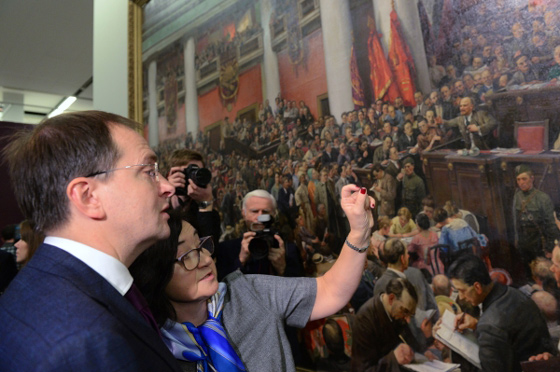 © Владимир Вяткин / РИА Новости Министр культуры РФ Владимир Мединский и Зельфира Трегулова на открытии выставки
Идея же госзаказа, так нравящаяся Трегуловой и Боякову — для которых это явно не только исторический концепт, но и нечто весьма актуальное, — связана с фетишизацией сильного государства как такового и подчинением ему воли художника, что не могло присниться ни одному самому ортодоксальному марксисту. Государство понималось как временная структура, предназначенная к отмиранию, пусть даже если отмирание начало серьезно откладываться; из этого исходили теоретики марксизма и вслед за ними — художники. Если госзаказ в теоретизировании художников насчет своей роли в ситуации социалистического производства и возникал, то скорее в качестве госмеценатства, как переходный момент в изменении статуса ремесленного медиума живописи в условиях индустриальной мобилизации. Но не как заказ, что исходит от могущественной тоталитарной структуры, Левиафана, делающего предложение, от которого невозможно отказаться, а как заказ «общественной организации», которая институционально опосредует социальные интересы производящего класса, а вовсе не является фетишем сама по себе, как это выходит у Боякова и Трегуловой.
Подмена идеи соцзаказа госзаказом в связи со связыванием в гладкий нарратив очень разных живописных объектов от ОСТа и АХРР до Лактионова и Ефанова приводит к стиранию из этой истории воли художника как политического актора и производителя, свободного в те времена хотя бы в том, что на начальных этапах он самостоятельно, исходя из своих профессиональных умений, формулировал свое предложение для тех институций, с которыми имел дело, будь то РККА или Наркомпрос — оно могло быть, опять же, принято или отвергнуто, но это уже другой вопрос. И нужно смотреть на эту ситуацию не как на госзаказ, а как на взаимное изучение формулирующих свое предложение производителей и находящихся в становлении институций, которое действительно в какой-то момент кончается выработкой узнаваемого соцреалистического канона. Но в чистом виде этот канон в продукции художников en masse не преобладал даже в 1930-е — это видно по любой коллекции реализма провинциальных музеев.
 © Музейно-выставочное объединение «Манеж»
Что касается большей части картин, представленных на «Романтическом реализме», то они как раз являются разными версиями предложений, которые — как формалистические или натуралистические — были отсечены в процессе формирования канона. Но хитрость в том, что Трегулова и Бояков никогда не взялись бы строить новый миф только из канонических работ соцреализма — такой зал был на выставке Гройса, и это выглядело как чистый постмодернизм, его бы никто не принял всерьез. Ведь слухи о могуществе соцреализма сильно преувеличены: в момент застывания канон теряет силу, становясь воспроизводящейся формой, а соцреализмом можно назвать только такой застывший канон, который способен констатировать, распространять и поддерживать, но не конструировать новое.
И ОСТ, и АХРР вместе по сути представляли собой полемизирующий с ЛЕФом проект по выживанию и реактуализации ремесленного медиума живописи, профессионалами которого они являлись, в условиях массового мобилизационного индустриального общества c машинным производством. И их предложение заключалось в тематической и, что важно, документальной, а не мифотворческой, картине как некоем новом типе объекта (концепция «сделанности» у теоретиков ОСТа, с отвращением писавших в своих декларациях о небрежном «псевдоимпрессионизме» эпигонов передвижничества, который вообще-то и лег в основу настоящего соцреалистического канона). Эта картина не должна была существовать как отдельная товарная единица, циркулирующая на свободном рынке, но должна была формировать «тематическую выставку» как способ наилучшим образом проработать общественно-действенную тему, причем для тех же остовцев тема не была просто чисто литературным нарративом, но мотивировкой для разработки пространственных аспектов фигуративного изображения на новых, учитывающих материальность медиума основаниях; отсюда постоянное внимание к объектам индустриальной архитектуры, военной технике или спорту как двигательно-пространственным способам совершенно иначе, чем в академической или реалистической живописи, освоить картинную плоскость.
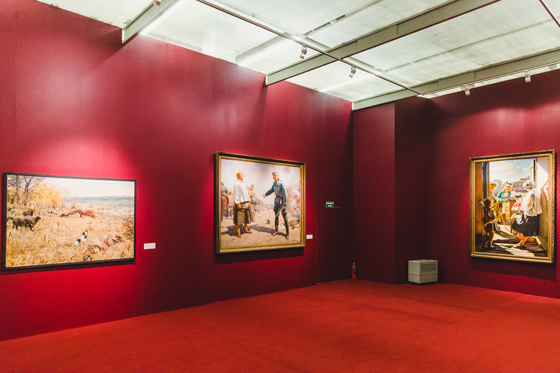 © Музейно-выставочное объединение «Манеж»
Но, конечно, противоречие лежало в «заказе общественных организаций» на станковые произведения изначально. Часть работ, которые производились в 1920-е — начале 1930-х, оказалась в коллекциях только что созданных нехудожественных музеев — таких, как Музей революции и Музей Вооруженных сил. Они опять-таки носили скорее документальный, информационный и репрезентативный, а не мифотворческий характер — в конце концов, это была современная, десакрализованная живопись, и если того же Бродского в чем-то и упрекали, так это в недостаточной парадности и чрезмерном буквализме.
Что касается деятельности членов ОСТа и Изобригады, то и до, и после войны она реализовывалась в значительной степени не в станковом, а в прикладном искусстве, полиграфии и монументалистике, станковизм же был для них скорее промежуточным, трансферным пунктом между разными, в том числе индустриальными, медиумами. Не сводилась к вопросу отдельной картины и деятельность АХРР, которая много внимания уделяла репродуцированию и распространению образов.
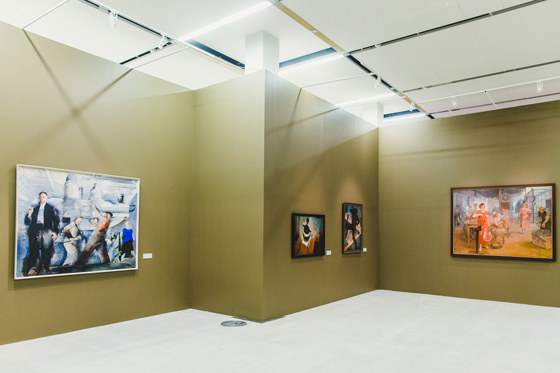 © Музейно-выставочное объединение «Манеж»
Сама же по себе станковая картина, переставшая быть «товарной формой», могла найти себе место только внутри общественной организации, музейного нарратива или в рамках отдельного, ограниченного во времени высказывания, которым были тематические выставки. Множество картин, по сути, оставалось после конца этих экспозиций (или в случаях вроде несостоявшейся выставки «Индустрия социализма») в положении сирот — эти «сироты» и легли в основу архива РОСИЗО, создав материальную базу для описываемой в этой статье кураторской практики. Забавно, что после «Постановления об излишествах» именно эта шаткость статуса станкового полотна привела к стремительному опрокидыванию соцреалистической художественной номенклатуры и переориентации всей инфраструктуры художественного заказа на прикладные сферы монументального и полиграфического искусств, в которых старые остовцы, в отличие от «настоящих» соцреалистов, смогли успешно реализовать свой профессионализм в условиях хрущевской модернизации.
Обширное наследие монументалистики, где также важна тематическая составляющая — будь то тема труда, спорта, нового человека и полета (все это темы прежде всего пространственные, связанные с освоением не только космических пространств, но и пространства листа, стены), — не встраивается с такой легкостью в идеологические выставочные спекуляции, как это происходит с несчастными картинами из архива РОСИЗО. Монументальная мозаика, например, приписана к общественной функции здания, и ее сложнее диффамировать, как это можно сделать с полотном. Похоже, тут виновата сама отдельность и институциональная неприкаянность тематической станковой картины — самого противоречивого звена советской системы искусства.