
Translated material
Marina Davydova: "My homeland is the space of the modern theater"
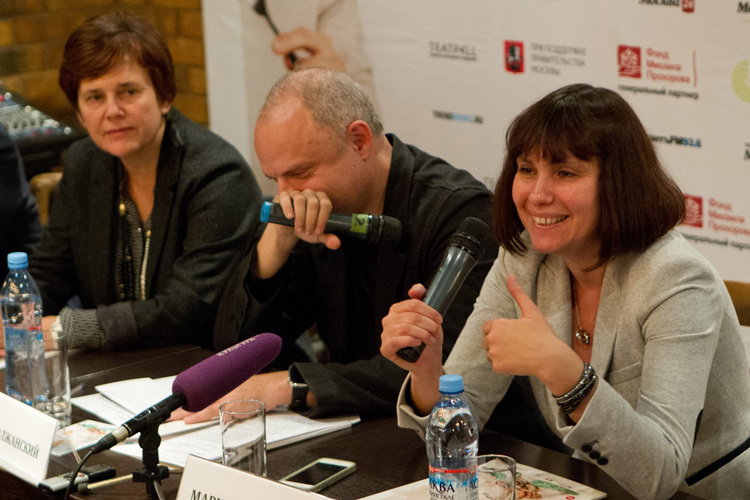
- The Wiener Festwochen -2016 program announced last week attracts primarily the lack of genre borders - performances, performances, exhibitions, installations, film screenings and events of the public program are even purely graphically presented in it with a single conceptual monolith. What place is the theater itself in it?
-I remember, in the 90s to me, and it began to seem to many that the theater is a dying form of art, which will soon be listed in the Red Book due to its old fashion, slowness, logistics complexity. But it turned out exactly the opposite: the theater, it seems to me, has become a plot -forming, rod form of art today. Its innate ability to intelligence into himself - from video to circus technologies - allowed him to become the center of Multidisciplinary Fashion now. Arriving for film festivities, you will first of all watch a movie, and not go to exhibitions. The same story with music festivals, and, say, with book fairs. But if you arrive next year on Wiener Feswochen and visit the Kü nstlerhaus festival center, then on the one hand you will see a huge retrospective of Sigalit Landau, on the other, the performances of the Israeli choreographer Yasmin Hoder, working somewhere on the boundaries of modern dance and performative practices. In the same place, in Kü nstlerhaus , you can accept the “intellectual bath” - for the authors of the game installation “Les Therms” the theater is not so much Play as Game - either to watch the retrospective of the films of Susan Umbrella, in which, in particular, it reflects on theatricality and parataatetal.
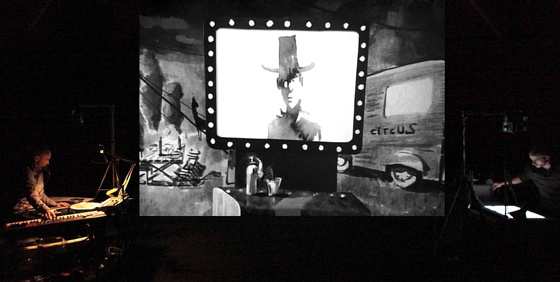 © Wiener Festwochen Scene from the play "Dark Circus"
All these diverse Activities One way or another, they are twisted around the theater-and it was very important for me that they somehow interact with the theater program itself. The performances are also very different and represent the modern theater in its most diverse forms: there is, for example, the “ Dark Circus ” of the Stereotipik group, eroding the line between the theater and multiplication, and there are “ DAKH DAUGTERS ” , balancing at the border between the performance and music. There is a purely acting theater - with brilliant artists like Corinna Harfuh in the play “Der Auftrag” according to Hinter Muller.
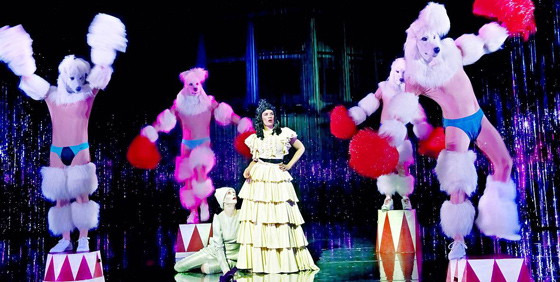 © Wiener Festwochen Scene from the play "Der auftrag"
There is a theater in which, on the contrary, no one plays any roles, in which a personal personal statement is much more important - the “first -person Theater” like the “MDLSX” of Sylvia Calderoni. For me, the proximity in the program of these different types of theater was of particular importance-from the metaphysical and thoughtful theater Dimitris Papaioanna to the acute-social performances of Oliver Frlich and Cornel Mundruzo . The Wiener Festwochen - 2016 - in a certain sense is historical: it seems to me that this is the last edition of the festival in the form in which it was formed during the time of Luke Bonda. With the departure of the Marcus Hoemuser, in 2017, powerful structural changes await the festival - and, apparently, it will move even more in the direction of multidisciplinary. The only question is whether the theater will dissolve in this multidisciplinary. It was about the danger of this dissolution that I spoke during the press conference at which the program was announced. In my program, he did not dissolve, but became an axis around which other types of art are driven by round dances.
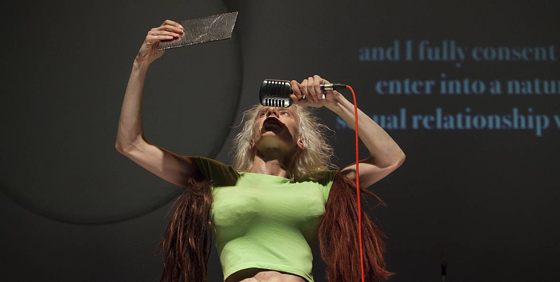 © Wiener Festwochen Scene from the play "MDLSX"
- Each large European forum - whether it is the Avignon festival or Ruhr Tiennale - is characterized by a characteristic “face with an incomprehensible expression”. To what extent was the traditions and specifics of Wiener Festwochen affected you as a program director ?
- I will say right away: if I programmed any other large European festival - say, in Avignon - his poster would look completely different. If you look from Russia, then the European theater space may seem whole and indivisible: here we are, there is a certain buffer East European zone - and there is the rest of the theatrical Europe. In fact, being inside this space, you understand that it is not so homogeneous - everywhere your traditions and nuances. Say, immigrants from the Mediterranean region - from Italy or Spain - fall into the program of the Avignon festival much more often than in the posters of the same Wiener Festwochen . But the East European theater is much more interesting to Vienna than Avignon - like Bernard Fevr d'Arsier at one time tried to open the door to the west for him. These circumstances were determined by many accents of the Wiener program Festwochen - 2016: say, Pippo Delbono, who seemed to be at all major European festivals, never toured in Vienna - so we will show his “ orchids ” . Or here is another example for you: in the capital of Austria, as you know, a countless number of festivals of modern dance are held annually, but neither Dimitris Papaioanna, nor Yasmin Heroder, for some reason, still did not speak-and of course, it was important for me to open new names, at the same time showing her a modern theater in all its versatility.
The most important thing in the theater is not what language the director speaks in, but how interesting the language of his performance is.
- Did you manage to realize everything conceiveda year and a half ago ?
- From the outside it may seem that for a person a festival programming that has been enabled and guided in the context of the searches of the modern European scene is a spitting business: my knowledge about the modern theater was quite enough to throw the program of this very Wiener on the knee Festwochen for one sitting. In reality, of course, the program that was formed in my head, and the poster that was presented last week in Vienna is, as they say, two big differences. Wiener Festwochen - The structure is extremely tough, and you have to correlate your plans with a bunch of prescriptions. And the point here is by no means in the budget - unfortunately, in Vienna, which has the ability to sharply decrease at the very last moment. Say, one of the main parameters that the program director has to focus on is the total number of tickets that you must sell: Wieener Festwochen It is financed from a state pocket, and the authorities annually put forward certain requirements for what volume of tickets should be offered to the city in conjunction for all the events of the festival. Next, the coefficient is calculated between the costs and the number of tickets offered by the viewer: even if you fit into the budget, but you sell less tickets than the city you ordered, you have to turn over the program.
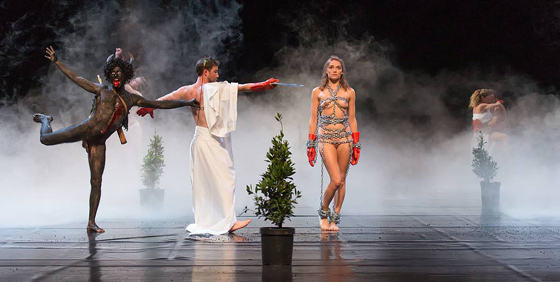
A characteristic example is the situation with the play by Jan Fabra “ Mount Olympus ” , which for me from the very beginning was one of the key events of the festival and which I was ready to defend by hook or by crook. The performance is expensive, and it can be sold only once-a 24-hour performance cannot be played three or four times. For the performance of Frank Castorf, say, you can sell four or five halls, that is, something about five thousand tickets-and the expenses for it are about the same as on Mount Olympus . Therefore, from the point of view of the festival logistics " Mount Olympus ” is a bad performance, it spoils us all the reports. I will not bore you with stories about the battles that I had to withstand so that this performance was still shown in Vienna ...
 © Wiener Festwochen Scene from the play "Mount Olympus"
The next important aspect is the presence or absence of sites suitable for showing a particular performance. As you as a program director, you have to choose not from the performances that you like, but from the performances, which at the same time also stand on a particular scene. After the triumphal last year's tour of the Dead Souls, Kirill Serebrennikov, I wanted to continue the diptych of the latest premiere of the Gogol Center- “ Who lives well in Russia. ” But this year the festival chose not to conclude a contract with Volkstheater , where “dead souls” were shown last spring, and we had only one large site - Halle E in Museumsquartier . The choice, alas, had to be made in favor of the performances of directors who have not yet performed on Wiener Festwochen -it is for this reason that we do not bring, say, the outstanding Oedipa Tirana Romeo Castelcucci (he was also in Vienna last year). But The Encounter , one of the best last works by Simon McBberny, whose performances have not been in Vienna for a long time, remained in the program. There will be no " Needles And Opium ” by Robert Lepage, the most interesting project Erna Omarsdottir and Matthew Barney “ Sacrifice Tryptych ” , for logistics reasons, had to abandon the second part (sequel)“ Shtifter’s things ”Hayner Göbbels - we spent enormous efforts, but could not find a space in which this grandiose installation could accommodate. Or from the project Antonio Araujo: for him it was necessary to obtain permission to use the city underpass, and we simply did not have time to do it. Such nuances are a million: a huge number of circumstances that are very far from the actual aesthetic preferences affect your work. Nobody, of course, tells you-do not bring a bare ass, do not swear obscenities, do not touch on such and such topics: do, in essence, whatever you want. But when you begin to lay out the festival solitaire, at some point it becomes very, very difficult for you.
My main Statement was that I do not think that I need to treat as a program director from Russia or from Eastern Europe.
It is clear that my Dream Program would be completely different. There is now no Angeliki Lidell, nor the Norwegian frantic avant -garde Vagrad Vegada Vinca. Starting to draw up a festival program, in any case, you must enter into negotiations with a huge number of companies, the projects of which, as you hope, will fall into the final poster. Then, for a number of reasons, many ideas have to be abandoned - this, of course, costs nerves. One of the fundamental projects, from which, in fact, I began my work two years ago, is Anatoly Vasiliev’s return to Vienna. He once showed on Wiener Festwochen legendary already “Six characters in search of the author” - and my thought was that Vasiliev return to the festival with a new Piranello performance. Anatoly Alexandrovich was going to put him in Italy with Italian artists, he already had some sketches for the future production-but, unfortunately, we did not find the necessary Italian producer in time, and we also had to abandon the project.
- It was natural to expect a more powerful presence of the domestic theater in the festival program from the program director from Russia ...
-As you can see, my program is not about Russian and not about the East European Theater, I did not seek to place some national accents in the poster. At the same time, in Vienna, they partially even pushed me to such a development of events - everyone expected that I would make a program with a Russian background. But I simply forgot how to draw national boundaries: my main statement was just that I do not think that I need to treat as a program director from Russia, because in such “national” categories to think about the modern theater is simply impossible: this space that does not know borders. The ideas of national theater cultures were relevant some time ago, but today, falling into the space of the Major League festival theater, national features do not play any significant role. Is it so important that Jan Fabr is a Belgian, and Simon McBberney is a Briton? Not to mention the fact that in a number of projects it will be strongly impossible to conduct national certification. Take at least Solaris - a project that is specifically for Wiener Festwochen living in Berlin Ukrainian director Andriy Zholdak makes with the Latvian sceno Monik Portmale at the Macedonian Theater. Plus, Zholdak as a student of Anatoly Vasiliev is somehow connected with the Russian theatrical tradition ...
 © Wiener Festwochen Scene from the play "Chevengur"
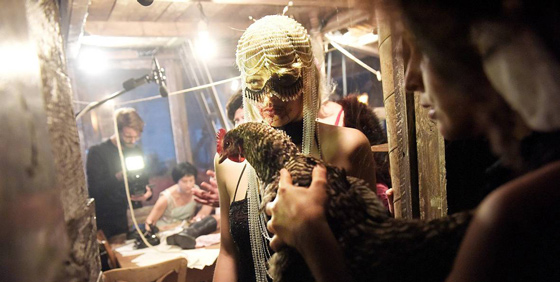
Or, say, Frank Castorf, who made a performance on the Platonov “Chevengur” in Stuttgart: the Russian theme will be present in the festival poster one way or another-it’s not that I somehow specially tried to identify it, just Russian culture is still quite powerfully present in the western context. As for the Russian theater, in its highest manifestations, this is just part of the European theater - just like Hungarian, Polish, Belgian ... The most important thing in the theater is not what language the director speaks in, but how interesting the language of his performance is. There is no development and the search for theatrical language - no social message or national specificity will have any meaning for me. At the Wiener press conference Festwochen - 2016, representing the program, immediately said that my homeland is not Russia, but the space of the modern theater, a variety, but one at the same time. If you ask me what the program is about, I will answer briefly - she is about the theater, about the amazing form of art in which people create three -dimensional alternative worlds here. And they create many different ways. These absolutely living and voluminous worlds give us the opportunity to contrast something around us with reality. They are sometimes more interesting for me more than the reality itself. They force them to believe that everything around can be arranged in a completely different way.