
Translated material
How the empire dies
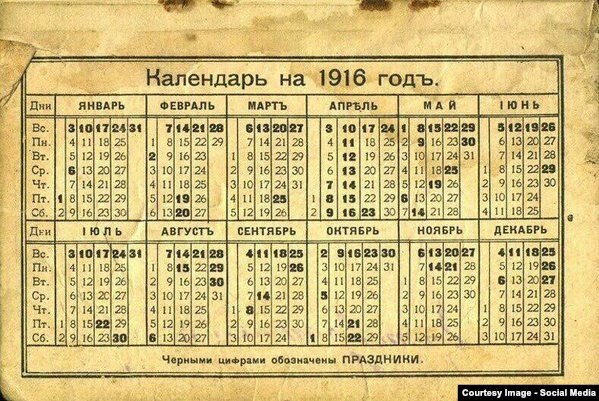
What was the last year of tsarist Russia, why 1916 became a year of no return and how poets predict the revolution
This happens, although not too often: the calendar of 2016 completely coincided from 1916 , even though hang on the wall the yellowed calendar of a hundred years ago. The coincidence, of course, is conditional, given that in 1916 the Julian calendar was still in the course of Russia, and not the Gregorian, as it is now, and the country met the new year on the night of January 13-4 according to the "new" style. Nevertheless, in social networks they gave free rein to analogy analogies: after all, the 1916th is the last pre-revolutionary year! What was this “twin year”, why did he become the last in the history of tsarist Russia, which collapsed two months after its end, and could the story be canceled with a tragic revolutionary fork?
The historian, professor of the European University in St. Petersburg Vladimir Lapin answers questions from Radio Liberty.
- 1916 is the height of the most severe for Russia and, as a result, it lost the First World War. What was the situation on the fronts and the state of the Russian army, how did it meet the last year of the Russian Empire?
-1916 for the Russian army, of course, turned out to be somewhat lighter than the previous one, 1915, which was called the "year of the great retreat." The army, on the one hand, has accumulated combat experience, but on the other hand, its main composition was already knocked out twice. In her ranks there were no longer those who studied the military affairs in the "dead" charter and the Krasnoselian maneuvers, but at the same time a large number of people came, in which there were no, as they said then, a military bone. There was a decrease in the level of officers.
- Do you mean reservists?
- Reservists, yes. Those who in August 1914 came, when the war began, as if they were not going to send to the front. If in 1914 the highest command staff was told who they would be called to the front after a year and a half, they would all be horrified. But, as I said, the army gained combat experience - this is also very important. In 1916, the situation was easier with weapons. With them, and especially with ammunition, it was still bad, but badly-this is no longer a disaster.
All countries who fought in the First World War were not ready for her
- Russia entered the war poorly equipped or was this the result of the defeats of 1915, when the Russian troops were forced to leave part of Poland and a number of other territories belonging to the Russian Empire?
- All countries who fought in the First World War were not ready for it, everything is absolutely. This is not to say that Russia was worse ready. It’s just that the others were able to catch up, quickly rebuild the industry in a military way and so on. And Russia, due to its characteristics, could not do this sufficiently. Russia was re -supported very slowly, everything was done with a great delay. According to some types of ammunition, production was increased already at 20 or even, according to some sources, 30 times, but since it was almost from scratch and went very slowly, there were still not enough ammunition.
- What was the ratio of forces, technical equipment, in particular artillery, with the enemy? I met different data, up to the point that at some decisive moments the Germans had a 6-7-fold advantage in artillery. Is this this way or not?
- And so, and not so. In light artillery, the advantage of the Germans was not so great, it was, but it was not huge. However, the Austrians and Germans had a great advantage in heavy artillery, and for the positional war that went at that time, it was the most important thing. In heavy artillery, we were inferior to the Germans repeatedly, in many cases simply catastrophically - 1 to 20, 1 to 15 in some sections of the front.
- And this influenced what happened in 1915?
-Yes, and in 1916 too. Let us recall the main operations of 1916. Indeed, in the summer there was a powerful Brusilov breakthrough , probably one of the most famous military operations of the First World War on the Eastern Front.
-almost defeated Austria-Hungary.
- Yes, in the military sense she literally hung in the balance. A very strong blow was also inflicted on Turkey, Russian troops advanced hundreds of kilometers deep into Anatolia , occupied almost all of Turkish Armenia, took Erzurum, Kars ...
The successes were on the map, and for self -awareness of the army they were insignificant
- And this is against the background of the fact that the Union British just by the beginning of 1916 the Turks and the Germans beat Gallipoli . That is, the impression of the successes of the Russian troops were to produce strong.
- We must consider what impression it made not on the outside world, but on the army itself. It makes sense to compare with the Second World War - since 1943, when a war has been going on for the Soviet Union for a year and a half. In 1943, the Red Army all the time moved west. He suffered heavy losses, monstrous, but the movement went constantly, as they said then, to the "den of the beast." And in the First World War passed several hundred kilometers and stood up. The then-peasant soldier sits in the trenches 150 or 200 miles west or east-what's the difference? He needs to go home, to women, to the ground. This very much demoralized the army. The successes were on the map, and for self -awareness of the army, they were actually very insignificant.
- And how did the mood in the troops changed in 1916? They were just gloomy - the war dragged on, tired, I wanted to go home, for which we are fighting - or did the revolutionary fermentation begin there? Because the line of Mayakovsky "in the thorns of the crown of revolutions is coming to the sixteenth year" We all remember from school. It was the 1916th.
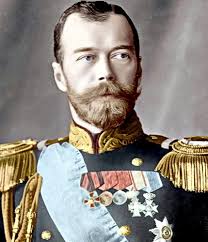
- Of course, the most important thing is fatigue from the war, disbelief in the possibility of close victory. This is unbelief in the supreme command, because a degree of no confidence in the commander, including the Supreme ones, constantly increased. First, to Grand Duke Nikolai Nikolaevich , and then to the emperor himself, who took on command.
- Do you think this decision is a mistake or it was inevitable?
- It was inevitable, but it was an inevitable mistake. Because it was such an increase in the rate, after which there was already nothing to lay out on the table. Prior to this, it was possible to throw Nikolai Nikolaevich for defeat, figuratively speaking, as in pre -Petrine Russia, they threw off the rioters on the spears of the frightened boyars. But when Nicholas II himself became the commander, it is clear that there was no one to “throw it on spears” further, the king himself had to be responsible for everything. Now all the defeats, all failures have been associated with his name, and most importantly - the unattion of victory. The army was tired of the fact that the victory was not approaching. Soldiers are ready to bear any hardships, huge losses when they see the result.
- But the same situation was in other armies. And German soldiers were tired because there was no approach of victory, both Austrian and French. However, it was the Russian army that collapsed first , not in 1916, already in 1917, but still the first.
Soldiers are ready to bear any hardships, huge losses when they see the result
- Here, of course, the national crisis affected. Sometimes they remember Churchill's words about tsarist Russia, he compared it to the ship, which sank when the pier was already not far. But still, the crisis was very deep in Russia. In general, the country could not stand the test of the First World War. The state mechanism, many social institutions, Russia as a whole as an organization turned out to be too fragile for such a test. She was a weak link among European powers, like two other empires-Austro-Hungarian and Ottoman.
- You mentioned that distrust of the highest ranks increased. How common was this in the soldier's mass? Rumors that around the throne is a prime clique, Rasputin , who was sold by the enemies, was finally killed at the end of 1916 ... How much did all these rumors influenced the army or was it mainly in the capital's wandering of minds, conditionally speaking, how are there any political discussions on Facebook?
- No, I think that these rumors had a very strong influence on the masses. The fact is that in Russia the back of the lack of right is the lack of responsibility. Each group, each layer of society considered itself innocent in what was happening and delegated responsibility for it by higher layers. Therefore, the army as a whole was unhappy: the soldiers were unhappy with platoon and company, company and battalion command - regimental, regimental - divisional, and so on to the very top. It was a very big problem. Then, of course, at all times, the idea of a blow to the back, that it was espionage, that everything would be in order with us, if not for enemies, not treason, this is a picture characteristic of all times and peoples.

- That is, the "fifth column" was talked not only now, but a hundred years ago?
- This is eternal. Moreover, spyingomania is very well sold at all times, it comes from the natural horror sitting in a person in front of the secret, and intelligence is a secret business by definition. The idea of espionage in the Russian army of that time was very strong. It is no coincidence that such a high -profile case as the matter was removed from his post in 1916 and later taken under the arrest of the Minister of War Sukhomlinov . After all, in no country in the world they did not undertake to judge on suspicion of espionage of the military minister, as it was in Russia. Much higher. Thus, the Supreme Commander -in -Chief Nicholas II was compromised. We add to this the stubborn hostility of society towards Empress Alexander, by origin of the German, which was stubbornly called a spy. In this sense, the discrediting of the Russian tops was simply colossal. The situation, from my point of view, was really tragic.
-Of course, I understand that history does not know conditional mood, but have there were any ways to save in this situation? It is clear that opposition speeches were then conducted in the Duma, the king was always proposed to begin political reform, to rely on the wider layers of society. It was all real projects or, as of 1916, it was possible to do anything by and large?
- Here really a subjunctive inclination is difficult to use. From my point of view, 1916 was a point of no return. The return point was another year 1913, 1914, maybe even the beginning of 1915. By 1916, the crisis had already reached such a depth that it was supposed to be resolved by some kind of disaster. Maybe not as terrible as it really happened in 1917, but, let's say, some kind of tragedy. According to what scenario it would develop - it is difficult to say, but the tragic outcome was virtually inevitable.
-The reasons for this tragedy, if taken from the very beginning, is that the leaders of Russia have bet on foreign policy ambitions to solve some internal problems of the empire by entering the war and assumed to solve the victory? If so, then this is a move that causes many parallels with today.
In fact, the crisis was in almost all areas
- It is. Indeed, the authorities wanted to solve problems with the help of a “small victorious war”, but it was only one line. Because in fact, the crisis was in almost all areas - in political, economic, social. Let me quote Valerian Zubov , there was such a statesman, in 1803 he advised Alexander I to start a war with Persia. He wrote the following: “Nothing makes so much impression as a happy war, if it is not exhausting to him. Victories and acquisitions exalt the concept of his government, enhance the trust in his wisdom and conquer the mind with the power of surprise. The victory is quick, the triumph of important, the acquisitions of important, glory has always been more stunning - which can be most exalted by wisdom and the strength of the government in the authorities in the eyes People's! " We can find similar texts in all eras in all states. In Russia, the situation was aggravated by a lot of other circumstances. Of course, the government wanted to relieve internal stress by transferring this stress outside, but there were a lot of problems and internal ones that the government underestimated. And I must say, the majority of society underestimated them. Rare minds in Russia generally saw the whole depth of the crisis, which existed and which was aggravated by the war.
It is worth listening to poets, not economists and politicians
-And who had foreseen?
- I think that the poets foresaw, oddly enough, because logically it is very difficult to predict such things. I looked through Russian newspapers of the beginning of the twentieth century and drew attention to the fact that the articles of 1913-15, and until 1916 inclusive, in principle, in principle, do not differ from each other-as for the words about the crisis and so on. The predictions of analysts of political, economic, no different for years. And none of them suggested that everything would collapse so soon. But the poets, they had a feeling of something formidable impending. Therefore, I think that in such situations it is worth listening to poets, not economists and politicians.