
Translated material
The future mollusk
“The future has come, and it / transferred; The subject falls, / the violinist comes out, the music does not last, / and the sea is all wrinkled and the face. / But there is no wind. / Someday it, and not-alas- / we, the promenade will overwhelm / and will move under the exclamations of “do not”, / rising crests above the head, / to where you drank your wine, / slept in the garden, dried a blouse, /-destroying the tables, coming mollusk / preparing the bottom. ”
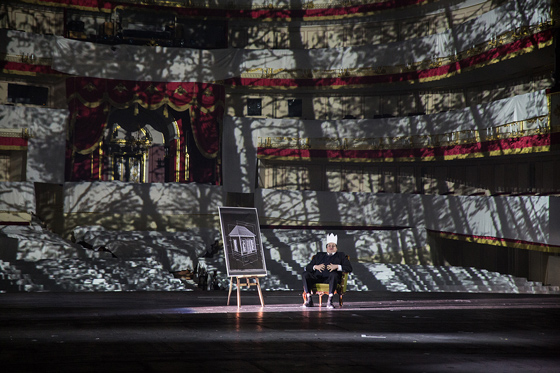
It is indecent to start a review of the quote, and even with this, but the text about the future death of Venice is revealed by the figurative series and the metasyust of the post -apocalyptic performance of Andriya Zholdak based on the “three sisters” with deafening accuracy. The element licks the bone culture. The spirit rushes over the waters a second time - after the eternal return, something in nothing. Visually, everything is like this: a white storm for a white noise washes the cleaned chairs on the other side of the curtain. The chairs where we all sat more than once (and not only we - the author of the play sat). Monochrome waves dare to the imperial box ...
These stage already knew such a game - when the hall of the Alexandrinsky Theater becomes the main decoration and plays the culmination of the performance: “Ivanna” of the mighty, “ p . S. "Kozlova ... But he had never been so mercilessly eaten by chaos. Never through it sprouted, like in a new Mesozoic, a forest.
The measure of all things is a person - at the far from the audience of the edge of the ramp: in the golden frame of the mirror of the scene that cries infinity - three broken figures. A terrible dream of anthropocentrism, revival hell. Yes, hell of the Renaissance, who for the first time in our era recognized man as a crown. And classicism, which is a monument to the Russian building: a perfect design, the pride of the mind that subordinated to algebra harmony. And the XIX century - the most rational, prosperous, fulfilled faith in the civilization and progress of the century, to which the "three sisters" - the requiem. The chaos laughs at all this.
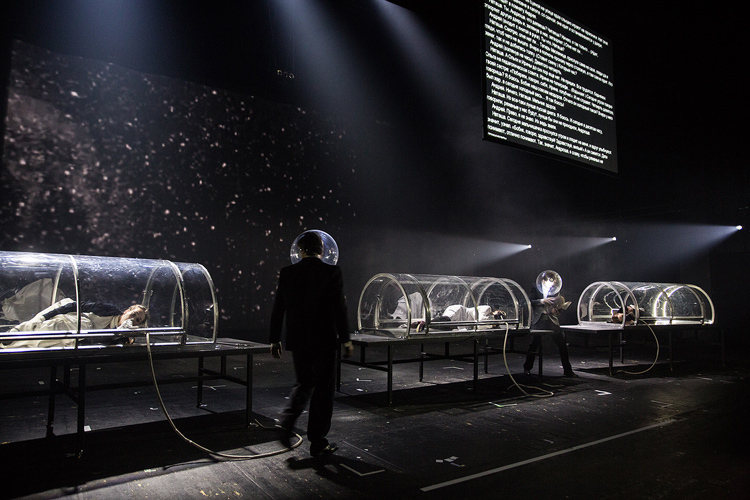
The action is launched from the future. We are informed (in the credits and voice) that now 4015 is an experiment to introduce the consciousness of three sisters into the revived brain. What kind of new world is this is unclear. But it is felt that those who dominate it are those who set up experiments are rather proportionate to the ocean than anthropomorphic. The world is like a will ... and - in a paradoxical way - this is emphasized by black mounters who are building plexiglass sarcophagi built on the stage, where experimental sisters are squealing ... Sleeping shadows are not like servants of the theater, but to the servants of this overpersonal will, to the shadow of the Aidovs.
 © Press Service of the Alexandrinsky Theater
"Girls, home!" -He calls on the slander, like a siren, a young flying mother in the Amazon, for some reason with a gun. Repeatedly. Another chiseled figure in the distance ...
The Chekhov text is in the channel of the plot about the resurrection of memory with the ease of snow. The layers, layers, layers of the former ... Everything is gathered in a single layer of a tripling life - and what is the events of the play, and the fact that exactly a year ago, when the father died, and the fact that in Moscow in distant childhood, when "everything is already in bloom, everything is filled with the sun ...". And composed sketches - like the first meeting of Masha and Kulygin in the lifted classroom of the gymnasium. And the Freudian scenes with the father, to whom, echoing the invisible door to the invisible door, with the disgust and fading of the heart, the daughter walks along the diagonal of the stage (father, like Vershinin, plays Igor Volkov) ... The replicas are mixed, the sparkling Irina suddenly instead of Olga says that she grew up and rustled because they are angry in the gymnasium ... they are a three One - split into thirsty non -resistance (Irina Olesya Sokolova), for exhausting the lack of passion (Olga Elena Kalinina) and to exhaust the passion of a man (Masha Elena Vozhakina).
There is a substitution, a trick, a trick. In conversations about a person as a measure of things and about all anthropocentric paradigms in the history of culture, a person is understood as a man. Here - no. The figures are female, and they are not opposed to the elements (no matter how much the landscape referred to romanticism), but the flesh from its flesh. Not about people all this - about Menad, Erinius. About their suffering.
The whole structure, full of chaos, is kept on antinomies; on the polarities of extremes; on symmetry.
All the local, which happened to the sisters, is a phantom and the Morok, a minute game of minute earthly incarnation. The very thing that can be neglected. “There is nothing in the world, we are not, we do not exist, but only it seems that we exist ...” - says the Semennik seeds closer to the final, and this replica sounds as if an additional (and almost superfluous) alibi to the director's plot. Chekhov’s heroines live in memories, they perceive their extinction as a sign of disaster (“I forget everything, but life leaves and will never return, never ...”). Zholdakov heroines, passing through torture with memory and life, gain the joy of deliverance. The sisters are released. They die on the edge of the ocean gratefully. Shot. Shot. Shot. And each curls in the pose of the embryo. And it rhymes strangely with that cry "Home! ..". In which house did their phantom mother with a gun calling behind all the house? ..
Sensory return, surrender of the diet requires this performance. There is almost no irony in it (and in this he is the opposite pole to the masterpiece of the Yernichi “Zholdak Dreams” ) - and the sensual intellectual overshadows. He is apophatic and apophatic. About the abyss. Here, the underworld descends not for the sake of truths, but for the sake of the underworld itself.
Actually, the abyss and tearing off the notorious covers, thrown into it, has long been the center of attraction of the attention of Zholdak. But his directing never expressed its super -unit so symphonic powerfully. One woman (gate to the htonic horror) is always few - he needs to propagate them, as was already in Madame Bovary. And having received the play, where the female, as a Christian god, is moving, he teaches such an orgy of total beauty ... There are wolf pits in this structure, where attention fails; But there are volcanic ups.
 © Press Service of the Alexandrinsky Theater
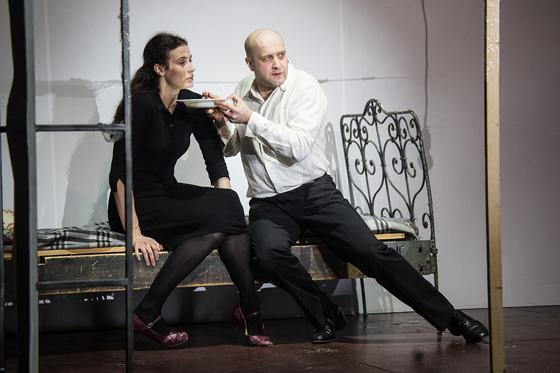
The first act is the circle and shudder of light bodies, fertilized by unusual, fresh breaths of life. The gradations of the girl - but not constrained by the decency of the light: without scum, without needlework, without walls and barriers. The second act is the tyranny of male, civilizational; Putting and submission. The whole structure, full of chaos, is kept on antinomies; on the polarities of extremes; on symmetry. Irina owned with two figures of pages rushing for her on a black scene with tennis rackets, giving and devoting to her elastic strikes on the ball. I went between them, as if trying on an alien role and digging my lips to the test in one or the other - in the first act. Two men enslaved Masha - in the second. And now she, exhausted, is winging between her husband, demonstrating ashamed masculine power, and Vershinin, dancing with the void at the bed of the bed ...
Pages of Irina (Tuzenbach Ivan Efremov and salty Vladislav Shinkarev) are too young and, with embarrassment, look like jesters. Masha’s demons are too old. The Vershinin, reminiscent of the aging engineer, is, of course, extremely charming, but still attracts Masha - obviously - only because she is in the appearance of her father. And Kulygin Vitaly Kovalenko is turned into melodramatic (not from a comic book, or from a Gothic novel) the villain. In a neat suitcase, he wears roses for his wife and lunch dishes, but it seems that the torture apparatus ...
And all this for a moment becomes like a duel of trivial female destinies: what is worse - to exhaust from bodily hunger, almost not realizing what is happening to you, like Irina? Landing my sister's husband, like Olga? Or to be like Masha - as if in a vulgar criminal summary - a victim of domestic violence? Melodramatic stories are poured ... But the unit, everyday directing initially sets a cosmic scale.
 © Press Service of the Alexandrinsky Theater
The backdrop for passions, according to the asshole, is the interior - wallpaper with warm flowers. Some Magrittovsky Pavilion house is rolled up on the tanks and wedges into an eschatological landscape: with these huge windows, through which sterile surrogate coziness shines, the house looks like a clean decoration for a catastrophe film-to easy prey for the first wave. All domestic (pseudo) is played closely, in front of the viewer. All supervisor is shifted into the distance, to the elements, covers the black space of the scene.
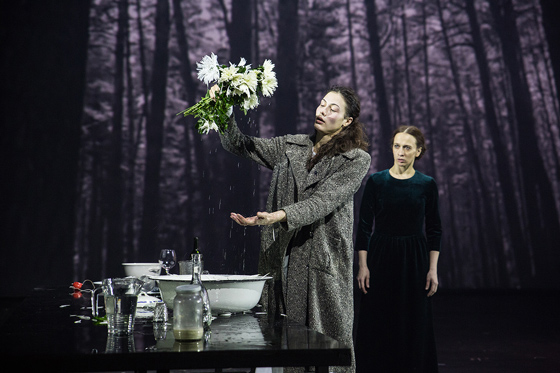
And no matter how much Masha showed Irina Shrama on her back, discouraging to go out behind Tuzenbach, no matter how much it was washed from the pelvis with water from flowers, hiding in the house, to the ceiling of which the video camera was attached, it is clear that her tyrant is her victim. Femicine as inhuman, as natural, spontaneous, tea , as an absolute, not aware of itself, devoid of ethical principle of evil. The inflorescences of chaos, an invaluable biological weapon, which the impersonal fights with personal. And then, then oozing later and tears, the executioner exhausted by work looks into the hall and seeks sympathy. Erinius is good - the original one is clearly waiting for them, and he ... he is human. He remains a measure of all things.