
Translated material
Black Cube. Camera Lucida
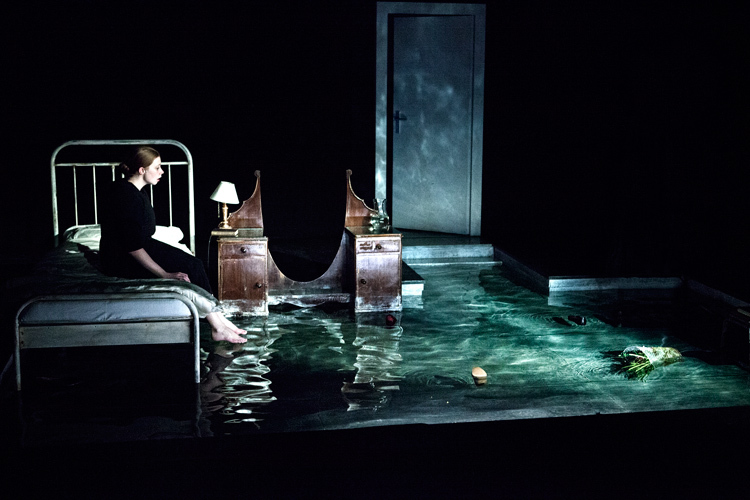
The Ophelia Room introduces Katie Mitchell to a new turn of directorial thinking. After radical performances online , which were on the screen, although their shooting, installation, voice acting took place on stage, in front of the public; After other surprises in the dramatic (and in the opera ) theater, she became interested in the acting presence - as well as conceptualized structural levels, the impulses of the performance in which transitions of prosaic and poetic fragments were correlated or tangent with the text of Shakespeare. At the same time, the shadows of famous images that turned out to be strangers exist here in a paradoxical intimate incarnation for Mitchell.
For this, she needed a chamber scene, but not a chamber performance.
An iron cube covers Ophelia's room with a roar. The heavy gates of the castle are slapped in such a gulp. So the press machine at some huge plant sounds. A black cube rises - Ophelia's bright room opens. The camera is a prison. And close and remote Denmark remains behind the small scene of the Schaub ü Hne Theater.
In the Black Cuba - credits. They declare the names of the episodes of a two -hour performance: defense; Hurring his breath; fainting; agony; Clinical death.
To the left of the heavy cube, with a clang of Ophelia (Jenny König) with a window with a window and a light white door, is a tiny space with an iron door. She leads to the vastness of nature. It is opened, closed with a key lamb, Hamlet, Claudius. Because of the wings in the Ophelia chamber, the cries of a rooster, a hoot of owls, quiet music, a crunch of steps along gravel, a thunder of the weather will be heard.
In the play, Mitchell Ophelia parted with the myth of herself - the heroine of Shakespeare.
In the Ophelia room, there is a girlish bed with snow -white linen, a dressing ware without a mirror, with boxes where she wares the letters of Hamlet, recorded on cassettes brought by a servant, and an old tape recorder. Having put off embroidery, Ophelia will insert cassettes, listen to the obscene desperate confessions of the prince. Turn off the record and press Play again. On the white canvas is embroidered with red threads: I am so Happy and - heart.
There is also a hanger in this room. It has a bunch of dresses, a nightgown and a cloak. Under the hanger - rubber boots, shoes. Next to the bed is the garbage bucket, where Ophelia regularly throws out bouquets of flowers from a glass vase with water, which the malet brings every morning from Hamlet. Free flowers turn immediately into dead and tormented.
Ophelia sits on a chair in underwear. It begins to dress. A heap of dresses - knitted, silk, velvet, linen - on cases of a short -term exit from the room - she puts on one on top of the other, turning a fragile body into a cocoon, a thickening body to the size of a horseman recluse in a single chamber. Or - swollen (in the future of the performance) drowned. This vestigo of the half -naked body is a rehearsal of the final with a heavy body of a protagonist.
Ophelia, hearing the steps in the corridor, repeatedly goes for a walk and instantly returns, takes off his cloak, boots. Behind her scenes calls her sex. Clicks with a cup, reads. He hears crispy steps in the corridor - in the courtyard of the castle. Having received the next envelope with a letter from the maid - the directorial refrain, she inserts the cassette into the tape recorder, listens, turns off, embarrassed by obscene text, then presses on Play again. The letters of Hamlet are erotic for her.
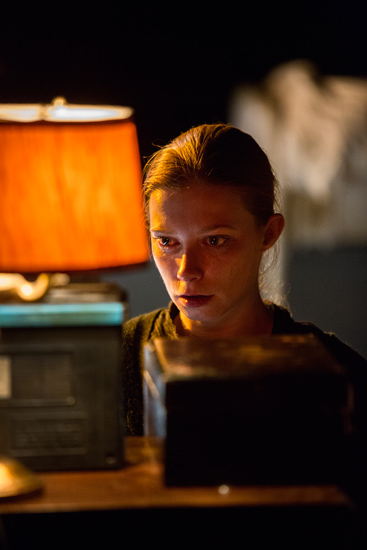
The Englishwoman Alice Burch, whose play directed by Katie Mitchell, writes a letter of letter not for the gentle hearing of Ophelia. The light in a white cube - the heroine’s room is cold. In the course of the performance, it rhythmically replaces the light of the light bulb by the bed - warm, cozy.
 © Gianmarco Bressadola
The rhythm of the play, based on the high-speed movement of Ophelia back and forth, from the room out the door and again into the room, recreates the conditional feeling of time condensed in a second, for which something happens outside its personal space. The rhythmic change of light forms an unusual score of the performance. It is folded according to the principle of installation, which performs action with gaps, where something happens, but remains outside the field of view of the audience. Mitchell leaves them alone with Ophelia. Her feelings, reactions, moods are initiated by Shakespeare's text, which Burch means, but does not interpret in any way. The only motive explaining the behavior of Ophelia is the (Shakespearean) instructions of Laerta with the Polonia that the prince is not her star, that she had to "close his praise to the key, / drive the gifts and return the gifts." They do not neglect Mitchell with Burch and the order of Hamlet: to clog Ophelia in the monastery. The local monastery will become a white camera. The motive of the key is not accidental here, which, like an echo of Shakespearean replicas, will help Ophelia to hide from the affectionate obscenities of Hamlet. (Laerte: “Farewell, Ophelia, and remember firmly, / What was it about.” Ophelia: “Close in the shower, and the key / take with you.”)
In the play, Mitchell Ophelia parted with the myth of himself, the heroine of Shakespeare, and, deduced from balance with letters of Hamlet, the corpse of Polonia, who with the lumped brains carries her into the killer’s room, is exempted from the prince’s candid temptations. She represents her own, previously unknown to the public.
It would be possible to record Katie Mitchell into a string of French directors-especially since her performances “Christina” and “Yellow Wallpaper” suggested such an interpretation. There is a share of truth in such a reading of the Ophelia Room. But not the whole truth, although the image of the German -speaking Ophelia is a projection of the backstage palace intrigues, the accidents and oppression against which the heroine Mitchell -Burch is forced to rebel - besides, she was prepared for this step by psychotropic tablets, which are stuffed with palace benefactors, thus pacifying experiences after the death of Polonium.
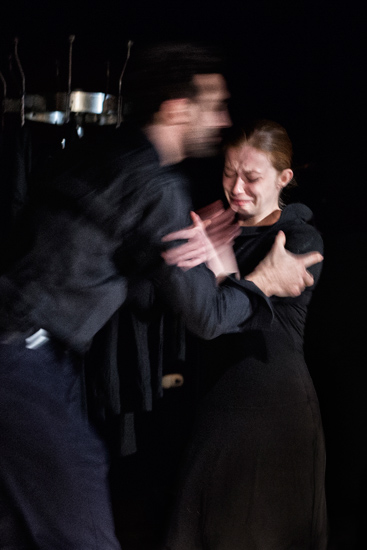
The genre of this performance is a psychotriller, minimalist and strict in design. The frame frame without a mirror is a metaphor for the “portrait of Ophelia”, which puts on dresses, changes shoes, not knowing how it looks. This is a frame into which its invisible internal - hidden - world is pulled or drawn; Nobody guesses about him. Even the Hamlet, which suddenly bursts into the room, includes a tape recorder and twitches in a macabric dance under the song Joy Division “Love Will Tear Us Apart” : “ Who is Bedroom So Cold? / You have Turned AWAY ONT YOR SIDE ... / You Cry Out in Your Sleep, / All my Failings Exposed ... / As Desperation Takes Hold . "
Ophelia, awakened slowly to madness, is locked with a key - thereby the “key” that issued Ophelia in the Shakespearean text of Laertu. Her room, deepened in the floor, is filled with water. There are flowers that fell out of the garbage bucket, where Ophelia “fused” them, like funeral wreaths. Water rises de Profundis . Ophelia pierces the throat and slides into the “pond”. There was no association with a dead Ophelia in the picture of Mill here - Mitchell does not aesthetize the death of his heroine.
The inhabitants of the castle - the maid, Claudius, Laerte - step on the water, not noticing it, they walk like on solid ground. A black cube turns into a glass transparent aquarium, into which Ophelia is embroidered.
 © Gianmarco Bressadola
Such is the work of Mitchell - Burch with the content, and not the plot of the Shakespearean text, canceled for them with a delicacy for interpretation. The comparable move was proposed by the curators of the Double Vision exhibition, which took place this winter in Berlin and Cricking 120 engravings of Dürer with the works of William Kentridge , encouraging to think about the dynamics of dialogical connections of artists of different times and cultural dissimilarity. The Centridge, born in 1955, used the visual motifs of the artists of the German Renaissance, adapting them for personal graphic metaphors. So, on one of the walls, the “melancholy” of Dürer and the leaf of the Cantryge “Kill Treashed the truth” are hanged near the “melancholy”. So Mitchell and Burch translate the performance into close antiquity-in the 1970s: not into the current reality, but not in the Middle Ages. They leave the history of Ophelia in interdity, not completely forgotten, but almost lost.
Ophelia’s room is “cut” on stage as an image of the head from the book of her life. As a metaphor for her inner world. Like a space where she quickly returns from behind the curtains, from a walk, from the corridors of the castle. He comes to his senses, and not just to himself.
Switching of light indicates the time of morning, evening, night. It is also a signal of anxiety or tremor of statement/denial, whiteness and darkness - in an allegorical sense. The dualism of the performance, the image of Ophelia represents an expressive line of actions, the place of fears and the solution of Berlin Ophelia.
Mitchell in this transparent rhythmic performance separates consciousness, subconscious nightmares of Ophelia from her body. Protecting with clothes - beautiful dresses that distort her thin figure, the heroine Mitchell -Burch is powerless to cope with internal helplessness and interrupts her by opening the aorta.
The flowers thrown into the basket puts Claudius in her hands, trying to pull off the offline into the funeral of Polonia. But the flower - lily, of course - she will pick up only after he swallows the medicine: she, as if in mental hospital, is forcibly stuffed with psychotropic.
Gradually, the air element of the white chamber sticks together (“merges”) with a water pipe. The water is heavier than the air, but its courtiers do not notice because Ophelia lives in its world, and they - in a completely different way.
I repeat: the door to her room, in her inner world is locked with a key, and another is located at a distance. Both doors divide the space of the performance, which the characters apparently/invisibly crossed, but with which they come into contact only by force. Sometimes - feasible.
The final aquarium behind the transparent walls of the cube is a variation of the "Crystal coffin". Or simpler - a cube of glass, (a bullet) impenetrable. The contrast of the black metal cube, the pressing, protecting Ophelia in her cell, and the white room where the heroine Mitchell-Berch rested among the filled water, thereby reviving flowers, literalizes the relevant connection between the need to oversee and punish.