
Translated material
Unfinished grandmother
Does Grigory Yavlinsky have, who has already stated that he would go to the presidential election and win Vladimir Putin, a chance to get to the Duma, why did the Kremlin treat the Liberals of the nineties, and the Kremlin “Yabloko” Kremlin
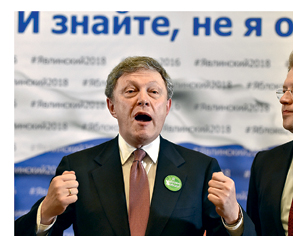
Navalny Yavlinsky will not go to any contacts expelled from Yabloko at the beginning, Moscow, on February 28, 2016. Photo: Anatoly Zhdanov (Kommersant)
When, on the night of the December elections of 1993, a prominent expert on Dostoevsky Yuri Karjakin explained to Russia that “it was fooled”, many had a suspicion that someone else had stupefied. And just Russia, which gave 23% for the LDPR and so upset Karjakin, was entirely in its mind and in its right. She just showed herself as it really is, and not the way to see smart specialists in the people-bearer.
Well, people like Zhirik! They still like Latin American TV shows, Stalin, Kashpirovsky, Dmitry Kiselev, 7 days magazine and Vladimir Putin. This is fine. The people must be respected as they are.
Bureaucrats in the game
In addition to the ditch separating the wide masses from the well-intentioned metropolitan intellectuals, the 1993 elections showed that the counting of votes is far from fully controlled by the federal government. Fascinated by criticism of totalitarianism, the humanities somehow did not notice that the real administrative (including falsification) resource is more in the hands of regional elites than the Kremlin. Although this was clearly confirmed by the data on the simultaneously voting for the Constitution, which failed in regions, where local, in essence, the regional authorities, firstly, tightly controlled the counting of votes, secondly, sought to lower the constitution on the brakes because it infringes on their sovereignty, and thirdly, they were afraid that the “DURA Moscow” (as they called the Kremlin’s attempts among themselves. Democratization) will put their regional omnipotence at risk.
Seven republics-Adygea, Bashkortostan, Dagestan, Karachay-Cherkessia, Mordovia, Tuva and Chuvashia-gave less than 50% of the vote for the Constitution. Chechnya generally ignored, and Tatarstan expressed his attitude, showing a scandalously low turnout 13.9%. Less than half of the votes was also given by a compact group of regions, which later began to be called the “red belt”: Belgorod, Bryansk, Volgograd, Voronezh, Kursk, Lipetsk, Oryol, Penza, Smolenskaya, and Tambov regions.
It was an important signal, correctly understood in the Kremlin, but passed by the capital's progressive public: electoral democracy in Russia reflects not only the mood of voters, but to no less mood of the elites. It became clear that no reforms would go without taking into account the skins of the bureaucracy. Here the line lay, for a long time, if not forever, separating political pragmatists from well -intentioned idealists. Russia was not at all the same as Moscow Democrats. Mirror stress experienced wide masses: democracy also came out not the same as they painted in their imagination.
The way down
It was unlikely to be otherwise. At the beginning of the process, it seemed that it was worth abandoning the emergency of the CPSU and introducing a market economy, as we would equal to the USA or Germany. Nobody wanted to remember that parity with the west of the USSR was only in space, defense and hockey; And so in Argentina, Brazil or Pakistan, there is also no CPSU and there is a market economy - but this is not enough to compare with world powers. Disappointment, and with it the nomenclature revenge on the basis of Soviet missile-hockey illusions, which successfully cultivates and exploits the Putin regime, were inevitable.
It could be worse: look back at the experience of Uzbekistan or Kazakhstan, where former Soviet leaders did not let control of their hands at all. Could it be better? The question is how complicated is so idle. However, it was he who has been putting at the Center for Political Life for 20 years steadily losing electoral support to the Party of Valoko Liberal Theoretics. They know how to.
Only now they were not lucky with the people. Political practice is harsh. In 1993, Yabloko gained 7.9%. In the following elections, in 1995, the indicator decreased to 6.9%. In 1999, the result is even more modest - 5.9%. In 2003, Yabloko officially reached only 4.3%. At the same time, few doubt that the party (together with the ATP) politely “threw” when counting the voices just in its supporting urbanized zones - primarily in Tatarstan. There, Yabloko counted only 2.5% (at 59.5% per EP), although even in Bashkiria it was 3.6%. Alternative calculations made by the Communist Party showed that the real result was 5.7% - it is not God the news, but enough to pass in the State Duma.
However, this amendment does not cancel the general trend towards a decrease. In 2007, Yabloko had only 1.6% (an alternative calculation showed 2.15%). In 2011, 3.4%, in the absence of traditional competition from the disappeared ATP, but with obvious signs of falsification in favor of the EP. After which Moscow fell into Bolotnaya Square. Since the formation of the “Putin’s consensus, the election results are increasingly dependent on the Aziopian nomenclature, which the European opposition does not need at all. But the harsh truth lies in the fact that if the party had 9-10 real percent of support, no administrative resource could drive it under the shop. However, such support was not even in 1993, when urban Russia still had European illusions. Now and even more so. Against this background, the constant reproachful in the fact that the reforms had to be carried out wrong, to vote not like that and build a bright European future is also wrong - in a country where elites and the population were brought up in the traditions of a completely Asian despotism for at least three generations - they cause, to put it mildly, perplexity. Well, yes, of course, Russia was fooled: she had to vote for Yavlinsky, and everything would have worked out.
Guest from the past
In a simple -minded language of political science, this is called to smear past the target audience. Over the 25 years since the beginning of the 1990s, the country has come a long way-and mainly up. There is a market economy that focuses on payment demand, and not on the directives of the Politburo. There is a convertible ruble. There is information freedom. There are elections and political parties. It is clear that all this is distorted by monopolization, bureaucratization and falsification. It is also clear that the Putin nomenclature slows down and in places even turns back the normal development. But do not deny that we live in a new reality compared to the USSR. And the problems before the country are others.
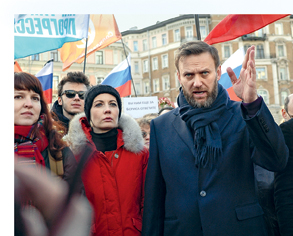
But Alexei Navalny and without an alliance with Yabloko has a political future. And at the "apple"? Moscow, February 27, 2016. Photo: Kristina Kormilitsyna (Kommersant)
New challenges are more acutely feeling new politicians. Corruption - this topic is more successful by Alexei Navalny. Legal lawlessness - Mikhail Khodorkovsky looks stronger here. The legend of Russia - Ilya Yashin speaks more about this louder and clearly and the deceased Boris Nemtsov spoke. Yavlinsky is an excellent economist who argues. But today, unlike the USSR in Russia, dozens, if not hundreds of excellent economists.
What else? In essence, Yabloko has only two serious trade advantages in the modern political market. Firstly, the real party structure, which is worth a lot (“apple” honor and praise that it managed to preserve; it is stupid to blame him for the fact that for the sake of this it was necessary to compromise). And secondly, the image of an adamant fighter for ideals. If the first paragraph is not in doubt and in the new, more pragmatic Russia is unlikely to be disputed by anyone, then with the second problem. He contrasts too clearly with the first. He is too narrowly focused on the ideological core (in order not to say - a sect) of Yavlinsky's witnesses. He is too from the 1990s.
Dialectics of fundamental
The price of adamance in relations with Parnas is illustrated by the Hegelian triad, which the party leaders studied at school. Thesis. Navalny is a bad person. Nazi, imperialist and populist. Appeals to the low sides of human nature, looking for cheap popularity. The fundamental "apple" with him is not on the way. Antithesis. On the other hand, he gathered a damn numerous audience with his Nazi rhetoric. Could share with an incorruptible “apple”, which always lacks votes. The party with all the integrity insists that he urges his supporters to vote only for it! Synthesis. We do not change the principles for interest. Having screwed such a dialectics to the voter, party publicists on a blue eye hold him as an idiot. But this is still half -worn. Worse, if they themselves do not understand how they look from the outside. So used to explain their failures with incorruptible fundamentalness that they themselves believed in it. And the voter is tired of believing. You gentlemen, or negotiate, or do not fool your head with your steady course. With in mind that in 2013 in Moscow Navalny officially scored 27.2%(in fact 28.4%), and Yabloko leader Sergei Mitrokhin with his irreconcilable struggle against point development - 3.5%. The same with Khodorkovsky. The main apple negotiator Lev Schlosberg reasonably says that in the election bar there, there are elements that should not be taken onto the stage. And then he says loudly that the “Yabloko” will fundamentally not accept money from Khodorkovsky.
It seems to be just such a plot: if you were offered the money (it is not publicly, presumably?), Why not refuse them as well. If not offered, as Khodorkovsky himself immediately declared, even more so. The voters again are not idiots, they understand: since the topic went to the public, it means that it is necessary for someone. Who is Khodorkovsky? He is already in the know. Voters? It is strange to them - demonstrative financial showdowns are clearly not improving the negotiation climate. Kremlin? This is already warmer. But then again questions arise about non -beating. Well, it would be just to keep silent. There is no doubt in the mind, experience and sense of dignity of Mr. Schlosberg. Therefore, there were some very significant reasons. Apparently, only party love for directness and firmness - what other reasons can be. Not a call from the curator.
In the "Yabloko" they are used to talking and thinking that they are offended by envy - for an unfinished white tailcoat. Alas, this is self -deception. The theme of non -marked, if exists, then mainly in the imagination of the party itself or its nuclear electorate, which is clearly not enough for passing into the Duma. The so -called electoral train - people who are potentially sympathetic, but inclined to hesitate or be lazy, are rather preoccupied not with the purity of party clothes and the content of party programs, but by practical efficiency. Including agreement. If there is an agreement with Parnassus and Navalny, in addition to the amount of nuclear electorate, it will immediately add a pretty vote from the “plume” - just as a bonus for his sane. There will be no agreement - well, excuse me. In any case, Navalny will have a political future - for the simple reason that he is young, smart and talented, no matter how he treated him. But the most important thing: it has such things, the presence of which, as the best anthropologist of all time has established, distinguishes grandfather from grandmother. But the Yabloko party may not fit into a new reality, forever remaining an incorruptible grandmother from the 1990s.