
Translated material
The violinist is not needed. What is really behind Roldugin's offshores?
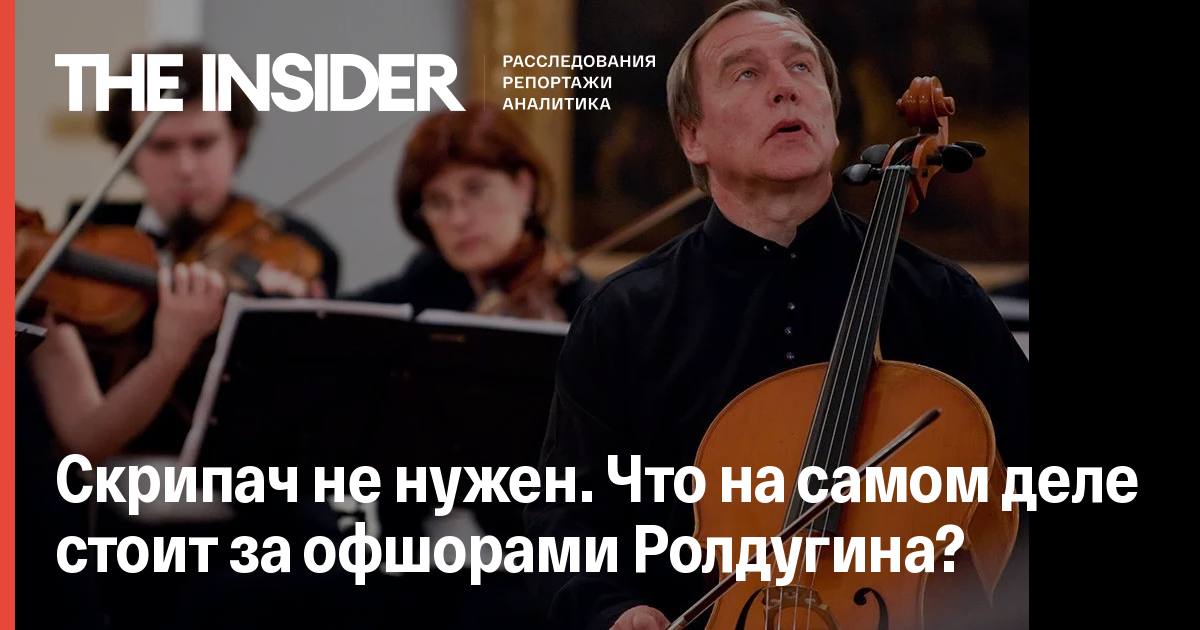
During the direct line, Vladimir Putin again stated that his old friend Roldugin spent all offshore tools on musical instruments, including the Stuart cello (why this is not true, The Insider was already writing ). It is curious that the Kremlin media themselves have essentially refuted this version, telling with reference to the FSB that the movement of funds in the Rolduginsky offshore reflected the special operation of the security forces who returned an important asset to Russia - the NTK telecommunication company. This is how the Kremlin version of this “hit in the teeth” sounds:
“In 2008, we received operational information about the interest of American special services in Russia's telecommunication assets. In particular, the largest operator of cable television and the Internet, his assets were displayed in offshore, prepared for a deal to sell these assets of the American company financed by special funds, ”said one of the FSB officers.
The company "National Telecommunications" with an audience of several tens of millions of spectators for sale in the stock market brought businessman Suleiman Kerimov into offshore. And American funds of direct investment instantly put their eyes on assets.
“A decision was made to return state control over this asset,” said one of the FSB officers.
The cost of shares of "national telecommunications" was estimated by owners of one and a half billion dollars. To collect such an amount in offshore, and it was necessary to redeem our cable networks there, the state turned to the business. The lion's share undertook to pay for the National Media Group. The package of smaller Severstal and Surgutneftegaz took over. Bank pool was formed in support. In equal shares - Sberbank, VTB and Gazprombank. In April 2008, the pool of Russian companies bought all 100% of the shares of “national telecommunications”. The strategic resource of Russia was taken from under the nose of Americans. This was a St. Petersburg blow in the teeth.
“And the transfer of assets of the company State Foreign company Rostelecom,” explained one of the FSB officers. It is significant in this regard that National networks were transferred to Rostelecom for the same money.
The fact that this story is nothing more than a comedy is easily confirmed by documents, and in general common sense. Here is what Olesier Shmagun, a member of OCCRP and one of the authors of the investigation dedicated to Rolduginsky offshore, said this.
“Stupidity and inconsistencies in the version about the participation of the FSB in the purchase and sale of NTK should not be sought in Panama documents. This version contradicts primarily to common sense and general ideas about how transactions are made in the free market. However, as is the case with any conspiracy theory, it is built in such a way that it is not easy to refute it. First of all, it is important to understand that the documents of the registration agent Mossak Fonse have no information about the transaction for the purchase of NTK. Judging by the open documents of the NTK itself, (in 2008-2012, this is an open joint-stock company, which publishes annual reports), the purchase and sale of the company took place without the participation of offshore from customers.
In 2008, the group of companies led by the National Media Group acquired NTK. So in the 2007 report, among shareholders, the Tokido Holdings Limited and Mebraco Investments Limited structures are two Cypriot companies that operate in the interests of Suleiman Kerimov. The report for 2008 says that the company was sold to new owners. In the list of shareholders at the end of 2008 - NMG CJSC, VTB Bank, Gazprombank, Sberbank, Surgutneftegaz and Raybrook Limited (Mordashev structure). In 2011, I purchased the company Rostelecom. This transaction can also be learned from open sources-annual reports of Rostelecom itself. In our investigation, we were not talking about the purchase and sale of NTK to structures close to the Russian Bank, but about how the transfer of the debt “NTK” took place, as a result of which Roldugin's structures received money from Rostelecom. We see that Kerimov gave about 4 billion against his own company - NTK. The company did not think to extinguish the debt. Until 2010, he hung over NTK, nothing happened to him. In 2010, Kerimov refuses the right to claim 4 billion, he rewrites the debt to the structure of Roldugin, which pays for this for 1 dollar. At this time, NTK for two years has been owned by the National Media Group and other close companies. Part of the debt "NTK" is repaid at this moment. Then the company is sold to Rostelecom, which pays for NTK and separately redeems its debts - about 4 billion (debt increased due to dripping interest). That is, now Rostelecom pays funds to the structures of Roldugin.
All this can be part of the purchase and sale transaction. Sometimes, large companies use very sophisticated methods and instead of selling the company “B” “B” generates such debts and the purchase amount is, as it were, the buyer pays the seller and what the buyer pays offshore as a debt. I know that such schemes are sometimes used to optimize taxes, but I have never heard that they were used for state security purposes with the participation of the FSB. At the same time, the Roldugin companies were still not part of the transaction. It turns out that the Kerimov structures simply gave the musician several billion rubles. In any case, if the transactions described by us were carried out under the cover of the FSB, the beneficiary was by no means a state, but Roldugin's company.
However, in general, the FSB gives instructions to companies, including joint -stock companies, we are not yet known. And on TV, we were not given any sensible explanations. If the FSB - the department is so influential that it can give instructions to the largest Russian companies, why did they simply not ban Karimov to sell NTK to American funds? ”
In this way, the Rolduginsky offshore was needed not at all for the purchase of NTK (nothing prevented the company from buying a company directly, as, in fact, was done), but in order not to pay taxes. This is a common practice - in order not to pay income tax, you start an offshore company from which you yourself “borrow” yourself, then you will pay all the profit to this offshore in the form of a debt and you have to pay for nothing (under the law, debt obligations have priority before taxes). In addition, it is in offshore that “gifts” flow from entrepreneurs, as we see in the case of Kerimov.
Moreover, it is not a fact that Roldugin himself had an idea of why it was used by offshore. In a conversation with The Insider, Roldugin's acquaintances described him as a good musical teacher and organizer (as a performer he did not shine), he did not engage in business. It is unlikely that he was devoted to the details of operations through his offshore, that he himself indirectly admits when the journalists answers “Guys, I, frankly, now I can’t give any comments. I have to see and understand what can be said, that you can’t. ”
 At least one of the offshores of Roldugin - Sandalwood Continental - was de facto controlled, in all likelihood, Putin’s old friend of Judo Yuri Kovalchuk, since a significant share of Offshore’s assets was associated precisely with Kovalchuk’s assets, including the video of the Internet, the Igor's ski resort (where The wedding of Putin’s daughter took place), premium - the hotel “Dacha Winter” (appearing in the press as “Putin’s dacha”) and others.
NTK was connected with Kovalchuk. The fact that the Russia was presented as a special operation of the FSB, when the oligarchs took off together to redeem the company, in reality, Kovalchuk’s old method to obtain control over media assets, the market participants spoke about this. In fact, some media assets are “parked” to Yuri Kovalchuk, which Putin considers important for one or another consideration, but since Kovalchuk does not have free funds, he collects them from the oligarchs, who are previously phoned from the Kremlin, explaining that “it is necessary to help”. This happened not only with NTK, but also with other assets of Kovalchuk, including STS, “5 channel”, etc.
Russian “investment” business is generally very simple: buy “the state” cheaply, pack, sell it backward
True, in the case of NTK, the asset was not so interesting and decided to sell it to the state. “NTK - with all its attractiveness from the point of view of capitalization - could not provide more adequate growth and profitability at the same time, as a result there was an idea to sell it to Rostelecom,” Media -analyst Vasily Gatov explained to The Insider, “Russian“ investment ”business is generally very simple: to buy“ from the state ”cheaply, pack it, sell it back.” In fact, the fact that the Rossiya TV channel presented as a return to the country of a strategically important asset was to get rid of a revalued company, and even with “compensation” at the expense of the state.
The question of what extent Vladimir Putin personally participates in operations, the traces of which are visible according to the documents of the Rolduginsky offshore, remains debatable, but it seems unlikely that the largest oil workers and metallurgists are thrown away on the mediators of Kovalchuk without the presidential lure. It is also extremely unlikely that the gray schemes, through which funds from Rosneft and VTB were pumped in favor of the Rolduginsky offshore, occurred without the knowledge of Vladimir Putin-in any case, Yuri Kovalchuk could not ensure this, not to mention any cellists.
Thus, the collected facts indicate that the money of state -owned companies and private investors were consolidated from the president’s knowledge, in the offshore of the president’s childhood, were controlled by the other old friend of the president and were spent on assets that the president and his family personally disposed.