
Translated material
Dear orphans, you are dug for the graves
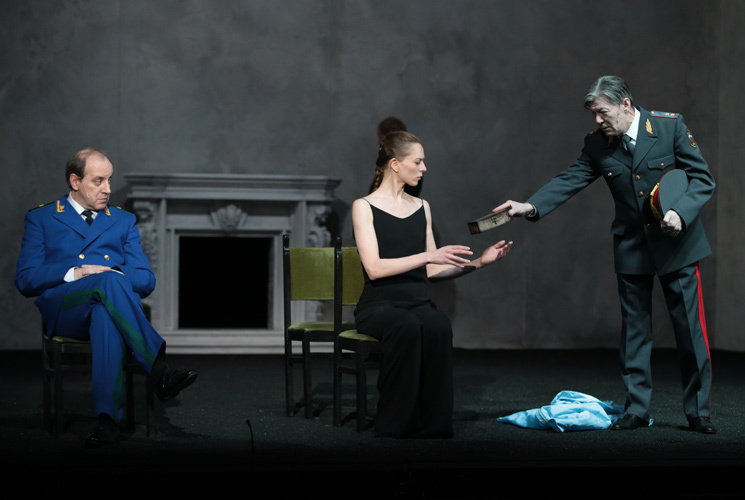
The new performance of Konstantin Bogomolov, released last weekend in the metropolitan “Lenkome”, managed to blow up the theater community and become the most discussed premiere of this season in a matter of days. Colta.ru represents to the attention of readers two projections of the “prince” - Andrei Pronin and Alena Solntseva .
It is amazing in this performance not that he, like the previous productions of director Bogomolov in recent years, caused sharp and meaningless discussions on Facebook, and not even that he somehow reactively applied the Moscow Komsomolets newspaper, which published several amazing materials. In one of them - for the first time, it seems, in the history of domestic theatrical criticism - the actress (not the character) was called, sorry, a bitch (it would not be necessary for me to apologize). It is amazing how this strange and painful performance is looking at the Lenkoma Hall, in which it was always accepted even incredibly talented and wisely, but to entertain. On a half-empty scene with a minimum of requisite (mainly green chairs, as in a state-owned institution), two or three actors in an extremely mean, introvert manner, in static scales exchange pood monologues taken from Dostoevsky's works. Unlike most of the performances of Bogomolov (the same Lenkomovsky “Boris Godunov” ), where the coolest turn was softened by the fact of the postmodern game, like a pillow of safety, the “prince” is too concise, too monotonous for the pastry, and the irony here often gives way to gall sarcasm. By all the usual standards, the “prince” should be too bored: in its exhaust, sparse space, even salty jokes sound with some longing. The hall, however, is sitting, not scattering, as if hypnotized, and in the final it is even persistently trying to applaud, although the bows are canceled and the scene response to the appeals of the public with grave peace.
Something coffin is already laid in the scenography of Larisa Lomakina, instead of the Dostoevsky bathhouse with spiders, who built a huge uncomfortable hall with gray, places blackened, like from soot, wallpaper. The only thing that stops the gaze is the huge opening of the fireplace, a frightening black square, and perhaps the firebox of the crematorium. Three men come here in uniform tunic of power structures: the one that is younger, - Ferdyshchenko (Alexei Skuratov), cop, head of the children's room of the police, and there is even older, Rogozhin (Alexander Zbruev), he is a General Mundyr here. Epanchin Sr. (Ivan Agapov) turned into a prosecutor: his piercing blue uniform visually rhymes from the heavenly blue balloon of Nastasya Filippovna (Alexander Vinogradov). Nastenka here is generally given exclusively toys, since she is here-a little girl, a minor nymph, childishly burnt and stretching words. And it doesn’t matter that she is played by an adult beauty Alexander Vinogradov, as well as the fact that not a debutant, but the venerable Elena Shanina, was assigned to the role of Aglaya Epanchina. It is not forbidden to argue that the director thus reveals not the physical, but the mental age of the characters, although the total celebration in the theater of the Bogomolov of the obstructive conventionality seems more important. A newcomer enters this room (I really want to write - a ward), although, it seems, on his mind, a lanky nonsense in a mint jacket (director Konstantin Bogomolov himself). The titer on the screen represents it as Prince of Tymyshkin, who arrived from Transylvania, although it is risky to believe in accompanying titers here, as in the former Bogomolovsky “Boris Godunov”: they seem to be written by a childish hand, not so much explain the action as they reduce it, lowering the sloppy booth and aggravating the total and hypnotizing the game discrepancies.
Men in the “prince”, as one, strive to adopt Nastasa Filippovna - how she herself will explain with children's spontaneity, “to rub” (Nastasya Filippovna does not pronounce the sound “P”, she is such a child). The topic of adoption with foggy humanitarian goals has already surfaced in the “ideal husband” ; In the Prince, pedophilian lust finds himself in the center of the plot.
The story of either a seduced, or raped girl, then either hanging, or being on the panel, for Dostoevsky inescapable Idée Fixe . He returns to her in his scriptures with such persistence and such a drawing of details that Porfiry Petrovich would undoubtedly interrogate him. In the rapprochement of Myshkin (or, if you like, his shadows - Tymishkin) with Stavrogin from the "demons", of course, there is provocative directorial arbitrariness. From the straightforward and mystically preoccupied literary criticism of the beginning of the 20th century, we firmly learned that Myshkin is Christ, and Stavrogin is an antichrist. However, having read the plots of both novels, you can notice that their plot functions are largely similar. Both “princes” (Stavrogina in the “demons” so called Lebyadkina) are mostly idle, floating with the flow, without counteracting other characters, and both turn out to be the catalysts of the disaster. If you read the “idiot” today, having renounced any mystical nonsense, you are surprised to find how much hidden swagger in the “victim” of Myshkin, condescending to marriage with a “fallen woman”.
The “prince” convincingly shows that the Bogomolov himself is a fair moralist, not a libertinist, unlike many of his colleagues in the modern theater.
The exposure of the hidden and the performance of Bogomolov is dedicated. “I love you not with love, but with pity,” Prince Nastenka says modestly, with a hitch. “Some kind of garbage,” the drunken nymph rudely retses, to which the intentions of the prince are clearer than himself. The infantile, free from adult etiquette, the view of the performance exposes lust under the mask of spirituality, lust under the mask of paternal custody, sexual sadism under the uniforms of responsible employees of law enforcement agencies. Where abstract and slurred “spirituality” turns out to be more respectable than any brain arguments, self -deception is inevitable, and now the menta of Ferdyshchenko in the company of his cardboard clones, pulled out onto the stage by the mounters, performs the children's song “Beautiful Far” in Latin - like a religious anthem. The sacred mission of Ferdyshchenko is to protect adults from children, which is imputing a meek obedience. If desired, you can find social allegory here: the world that shows the mantis in the “prince” is a world divided into children and prosecutors, and the first are the powerless slaves of the latter, the concerned of their lusts. The director’s statement does not only refer to Russia: the acting solo of Viktor Verzhbitsky as a deputy Afanasy Ashenbakh, the Couner of Nastasya Filippovna, the next victim of which was the Thai boy Tajio, turns out to be a great insert number in the first action. Fake spirituality in the play has its own musical markers - the Waltz of Evgeny Doga from the “My affectionate and delicate beast” with his sentimental mercy and the imperishable beach hit of Alla Pugacheva “Summer Star”. In one of the few staged attractions of the performance, Myshkin goes into the hall “swim” to this music, connecting it in the minds of the viewer with the tactile pleasure available to every tactile pleasure. The second time she will play, rising in the volume, as an accompaniment of an intensifying “spirit” from the corpse of Nastasya Filippovna.
It is funny to observe the criticism of the performances of Bogomolov from the perspective of insulted morality. The “prince” convincingly shows that the Bogomolov himself is a fair moralist, not a libertinist, unlike many of his colleagues in the modern theater. The difference between his moralism is simple and noble: instead of an administrative prohibitive range of the current hypocrisy, the director uses a different remedy - bitter satirical sarcasm. His sympathy is entirely on the side of the scolded childhood, whose toys disappear in the firebox of a terrible fireplace (the smoke comes from the ominous Buchenwald pipe), heating the villains who are frozen from the emptiness and fear of the death of villains.
But the most interesting thing is in this “prince” not “ideological content”, but acting. Having taken from Warsaw “ice” somnambulism, created by cunning failures of the temporite and avoiding vivid acting colors, the aesthetics of the “Hovering Theater”, Bogomolov, however, built his performance according to a different law. There is no “zero position”, detached reading, the actors play in a strictly psychological manner, repaired by the ban on extrovert manifestations. For example, Ivan Agapov constantly knocks down the pathos of the texts entrusted to him, lowering the tone to tired lethargy, says in addition - like a certain “dictatorship of conscience” prevents his character from achieving peace and comfort. The heroine of Natalia Schukina is hiding behind official, bravura intonations. Alexandra Vinogradov, in the role of Nastasya Filippovna, sparsely and sarcastically draws three directions of the image at once: the-autistic girl behind the hospital grille (the mounters carefully take out the openwork lattice copied from the fence of the summer garden), which can turn into a shielding swindler like a holy fool, and maybe into an impassive fashion model. On it is the same white shirt and the same wide trousers that the wordless hero (heroine?) Maria Fomina wore in the Bogomolovsky “Godunov” - if you like (not without irony, of course), “Magtic Girl Russia” (formula of the religious philosopher George Fedotova), humbly standing the sweaty embrace of political adventurers.
Participation in the performance of Viktor Verzhbitsky adds to the “prince” of cultural respectability. It was Verzhbitsky who at one time played “Sovetsky Myshkin” by the name of Koshkin in the famous performance of Mark Vail “Scenes at the Fountan” based on Semyon Zlotnikov’s play. As if in an ironic pandan, especially risky scenes are entrusted to Verzhbitsky. In the first act-a long reading from Thomas Mann, monotonous and output, with an unexpected capricious coloring in the words “caring anxiety”, in the second-a brilliant eccentric number, in which Verzhbitsky without a fur coat depicts a dying boy Ganya Ivolgin, and in a fur coat-a sickly doctor who prescribes a deadly diagnosis. The text is taken from the very chapter of the “Karamazovs” about Ilyusha Snegirev, which became the basis for Rozov’s “boys”. Here the Bogomolov is indeed merciless to Dostoevsky, who was saving the reader with a sentimental story, and the cold bile, spilled in the elegant eccentric of Verzhbitsky, is a powerful directorial weapon.
It is especially interesting to reflect on the role of Elena Shanina, who creates a special - metataral - the plot, undoubtedly inherits the “ideal husband” with his travesty “Hallelujah love”. The legendary Lenkomovskaya Kertchita plays (boldly and strongly!) To himself, about the “blue heroine”, ruthlessly thrown out by the sneaking age from the roles that she can perform as the younger partners never dreamed. Particularly acute to the plot is given by the fact that Myshkina is played by Bogomolov himself, that is, the director. The theatrical rivalry of a mature Aglaya with a lubricated debutant Nastasya is clothed in a fragment from the Nabokovskaya “Lolita”, where Shanina is Charlotte, and Bogomolov is Humbert, then in a hilarious reference to the “month in the village”, where Shanina is already Natalya Petrovna (her role in the Mirzoevsky performance!), And Bogomolov - Belyaev.
However, the center of the “prince” undoubtedly becomes Alexander Zbruev, whose role in the play exists mansion and is difficult to protocolized. This elderly Rogozhin, contrary to logic, causes sympathy, and although it is his knife that will become a sting that will stick into the body of Nastasya, you involuntarily follow the actor sympathetically and respectfully. In the play, the image of Rogozhin and an abundant acting commentary, the thoughts of the multi -permissive artist and man, with the sadness and wisdom of humanity and the error of mankind, are slyly mixed. It was Rogozhin - Zbruev who was entrusted with the most important monologue of the “idiot” about the death penalty: the actor seems to be transformed into the words of the novel, and when it reaches the description of the pallor of the suicide bomber, he himself becomes white as paper. He easily takes a two -minute pause in a monologue, which the hall listens with reverent respect. The most powerful place is the completely inexplicable episode, when Zbruev listens to Utesov, “by the Black Sea”, looking into the hall, making several insignificant gestures, slightly raising his head, scratching the eyebrow. When the song is silent, a standing ovation follows. As in the Jewelry's anniversary with Tabakov and Tenyakova, the director invites the actor to express himself in the conditions of the maximum stage austerity. The result is deafening - the scale of the personality of a large artist suddenly acquires a visible incarnation.
It remains to tell about the actor Bogomolov, playing Myshkin-Tmyshkin. He alone is alien to all psychologism and looks like a gutta -player hinge doll, half a trace of convulsions, holding either by the stomach, or by the bladder, misses the long monologues of partners, rebuilding the cord, performs illustrative actions after the sounding text and joyfully waved his hand, hearing that the prince has lost his feelings, it means, it means, it means, it means, it means, it means, it means, it means that the prince has lost his feelings You can not play further. He leaves to the final, finding a bottle of champagne and foolishly pouring it with the contents of other characters, circling under the waltz Evgeny Doga. In this idiocy, you can subtract self -irony, or you can - metaphysics. True, there is almost no noise in the play, but rage has not gone anywhere.