
Translated material
"Rosples" Sergey Chemezov
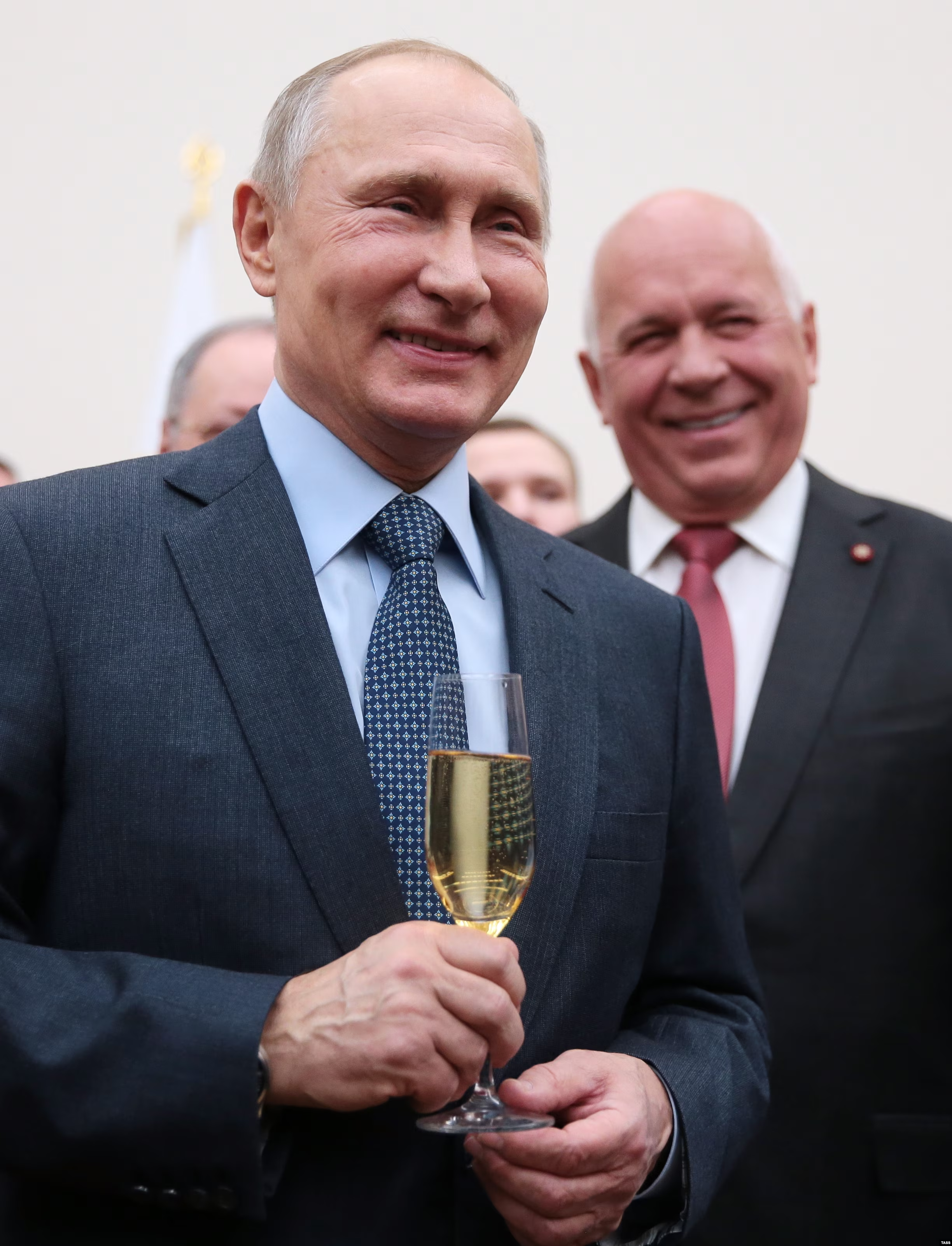
Career of Dresden friend Vladimir Putin: only up, despite the absence of any achievements
The names of Putin's Friends are most often heard because of their "immodesty in everyday life." The subject of scandalous revelations is usually palaces, villas, land, yacht collections, rarity parks, fur coats, offshore accounts and multi -billion dollar dollar states, in a word, all acquainted with overwhelming labor on the galleys of civil lines. In other cases, figures from the near circle of the leader themselves show the audience extravagant revelations, for example, about the "Chekist hook".
The general director of the Rostec State Corporation Sergey Chemezov holds in the shade. He does not flaunt the fact that he ate a capercaillie with the sovereign, and does not teach about patriotism. On the television screen, he is also not often, appearing there only when the protocol requires it, and preferring not to speak, but to limit himself to his branded smile of an experienced recruiter. All this indicates, at least, the presence of a mind, tact, understanding of your place in the Kremlin vertical, the ability to observe subordination and qualitatively disguise ambitions.
For all that, Chemezov is not just close to the first person, but he is familiar and friendly with him for three decades and in an unwritten table of ranks is listed in the highest category - it is part of the informal Putin Politburo. Starting since 2001, he was visited by the governors of the Irkutsk region, then to the premieres, then to the director of the FSB, and in 2007 even in the "successors".
What does it mean to marry!
In 2014 (declarations for 2015 have not yet been published), the official income of Sergei Chemezov amounted to 123.484 million rubles - more than two times more than in 2013. At that time, Chemyzov owned three land plots with a total area of almost 7 hectares (69,392 sq. M), three residential buildings (1673, 513.3 and 202.2 sq. M), an apartment (385.6 sq. M), a garage (182 sq. M), a non -residential premises of 390.3 square meters. m (common shared property, ¼) and ten more economic non -residential premises with a total area of 1226 square meters. m. In addition to this real estate in the use of the head of "Rostec" there is an apartment with an area of 259.7 square meters. m. is a fleet. In particular, the tax return recorded the availability of several retro-auto: a low-class limousine for the GAZ-13 GAZ-13 Higher Nomenclature, the legendary Soviet ZIL-410470 for members of the Politburo, as well as Cadillac Eldorado-one of the most expensive American representative vehicles (a model series of three-door "Personal class" classes Luxury). In addition to this is a light Mercedes-Benz sports car 280 SL (also retro, not produced since 1971), two motorcycle farms (ARCTIC CAT-STV 650 Pro and Polaris Ranger RZR), two snowmobiles (SKI-DOO SKANDIC SW 500F and Lynxy Eti V-800 ARMY), Snumaha YXZ700F PhINO, the legendary Harley-Davidson Flhtcvtg Trig, VTZ-2048A tractor, Auto-plot. The domestic “Lada Kalina” and the electric car “Lada Hellas” was also recorded - only the Minister of Industry and Trade of the Russian Federation Denis Manturov and the King of Jordan Abdullah II own , in addition to Chemezov.
The annual income of the entire Chemezov family in 2014 is two billion 250.139 million rubles. The main miningman, Ekaterina Ignatova, the second wife of Chemezova, with whom he was combined in 2004, brought her 2.126 billion rubles to the family piggy bank. Her land turned out to be much larger than that of her husband: six land plots with an area of just over 26 hectares (26,309 sq. M). In 2014, the wife of the head of Rostec became the owner of a house of 4442.5 square meters. m. with a fleet, the spouse is worse than that of her husband: only the Volga GAZ M21 and the compact pickup "Mitsubishi" L200.
According to the official biography, in 1994, Ekaterina Ignatova graduated from Moscow State University of Railways (until 1993 it was the Institute of Railway Engineers). Despite the diploma of the "railway" economist, she began her labor career at the department of oral translation of the Moscow State Linguistic University. Then she got into the management of the President of the Russian Federation, where her paths crossed with Chemezov. Under his beginning, she then worked in Promexport, which was engaged in the sale of weapons from the depots of the Ministry of Defense, and then in Rosoboronexport. According to Forbes, Ekaterina Ignatova owns 70% of Katya, which supplies AvtoVAZ Automatic gearboxes for Lada Kalina, she also owns 13% of the shares of the International Financial Club created by Mikhail Prokhorov Bank (IFC). Moreover, Mrs. Ignatova is not just a shareholder, but the chairman of the Board of Directors of the IFC. Chemezov himself in 2010 also became a member of the Board of Directors of the IFC, which includes another billionaire Victor Vekselberg, Mikhail Prokhorov, Alexander Abramov. In addition, Chemezov’s spouse is the main owner of the network of city restaurants “Floor”, the YE club, the Picasso DJ-bar, the Dal Capo pizzeria, the water park bara, the Troy restaurant and the Eclair cafe. In 2011, Vedomosti published the information that Ms. Ignatov was a co-owner of the ITER oil and gas holding (the third largest gas company of Russia), whose shares acquired through the Beliza Offshore Elsamex Enterprises LTD, but then from the ITER-owned shares of ITERS 4 percent sold to another Offshore, Symius Global Corp.
Chemezov himself then assured that he had no idea that his wife, co -owner of the ITER Holding and the dollar multimillionaire, and that this was a complete surprise for him ... In another interview, he said that he did not see anything that is being launched by a business that intersects with the activities of the state corporation headed by him. In particular, the purchase of automatic transmissions for AvtoVAZ, the deputy chairman of the board of directors, and KAMAZ, where the head of Rostec, Chairman of the Board of Directors, was made in mind the purchases of Katyza, made by the Ignatovaya company. There is no conflict of interests, they say, there is no and cannot be here, since the “scope of the“ Rostekhnologia ”is so extensive that, wherever Ignatov worked, with a great desire, the connection with the state corporation could be pulled by the ears everywhere.” True, as colleagues from Vedomosti found out, it is impossible to attract such a connection for the ears to any other top managers of this state corporation, since "only family members of the Chemezov himself are engaged in a business that is associated with the state corporation." Nevertheless, representatives of the state corporation then assured that Ekaterina Ignatova has been engaged in the “problems of the Russian auto industry” and the production of automatic transmissions since the late 1990s, but the chronology clearly suffers here: did they really do these boxes directly in the management of the President, Promxport or Rosoboronexport?! Even representatives of the state corporation assured that Katya LLC was created in 2004, when, they say, there were also no “rostechnologies” in the project, therefore, “there was no way to look for causal and related ties in this case. They simply weren’t and there were no.” Of course, no, because it was in 2004 that Ms. Ignatova married Mr. Chemezov. And after this marriage, her business talents bloomed brightly and magnificent.
Rosples, or Auto-Moto-Velo-Photo-Brichoko-Tractor Plant
In the hands of Sergey Chemezov, the most powerful state corporation of the country, the largest industrial giant, solely disposes of actually all the mechanical engineering of the state and, in its aggregate financial and economic power, perhaps even surpassed such a "national treasure" as Gazprom. And in terms of lobbying for their interests and grozing funds from Goskasza, the department of Chemezov this “natural monopoly” was precisely surpassed. When in 2007 they established the State Corporation of Rostekhnology (later renamed Rostec), it was nicknamed the Rosplesios, since this corporation tried to "absorb" almost the entire industry of the country at the dawn of its creation. If the initial list of property planned for transferring CHEMEZOV to the brainchild did not exceed 250 enterprises of the military-industrial complex, then the creators of the future state corporation requested as many as 600 industries, of which at least 20 percent-purely civilians, up to the printing sphere, did not have relations to the military sphere, but quite profitable. So, dozens of leading pharmaceutical enterprises and research institutes appeared on the Cheyzov list. Inexplicable, at first glance, claims to high -income production were justified by the need to ensure ... the biological security of the state. Moreover, the state corporation was also covered in the function of the state order of defense products, the recipient and manager of budget funds. At the same time, everything was supposed to look like this: we ourselves are developing everything by our own understanding, we ourselves experience, order and produce. And the consumer receives-at monopoly prices-what he is deigned to give ... Already at the preparatory stage, it turned out a natural golem: huge and clumsy, but crushingly powerful, which was supposed to produce everything, from titanium and steel rolled steel-carriers-self-vestlets-tunes-tunes.
The ambitions of "Rostechnologies" were then outraged by almost all interested ministries, services and departments: the Ministry of Finance, the Ministry of Economic Development, the Ministry of Industry and Trade, the Ministry of Transport, the Ministry of Defense, the Federal Antimonopoly Service. In addition to the pharmacopei, the stumbling block was the claims of the CHAMAZ, UAZ, UAZ, Uralvagonzavod team, the Tver Carbon-Building Plant, the Technopromesport, the Central Research Automobile and Automotive Institute, and a number of airlines. In the most sharp form, rebuffing the claims of "Rostechnologies" tried to give the then head of the Ministry of Economic Development Elvira Nabiullina. As Nabiullina believed, if the state corporation was created to optimize the activities of the military industry - this is how they justified the need to establish a new corporation - why does she need production not related to orders for the needs of defense?! The Ministry of Economic Development then considered it inappropriate to transfer KamAZ assets and state -owned assets of more than 120 enterprises to Chemusov. The Ministry of Industry and Trade at the same time blocked the transfer of pharmaceutical enterprises under the wing of Chemezov, and the first deputy prime minister Sergei Ivanov and the head of Russian Railways, Vladimir Yakunin, solidly refused to “issue” Chemusov Uralvagonzavod ... Vice-prime minister and Minister of Finance Alexei Kudrin in June 2008 sent an official letter to the government that transferring a number of assets "Rostekhnology" is a frank attempt to deduce the revenue of the state budget, since the mechanism for the sale of assets is opaque, and no control over the income of the state corporation is impossible.
He reacted promptly to that criticism of Chemeza: he accused the offenders of cunning, demagogy and the desire to "take a real business into a dead end." “Responding to all possible attacks by the opponents of the formation of state corporations and the Rostekhnology Group of Companies, in particular,” he wrote , “I declare: we have no goal of“ crush ”the entire domestic industry. And the accusations of the state corporation Rostekhnology and Rosoboronexport are not only miserable, but even illegal.”
And soon I was born, quoted the Federal Law of November 23, 2007, "The State Corporation to promote the development, production and export of high -tech industrial products." In fact, a giant managerial apparatus that does not produce anything, but controlling fantastic financial flows. Led by Sergey Chemezov ...
Mountain engineer of secret value
From year to year, the official biography of Sergey Chemezov is growing a list of regalia, ranks, titles, memberships and chairmans in all kinds of reasons and advisers of directors, funds, observation and trusteeships. Every two or three years he has been receiving state awards-he already has five orders of the Russian Federation, while all decrees on the awards closed, as if the head of the state corporation is performing a special task in the deep rear of the enemy. The mean information about his life path, the official chronicle is eaten by chronological gaps. For a long time, this understatement gave rise to guesses regarding the belonging of Chemezov either to Lubyanka, or even to the "neighbors" - this is the traditionally called military intelligence. What was confirmed by the presence of the title: Sergey Viktorovich-Colonel General.
Cheyzov began his career at the Irkutsk State Research Institute of Rare and Navy Metals (Irgicredmet) of the USSR Ministry of Hero Metallurgy. Mintzvetmet, who was leading to the Learning Research Institute, belonged to the most powerful and influential common -consuming ministries, and were engaged there not so much with non -ferrous metals as strategic raw materials for an even more powerful department - the Ministry of Medium Engineering, in fact the Ministry of Atomic Weapons. It is noteworthy that both of these inextricably linked departments permanently and almost until the end of the Soviet regime headed the "iron" Stalin People's Commissars: Mintsketmet - Peter Lomako, the Ministry of Environment - Efim Slavsky. Stalin put forward both, both worked on the creation of the first Soviet atomic and hydrogen bombs under the personal guidance of Beria.
One of the former color mixtures noted in the conversation that in the 1970s-early 1980s he was convinced by his own experience: both in the field and central apparatus of the ministry were extremely harsh, conservative, the spirit of total secrecy and universal informing dominated everywhere. Therefore, there were always unquestioning performers who have no opinion in price.
After the NII, he worked in the “Experimental and Industrial Association of Luch”, one of the important units of the USSR nuclear department, from 1983 to 1988 headed the East German representative office of the “Luch” in Dresden. Then a strange translation was followed into the foreign trade union “Sovintersport”, but this is already an insignificant part. The main thing was Dresden, where Chemezov lived in a neighboring one with a neighboring one with a neighboring one Putin’s apartment in the house on Radeberger Strasse.
At the end of 1999, when the acquaintance with Vladimir Putin became convertible currency, Chemezov, who then served as the head of the Department of Foreign Economic Relations of the Presidential Affairs, was set at the head of FSUE Promexport, which few people now remember. Formally engaged in marketing the “excess” property of the Ministry of Defense, in reality it acted as a dangerous competitor of the Power Muding, which was then lapidarously nicknamed Rosvor. With the advent of Chemezov, a number of events were connected in Promesport, which surprised the community of weapons merchants. First, the Promexport itself settled, whose income fell so sharply-from 250 to 120 million dollars that he rolled down from second place among Russian weapons exporters to the fourth, the lag behind the "tartar" was 12 times. As an “effective manager” of Cheyzov, it was clearly not held, but the first year of his stay in the arms business was marked by a grand scandal. The “Rosvooruzha” then prepared a contract for the supply of Mi-17 helicopters to Colombia, but at the very last moment, when everything was already agreed with the buyer, Chemezov’s messengers suddenly appeared in Bogota, who offered the Columbians the same helicopters cheaper. The completely confused Colombians generally refused the deal. A similar story was in India: the Air Force of this country announced a tender according to one of the weapons systems, the “Rosvooring” carried out a serious preliminary work, the Indians liked the proposal of the company, it was sent to the tender committee, and suddenly the application “Promexport”, which offers the same, was completely cheaper there. The Indians were perplexed by the consideration of Russian proposals, the contract was torn off ... Similar stories took place in other countries, the losses of "tartar -how -arrangements" were huge, the company was almost thrown from the markets in Algeria, Libya, Syria, the UAE, although before it had the best chances of contracts there. Perhaps the intrigue consisted in the fact that the protege of Yeltsin or his "family" Alexei Ogarev led the "tout". Soon, the “Rosvooruvo” and “Promesport” were leaked into one enterprise, and “Friend of the New Tsar” of Cheyzov received a leading chair in “Rosoboronexport”, however, still as the first deputy.
Further, his career gained a steady ascending orientation. True, at first, Andrei Bellyaninov, a former deputy Chemezov in Promexport, became the head of Chemezov. In response, Chemezov flatly refused to move to Gogolevsky Boulevard, to the head office of Rosoboronexport, from Stromyanka, where the premises of the former Promexport were located. He was forced to go to meetings to his married head of the company there. As one of the subordinates of Sergei Chemezov, "at home, is not only relatives, but also wiretapping." In April 2004, Sergey Chemezov was already a full -fledged general director of Rosoboronexport, and the company itself literally turned into supervisory before our eyes, having received the rights of a monopoly exporter of weapons in January 2007.
The dream of the ensign
So, "Rostekhnology". The corporation crushed entire industries for itself, while absorbed by an extensive plot and sectors of purely civilian. Moreover, it is about the absorption of already existing production, and not the creation of new ones. Получив госпакеты акций 420-440 предприятий, который "тянул" тогда на 18-20 миллиардов долларов, сейчас "Ростех", цитирую сайт корпорации, "это 663 организации в 60 регионах страны". Правда, на другой страничке говорится, что в состав корпорации входит уже более 700 организаций. Заполучив летом 2008 года от государства столь колоссальные активы, "эффективный менеджер" первым делом затребовал у того же государства еще 7,22 миллиарда долларов в виде денежных средств и госгарантий.
В сентябре 2007 года, выступая в МГТУ имени Баумана, Чемезов признавал, что "мы впереди планеты всей лишь по добыче и продаже наших сырьевых ресурсов". Там же доктор экономических наук Чемезов поставил и свой диагноз: позарез нужна военная техника 5-го поколения, а военная промышленность производит продукцию лишь 3-го поколения, потому что оборудование чудовищно устаревшее и доля относительно современных станков не превышает пяти процентов. А с новыми технологиями и вовсе плохо, поскольку "мы до сих пор используем открытия и научные разработки, сделанные советскими учеными еще в 70-80-е годы прошлого века... Сегодняшнее состояние отечественного машиностроения исчерпало возможность конкурировать на внешнем, да и на внутреннем рынке". В конце своей речи доктор Чемезов еще и рецепт выписал: "Уже найден рецепт преодоления застоя... Это создание в наиболее важных секторах экономики государственных корпораций".
Итоги применения рецепта таковы. Еще в 2007 году Чемезов заверил , что с 2008 по 2012 год в России будет произведено "более 430 самолетов Ил-96, Ту-204, "Сухой Суперджет", Ту-334, Ан-148", а доля России в мировом производстве гражданской авиатехники к 2015 году увеличится с 1 до 5 процентов, достигнув к 2015 году 10 процентов. До 2025 года еще далеко, но обещанные 2012-й и 2015-й уже прошли. Производство Ту-334 провалено – не выпущено ни одного; Ил-96 – в указанный период не произведено ни одного, эксплуатируются лишь оставшиеся 11 из числа выпущенных "до Чемезова"; Ту-204 в 2008–2012 годы выпущено 27, да еще пять единиц в 2013–2015 годы. Ан-148 произведено в Воронеже с 2008 по 2012 год всего лишь 15 единиц, еще 13 выпущено с 2013 года. Лишь 22 лайнера "Сухой Суперджет 100" сделано с 2008 по 2012 год, зато с 2013 года их выпущено 77. По факту же вместо обещанных Чемезовым к 2012 году 430 самолетов авиапром осилил лишь 64. Потом, правда, слегка нарастили авиапарк за счет "Суперджетов", только назвать эту машину российской сложно, поскольку собирается она в основном из импортных комплектующих, да и до обещанных 430 все еще не дотянули, сделав за "время Чемезова" всего лишь 159 машин.
Еще можно вспомнить АвтоВАЗ, взятый под крыло командой Чемезова еще в 2005 году: как были автовазовцы убыточным предприятием, так и остались. В 2014 году чистый убыток АвтоВАЗа составил 25,4 млрд рублей. А убытки ВАЗа за 2015 год вообще стали рекордными за всю его историю – 73,851 млрд рублей. Продажи, если сравнивать с 2005 годом, упали более чем в 2,6 раза. Однако один из самых близких Чемезову людей, Владимир Артяков, в 2006–2007 годах президент и гендиректор ОАО "АвтоВАЗ", лишь за 8 месяцев своей работы в этом качестве только в качестве премиальных получил около 1,5 млрд рублей.
Чемезов неоднократно заверял: чтобы избежать зависимости от Украины, Россия уже создала свои двигатели для вертолетов "Ми" и "Ка" и вовсю их производит. Но при этом приводятся какие-то странные цифры. В 2012 году было сообщено , что "Климов" резко увеличил объемы производства вертолетных движков, доведя их выпуск в 2011 году до 260. Но уже в 2014 году тот же Артяков, первый заместитель Чемезова, сообщил, что производство это все еще "опытно-конструкторское", то есть не серийное, и ставится задача увеличения серийности производства с 50 двигателей в 2014 году до 350 – к 2017 году. Что же за 260 движков тогда сделал "Климов" в 2011 году, если в 2014-м прогрессом сочли выпуск 50? В феврале 2015 года и генеральный директор Объединенной двигателестроительной корпорации Владислав Масалов проговорился : лишь "в прошлом году на производстве ОАО "Климов" были собраны первые десять двигателей полностью из российских комплектующих". То есть и в 2014 году не было даже и полусотни полностью своих, только десять! Значит, когда в июне того же 2014 года господин Чемезов докладывал , что "на сегодняшний день мы выпускаем около 50 штук в год", он лукавил?
Сегодня детище Чемезова фактически никому не подконтрольно, не считая, конечно, президента. По части непрозрачности равных этой госкорпорации нет: согласно Федеральному закону № 270-ФЗ от 23 ноября 2007 года "интересоваться" положением дел в "Ростехе" вправе только президент – и больше никто. Специально оговорено , что ни федеральные органы государственной власти, ни органы госвласти субъектов РФ или муниципальные органы местного самоуправления "не вправе вмешиваться в деятельность Корпорации". Более того, годовой отчет госкорпорации до недавнего времени вообще не подлежал публикации, направляясь лишь президенту и в правительство. После внесения поправок в закон отчет все-таки должны публиковать на официальном сайте, но, как оговорено, "с соблюдением законодательства Российской Федерации о государственной тайне, законодательства … о коммерческой тайне". Но в военно-промышленной корпорации по определению секретно всё.
На "Ростех" не распространяется действие ряда пунктов статьи 32 Федерального закона "О некоммерческих организациях" – статьи, как раз и регламентирующей порядок осуществления контроля. Много и других бонусов. Например, "Ростех" нельзя признать банкротом, корпорация "не отвечает по обязательствам Российской Федерации", а государство, в свою очередь, тоже не отвечает по обязательствам госкорпорации… Не случайно еще в 2007 году Сергей Чемезов одним из главных преимуществ госкорпорации называл именно кардинальное расширение ее правовых возможностей: облеченная государственной властью корпорация "действует эффективно, стабильно и без бюрократических проволочек".